MMSx Authority · Applied Biomechanics Lab
Hip and Groin Rehabilitation: 30 Evidence-Based Biomechanics Analyses
Thirty evidence-based hip and groin rehabilitation articles from the MMSx Authority Applied Biomechanics Lab: movement analysis, verified research data and decision pathways for hip and groin pain. Each article pairs a biomechanical analysis of three movements with verified research data, a decision pathway and APA 7 references with DOIs.
Cite this collection
Mehta, N. (2026). Hip and Groin Rehabilitation: 30 Evidence-Based Biomechanics Analyses [Collection]. MMSx Authority Applied Biomechanics Lab. Zenodo. https://doi.org/10.5281/zenodo.23735806
 01
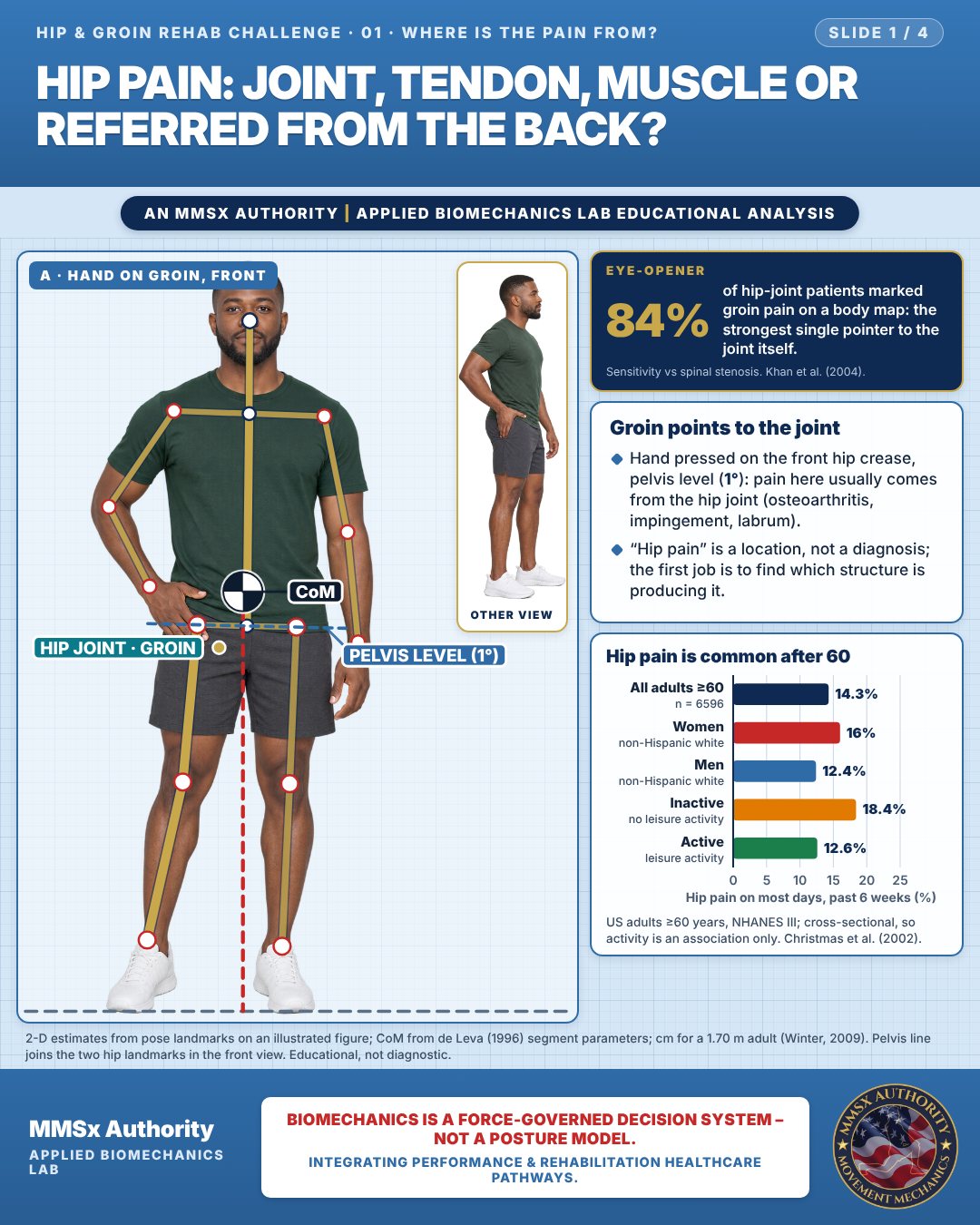
Hip pain: joint, tendon, muscle or referred from the back?
Hand pressed on the front hip crease, pelvis level ( 1° ): pain here usually comes from the hip joint (osteoarthritis, impingement, labrum). “Hip…
 02
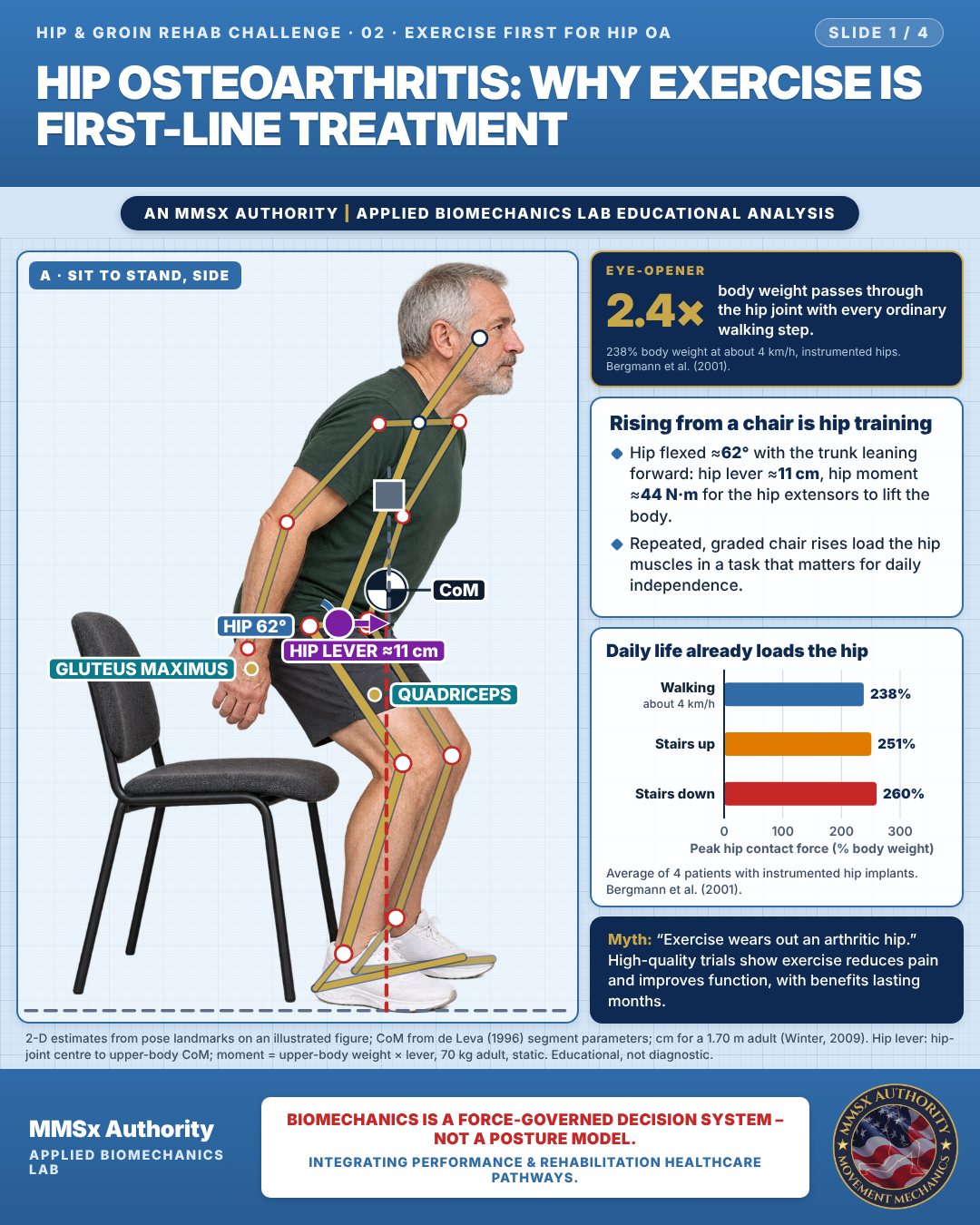
Hip osteoarthritis: why exercise is first-line treatment
Hip osteoarthritis (OA) is a whole-joint condition involving cartilage loss, bone remodelling, osteophytes and synovial change, which may cause…
 03
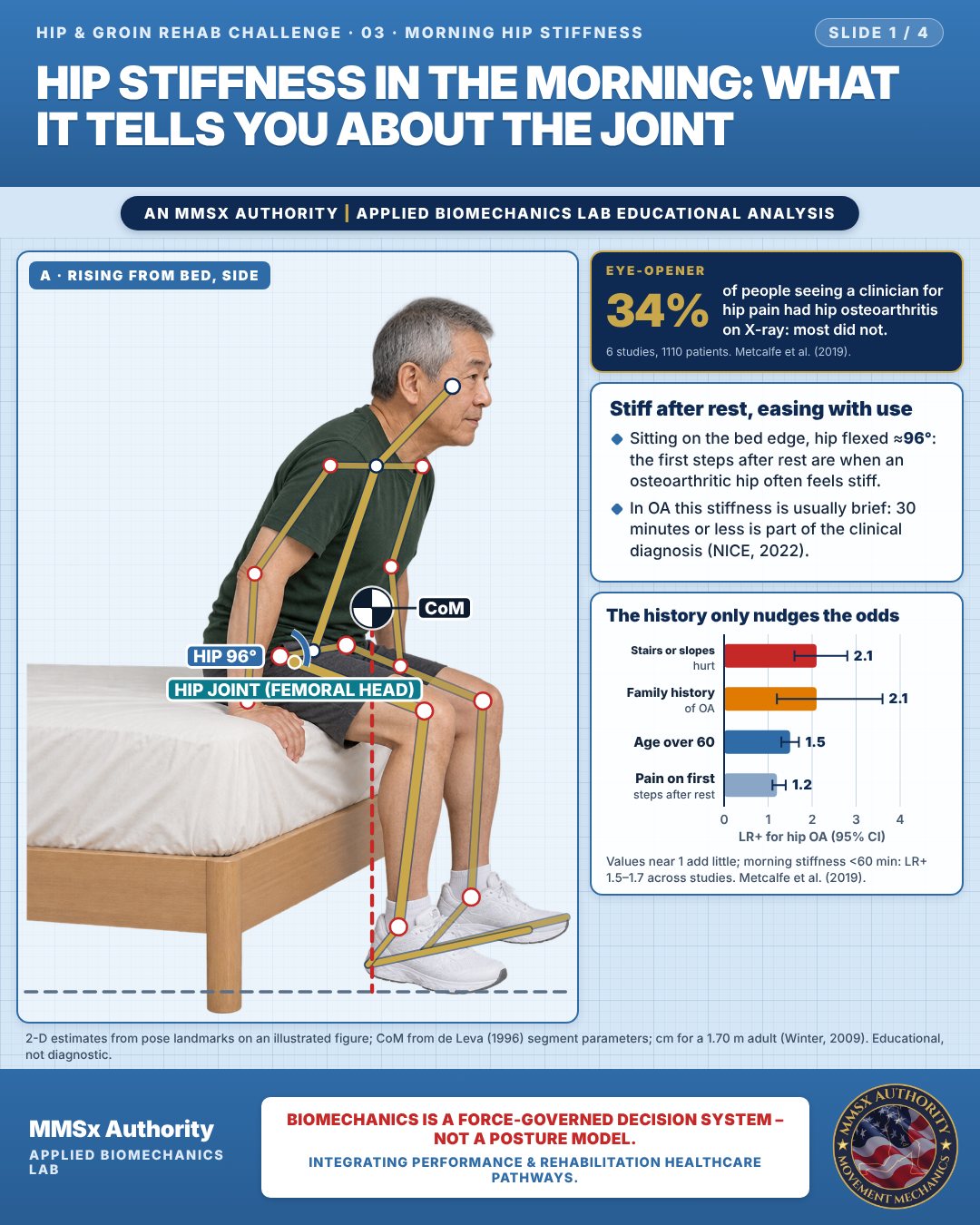
Hip stiffness in the morning: what it tells you about the joint
Morning (or after-rest) stiffness is difficulty moving the hip on rising that eases with activity.
 04
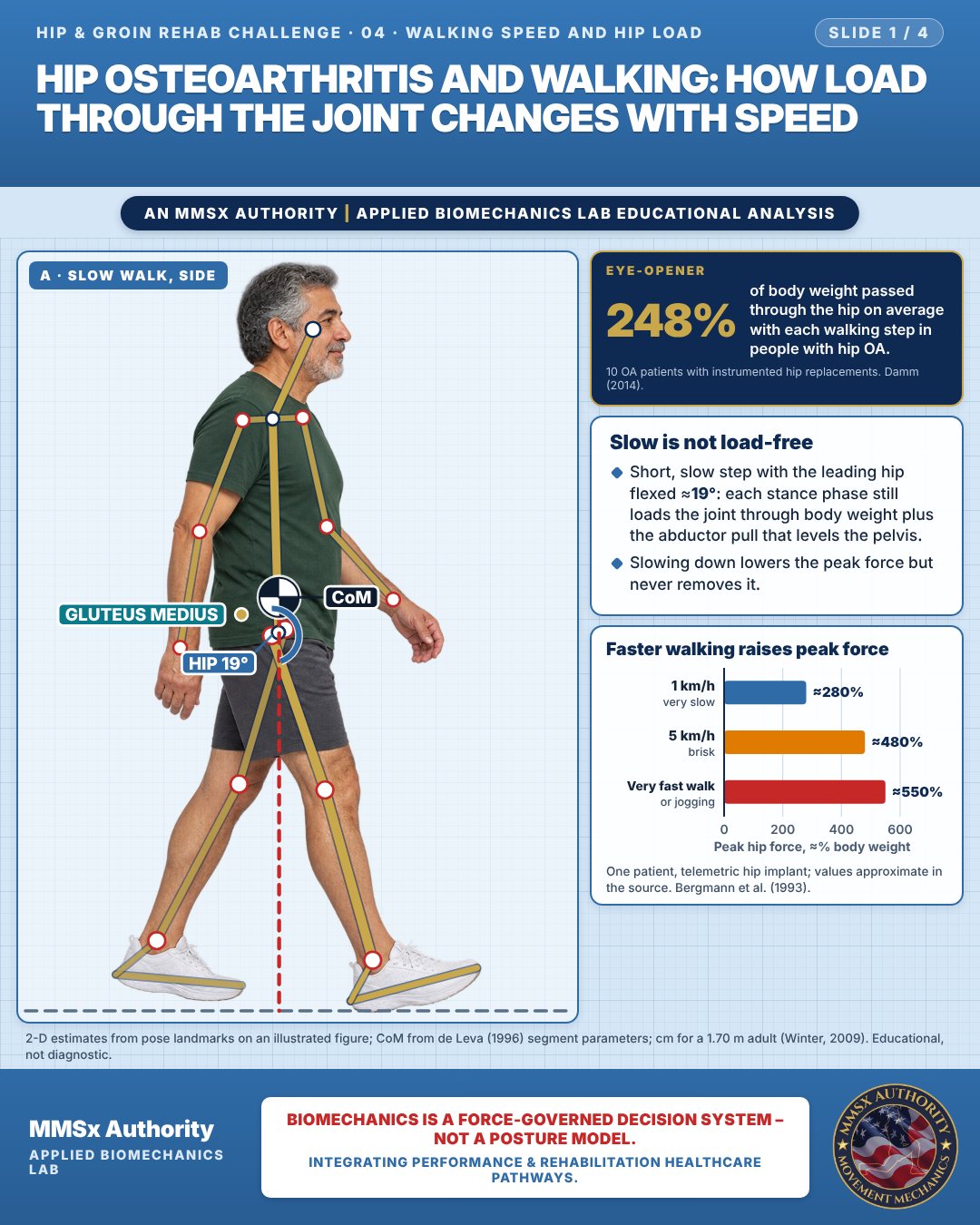
Hip osteoarthritis and walking: how load through the joint changes with speed
Each walking step loads the hip joint through body weight plus the pull of the hip muscles (mainly the abductors that keep the pelvis level), so the…
 05
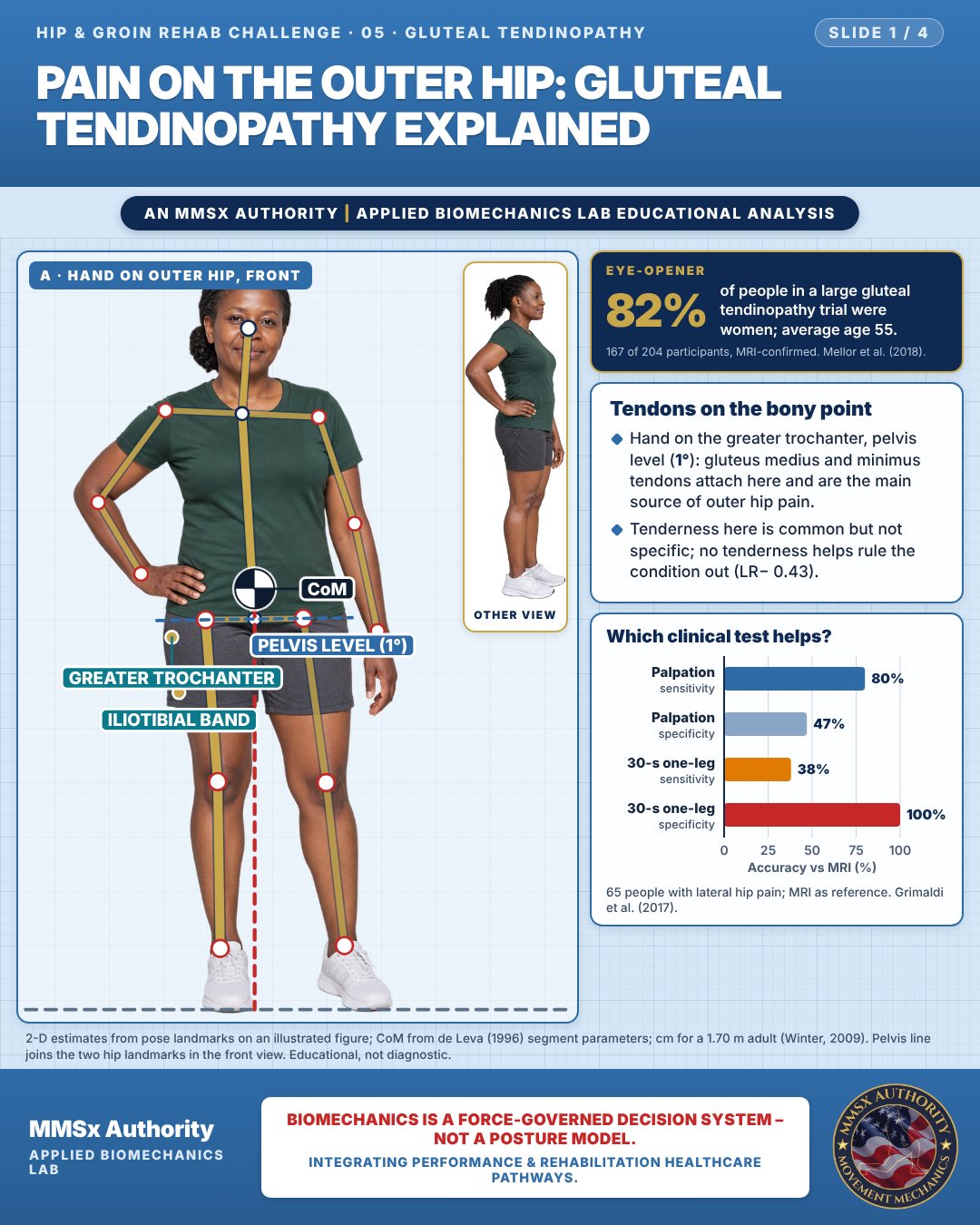
Pain on the outer hip: gluteal tendinopathy explained
Gluteal tendinopathy is a painful, load-related condition of the gluteus medius and/or gluteus minimus tendons where they attach to the greater trochanter.
 06
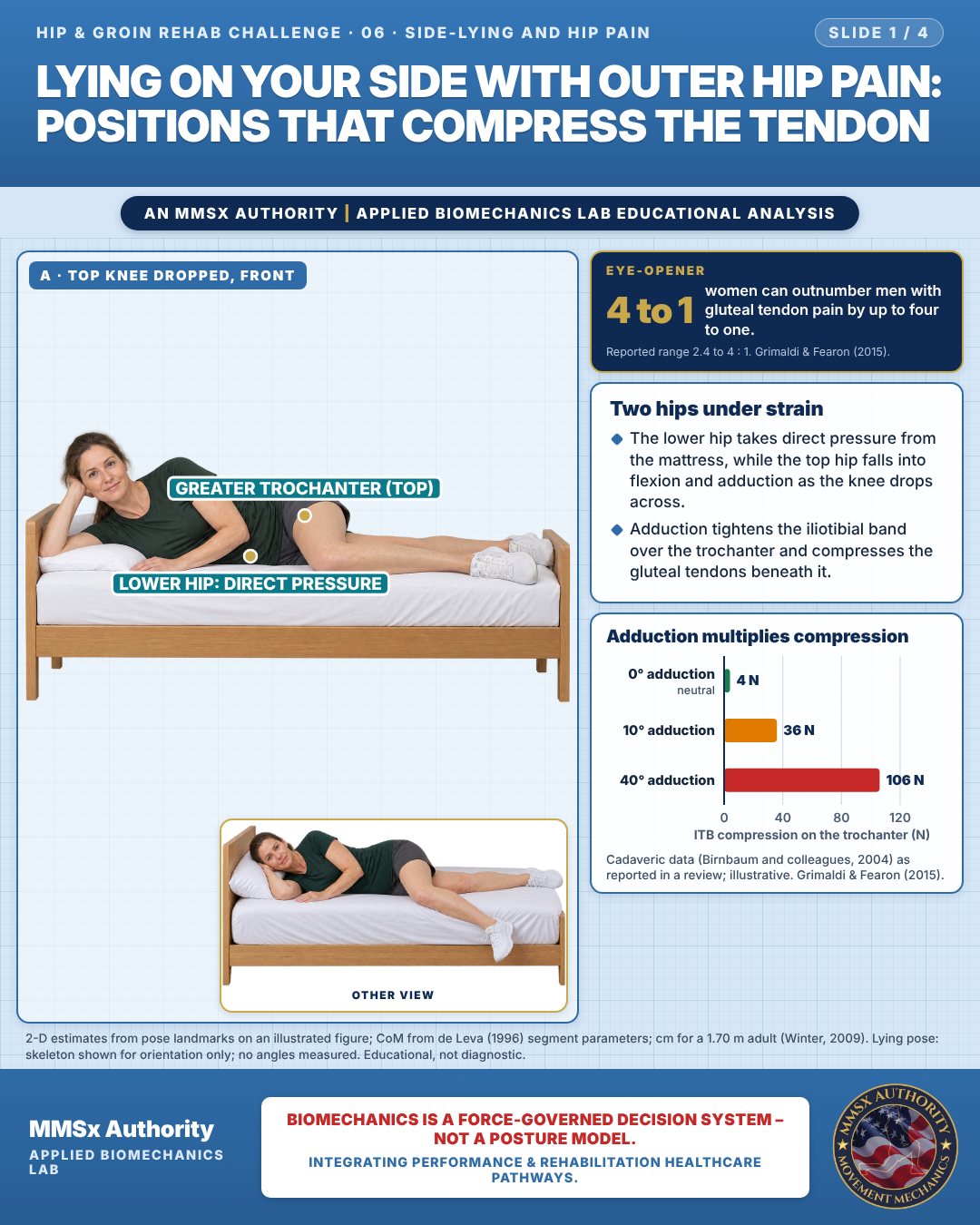
Lying on your side with outer hip pain: positions that compress the tendon
In gluteal tendinopathy, the gluteus medius and minimus tendons can be compressed against the greater trochanter by the overlying iliotibial band…
 07
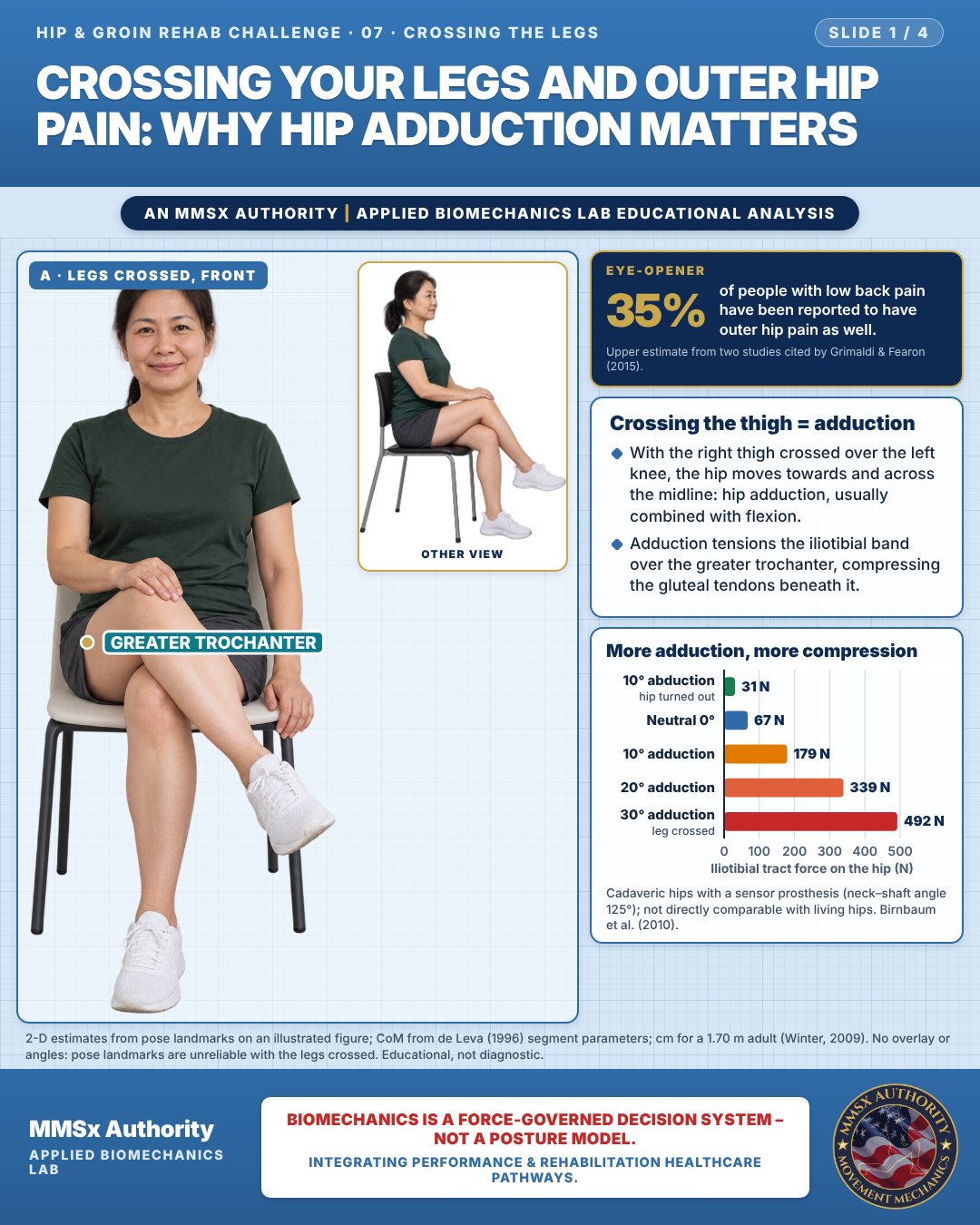
Crossing your legs and outer hip pain: why hip adduction matters
Hip adduction moves the thigh towards and across the midline. Movement analysis, verified research data and a decision pathway.
 08
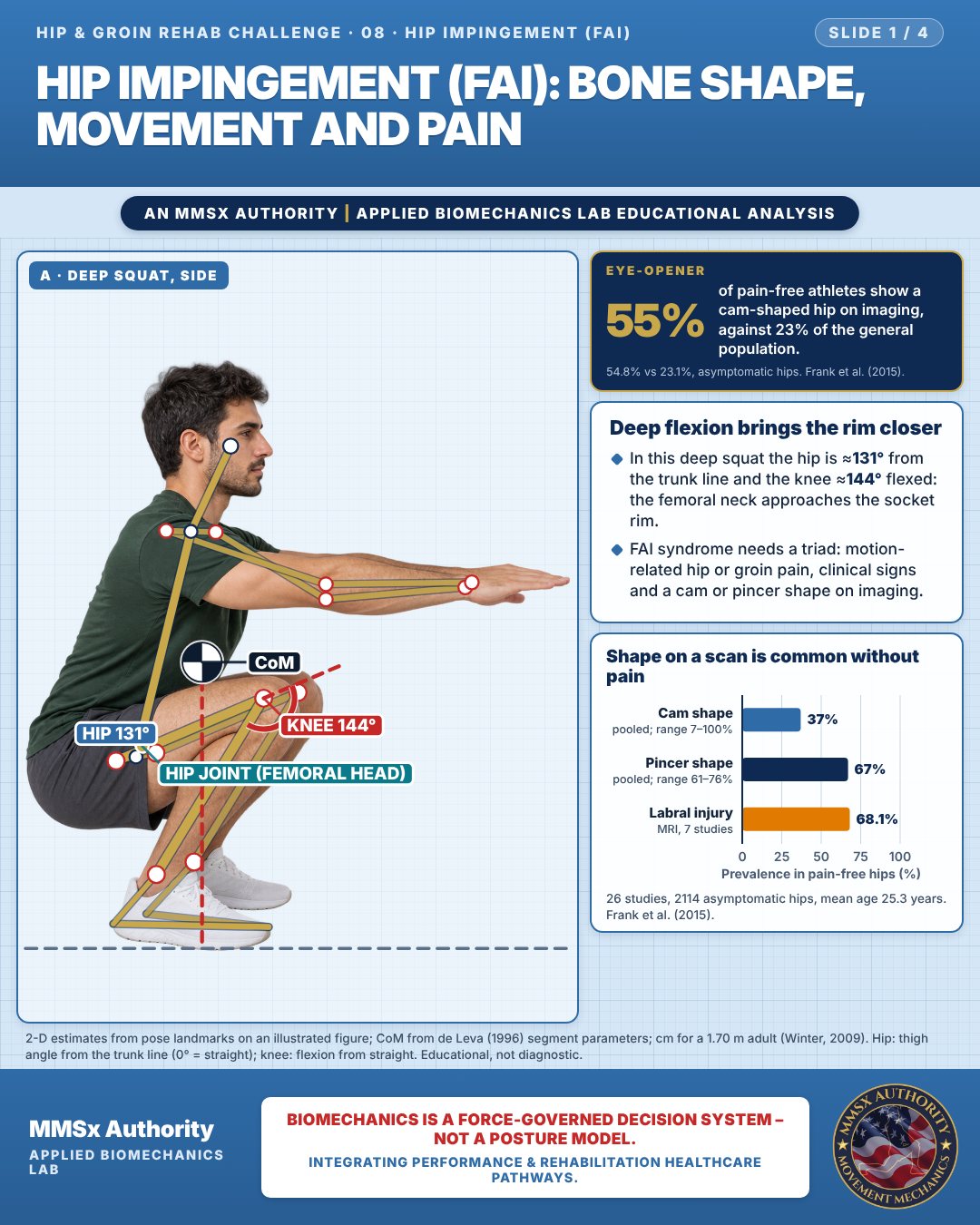
Hip impingement (FAI): bone shape, movement and pain
Femoroacetabular impingement syndrome (FAI syndrome) is "a motion-related clinical disorder of the hip with a triad of symptoms, clinical signs and…
 09
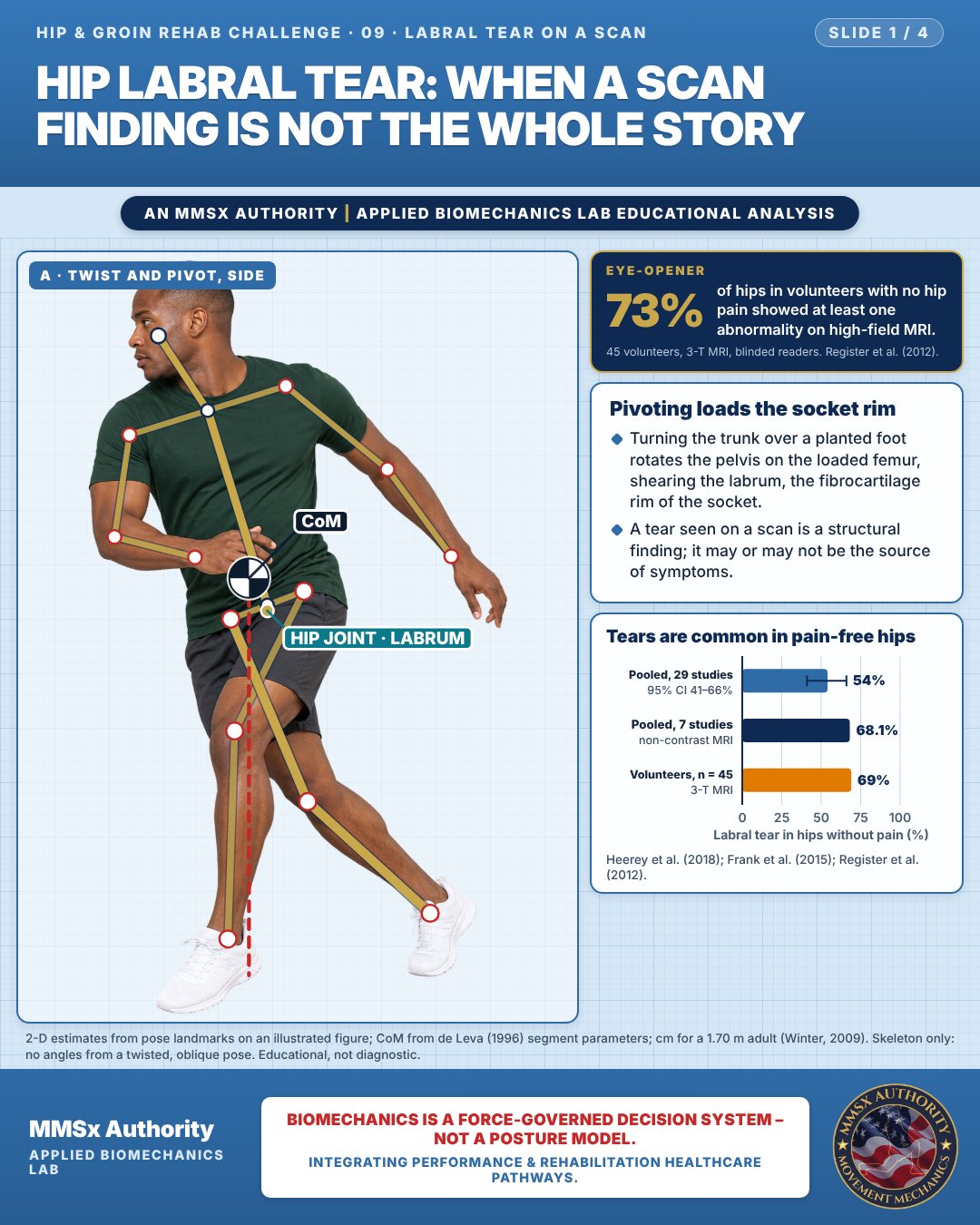
Hip labral tear: when a scan finding is not the whole story
The acetabular labrum is a fibrocartilage rim around the hip socket. Movement analysis, verified research data and a decision pathway.
 10
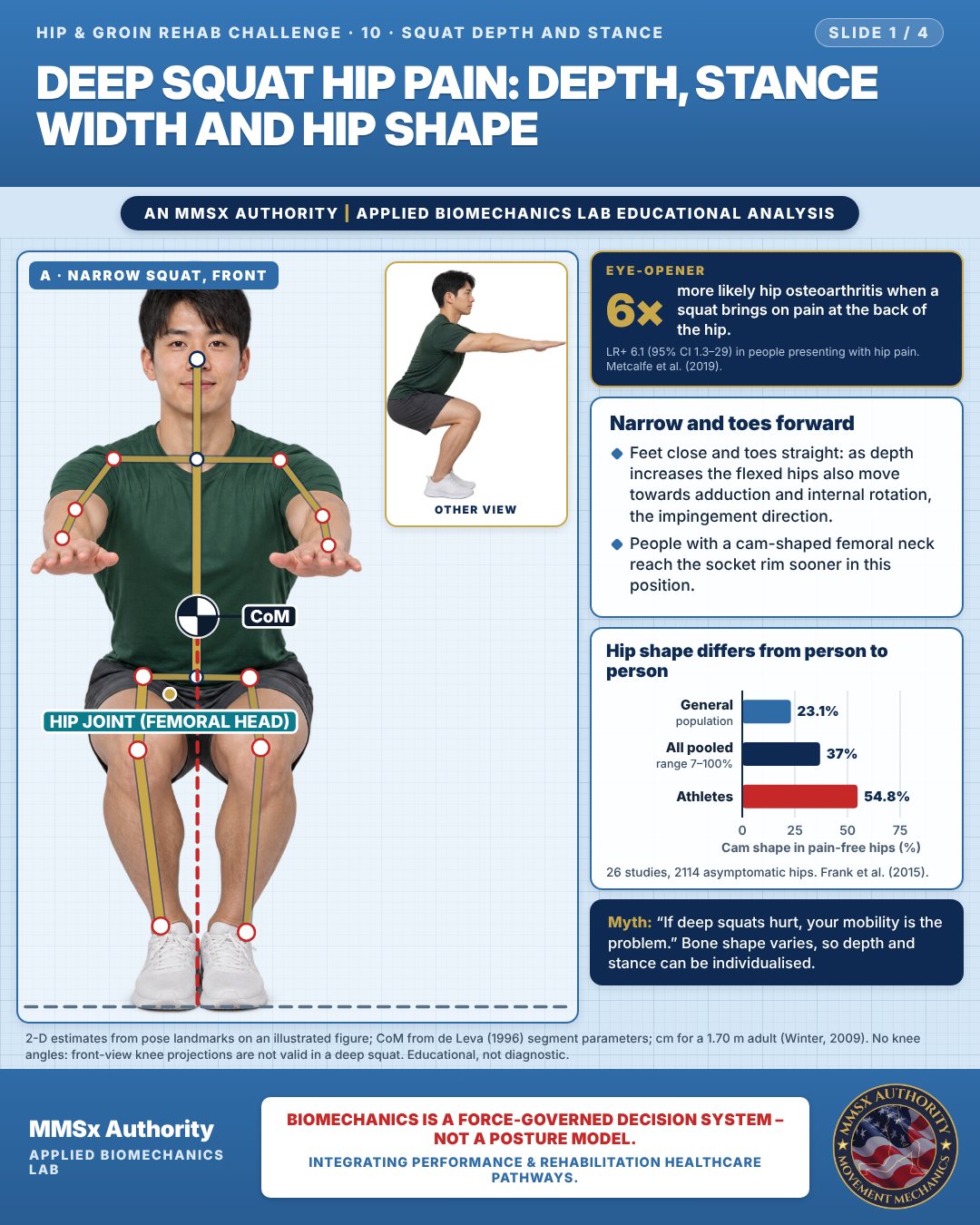
Deep squat hip pain: depth, stance width and hip shape
Feet close and toes straight: as depth increases the flexed hips also move towards adduction and internal rotation, the impingement direction. People…
 11
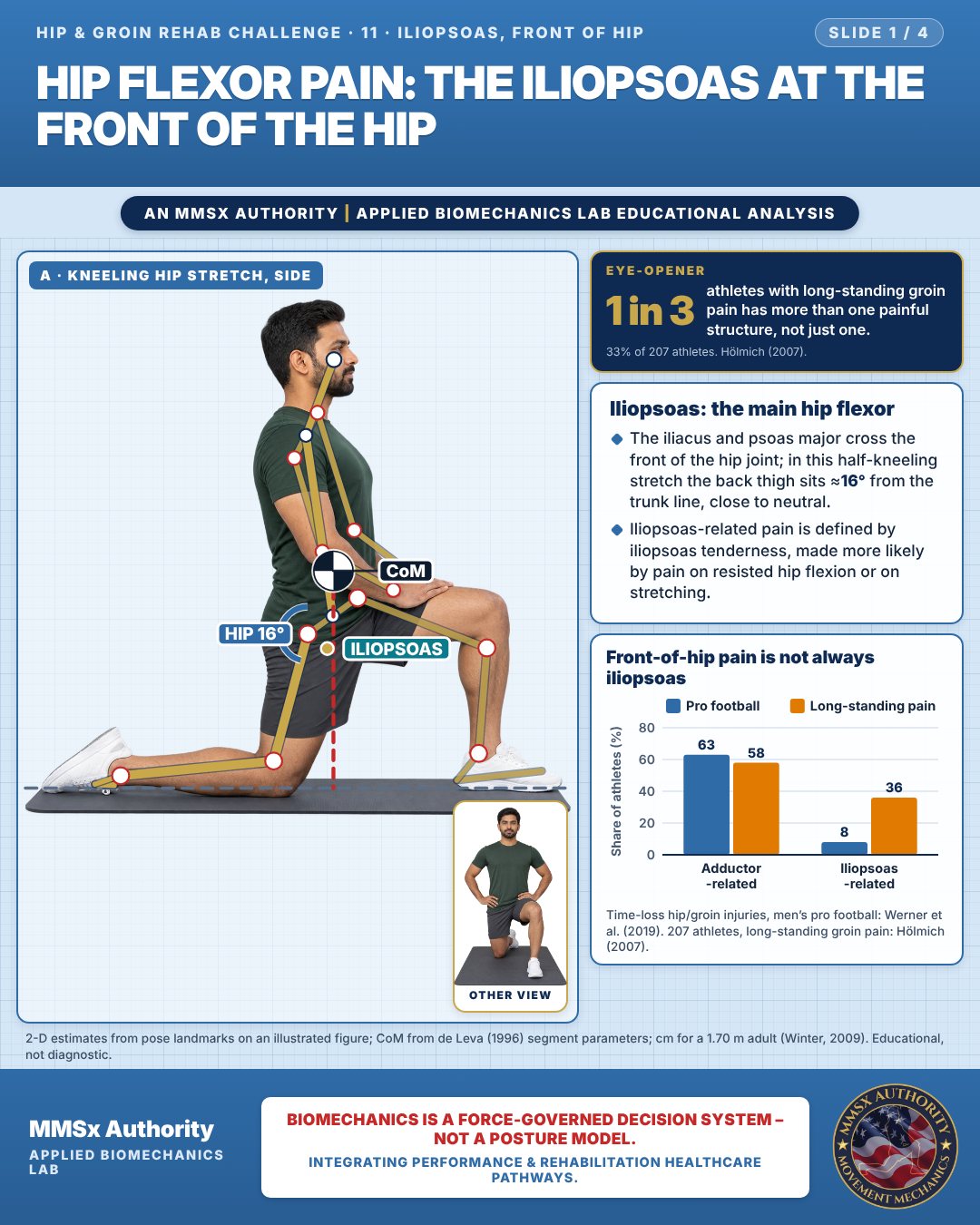
Hip flexor pain: the iliopsoas at the front of the hip
Iliopsoas-related groin pain is defined clinically by iliopsoas tenderness. Movement analysis, verified research data and a decision pathway.
 12
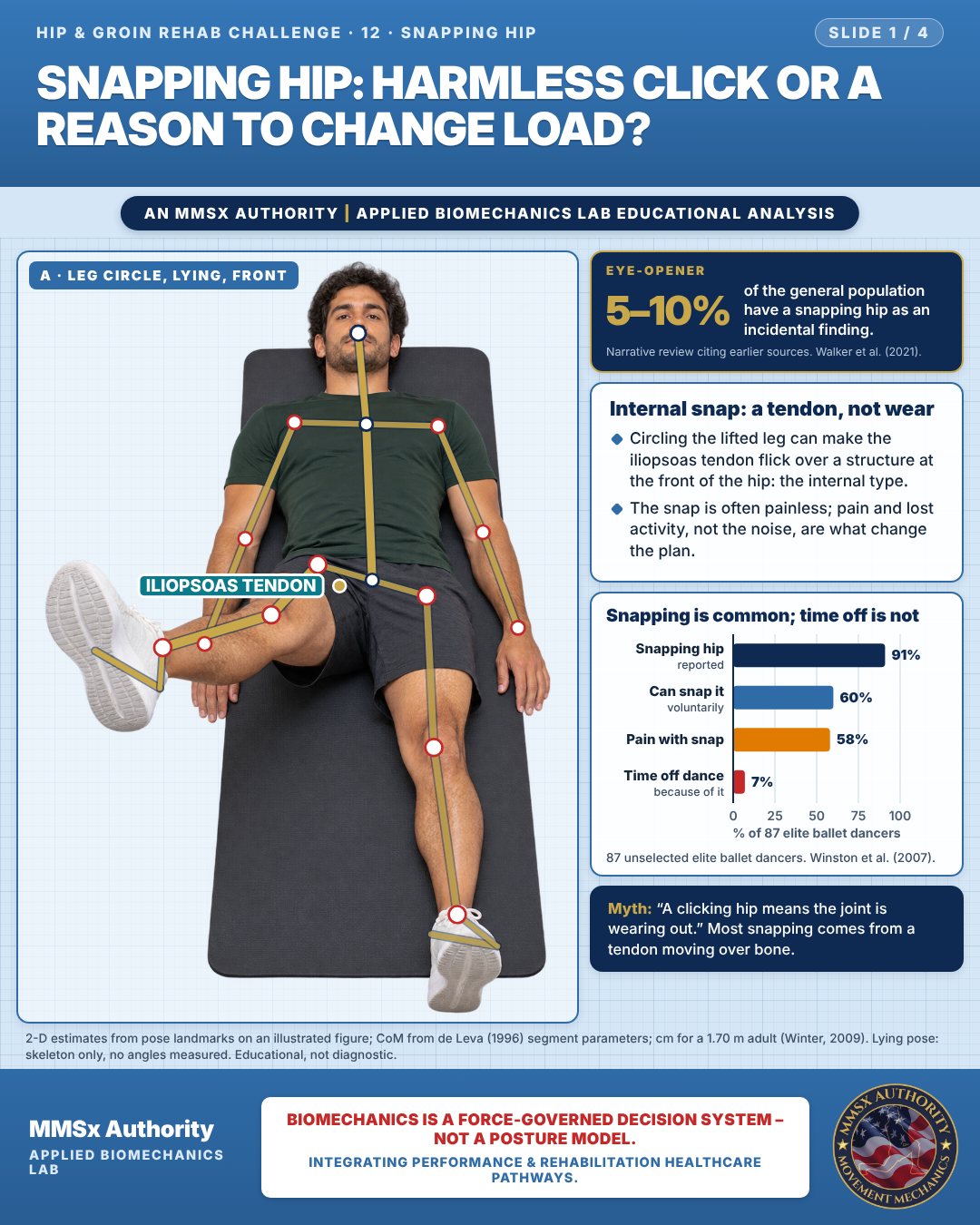
Snapping hip: harmless click or a reason to change load?
Snapping hip is an audible or palpable snap during hip movement. Movement analysis, verified research data and a decision pathway.
 13
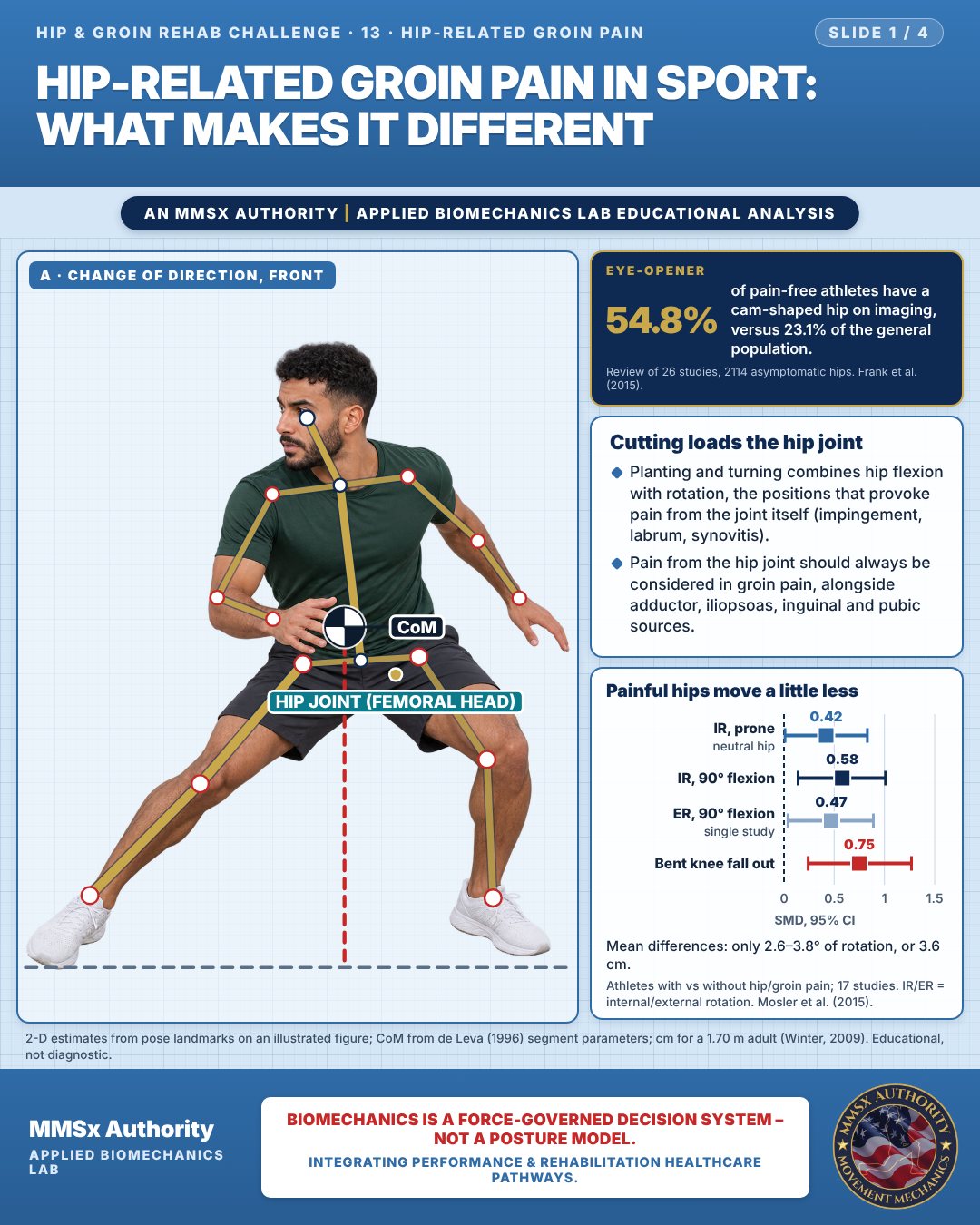
Hip-related groin pain in sport: what makes it different
Hip-related groin pain is groin pain arising from the hip joint itself (for example femoroacetabular impingement syndrome, labral injury or…
 14
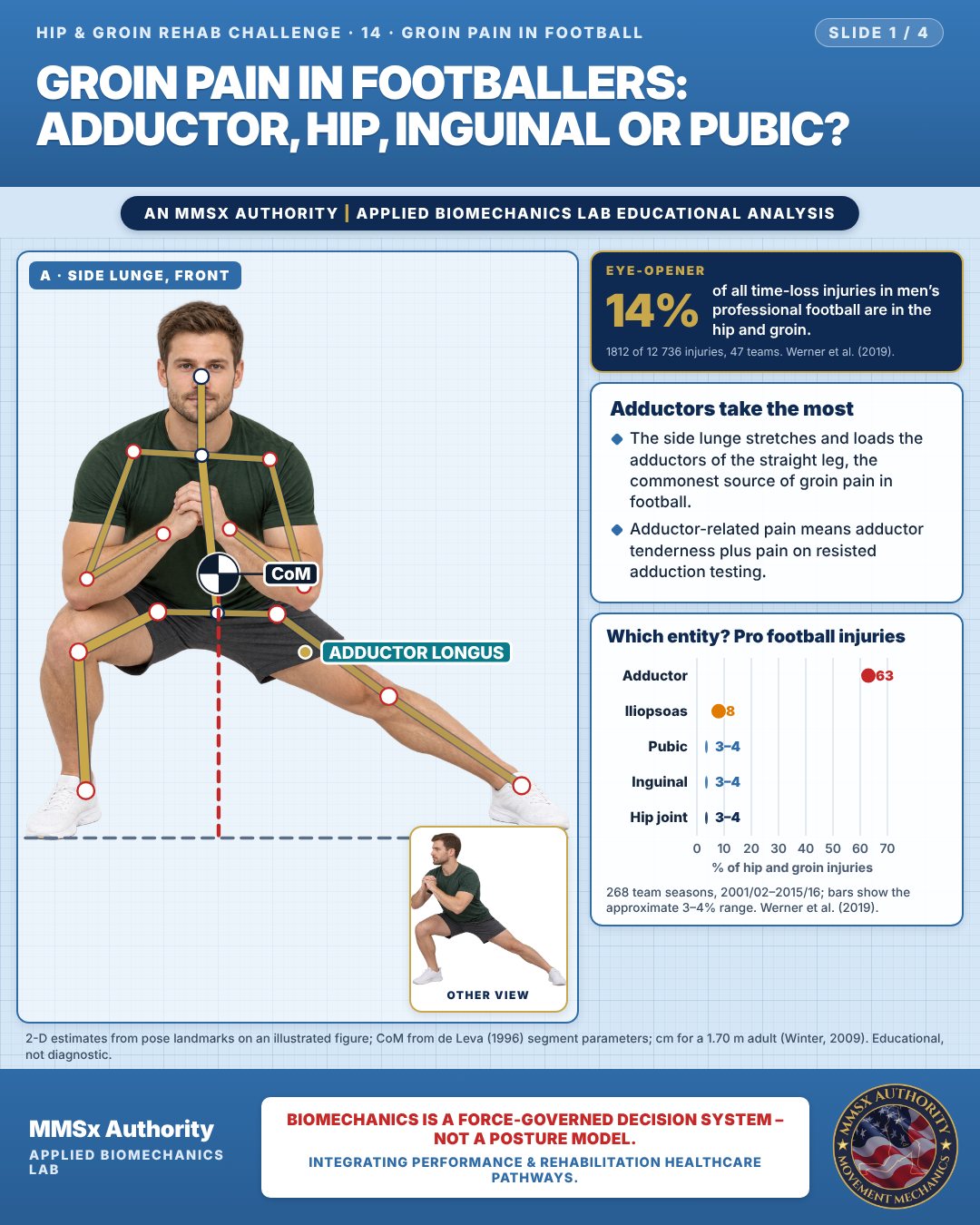
Groin pain in footballers: adductor, hip, inguinal or pubic?
The Doha agreement classifies groin pain in athletes by clinical examination into: adductor-related (adductor tenderness and pain on resisted…
 15
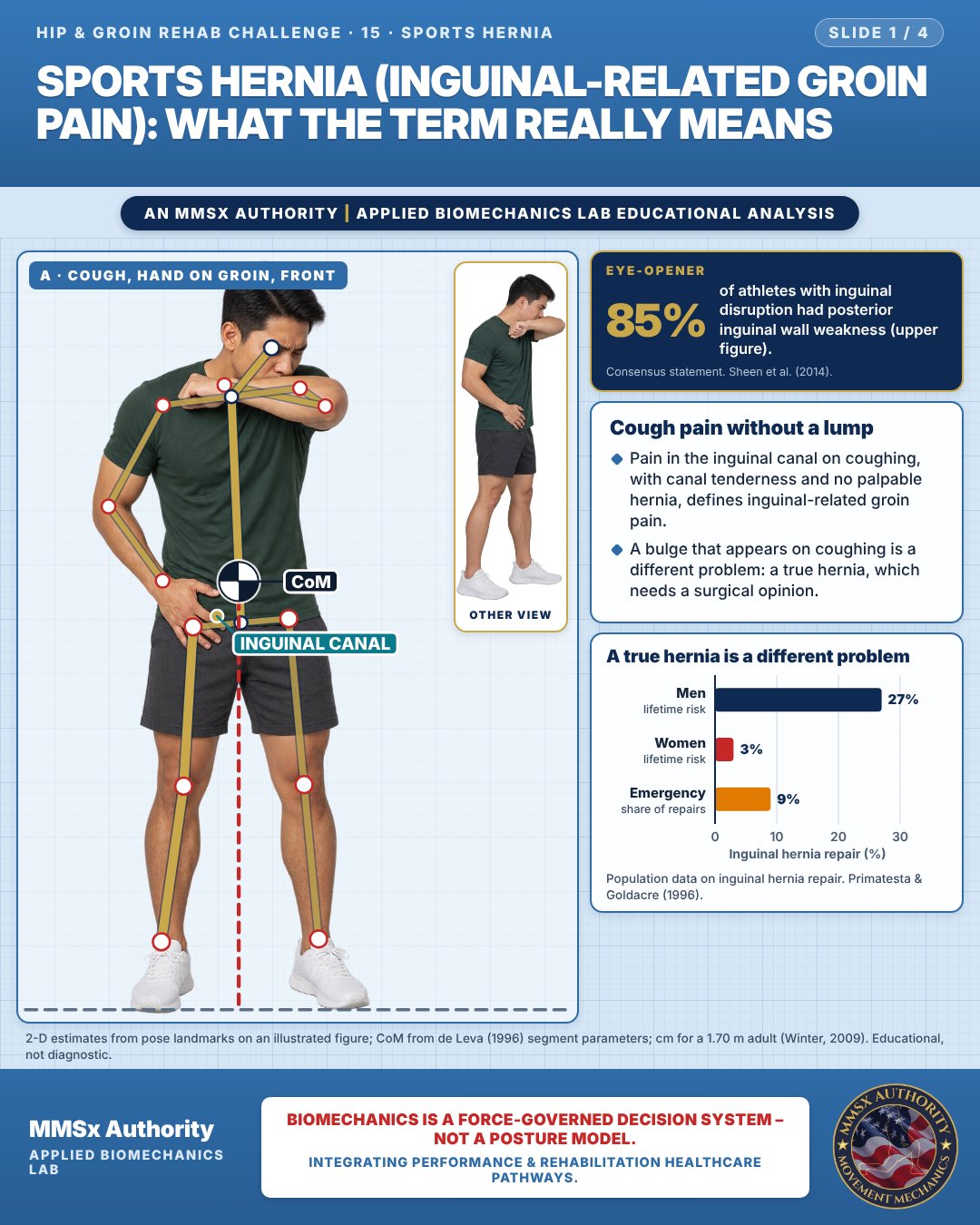
Sports hernia (inguinal-related groin pain): what the term really means
Inguinal-related groin pain is pain located in the inguinal canal region with tenderness of the inguinal canal and no palpable inguinal hernia (Weir…
 16
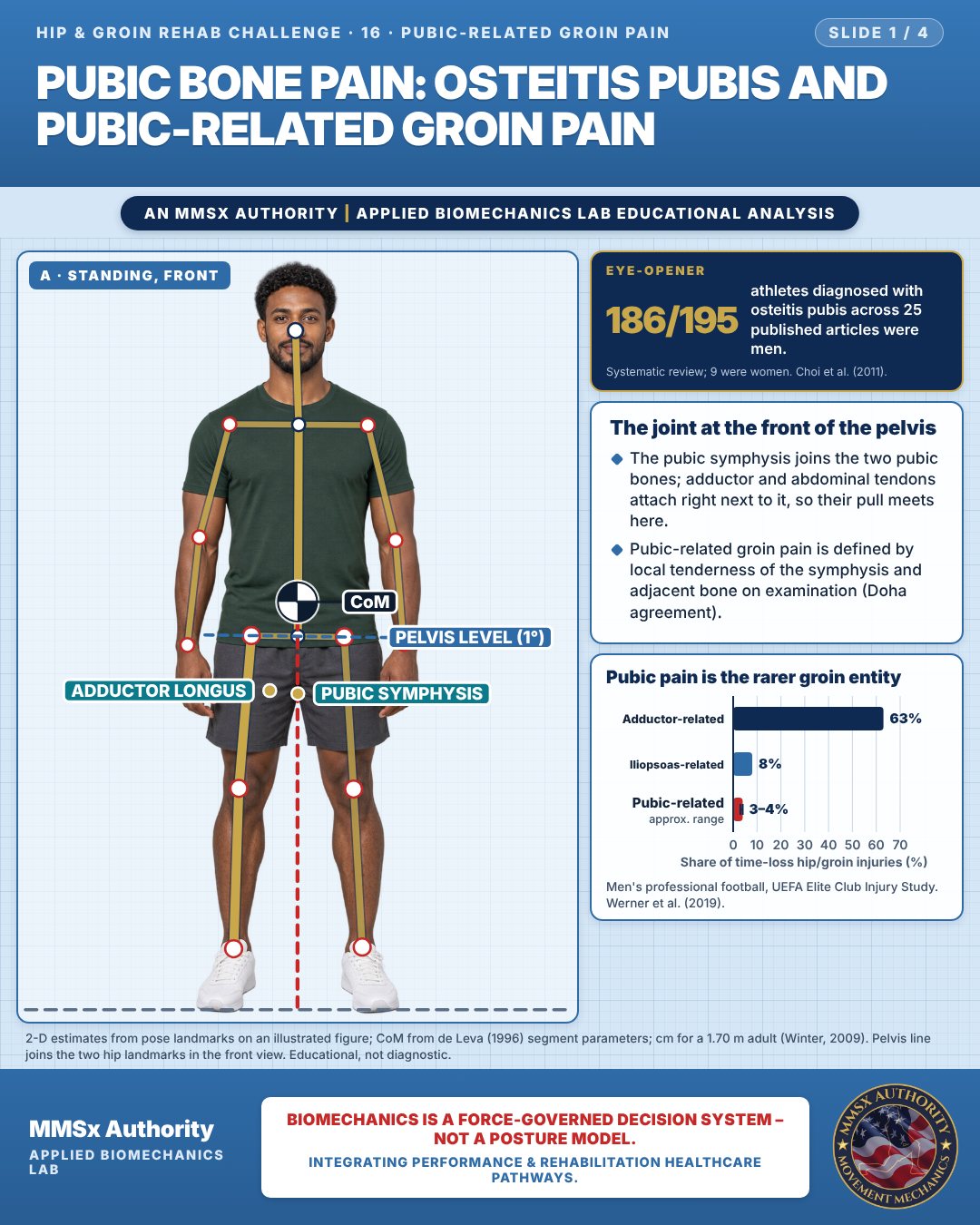
Pubic bone pain: osteitis pubis and pubic-related groin pain
Pubic-related groin pain is defined by local tenderness of the pubic symphysis and the immediately adjacent bone (Weir et al., 2015).
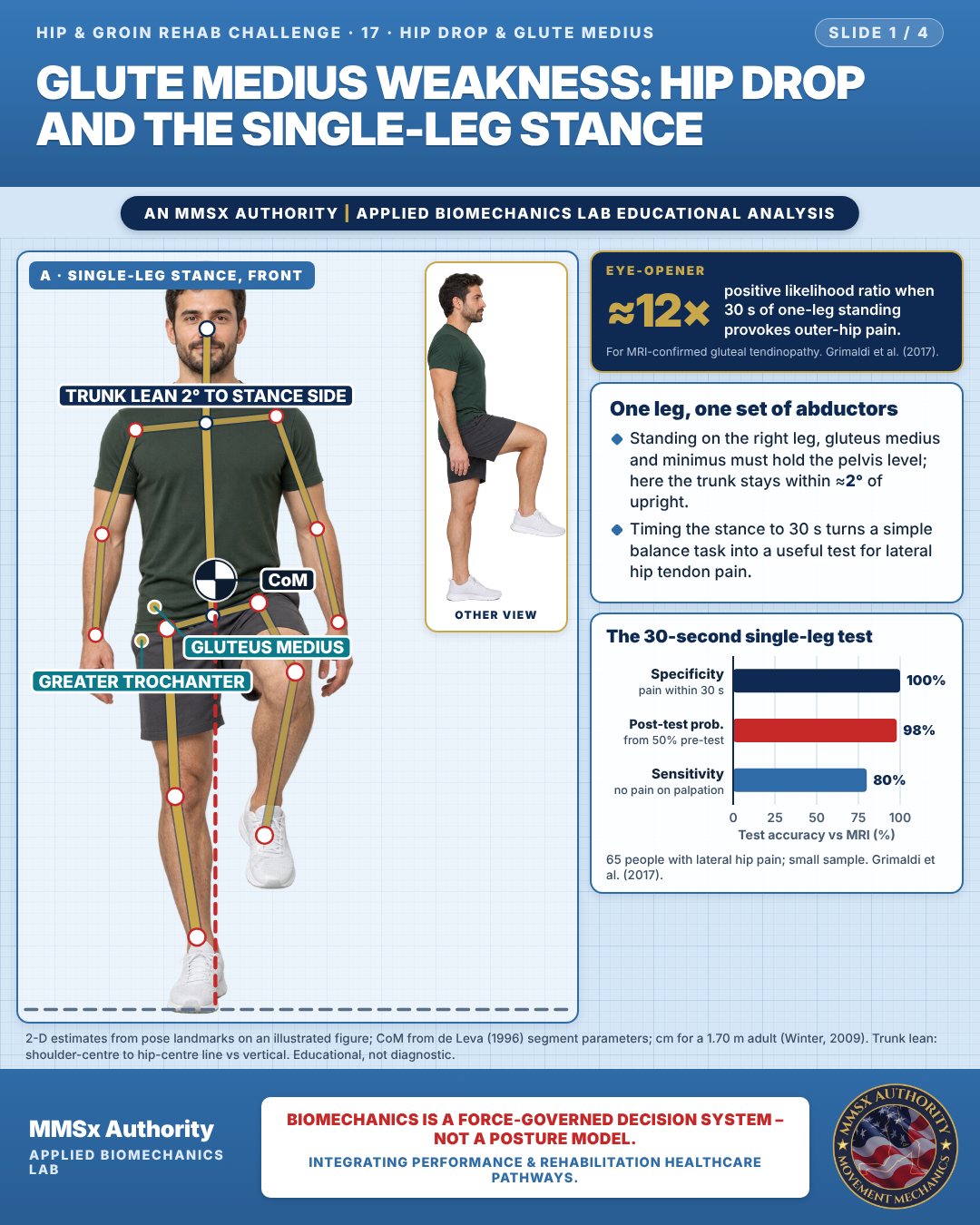 17
Glute medius weakness: hip drop and the single-leg stance
The hip abductors (mainly gluteus medius and minimus) hold the pelvis level when standing on one leg.
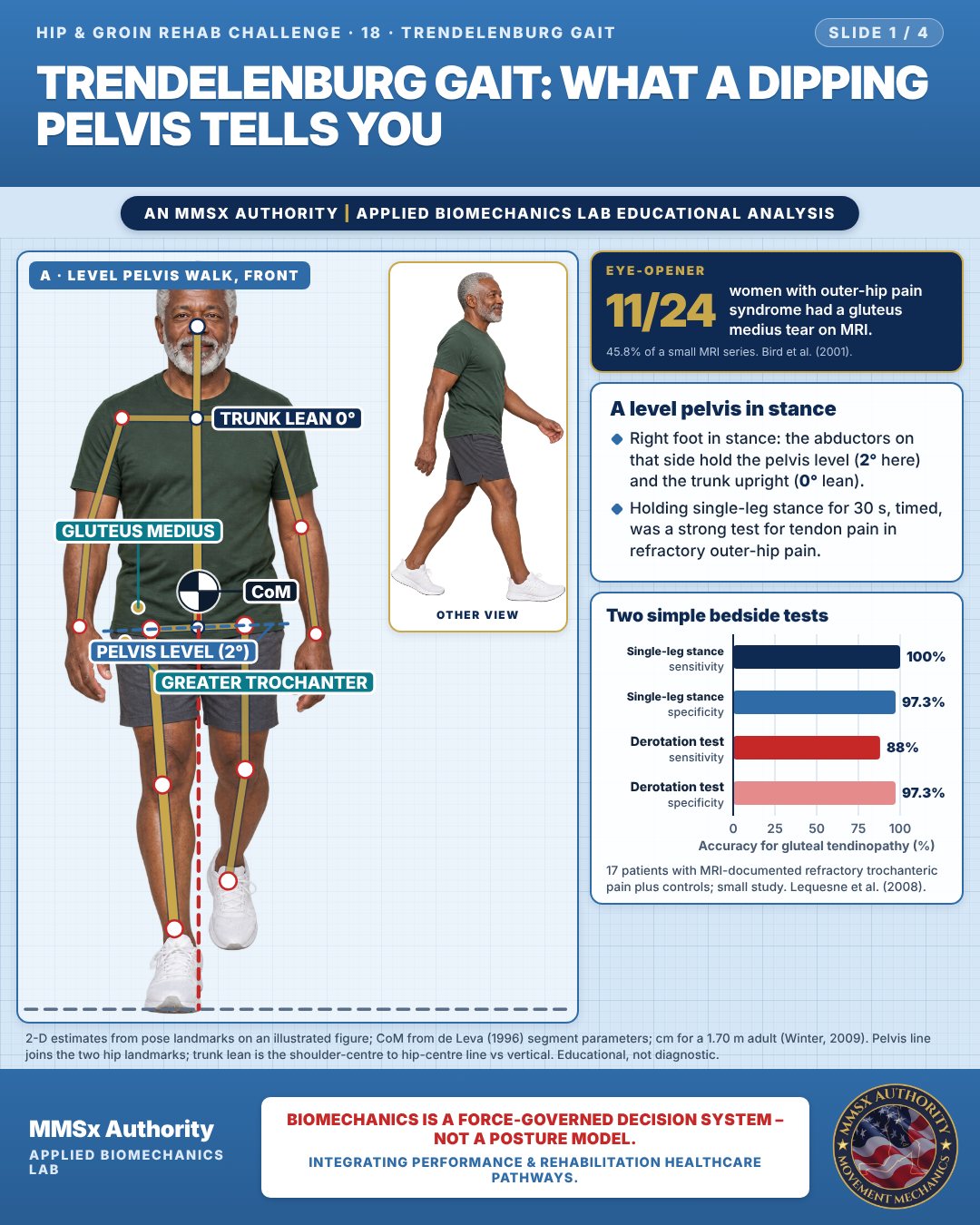 18
Trendelenburg gait: what a dipping pelvis tells you
The Trendelenburg sign is a drop of the pelvis on the side of the lifted leg during single-leg stance.
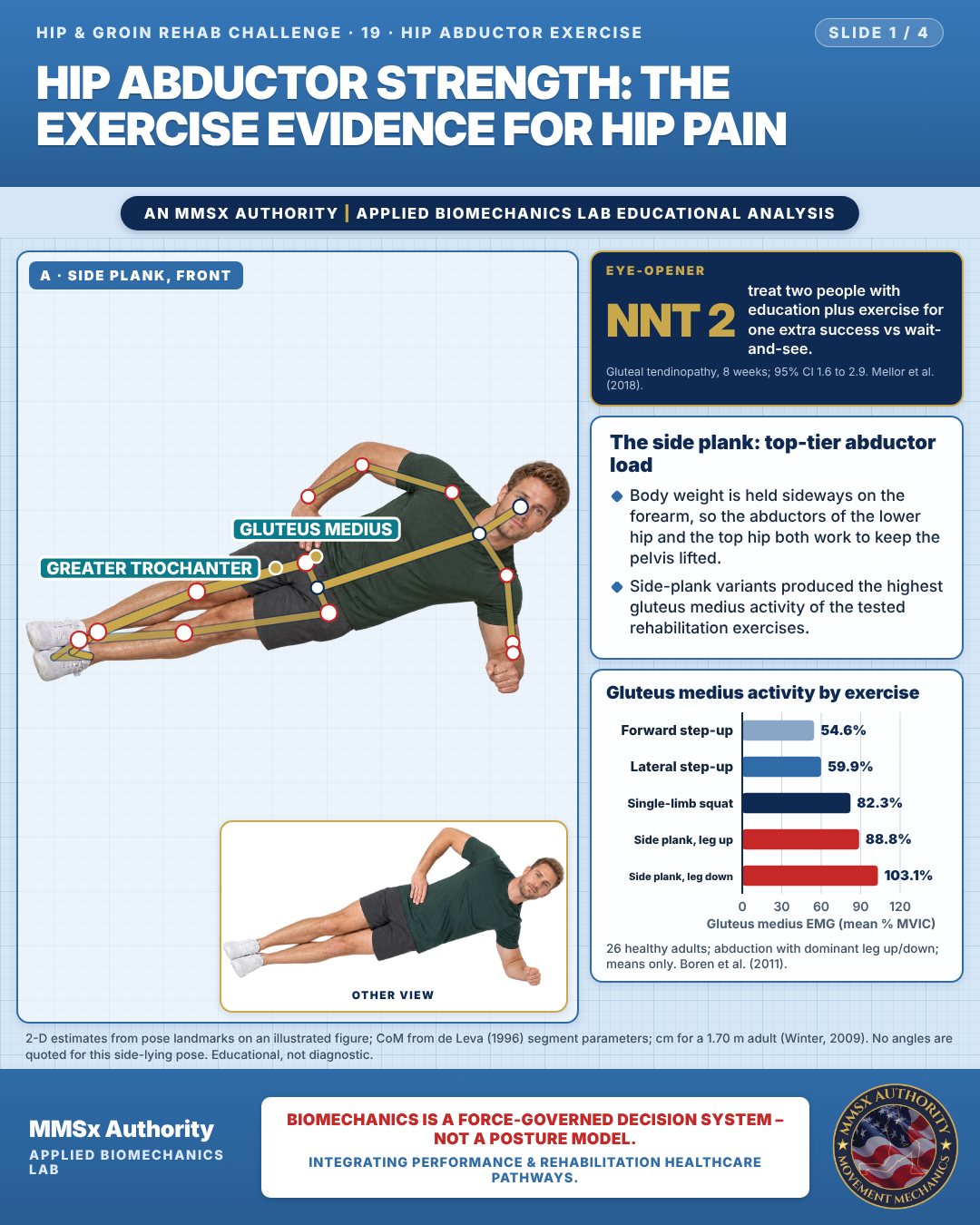 19
Hip abductor strength: the exercise evidence for hip pain
Hip abductor strengthening is progressive resistance training of gluteus medius and minimus (with tensor fasciae latae), using side-lying, standing,…
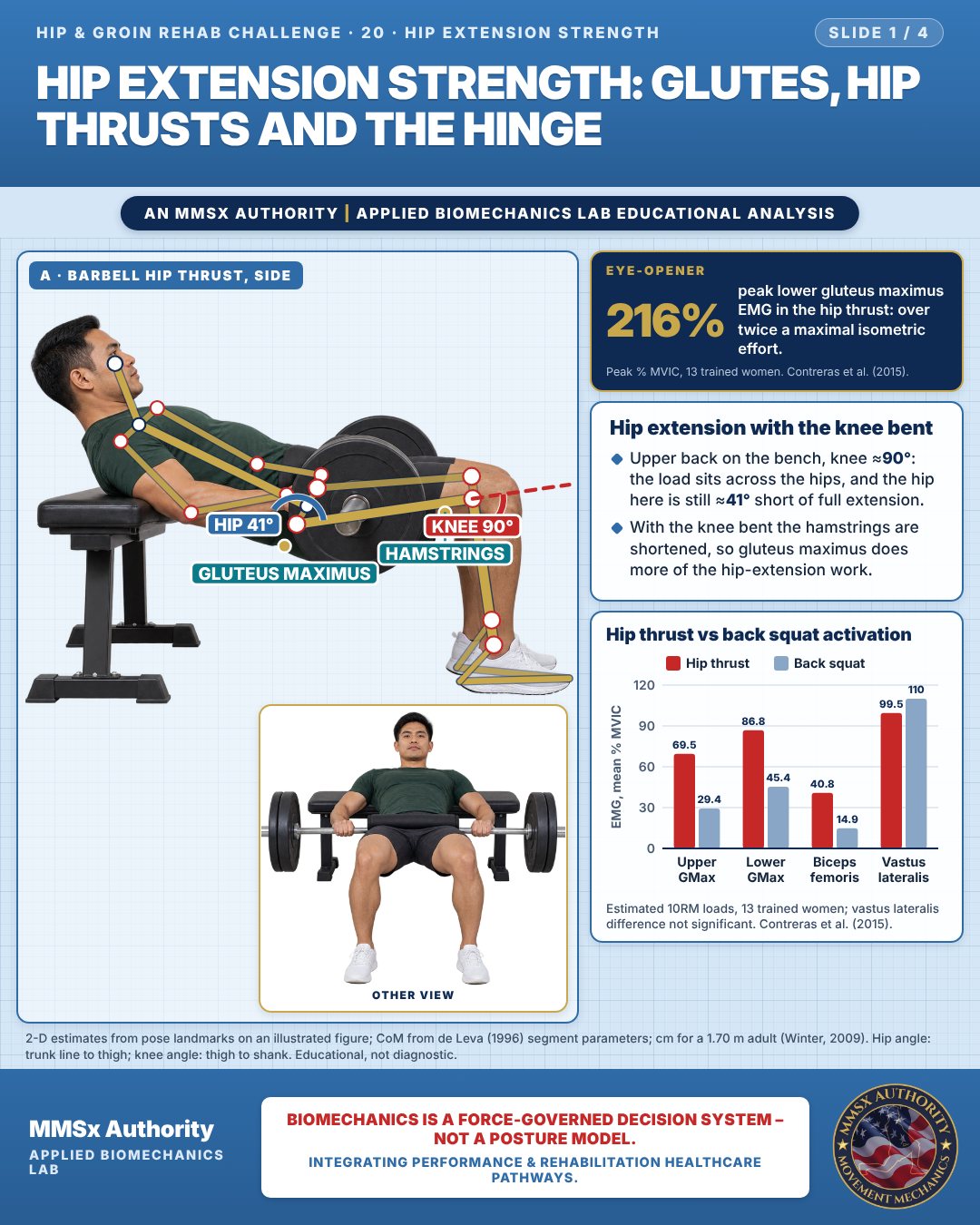 20
Hip extension strength: glutes, hip thrusts and the hinge
Hip extension strength is the capacity of gluteus maximus and the hamstrings to extend the hip.
 21
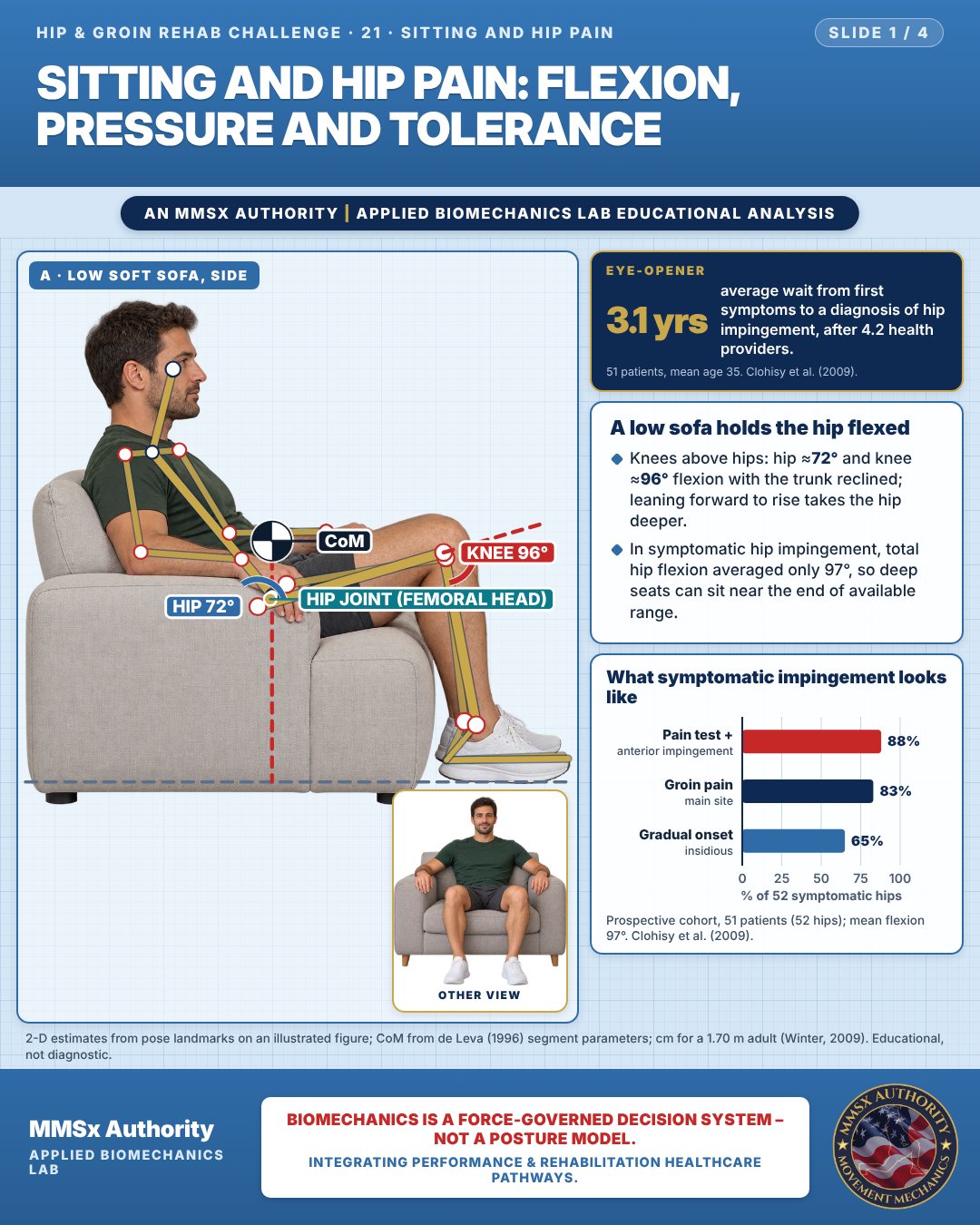
Sitting and hip pain: flexion, pressure and tolerance
Sitting-related hip pain is groin or front-of-hip pain provoked or worsened by sustained or deep hip flexion (low, soft seats.
 22
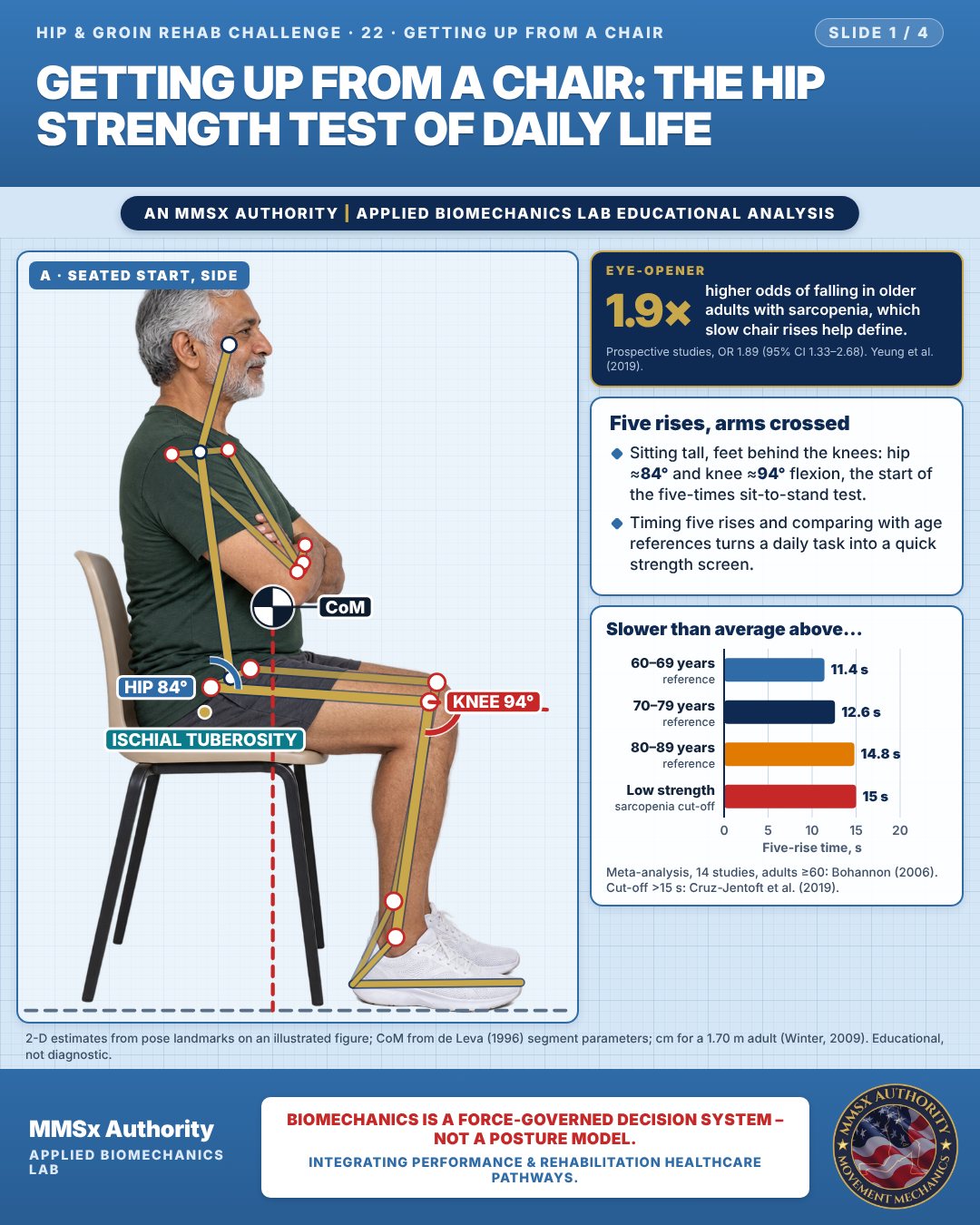
Getting up from a chair: the hip strength test of daily life
Sitting tall, feet behind the knees: hip ≈ 84° and knee ≈ 94° flexion, the start of the five-times sit-to-stand test. Timing five rises and comparing…
 23
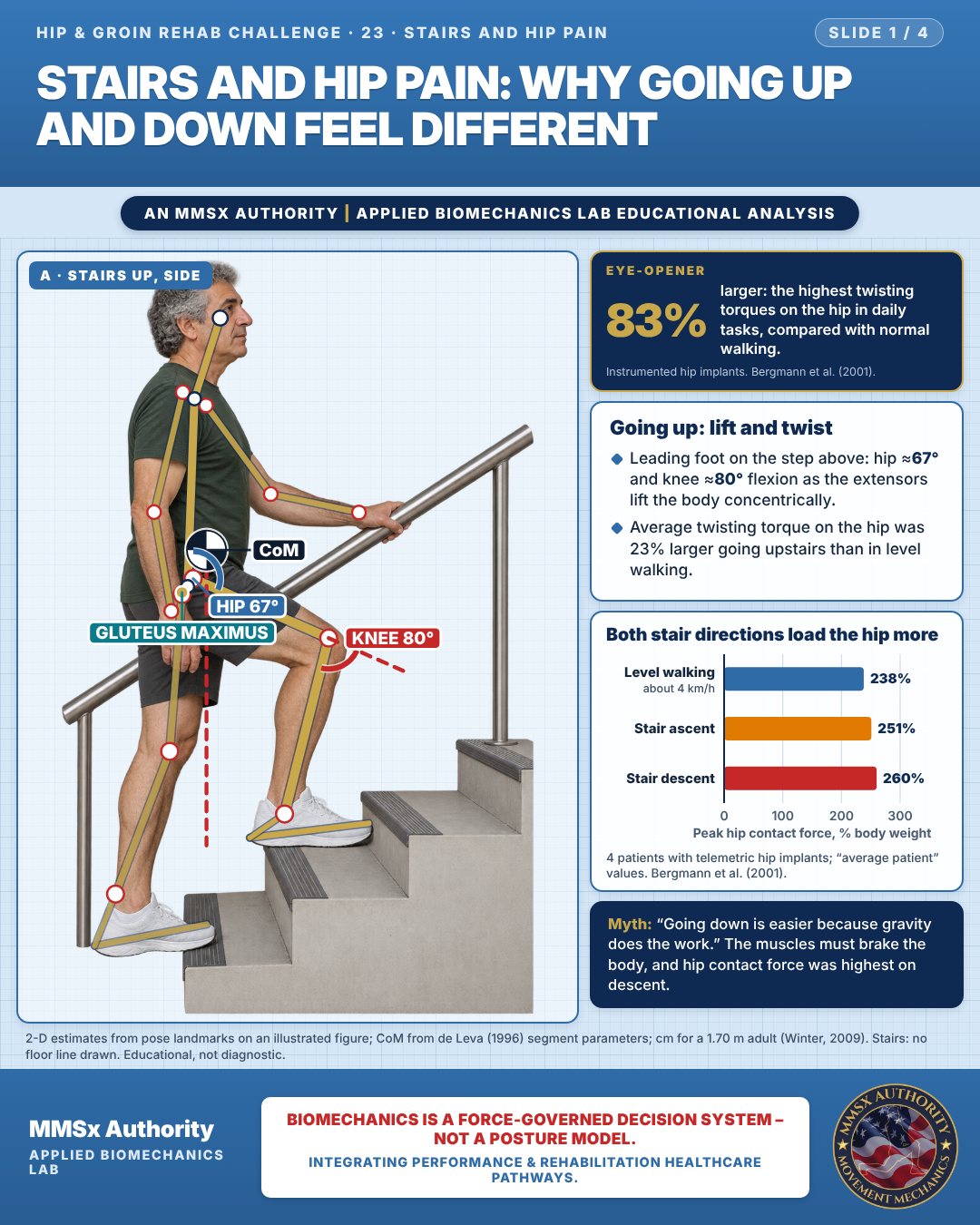
Stairs and hip pain: why going up and down feel different
Leading foot on the step above: hip ≈ 67° and knee ≈ 80° flexion as the extensors lift the body concentrically. Average twisting torque on the hip…
 24
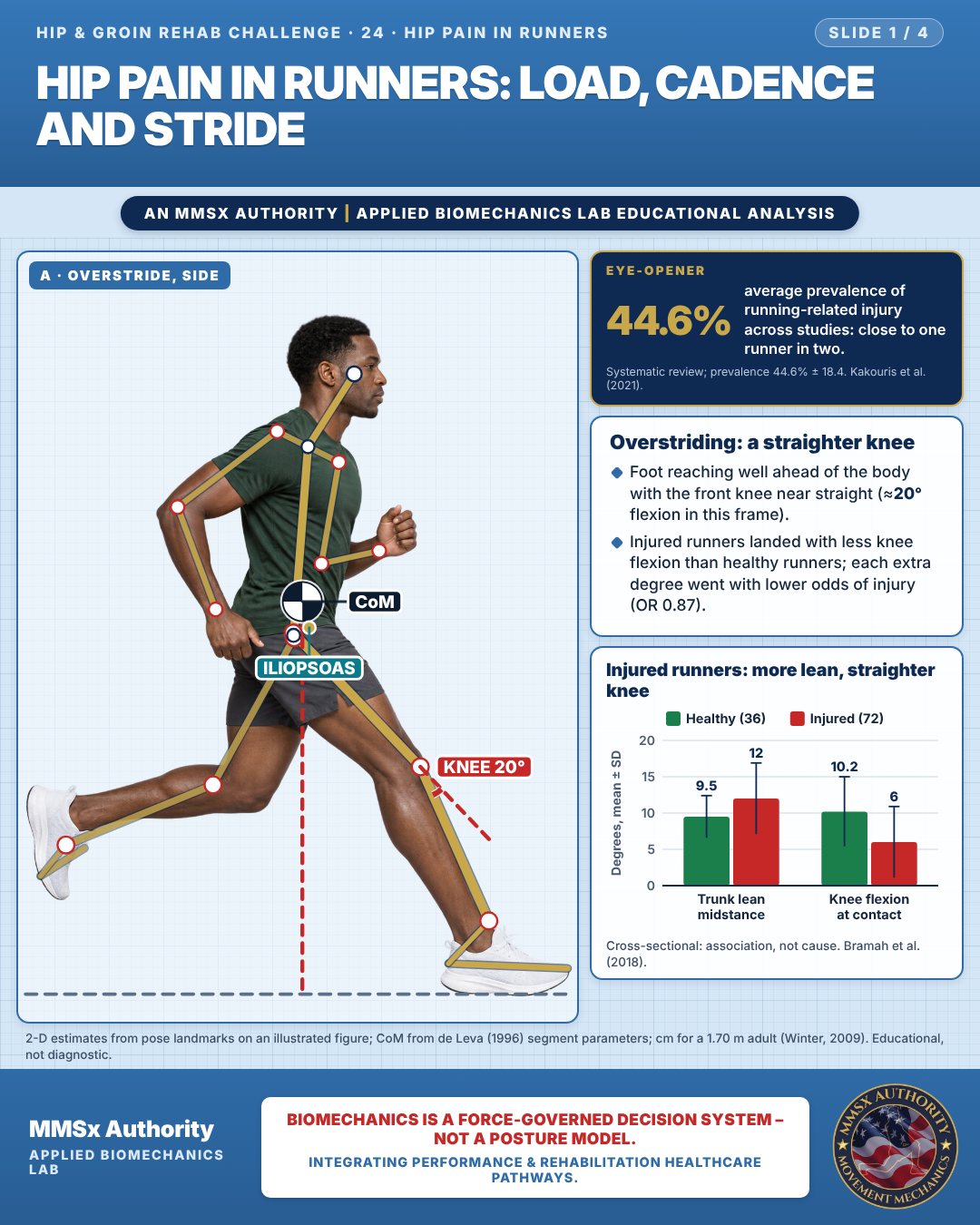
Hip pain in runners: load, cadence and stride
Running-related hip pain covers several conditions, including gluteal and hip flexor tendinopathy, hip-related groin pain and, less commonly, femoral…
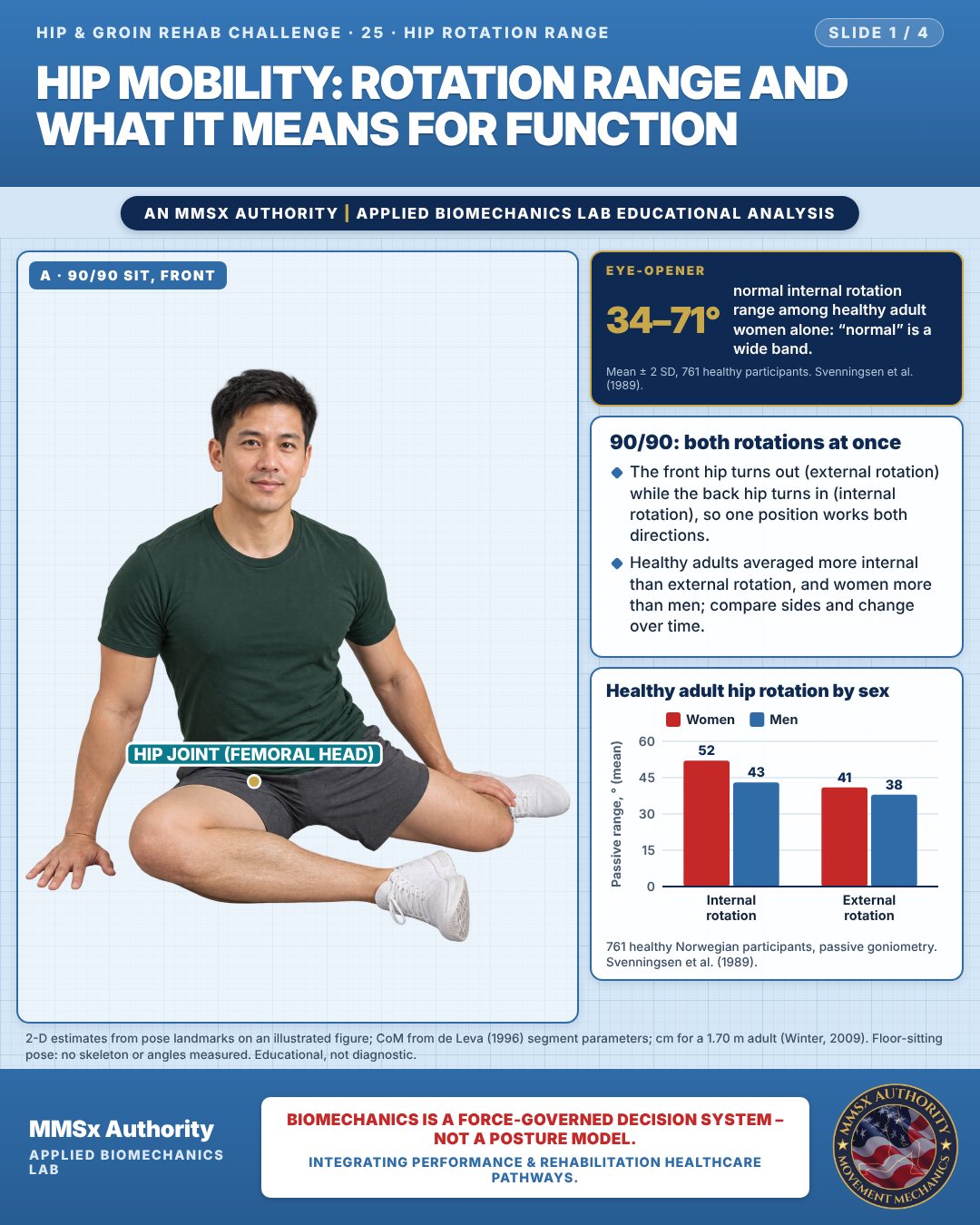 25
Hip mobility: rotation range and what it means for function
Hip rotation range is the arc of internal (inward) and external (outward) rotation of the femur in the acetabulum, usually measured with the hip and…
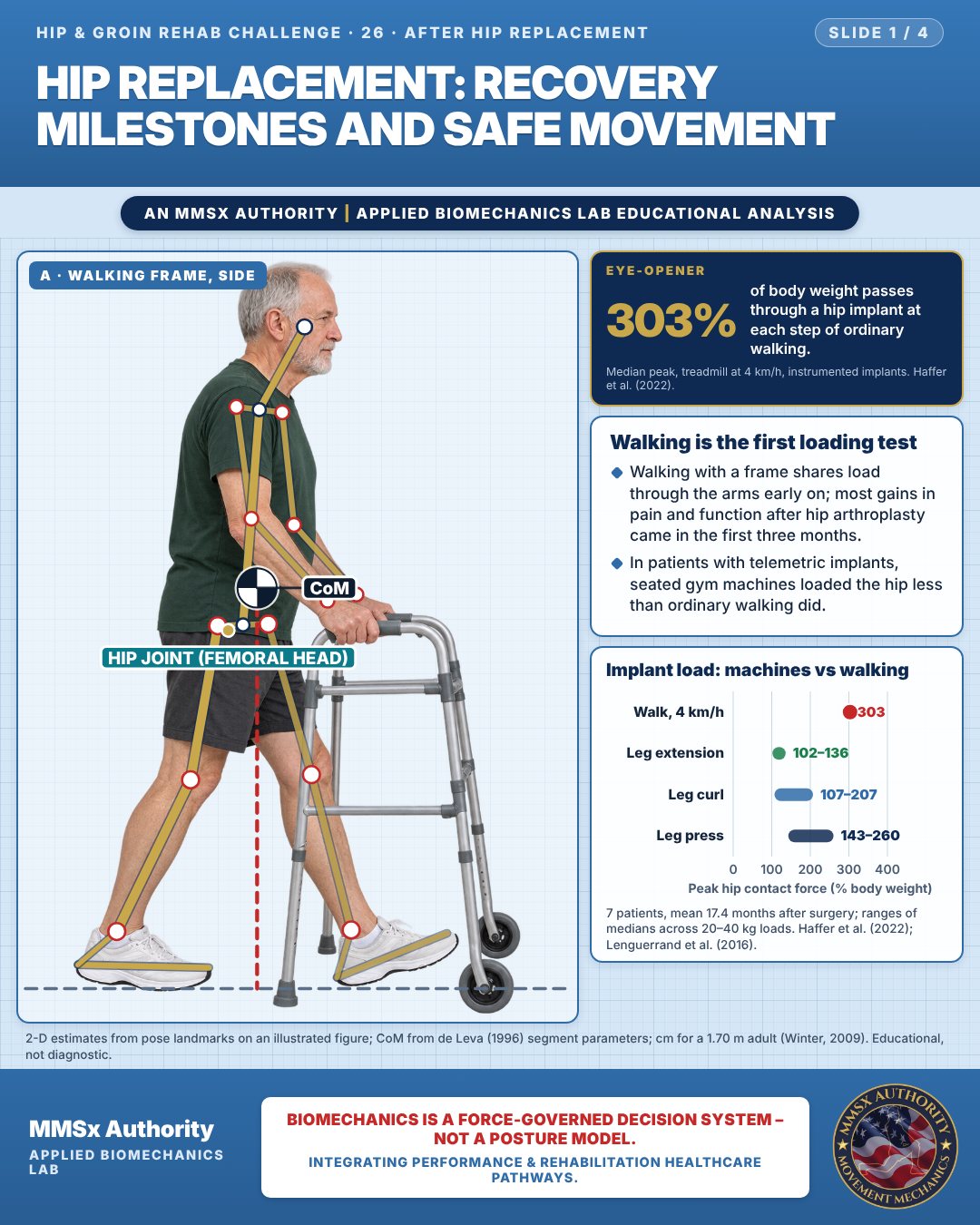 26
Hip replacement: recovery milestones and safe movement
Total hip arthroplasty (THA, total hip replacement) replaces the femoral head and acetabular surface with prosthetic components, most often for…
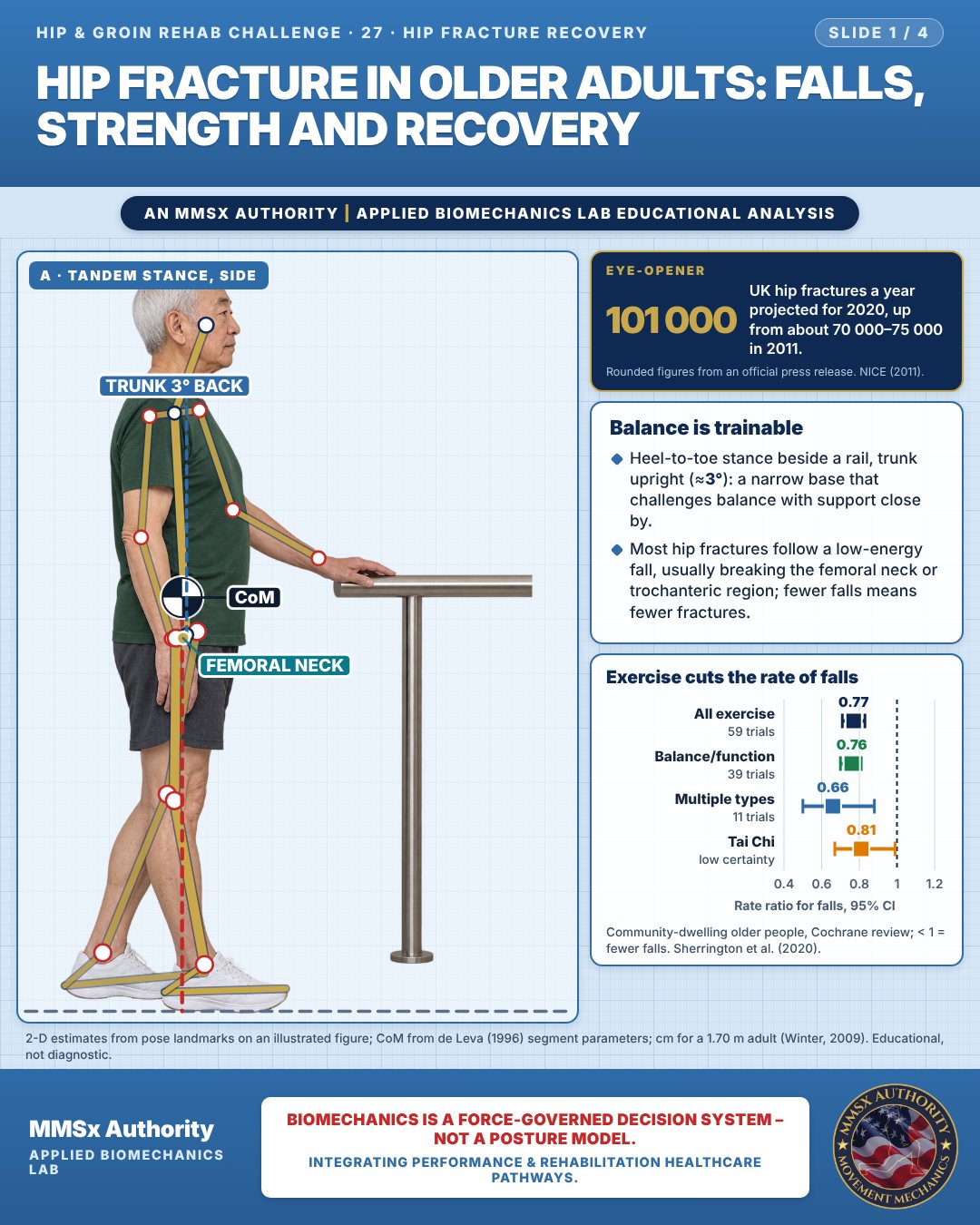 27
Hip fracture in older adults: falls, strength and recovery
A hip (proximal femoral) fracture is a break of the upper femur — the femoral neck or the trochanteric region — usually after a low-energy fall in an…
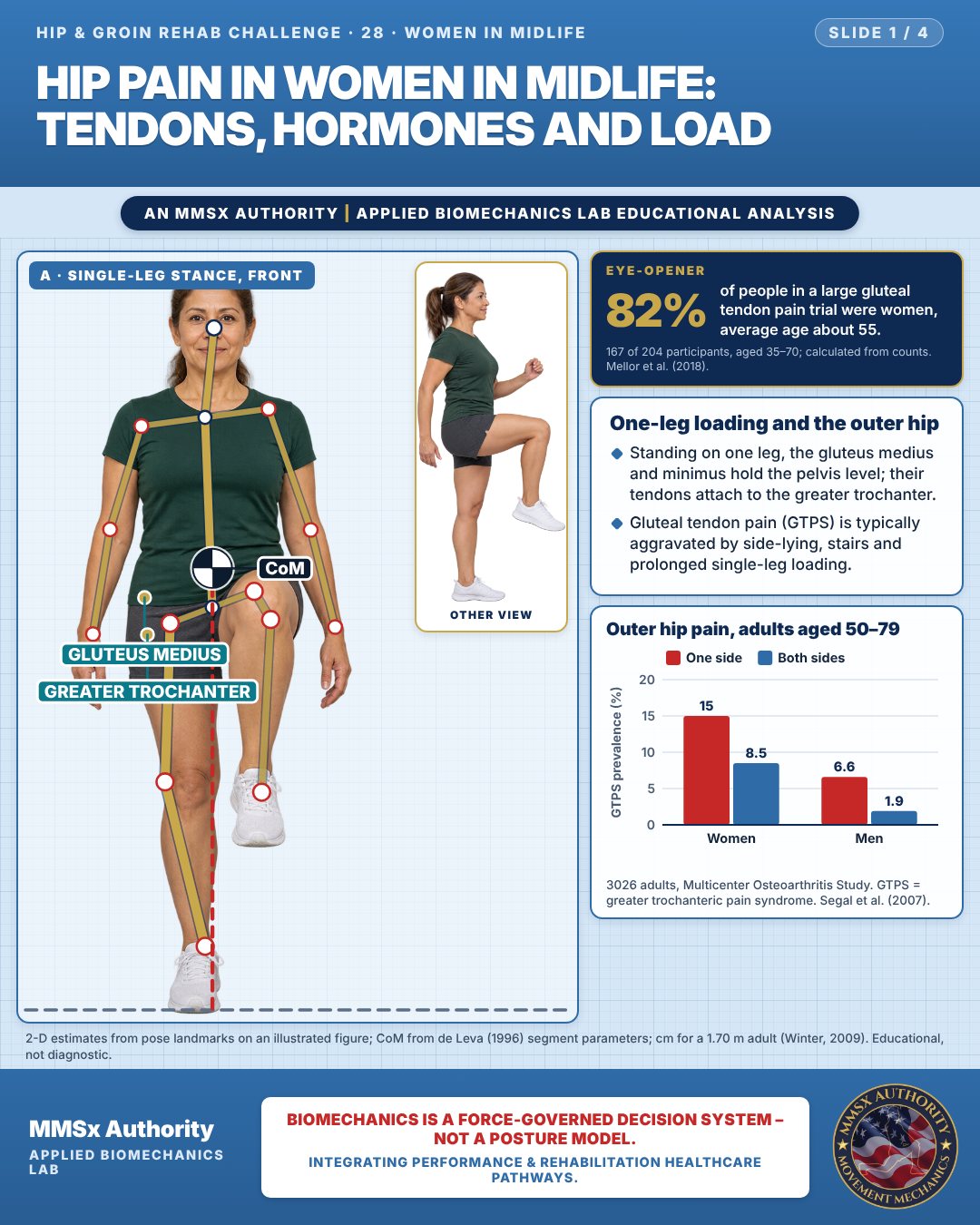 28
Hip pain in women in midlife: tendons, hormones and load
Greater trochanteric pain syndrome (GTPS) is pain and tenderness over the outer hip (greater trochanter), most often due to gluteus medius and…
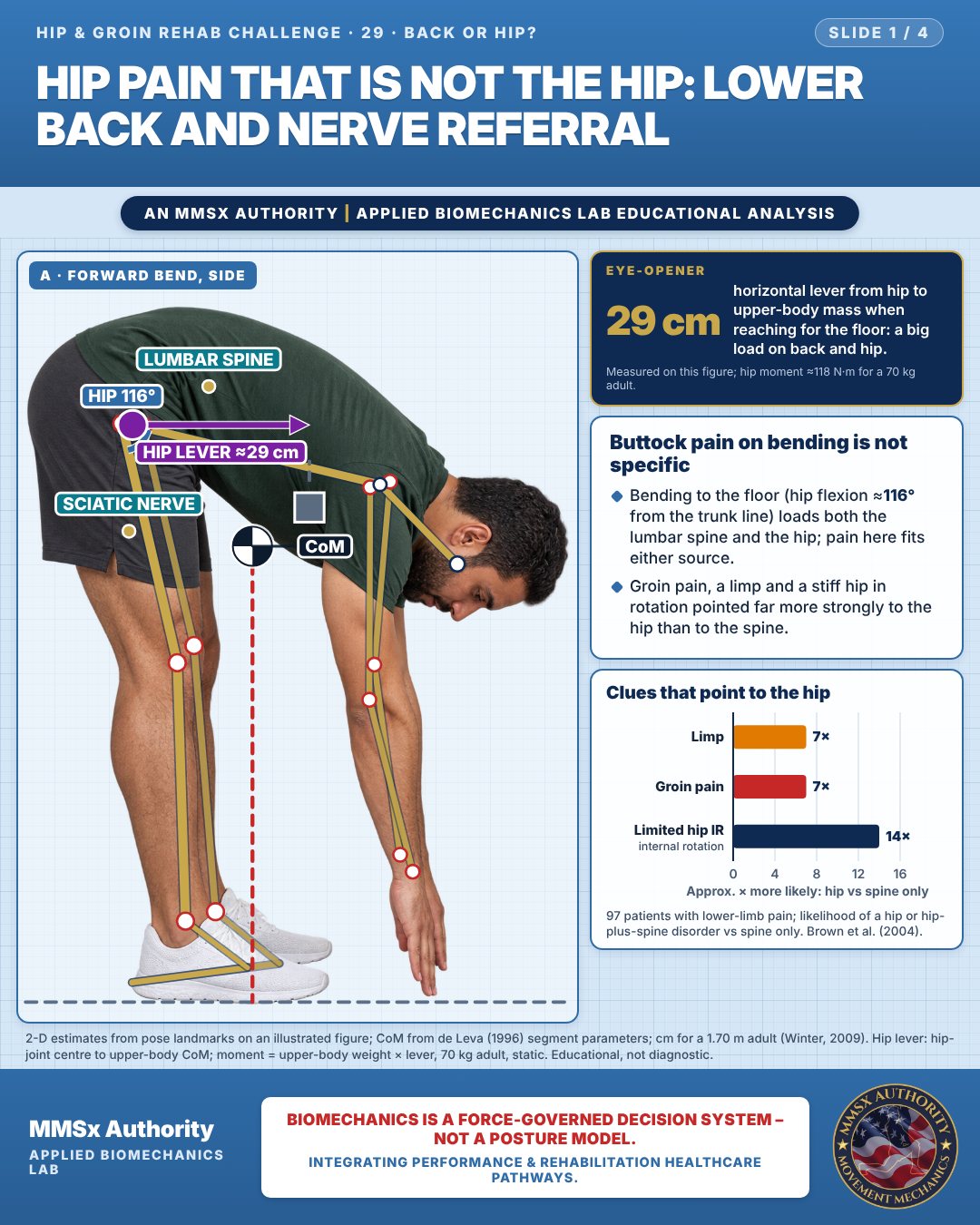 29
Hip pain that is not the hip: lower back and nerve referral
Referred "hip" pain is pain felt in the buttock, hip or thigh that originates elsewhere, most often from the lumbar spine (facet or disc problems, or…
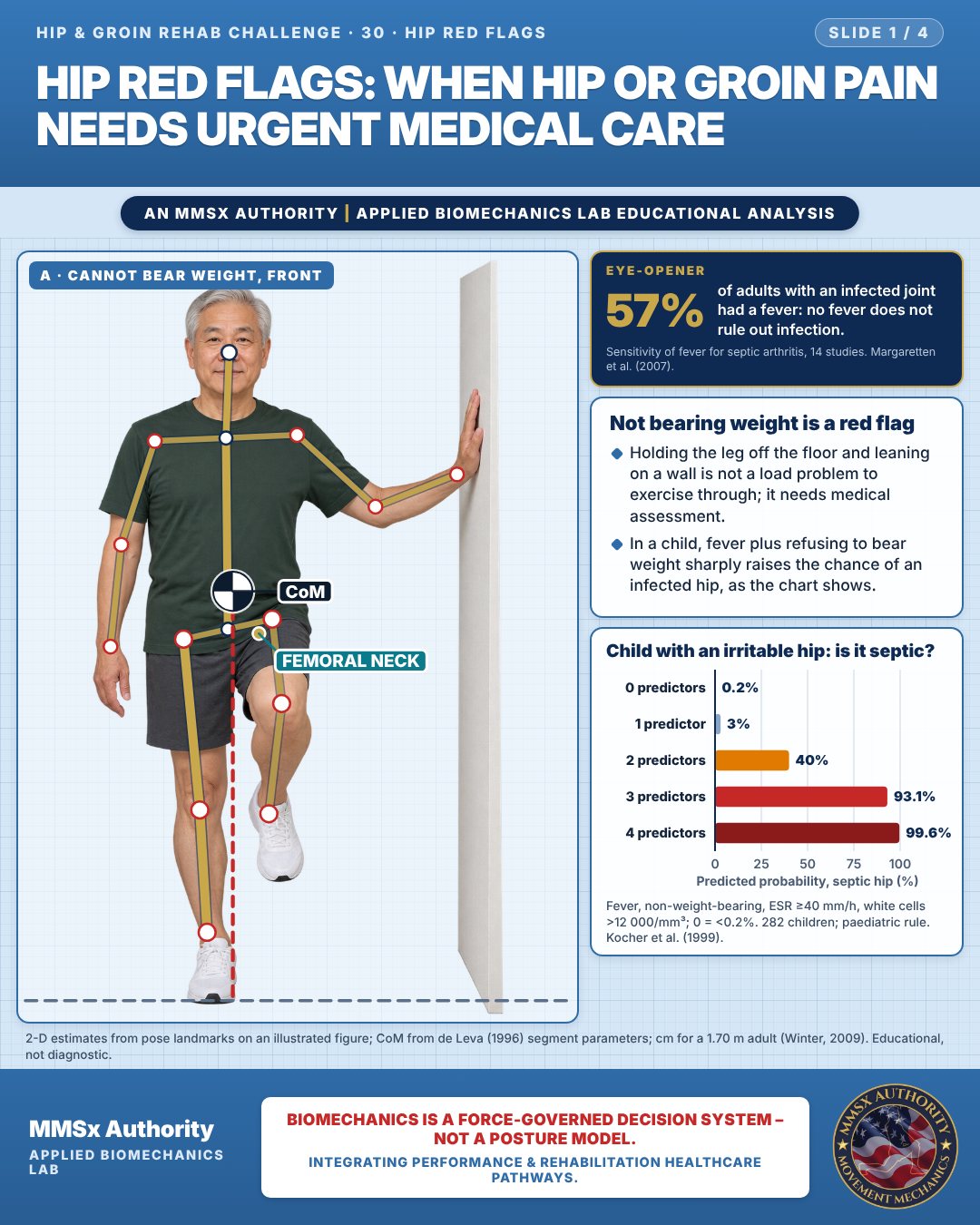 30
Hip red flags: when hip or groin pain needs urgent medical care
Hip red flags are features of hip or groin pain that suggest a serious, time-sensitive cause rather than a musculoskeletal load problem.