Hip & Groin Rehab Challenge · 12
Snapping hip: harmless click or a reason to change load?
Snapping hip is an audible or palpable snap during hip movement. Movement analysis, verified research data and a decision pathway.
Key points
- Reassure. A painless click is common and not an injury; most dancers with snapping lost no dance time.
- Examine. If snapping hurts or limits activity, examine the whole hip, including the joint, not only the tendon.
- Load, then refer. Graded conservative care first; consider surgery only for persistent painful snapping.
What it is
Snapping hip is an audible or palpable snap during hip movement. In the internal type a tendon (most often the iliopsoas) flicks over a structure at the front of the hip; in the external type the iliotibial band flicks over the outer hip. Snapping is often painless (Walker et al., 2021; Winston et al., 2007).
How we analysed the movement
Three movements relevant to this topic were analysed from illustrated reference figures. Joint centres were located with two-dimensional pose estimation; hip and knee angles, pelvis level, the whole-body centre of mass and, where relevant, the hip lever (the horizontal distance from the hip joint to the upper-body centre of mass) and the resulting static hip moment were then calculated from standard segment parameters. The figures are educational estimates that show how position changes mechanical demand; they are not measurements of a patient. Every research value quoted below comes from the published source cited beside it.
Movement A: Leg circle, lying (front view)
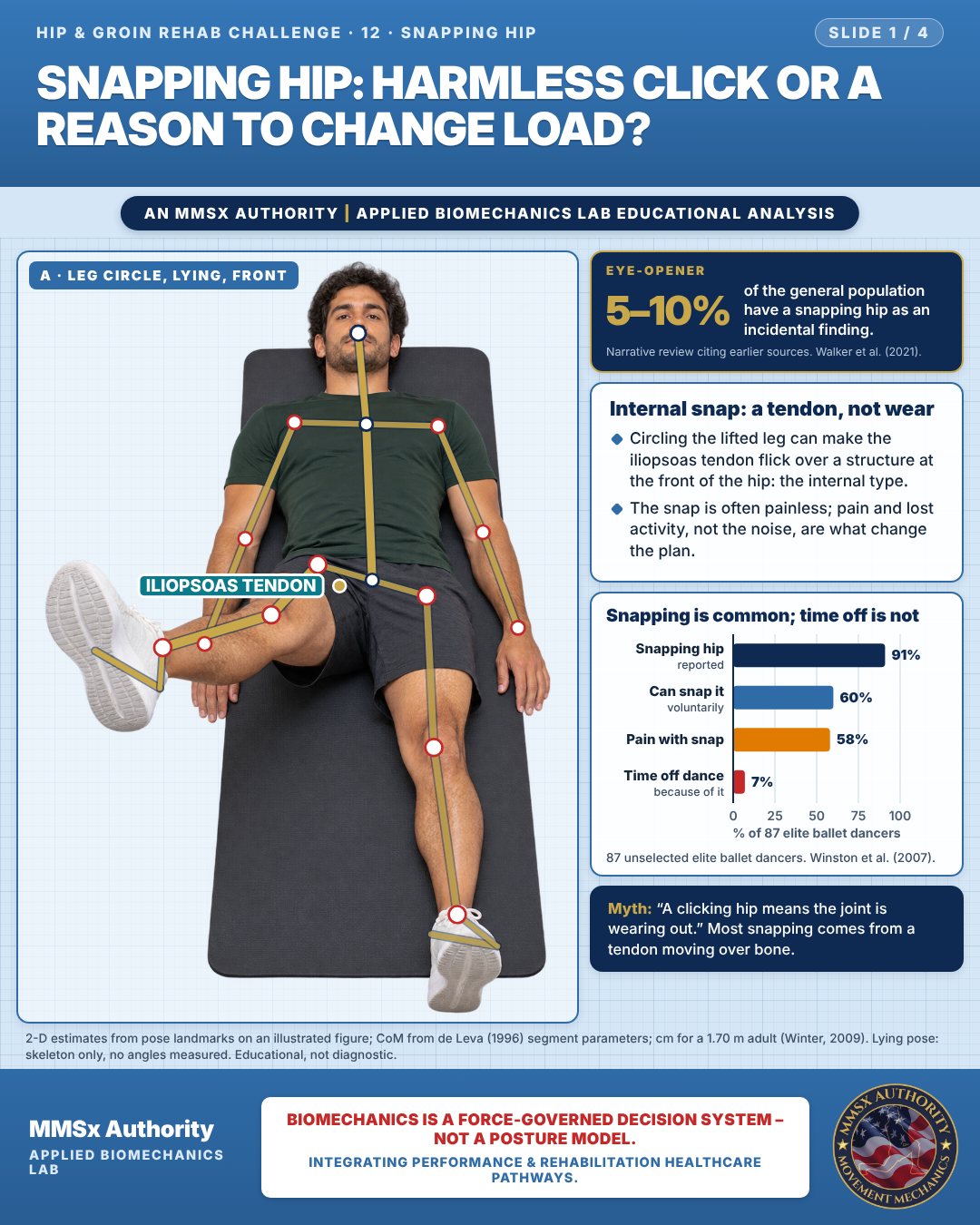
Internal snap: a tendon, not wear
Circling the lifted leg can make the iliopsoas tendon flick over a structure at the front of the hip: the internal type.
The snap is often painless; pain and lost activity, not the noise, are what change the plan.
Snapping is common; time off is not
Movement B: Hand on outer hip (front view)
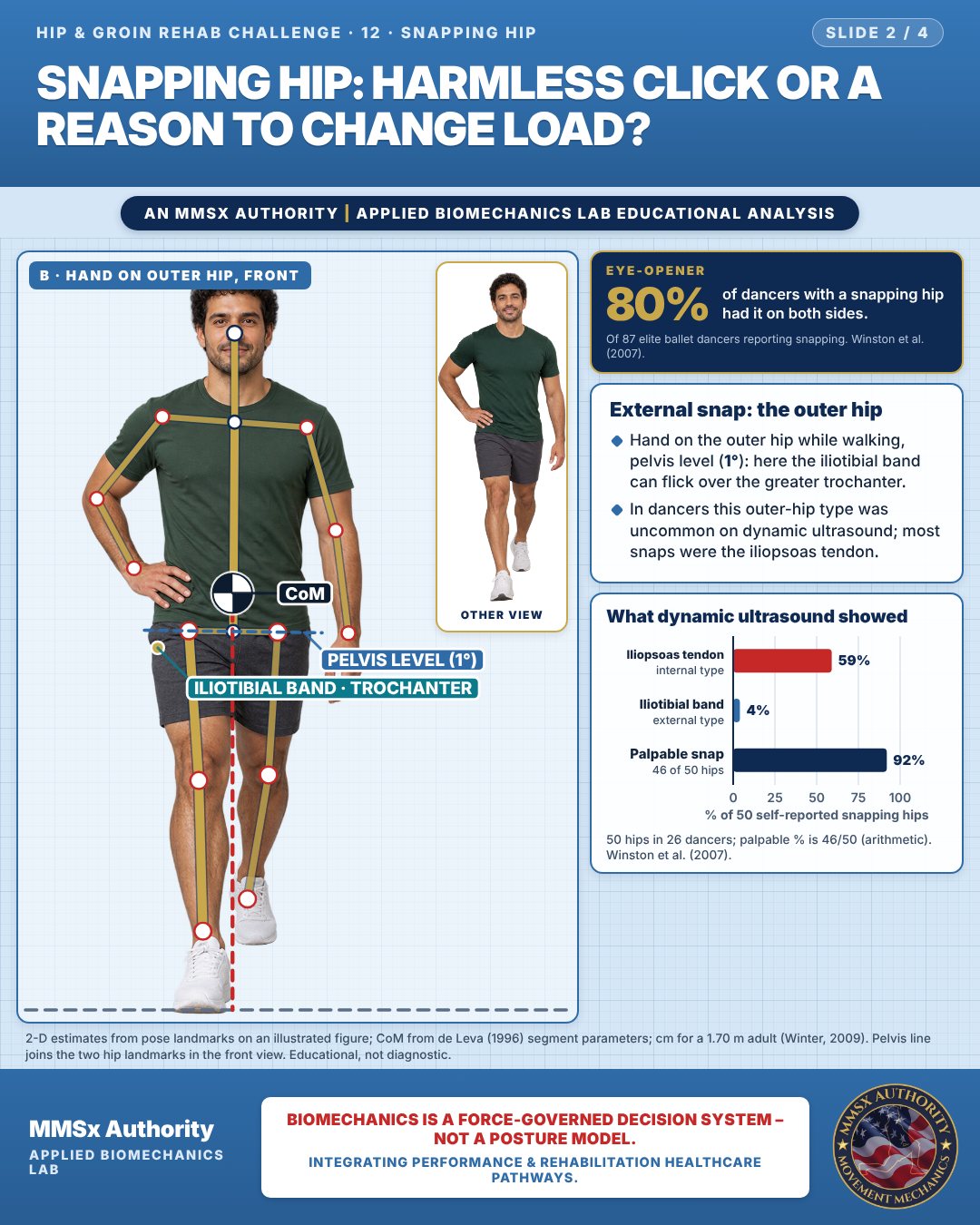
External snap: the outer hip
Hand on the outer hip while walking, pelvis level (1°): here the iliotibial band can flick over the greater trochanter.
In dancers this outer-hip type was uncommon on dynamic ultrasound; most snaps were the iliopsoas tendon.
What dynamic ultrasound showed
Movement C: Lunge to stand (side view)
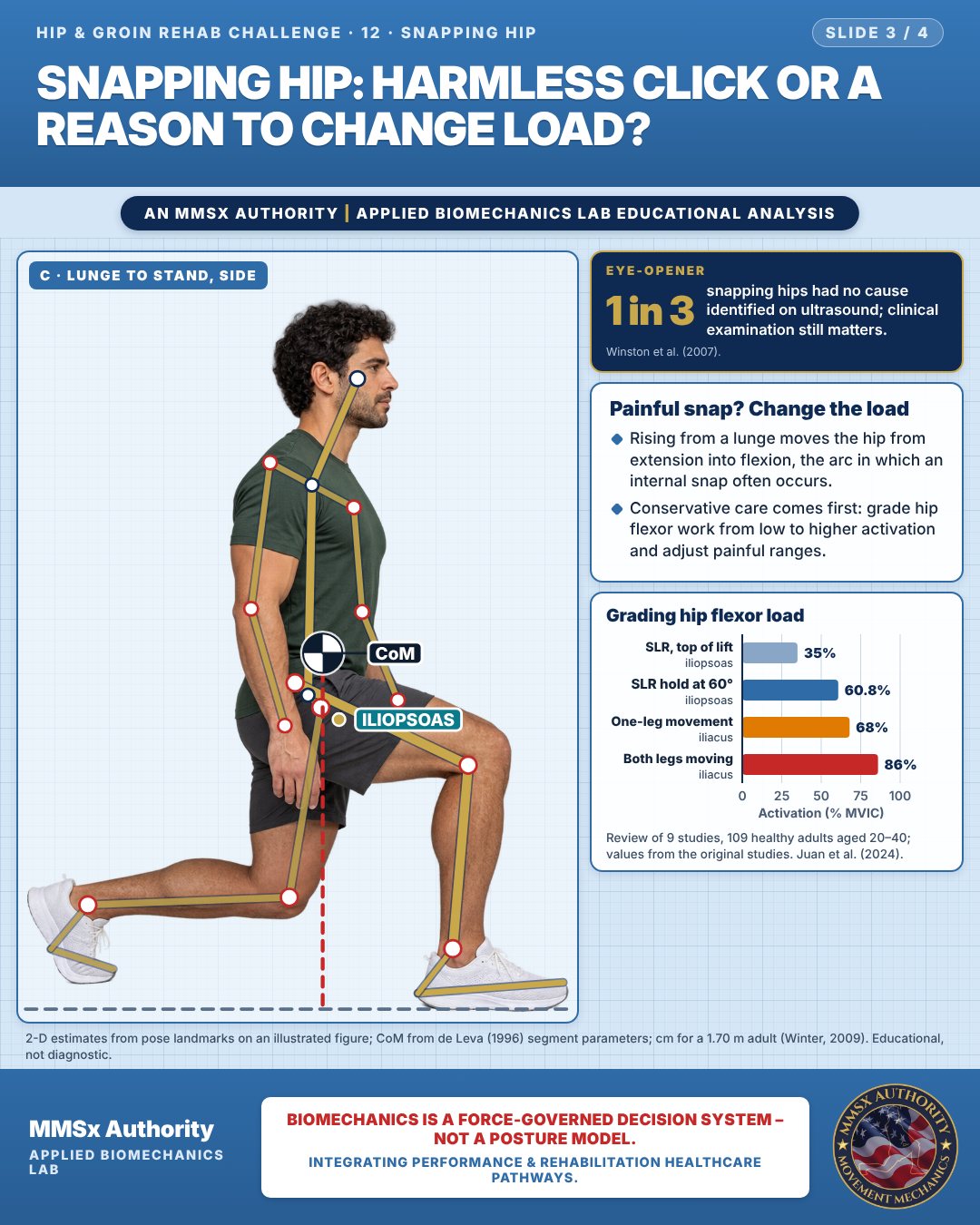
Painful snap? Change the load
Rising from a lunge moves the hip from extension into flexion, the arc in which an internal snap often occurs.
Conservative care comes first: grade hip flexor work from low to higher activation and adjust painful ranges.
Grading hip flexor load
Decision pathway
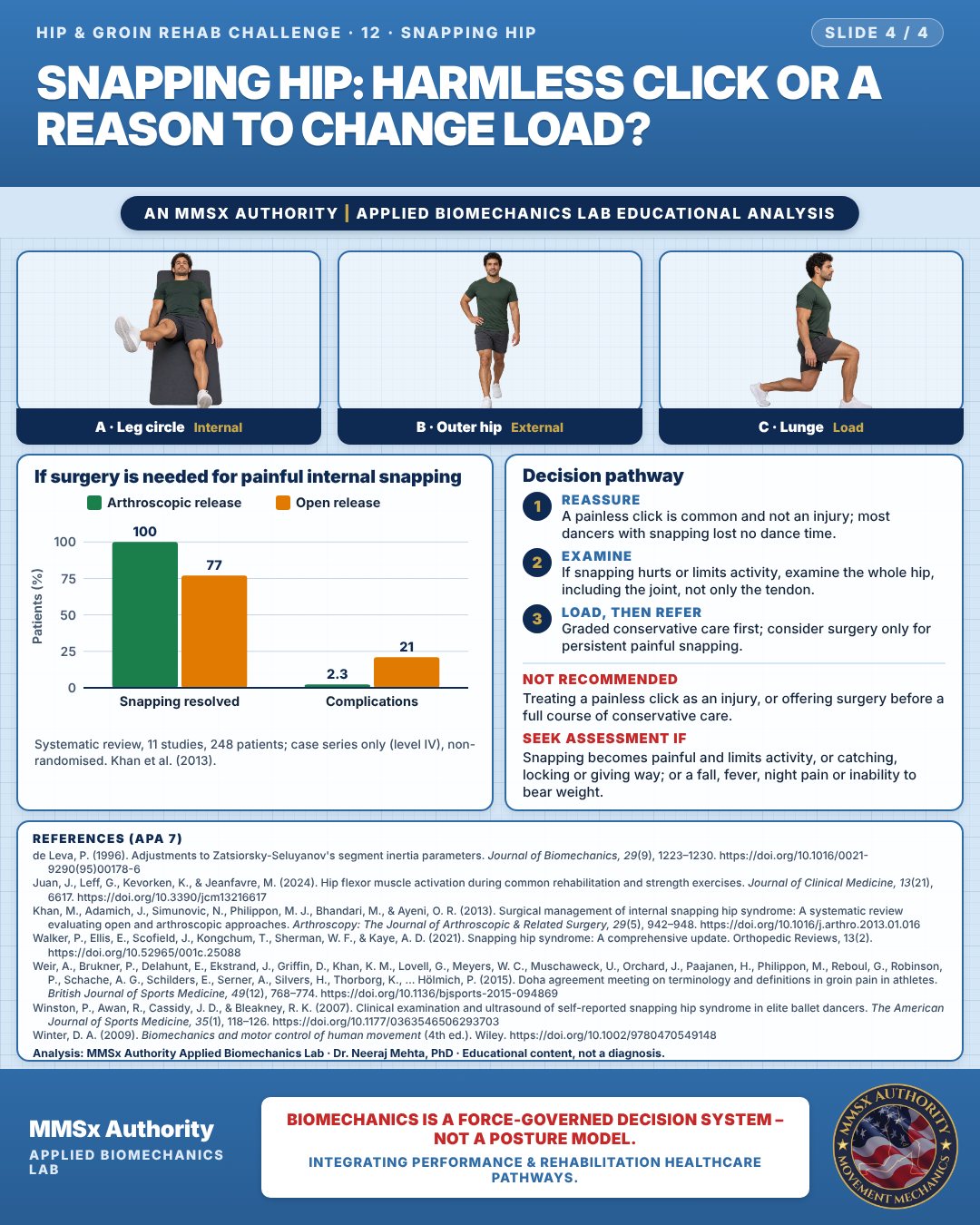
If surgery is needed for painful internal snapping
Reassure
A painless click is common and not an injury; most dancers with snapping lost no dance time.
Examine
If snapping hurts or limits activity, examine the whole hip, including the joint, not only the tendon.
Load, then refer
Graded conservative care first; consider surgery only for persistent painful snapping.
What the evidence supports
- Conservative care first; surgery is considered only when painful snapping persists after 2–3 months of physiotherapy and other conservative care (Walker et al., 2021, citing earlier case series; secondary).
- Where surgery is chosen for internal snapping, arthroscopic release was associated with fewer failures and complications than open release (Khan et al., 2013; level IV).
- Not recommended: treating painless snapping as an injury; most dancers with snapping did not lose dance time (Winston et al., 2007).
Myth and evidence
Myth“A clicking hip means the joint is wearing out.”
EvidenceIn elite dancers 91% reported snapping, yet only 7% lost dance time because of it (Winston et al., 2007). Most snapping comes from a tendon moving over bone (59% iliopsoas on ultrasound), not from joint damage.
Cautions
Not recommended
Treating a painless click as an injury, or offering surgery before a full course of conservative care.
Seek assessment if
Snapping becomes painful and limits activity, or catching, locking or giving way; or a fall, fever, night pain or inability to bear weight.
Methods note
2-D estimates from pose landmarks on an illustrated figure; CoM from de Leva (1996) segment parameters; cm for a 1.70 m adult (Winter, 2009). Lying pose: skeleton only, no angles measured. Pelvis line joins the two hip landmarks in the front view. These are educational estimates, not a diagnosis.
References
- de Leva, P. (1996). Adjustments to Zatsiorsky-Seluyanov's segment inertia parameters. Journal of Biomechanics, 29(9), 1223–1230. https://doi.org/10.1016/0021-9290(95)00178-6
- Juan, J., Leff, G., Kevorken, K., & Jeanfavre, M. (2024). Hip flexor muscle activation during common rehabilitation and strength exercises. Journal of Clinical Medicine, 13(21), 6617. https://doi.org/10.3390/jcm13216617
- Khan, M., Adamich, J., Simunovic, N., Philippon, M. J., Bhandari, M., & Ayeni, O. R. (2013). Surgical management of internal snapping hip syndrome: A systematic review evaluating open and arthroscopic approaches. Arthroscopy: The Journal of Arthroscopic & Related Surgery, 29(5), 942–948. https://doi.org/10.1016/j.arthro.2013.01.016
- Walker, P., Ellis, E., Scofield, J., Kongchum, T., Sherman, W. F., & Kaye, A. D. (2021). Snapping hip syndrome: A comprehensive update. Orthopedic Reviews, 13(2). https://doi.org/10.52965/001c.25088
- Weir, A., Brukner, P., Delahunt, E., Ekstrand, J., Griffin, D., Khan, K. M., Lovell, G., Meyers, W. C., Muschaweck, U., Orchard, J., Paajanen, H., Philippon, M., Reboul, G., Robinson, P., Schache, A. G., Schilders, E., Serner, A., Silvers, H., Thorborg, K., … Hölmich, P. (2015). Doha agreement meeting on terminology and definitions in groin pain in athletes. British Journal of Sports Medicine, 49(12), 768–774. https://doi.org/10.1136/bjsports-2015-094869
- Winston, P., Awan, R., Cassidy, J. D., & Bleakney, R. K. (2007). Clinical examination and ultrasound of self-reported snapping hip syndrome in elite ballet dancers. The American Journal of Sports Medicine, 35(1), 118–126. https://doi.org/10.1177/0363546506293703
- Winter, D. A. (2009). Biomechanics and motor control of human movement (4th ed.). Wiley. https://doi.org/10.1002/9780470549148
Cite this article
Mehta, N. (2026, October 28). Snapping hip: harmless click or a reason to change load? MMSx Authority Applied Biomechanics Lab. https://mmsxauthority.org/edu/analysis/hip-groin/12-snapping-hip-harmless-click-or-a-reason-to-change-load/
Part of the collection
Mehta, N. (2026). Hip and Groin Rehabilitation: 30 Evidence-Based Biomechanics Analyses [Collection]. MMSx Authority Applied Biomechanics Lab. Zenodo. https://doi.org/10.5281/zenodo.23735806
All Hip & Groin Rehab Challenge articles · Rehabilitation Library