Hip & Groin Rehab Challenge · 14
Groin pain in footballers: adductor, hip, inguinal or pubic?
The Doha agreement classifies groin pain in athletes by clinical examination into: adductor-related (adductor tenderness and pain on resisted…
Key points
- Classify. Name the entity by examination: adductor, iliopsoas, inguinal, pubic or hip; always examine the hip.
- Strengthen. Long-standing adductor pain: 8–12 weeks of active adductor and pelvic strengthening.
- Prevent. Adductor strengthening based on the Copenhagen adduction exercise reduced groin problems (OR 0.59).
What it is
The Doha agreement classifies groin pain in athletes by clinical examination into: adductor-related (adductor tenderness and pain on resisted adduction testing); iliopsoas-related (iliopsoas tenderness); inguinal-related (pain in the inguinal canal region with tenderness of the canal and no palpable hernia); pubic-related (local tenderness of the pubic symphysis and immediately adjacent bone); hip-related groin pain; and other causes. The agreement came from 24 experts from 14 countries (Weir et al., 2015).
How we analysed the movement
Three movements relevant to this topic were analysed from illustrated reference figures. Joint centres were located with two-dimensional pose estimation; hip and knee angles, pelvis level, the whole-body centre of mass and, where relevant, the hip lever (the horizontal distance from the hip joint to the upper-body centre of mass) and the resulting static hip moment were then calculated from standard segment parameters. The figures are educational estimates that show how position changes mechanical demand; they are not measurements of a patient. Every research value quoted below comes from the published source cited beside it.
Movement A: Side lunge (front view)
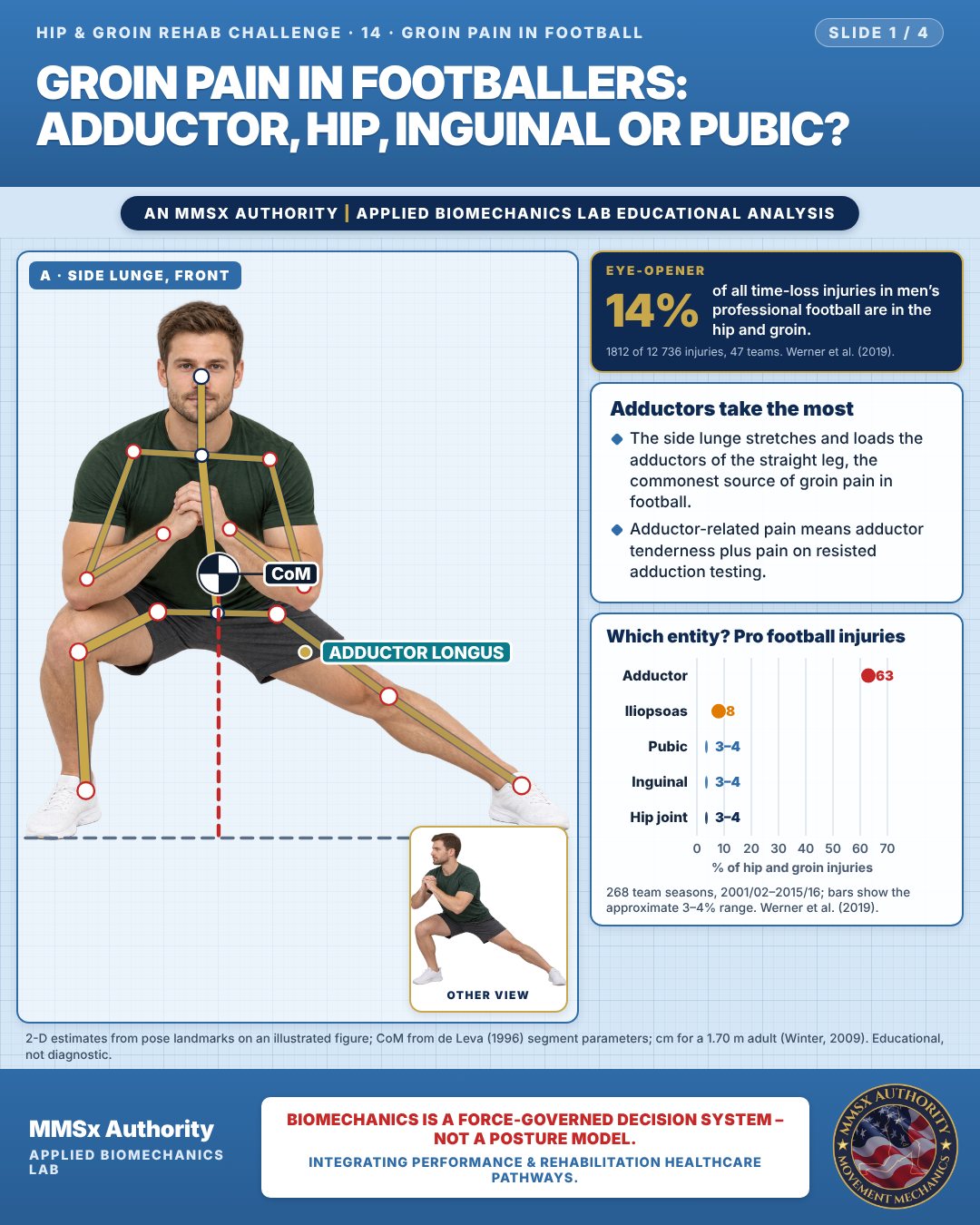
Adductors take the most
The side lunge stretches and loads the adductors of the straight leg, the commonest source of groin pain in football.
Adductor-related pain means adductor tenderness plus pain on resisted adduction testing.
Which entity? Pro football injuries
Movement B: Ball squeeze, lying (front view)
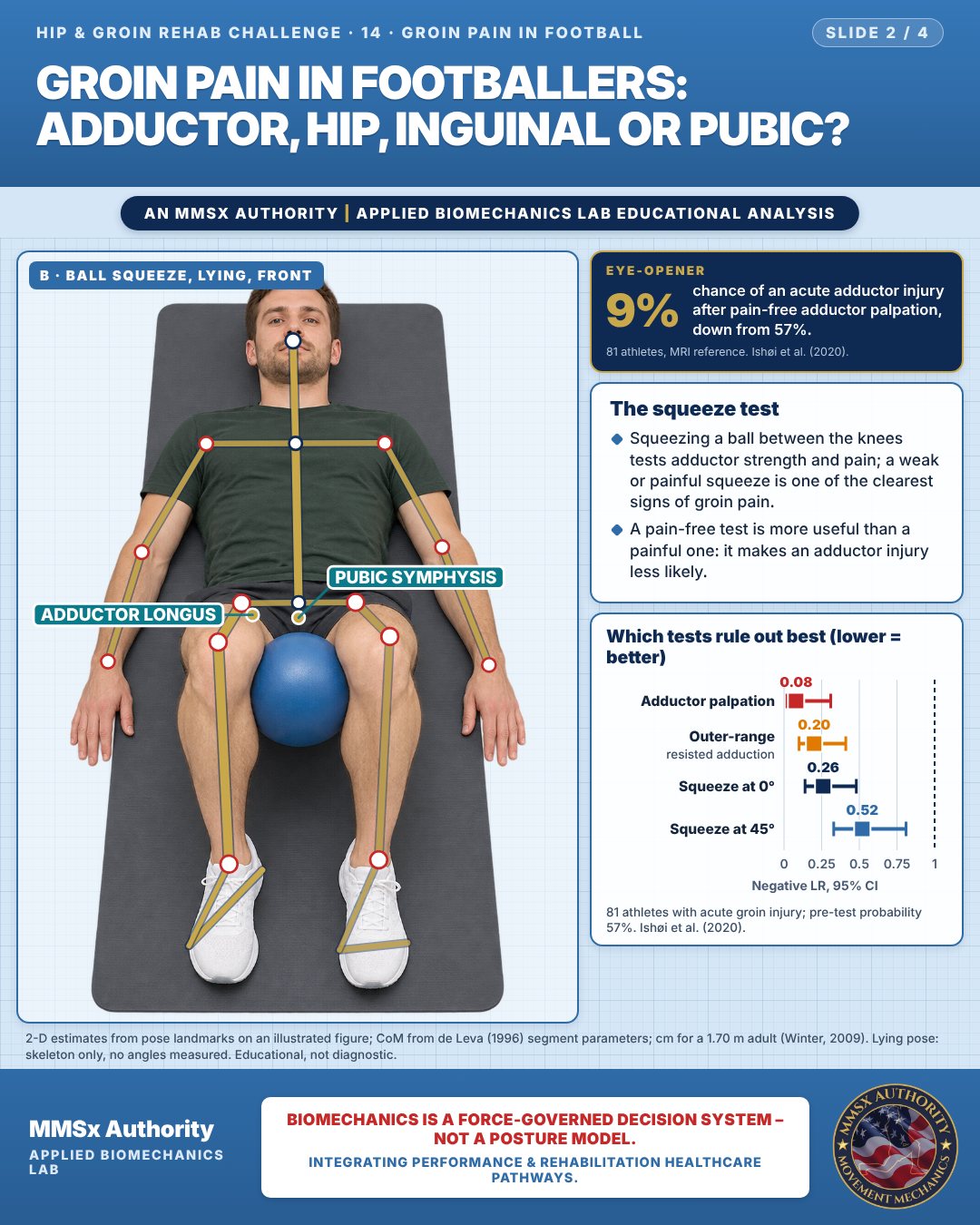
The squeeze test
Squeezing a ball between the knees tests adductor strength and pain; a weak or painful squeeze is one of the clearest signs of groin pain.
A pain-free test is more useful than a painful one: it makes an adductor injury less likely.
Which tests rule out best (lower = better)
Movement C: Sit-up, lying (front view)
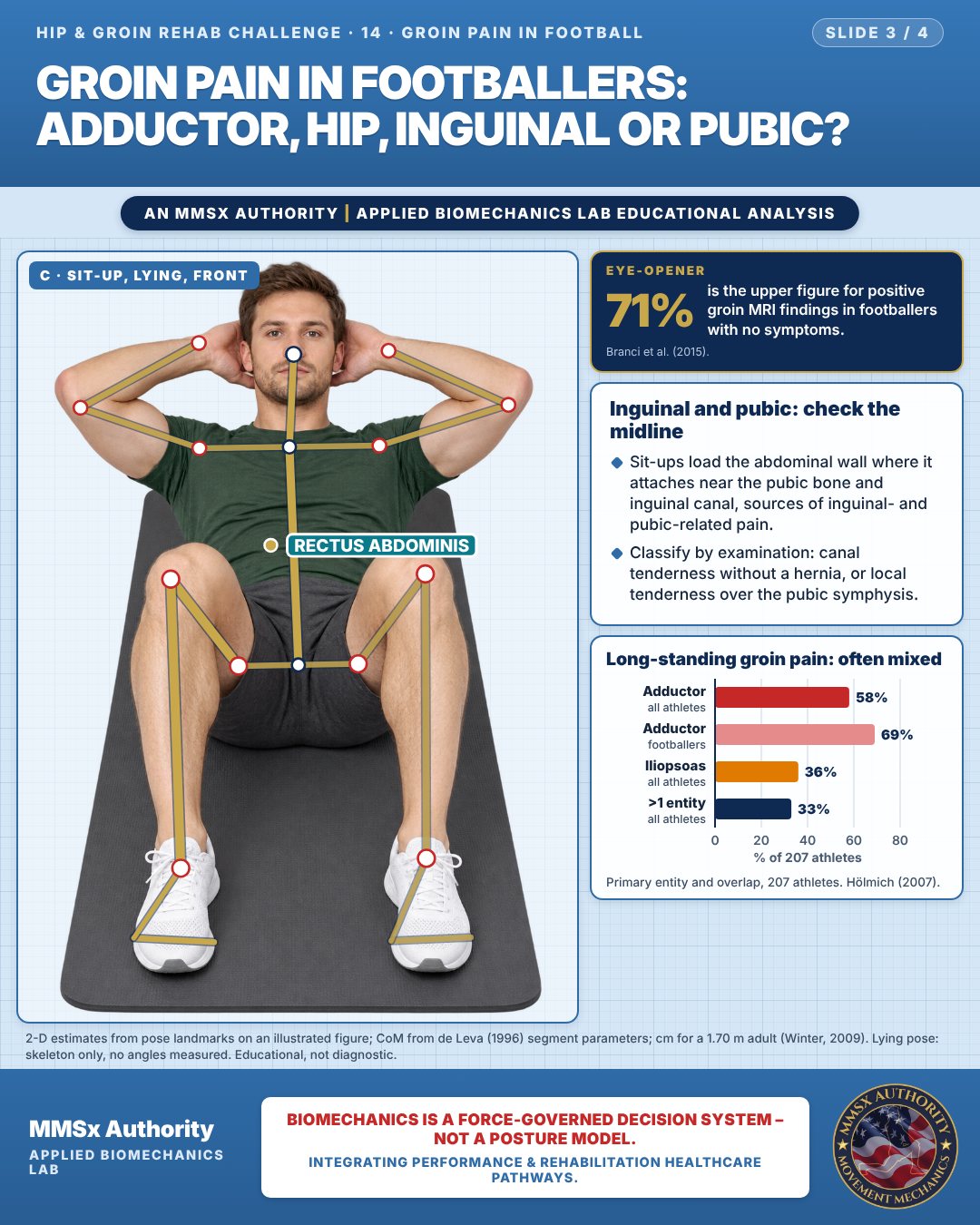
Inguinal and pubic: check the midline
Sit-ups load the abdominal wall where it attaches near the pubic bone and inguinal canal, sources of inguinal- and pubic-related pain.
Classify by examination: canal tenderness without a hernia, or local tenderness over the pubic symphysis.
Long-standing groin pain: often mixed
Decision pathway
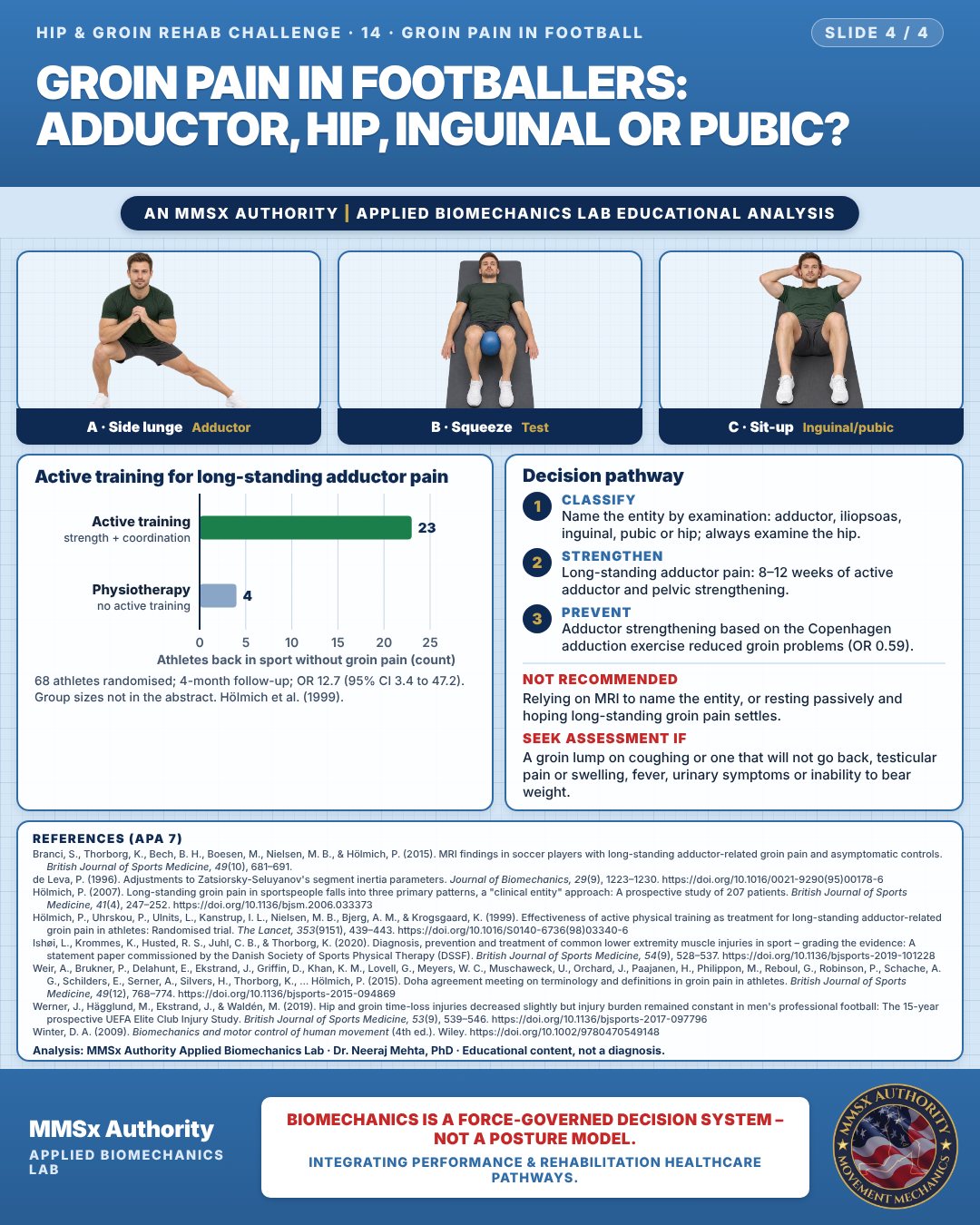
Active training for long-standing adductor pain
Classify
Name the entity by examination: adductor, iliopsoas, inguinal, pubic or hip; always examine the hip.
Strengthen
Long-standing adductor pain: 8–12 weeks of active adductor and pelvic strengthening.
Prevent
Adductor strengthening based on the Copenhagen adduction exercise reduced groin problems (OR 0.59).
What the evidence supports
- Classify with history and examination into the Doha entities, and examine the hip in every case (Weir et al., 2015).
- Long-standing adductor-related groin pain: an active strengthening programme focused on the adductors is recommended (Hölmich et al., 1999; Ishøi et al., 2020).
- Not recommended: relying on MRI to name the entity; up to 71% of asymptomatic footballers had positive MRI findings (Branci et al., 2015).
Myth and evidence
Myth“Rest will fix long-standing groin pain.”
EvidenceIn a randomised trial, 23 athletes in an active training group returned to sport without groin pain compared with 4 in a passive physiotherapy group (OR 12.7) (Hölmich et al., 1999).
Cautions
Not recommended
Relying on MRI to name the entity, or resting passively and hoping long-standing groin pain settles.
Seek assessment if
A groin lump on coughing or one that will not go back, testicular pain or swelling, fever, urinary symptoms or inability to bear weight.
Methods note
2-D estimates from pose landmarks on an illustrated figure; CoM from de Leva (1996) segment parameters; cm for a 1.70 m adult (Winter, 2009). Lying pose: skeleton only, no angles measured. These are educational estimates, not a diagnosis.
References
- Branci, S., Thorborg, K., Bech, B. H., Boesen, M., Nielsen, M. B., & Hölmich, P. (2015). MRI findings in soccer players with long-standing adductor-related groin pain and asymptomatic controls. British Journal of Sports Medicine, 49(10), 681–691.
- de Leva, P. (1996). Adjustments to Zatsiorsky-Seluyanov's segment inertia parameters. Journal of Biomechanics, 29(9), 1223–1230. https://doi.org/10.1016/0021-9290(95)00178-6
- Hölmich, P. (2007). Long-standing groin pain in sportspeople falls into three primary patterns, a "clinical entity" approach: A prospective study of 207 patients. British Journal of Sports Medicine, 41(4), 247–252. https://doi.org/10.1136/bjsm.2006.033373
- Hölmich, P., Uhrskou, P., Ulnits, L., Kanstrup, I. L., Nielsen, M. B., Bjerg, A. M., & Krogsgaard, K. (1999). Effectiveness of active physical training as treatment for long-standing adductor-related groin pain in athletes: Randomised trial. The Lancet, 353(9151), 439–443. https://doi.org/10.1016/S0140-6736(98)03340-6
- Ishøi, L., Krommes, K., Husted, R. S., Juhl, C. B., & Thorborg, K. (2020). Diagnosis, prevention and treatment of common lower extremity muscle injuries in sport – grading the evidence: A statement paper commissioned by the Danish Society of Sports Physical Therapy (DSSF). British Journal of Sports Medicine, 54(9), 528–537. https://doi.org/10.1136/bjsports-2019-101228
- Weir, A., Brukner, P., Delahunt, E., Ekstrand, J., Griffin, D., Khan, K. M., Lovell, G., Meyers, W. C., Muschaweck, U., Orchard, J., Paajanen, H., Philippon, M., Reboul, G., Robinson, P., Schache, A. G., Schilders, E., Serner, A., Silvers, H., Thorborg, K., … Hölmich, P. (2015). Doha agreement meeting on terminology and definitions in groin pain in athletes. British Journal of Sports Medicine, 49(12), 768–774. https://doi.org/10.1136/bjsports-2015-094869
- Werner, J., Hägglund, M., Ekstrand, J., & Waldén, M. (2019). Hip and groin time-loss injuries decreased slightly but injury burden remained constant in men's professional football: The 15-year prospective UEFA Elite Club Injury Study. British Journal of Sports Medicine, 53(9), 539–546. https://doi.org/10.1136/bjsports-2017-097796
- Winter, D. A. (2009). Biomechanics and motor control of human movement (4th ed.). Wiley. https://doi.org/10.1002/9780470549148
Cite this article
Mehta, N. (2026, October 28). Groin pain in footballers: adductor, hip, inguinal or pubic? MMSx Authority Applied Biomechanics Lab. https://mmsxauthority.org/edu/analysis/hip-groin/14-groin-pain-in-footballers-adductor-hip-inguinal-or-pubic/
Part of the collection
Mehta, N. (2026). Hip and Groin Rehabilitation: 30 Evidence-Based Biomechanics Analyses [Collection]. MMSx Authority Applied Biomechanics Lab. Zenodo. https://doi.org/10.5281/zenodo.23735806
All Hip & Groin Rehab Challenge articles · Rehabilitation Library