Hip & Groin Rehab Challenge · 26
Hip replacement: recovery milestones and safe movement
Total hip arthroplasty (THA, total hip replacement) replaces the femoral head and acetabular surface with prosthetic components, most often for…
Key points
- Plan. Agree a rehabilitation plan before discharge (NICE); add supervised help if daily activities stay difficult.
- Move. Walk early with an aid, rise from a high chair using the armrests, and follow your surgical team.
- Progress. Add strength work: seated machines loaded the implant less than walking.
What it is
Total hip arthroplasty (THA, total hip replacement) replaces the femoral head and acetabular surface with prosthetic components, most often for end-stage osteoarthritis. Recovery involves early walking with an aid, a return to independent daily activities, and progressive strengthening, with movement advice tailored to the surgical approach and the surgeon's protocol (National Institute for Health and Care Excellence [NICE], n.d.; Korfitsen et al., 2023).
How we analysed the movement
Three movements relevant to this topic were analysed from illustrated reference figures. Joint centres were located with two-dimensional pose estimation; hip and knee angles, pelvis level, the whole-body centre of mass and, where relevant, the hip lever (the horizontal distance from the hip joint to the upper-body centre of mass) and the resulting static hip moment were then calculated from standard segment parameters. The figures are educational estimates that show how position changes mechanical demand; they are not measurements of a patient. Every research value quoted below comes from the published source cited beside it.
Movement A: Walking frame (side view)
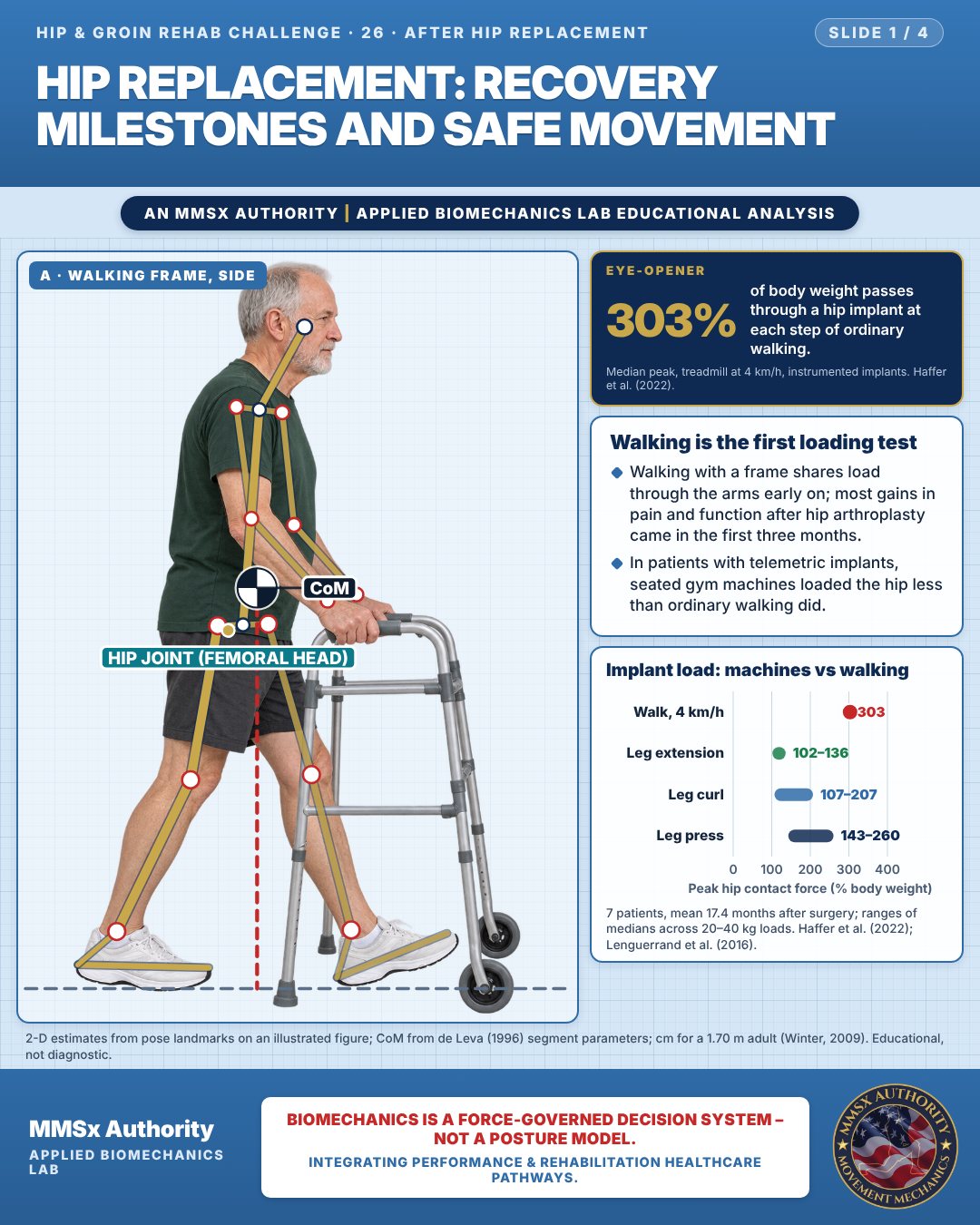
Walking is the first loading test
Walking with a frame shares load through the arms early on; most gains in pain and function after hip arthroplasty came in the first three months.
In patients with telemetric implants, seated gym machines loaded the hip less than ordinary walking did.
Implant load: machines vs walking
Movement B: Rising, high chair (side view)
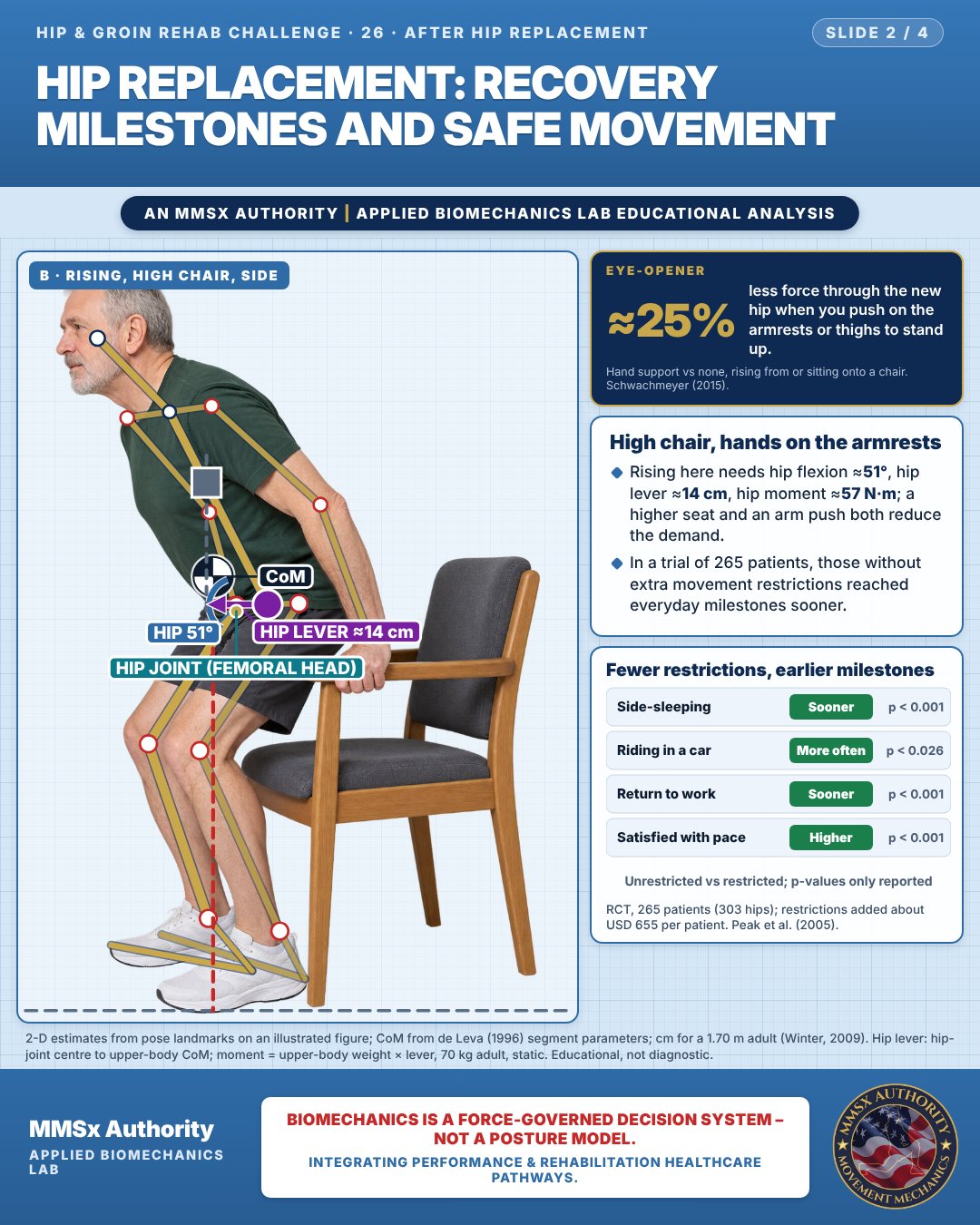
High chair, hands on the armrests
Rising here needs hip flexion ≈51°, hip lever ≈14 cm, hip moment ≈57 N·m; a higher seat and an arm push both reduce the demand.
In a trial of 265 patients, those without extra movement restrictions reached everyday milestones sooner.
Fewer restrictions, earlier milestones
Movement C: Leg out to side (front view)
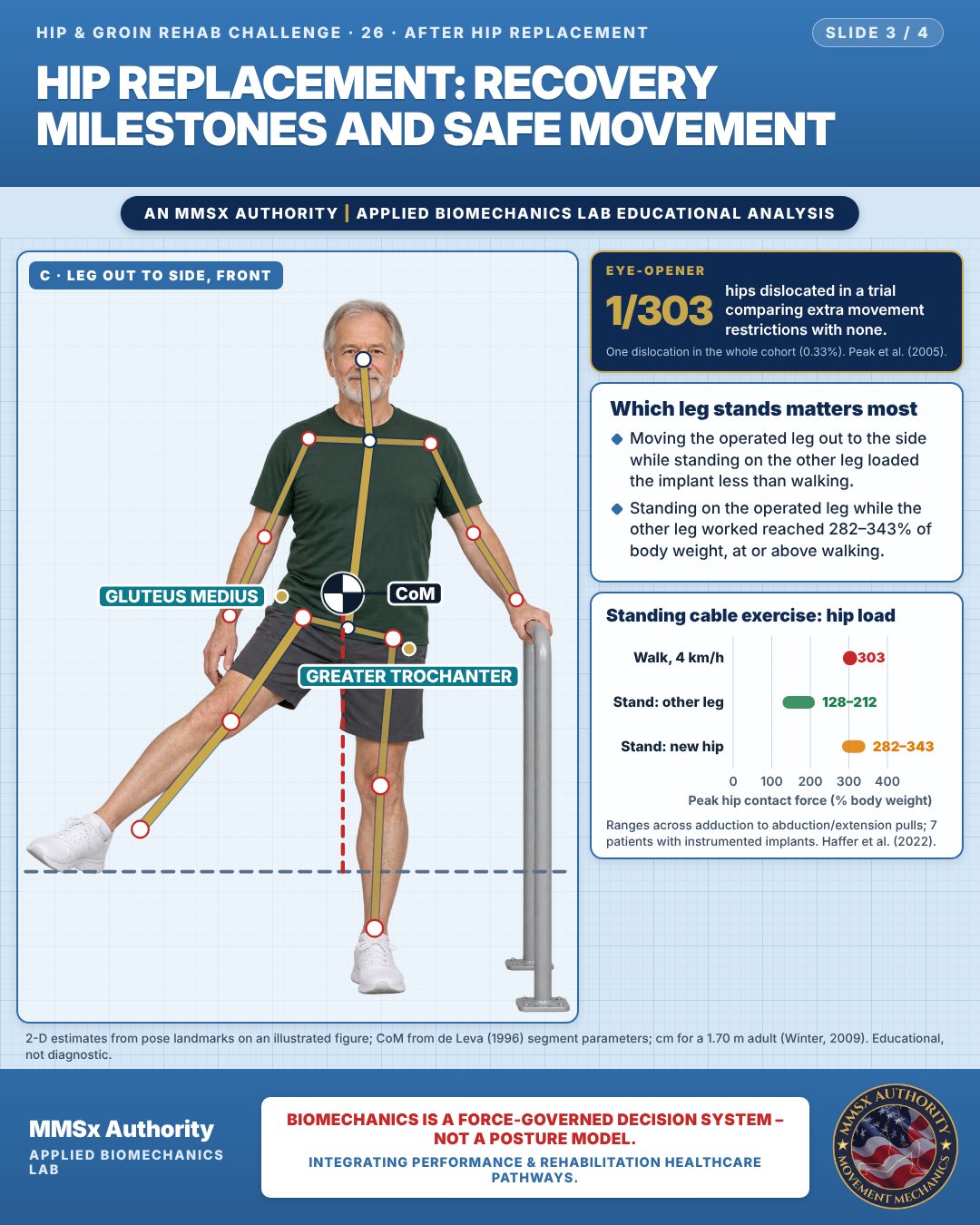
Which leg stands matters most
Moving the operated leg out to the side while standing on the other leg loaded the implant less than walking.
Standing on the operated leg while the other leg worked reached 282–343% of body weight, at or above walking.
Standing cable exercise: hip load
Decision pathway
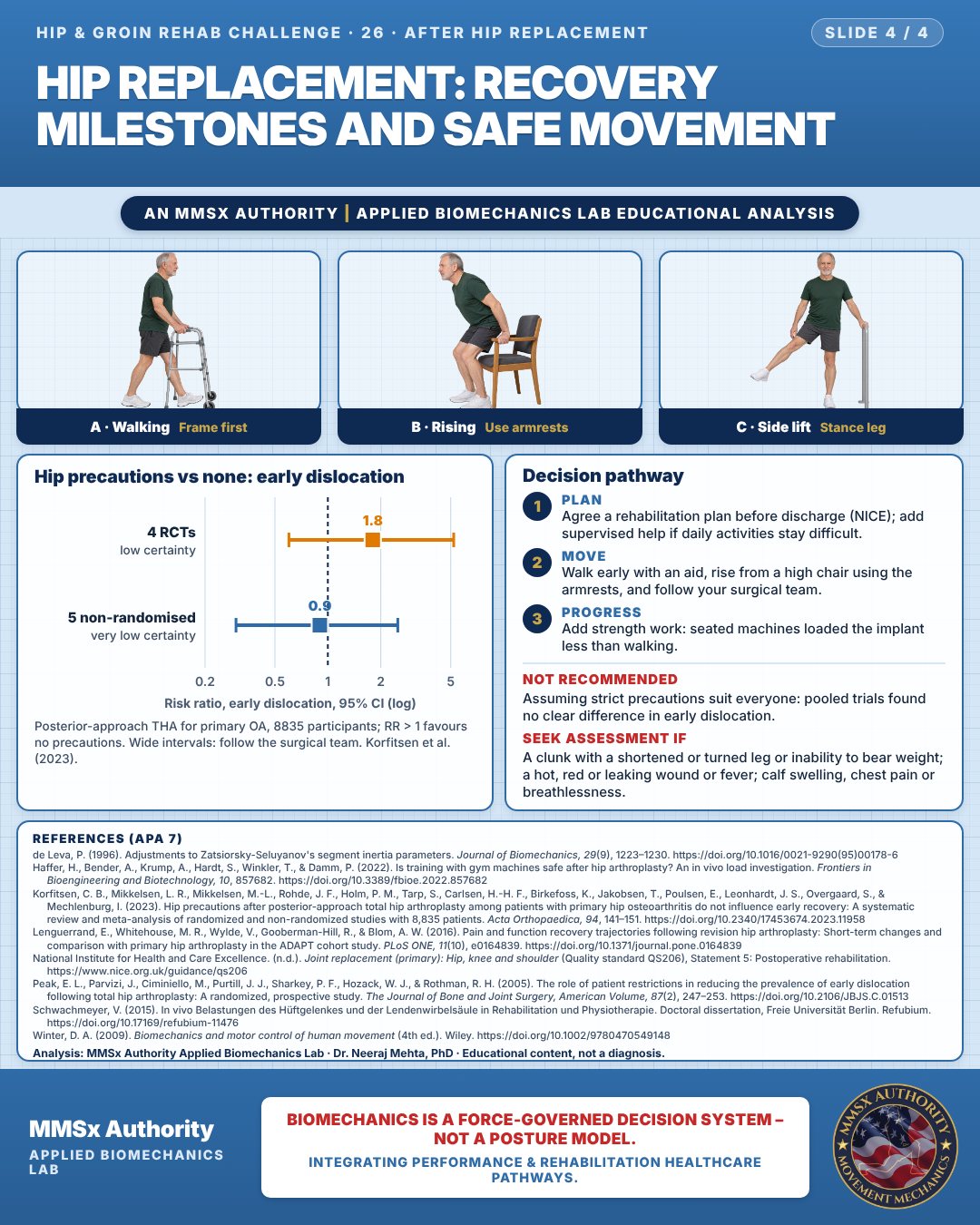
Hip precautions vs none: early dislocation
Plan
Agree a rehabilitation plan before discharge (NICE); add supervised help if daily activities stay difficult.
Move
Walk early with an aid, rise from a high chair using the armrests, and follow your surgical team.
Progress
Add strength work: seated machines loaded the implant less than walking.
What the evidence supports
- Progress strengthening using in vivo load data: many seated machine exercises load the implant less than walking (Haffer et al., 2022).
Cautions
Not recommended
Assuming strict precautions suit everyone: pooled trials found no clear difference in early dislocation.
Seek assessment if
A clunk with a shortened or turned leg or inability to bear weight; a hot, red or leaking wound or fever; calf swelling, chest pain or breathlessness.
Methods note
2-D estimates from pose landmarks on an illustrated figure; CoM from de Leva (1996) segment parameters; cm for a 1.70 m adult (Winter, 2009). Hip lever: hip-joint centre to upper-body CoM; moment = upper-body weight × lever, 70 kg adult, static. These are educational estimates, not a diagnosis.
References
- de Leva, P. (1996). Adjustments to Zatsiorsky-Seluyanov's segment inertia parameters. Journal of Biomechanics, 29(9), 1223–1230. https://doi.org/10.1016/0021-9290(95)00178-6
- Haffer, H., Bender, A., Krump, A., Hardt, S., Winkler, T., & Damm, P. (2022). Is training with gym machines safe after hip arthroplasty? An in vivo load investigation. Frontiers in Bioengineering and Biotechnology, 10, 857682. https://doi.org/10.3389/fbioe.2022.857682
- Korfitsen, C. B., Mikkelsen, L. R., Mikkelsen, M.-L., Rohde, J. F., Holm, P. M., Tarp, S., Carlsen, H.-H. F., Birkefoss, K., Jakobsen, T., Poulsen, E., Leonhardt, J. S., Overgaard, S., & Mechlenburg, I. (2023). Hip precautions after posterior-approach total hip arthroplasty among patients with primary hip osteoarthritis do not influence early recovery: A systematic review and meta-analysis of randomized and non-randomized studies with 8,835 patients. Acta Orthopaedica, 94, 141–151. https://doi.org/10.2340/17453674.2023.11958
- Lenguerrand, E., Whitehouse, M. R., Wylde, V., Gooberman-Hill, R., & Blom, A. W. (2016). Pain and function recovery trajectories following revision hip arthroplasty: Short-term changes and comparison with primary hip arthroplasty in the ADAPT cohort study. PLoS ONE, 11(10), e0164839. https://doi.org/10.1371/journal.pone.0164839
- National Institute for Health and Care Excellence. (n.d.). Joint replacement (primary): Hip, knee and shoulder (Quality standard QS206), Statement 5: Postoperative rehabilitation. https://www.nice.org.uk/guidance/qs206
- Peak, E. L., Parvizi, J., Ciminiello, M., Purtill, J. J., Sharkey, P. F., Hozack, W. J., & Rothman, R. H. (2005). The role of patient restrictions in reducing the prevalence of early dislocation following total hip arthroplasty: A randomized, prospective study. The Journal of Bone and Joint Surgery, American Volume, 87(2), 247–253. https://doi.org/10.2106/JBJS.C.01513
- Schwachmeyer, V. (2015). In vivo Belastungen des Hüftgelenkes und der Lendenwirbelsäule in Rehabilitation und Physiotherapie. Doctoral dissertation, Freie Universität Berlin. Refubium. https://doi.org/10.17169/refubium-11476
- Winter, D. A. (2009). Biomechanics and motor control of human movement (4th ed.). Wiley. https://doi.org/10.1002/9780470549148
Cite this article
Mehta, N. (2026, October 28). Hip replacement: recovery milestones and safe movement. MMSx Authority Applied Biomechanics Lab. https://mmsxauthority.org/edu/analysis/hip-groin/26-hip-replacement-recovery-milestones-and-safe-movement/
Part of the collection
Mehta, N. (2026). Hip and Groin Rehabilitation: 30 Evidence-Based Biomechanics Analyses [Collection]. MMSx Authority Applied Biomechanics Lab. Zenodo. https://doi.org/10.5281/zenodo.23735806
All Hip & Groin Rehab Challenge articles · Rehabilitation Library