Hip & Groin Rehab Challenge · 23
Stairs and hip pain: why going up and down feel different
Leading foot on the step above: hip ≈ 67° and knee ≈ 80° flexion as the extensors lift the body concentrically. Average twisting torque on the hip…
Key points
- Scale. Use the rail and, when painful, a step-to pattern: stronger leg first going up, painful leg first going down.
- Strengthen. Train hip abductors and extensors, including slow, controlled lowering for the descent.
- Progress. Return to step-over-step stairs as strength and pain allow; exercise benefit persisted for months.
What it is
Stair negotiation loads the hip more than level walking. Going up is a concentric task, with the hip and knee extensors lifting the body; going down is an eccentric (lengthening) task, with the extensors controlling the descent. People with hip pain often report stairs as one of the first activities to become difficult, and many adopt a step-to pattern (both feet on each step) to reduce demand (Bergmann et al., 2001; Hall et al., 2017).
How we analysed the movement
Three movements relevant to this topic were analysed from illustrated reference figures. Joint centres were located with two-dimensional pose estimation; hip and knee angles, pelvis level, the whole-body centre of mass and, where relevant, the hip lever (the horizontal distance from the hip joint to the upper-body centre of mass) and the resulting static hip moment were then calculated from standard segment parameters. The figures are educational estimates that show how position changes mechanical demand; they are not measurements of a patient. Every research value quoted below comes from the published source cited beside it.
Movement A: Stairs up (side view)
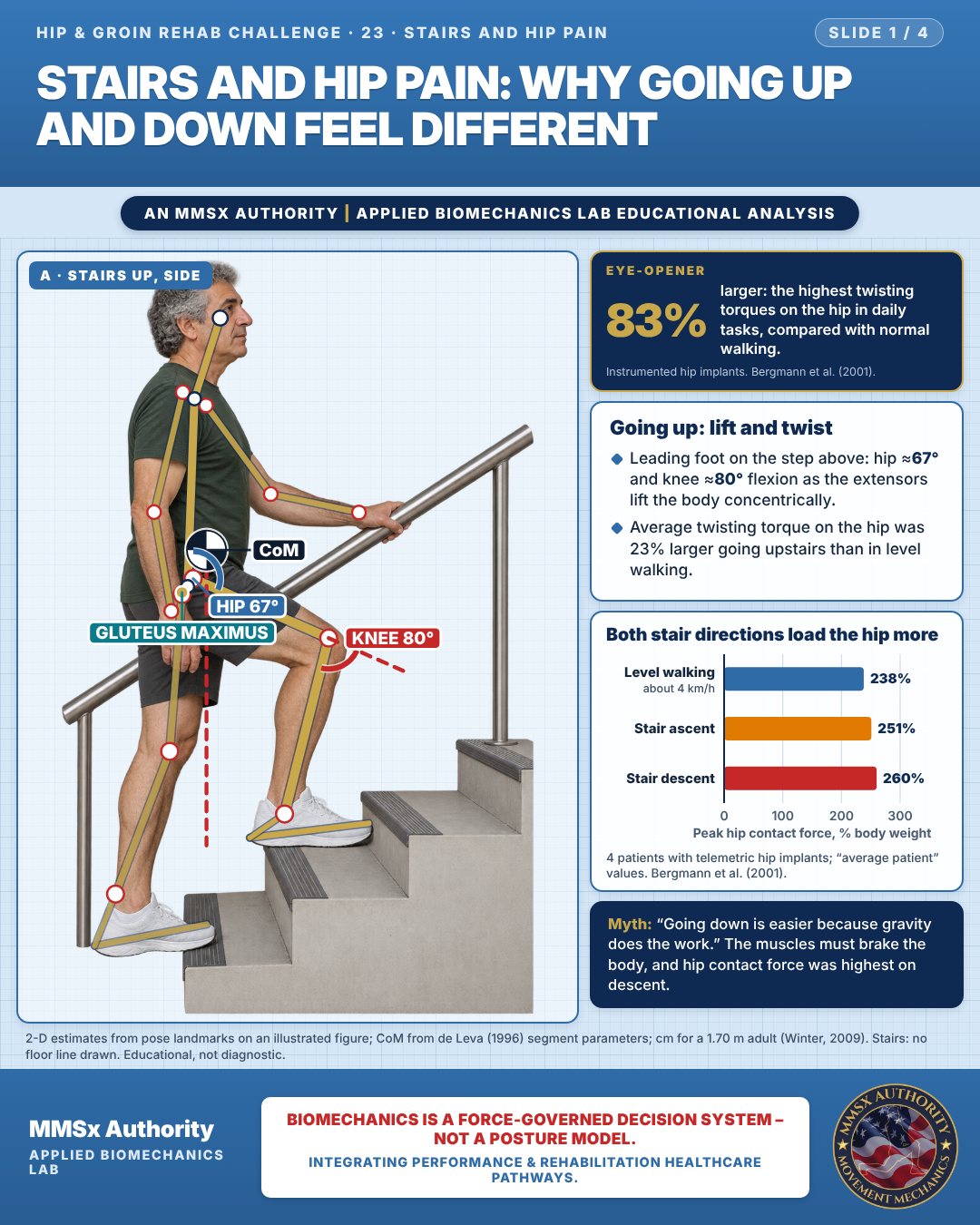
Going up: lift and twist
Leading foot on the step above: hip ≈67° and knee ≈80° flexion as the extensors lift the body concentrically.
Average twisting torque on the hip was 23% larger going upstairs than in level walking.
Both stair directions load the hip more
Movement B: Stairs down (side view)
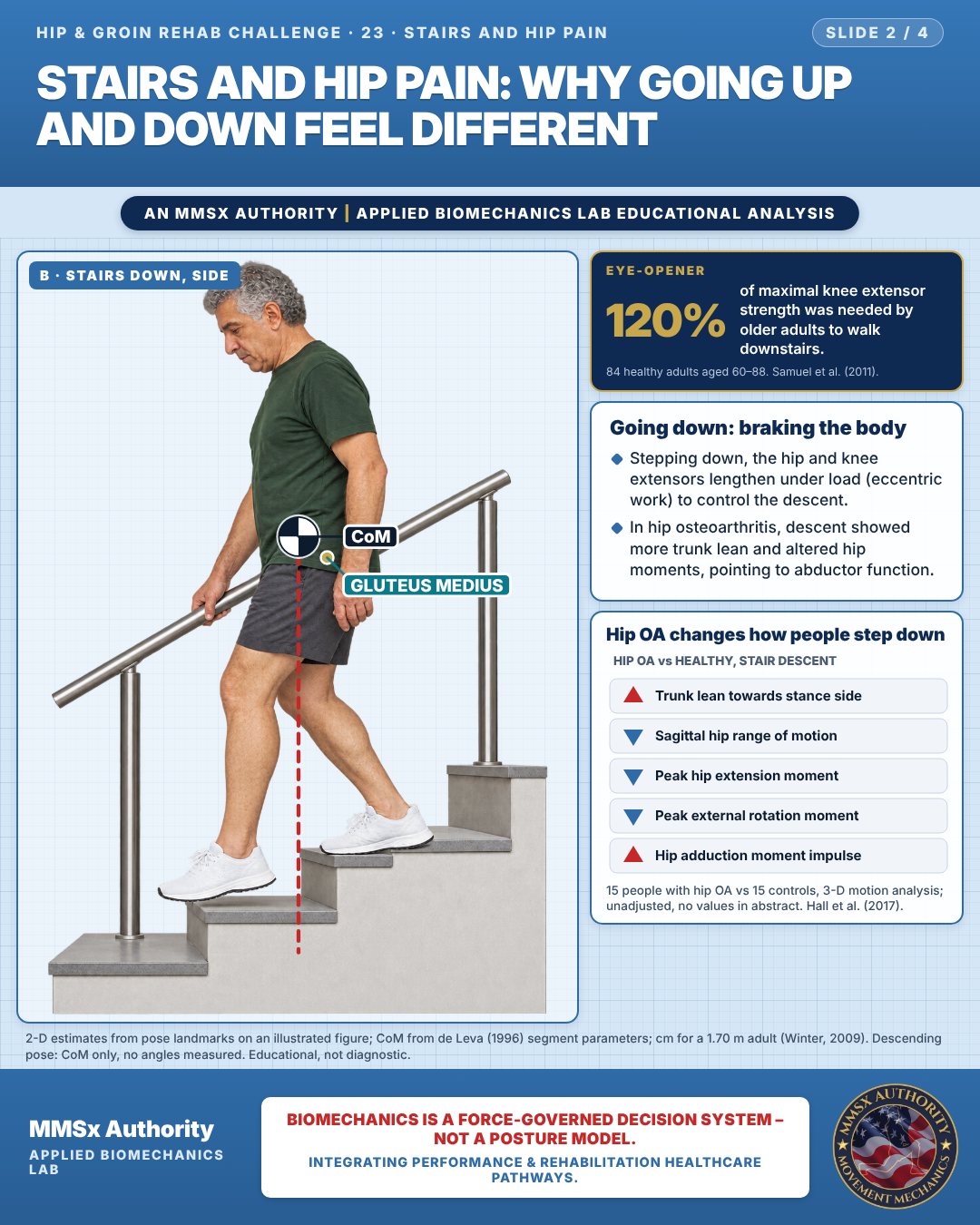
Going down: braking the body
Stepping down, the hip and knee extensors lengthen under load (eccentric work) to control the descent.
In hip osteoarthritis, descent showed more trunk lean and altered hip moments, pointing to abductor function.
Hip OA changes how people step down
Movement C: Step-to pattern (side view)
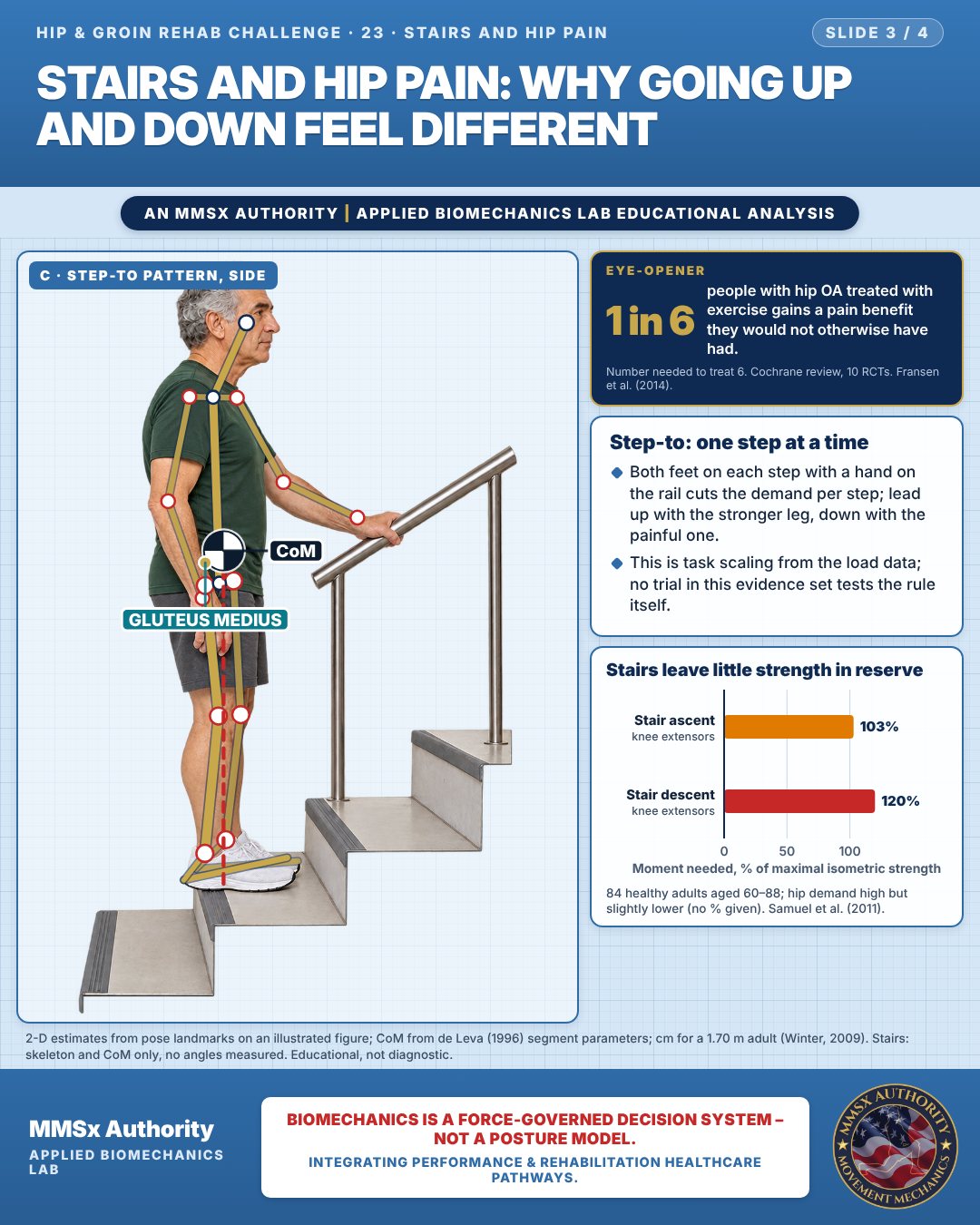
Step-to: one step at a time
Both feet on each step with a hand on the rail cuts the demand per step; lead up with the stronger leg, down with the painful one.
This is task scaling from the load data; no trial in this evidence set tests the rule itself.
Stairs leave little strength in reserve
Decision pathway
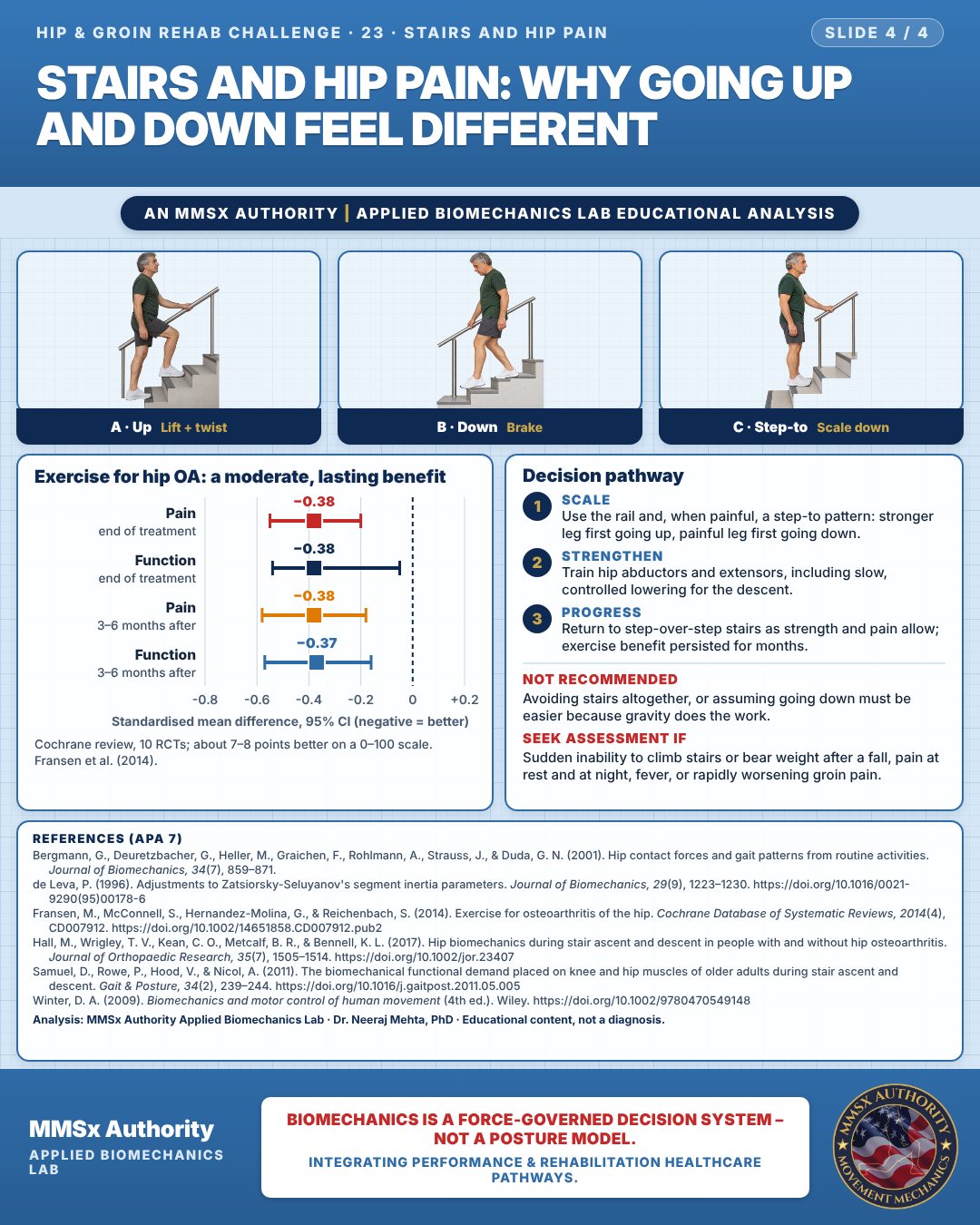
Exercise for hip OA: a moderate, lasting benefit
Scale
Use the rail and, when painful, a step-to pattern: stronger leg first going up, painful leg first going down.
Strengthen
Train hip abductors and extensors, including slow, controlled lowering for the descent.
Progress
Return to step-over-step stairs as strength and pain allow; exercise benefit persisted for months.
What the evidence supports
- Exercise therapy is recommended for hip osteoarthritis; the benefit on pain and function persisted 3–6 months after supervised treatment ended (Fransen et al., 2014).
- Train hip abductors and extensors, given altered abductor moments and trunk lean on stairs in hip OA (Hall et al., 2017).
Cautions
Not recommended
Avoiding stairs altogether, or assuming going down must be easier because gravity does the work.
Seek assessment if
Sudden inability to climb stairs or bear weight after a fall, pain at rest and at night, fever, or rapidly worsening groin pain.
Methods note
2-D estimates from pose landmarks on an illustrated figure; CoM from de Leva (1996) segment parameters; cm for a 1.70 m adult (Winter, 2009). Stairs: no floor line drawn. Descending pose: CoM only, no angles measured. Stairs: skeleton and CoM only, no angles measured. These are educational estimates, not a diagnosis.
References
- Bergmann, G., Deuretzbacher, G., Heller, M., Graichen, F., Rohlmann, A., Strauss, J., & Duda, G. N. (2001). Hip contact forces and gait patterns from routine activities. Journal of Biomechanics, 34(7), 859–871.
- de Leva, P. (1996). Adjustments to Zatsiorsky-Seluyanov's segment inertia parameters. Journal of Biomechanics, 29(9), 1223–1230. https://doi.org/10.1016/0021-9290(95)00178-6
- Fransen, M., McConnell, S., Hernandez-Molina, G., & Reichenbach, S. (2014). Exercise for osteoarthritis of the hip. Cochrane Database of Systematic Reviews, 2014(4), CD007912. https://doi.org/10.1002/14651858.CD007912.pub2
- Hall, M., Wrigley, T. V., Kean, C. O., Metcalf, B. R., & Bennell, K. L. (2017). Hip biomechanics during stair ascent and descent in people with and without hip osteoarthritis. Journal of Orthopaedic Research, 35(7), 1505–1514. https://doi.org/10.1002/jor.23407
- Samuel, D., Rowe, P., Hood, V., & Nicol, A. (2011). The biomechanical functional demand placed on knee and hip muscles of older adults during stair ascent and descent. Gait & Posture, 34(2), 239–244. https://doi.org/10.1016/j.gaitpost.2011.05.005
- Winter, D. A. (2009). Biomechanics and motor control of human movement (4th ed.). Wiley. https://doi.org/10.1002/9780470549148
Cite this article
Mehta, N. (2026, October 28). Stairs and hip pain: why going up and down feel different. MMSx Authority Applied Biomechanics Lab. https://mmsxauthority.org/edu/analysis/hip-groin/23-stairs-and-hip-pain-why-going-up-and-down-feel-different/
Part of the collection
Mehta, N. (2026). Hip and Groin Rehabilitation: 30 Evidence-Based Biomechanics Analyses [Collection]. MMSx Authority Applied Biomechanics Lab. Zenodo. https://doi.org/10.5281/zenodo.23735806
All Hip & Groin Rehab Challenge articles · Rehabilitation Library