Hip & Groin Rehab Challenge · 03
Hip stiffness in the morning: what it tells you about the joint
Morning (or after-rest) stiffness is difficulty moving the hip on rising that eases with activity.
Key points
- Time it. Ask how long morning stiffness lasts: 30 minutes or less fits osteoarthritis (NICE, 2022).
- Test movement. Check passive adduction and rotation: lost movement in several planes points to the joint.
- Move. Start tailored exercise and gentle range-of-motion work, built up gradually.
What it is
Morning (or after-rest) stiffness is difficulty moving the hip on rising that eases with activity. In osteoarthritis it is typically short-lived: NICE uses "no morning joint-related stiffness or morning stiffness that lasts no longer than 30 minutes" as part of a clinical OA diagnosis, and the American College of Rheumatology classification uses morning stiffness of the hip for ≤60 minutes. Prolonged morning stiffness is an atypical feature that suggests another or additional diagnosis such as inflammatory arthritis.
How we analysed the movement
Three movements relevant to this topic were analysed from illustrated reference figures. Joint centres were located with two-dimensional pose estimation; hip and knee angles, pelvis level, the whole-body centre of mass and, where relevant, the hip lever (the horizontal distance from the hip joint to the upper-body centre of mass) and the resulting static hip moment were then calculated from standard segment parameters. The figures are educational estimates that show how position changes mechanical demand; they are not measurements of a patient. Every research value quoted below comes from the published source cited beside it.
Movement A: Rising from bed (side view)
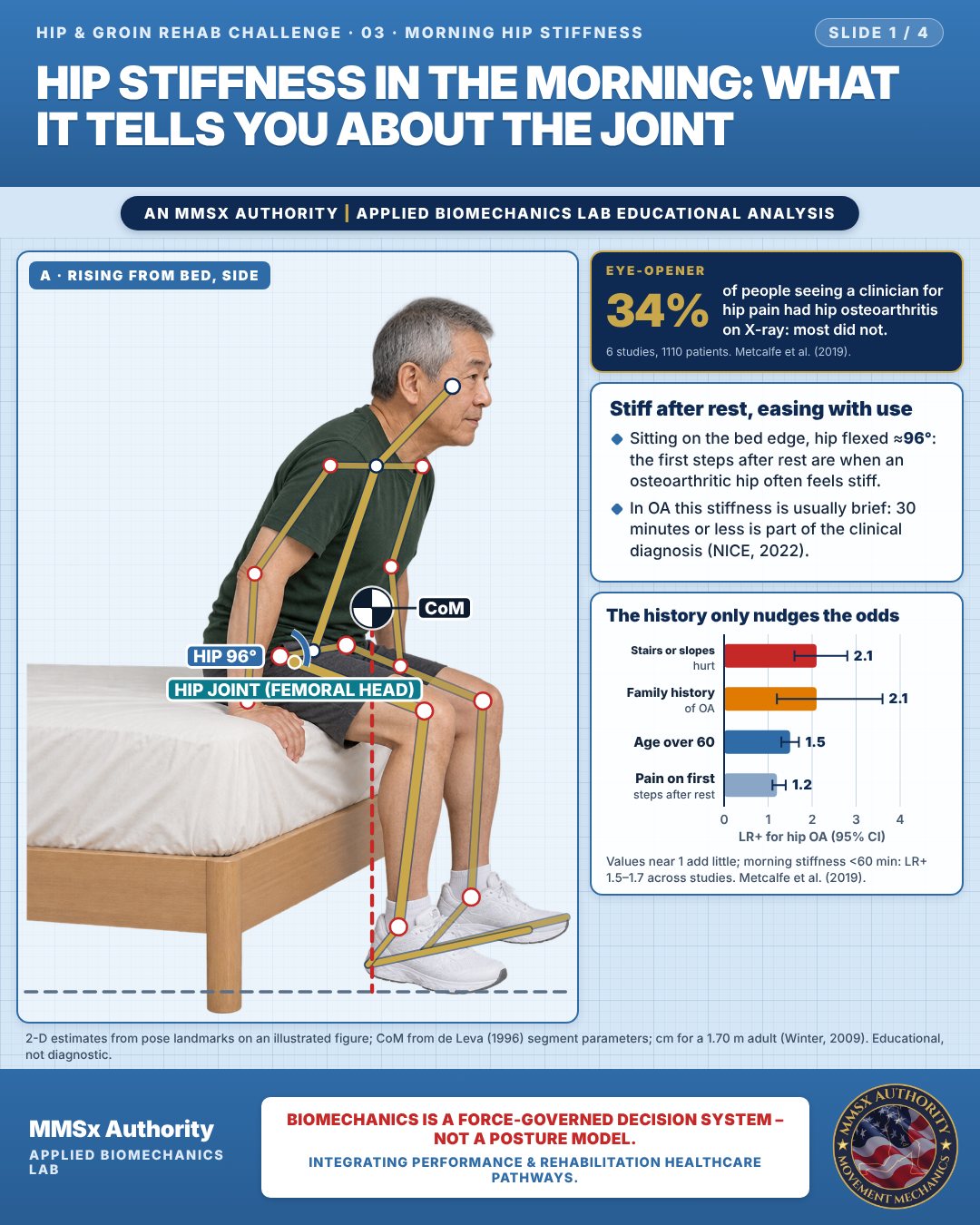
Stiff after rest, easing with use
Sitting on the bed edge, hip flexed ≈96°: the first steps after rest are when an osteoarthritic hip often feels stiff.
In OA this stiffness is usually brief: 30 minutes or less is part of the clinical diagnosis (NICE, 2022).
The history only nudges the odds
Movement B: Putting on a sock (side view)
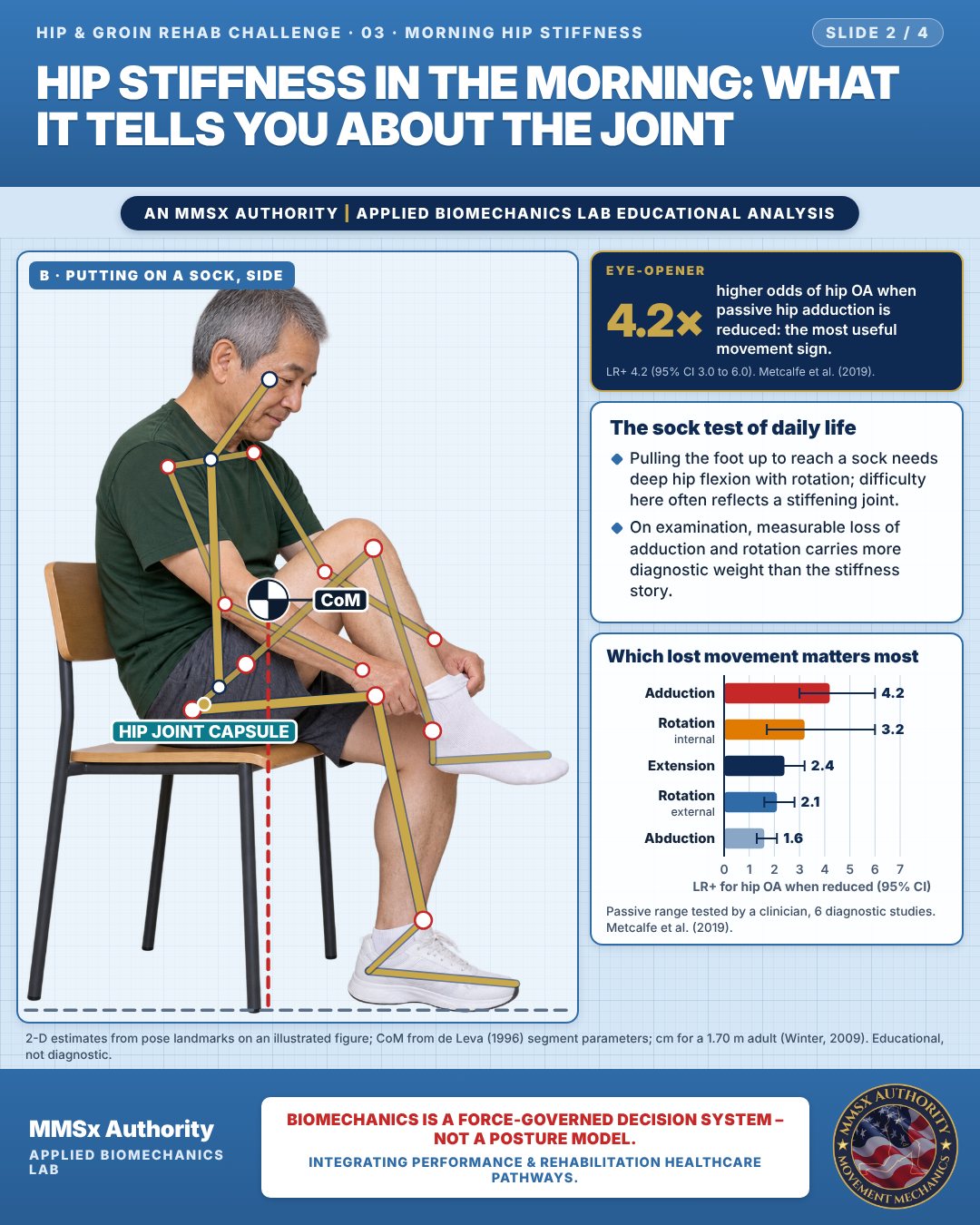
The sock test of daily life
Pulling the foot up to reach a sock needs deep hip flexion with rotation; difficulty here often reflects a stiffening joint.
On examination, measurable loss of adduction and rotation carries more diagnostic weight than the stiffness story.
Which lost movement matters most
Movement C: Standing hip circle (front view)
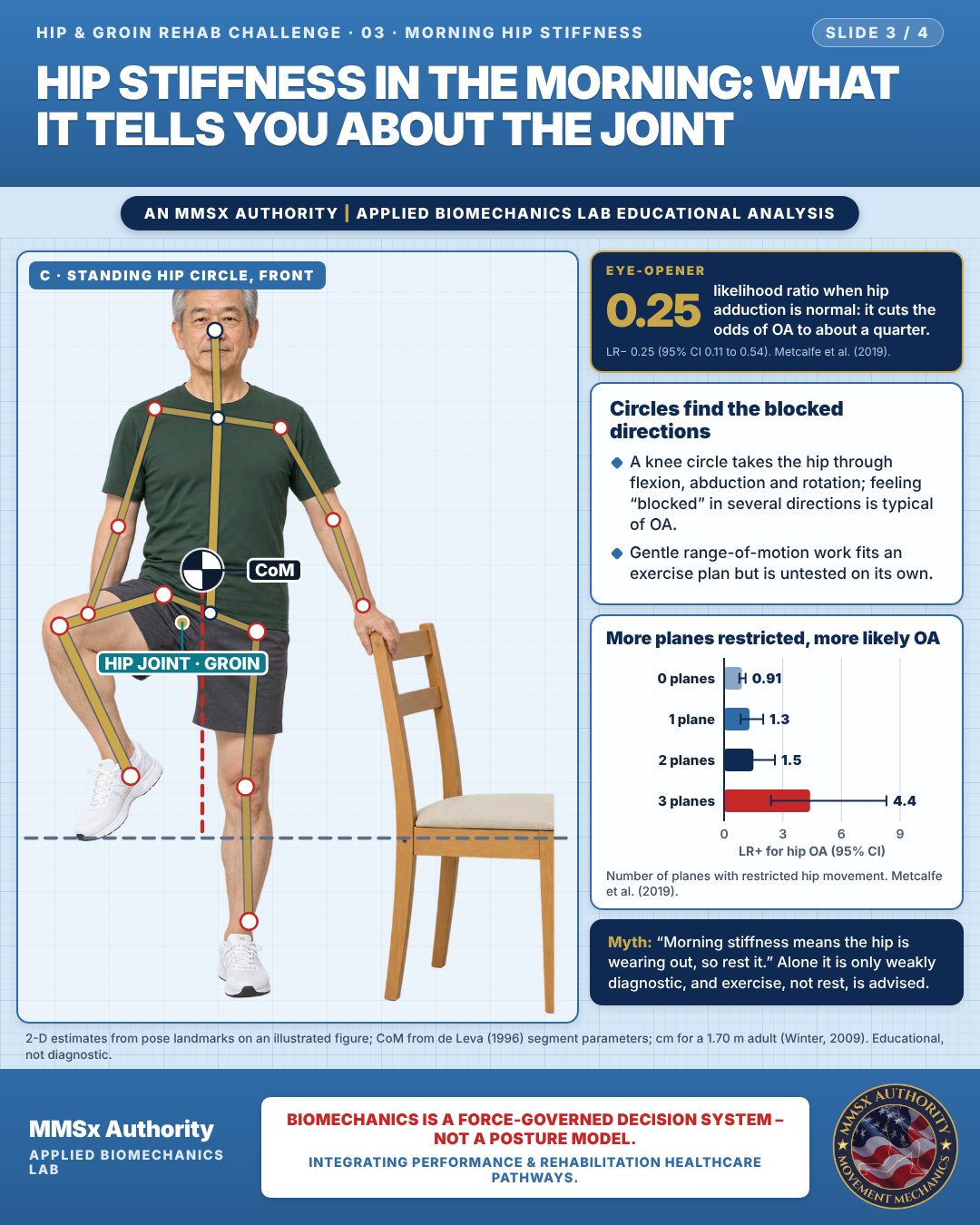
Circles find the blocked directions
A knee circle takes the hip through flexion, abduction and rotation; feeling “blocked” in several directions is typical of OA.
Gentle range-of-motion work fits an exercise plan but is untested on its own.
More planes restricted, more likely OA
Decision pathway
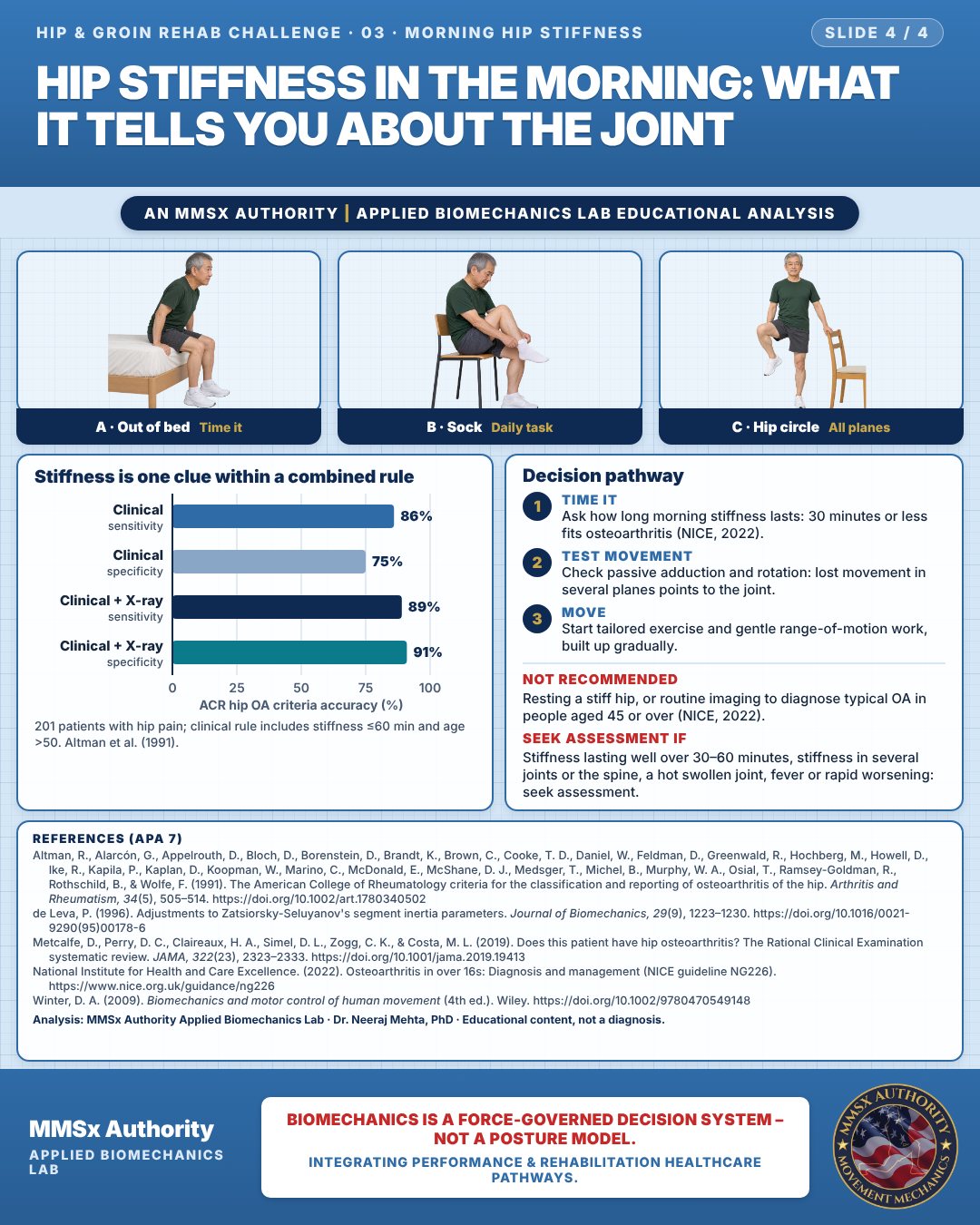
Stiffness is one clue within a combined rule
Time it
Ask how long morning stiffness lasts: 30 minutes or less fits osteoarthritis (NICE, 2022).
Test movement
Check passive adduction and rotation: lost movement in several planes points to the joint.
Move
Start tailored exercise and gentle range-of-motion work, built up gradually.
Cautions
Not recommended
Resting a stiff hip, or routine imaging to diagnose typical OA in people aged 45 or over (NICE, 2022).
Seek assessment if
Stiffness lasting well over 30–60 minutes, stiffness in several joints or the spine, a hot swollen joint, fever or rapid worsening: seek assessment.
Methods note
2-D estimates from pose landmarks on an illustrated figure; CoM from de Leva (1996) segment parameters; cm for a 1.70 m adult (Winter, 2009). These are educational estimates, not a diagnosis.
References
- Altman, R., Alarcón, G., Appelrouth, D., Bloch, D., Borenstein, D., Brandt, K., Brown, C., Cooke, T. D., Daniel, W., Feldman, D., Greenwald, R., Hochberg, M., Howell, D., Ike, R., Kapila, P., Kaplan, D., Koopman, W., Marino, C., McDonald, E., McShane, D. J., Medsger, T., Michel, B., Murphy, W. A., Osial, T., Ramsey-Goldman, R., Rothschild, B., & Wolfe, F. (1991). The American College of Rheumatology criteria for the classification and reporting of osteoarthritis of the hip. Arthritis and Rheumatism, 34(5), 505–514. https://doi.org/10.1002/art.1780340502
- de Leva, P. (1996). Adjustments to Zatsiorsky-Seluyanov's segment inertia parameters. Journal of Biomechanics, 29(9), 1223–1230. https://doi.org/10.1016/0021-9290(95)00178-6
- Metcalfe, D., Perry, D. C., Claireaux, H. A., Simel, D. L., Zogg, C. K., & Costa, M. L. (2019). Does this patient have hip osteoarthritis? The Rational Clinical Examination systematic review. JAMA, 322(23), 2323–2333. https://doi.org/10.1001/jama.2019.19413
- National Institute for Health and Care Excellence. (2022). Osteoarthritis in over 16s: Diagnosis and management (NICE guideline NG226). https://www.nice.org.uk/guidance/ng226
- Winter, D. A. (2009). Biomechanics and motor control of human movement (4th ed.). Wiley. https://doi.org/10.1002/9780470549148
Cite this article
Mehta, N. (2026, October 28). Hip stiffness in the morning: what it tells you about the joint. MMSx Authority Applied Biomechanics Lab. https://mmsxauthority.org/edu/analysis/hip-groin/03-hip-stiffness-in-the-morning-what-it-tells-you-about-the-joint/
Part of the collection
Mehta, N. (2026). Hip and Groin Rehabilitation: 30 Evidence-Based Biomechanics Analyses [Collection]. MMSx Authority Applied Biomechanics Lab. Zenodo. https://doi.org/10.5281/zenodo.23735806
All Hip & Groin Rehab Challenge articles · Rehabilitation Library