Hip & Groin Rehab Challenge · 13
Hip-related groin pain in sport: what makes it different
Hip-related groin pain is groin pain arising from the hip joint itself (for example femoroacetabular impingement syndrome, labral injury or…
Key points
- Examine. Test hip range, FABER and FADIR in every athlete with groin pain; use negative tests to rule out.
- Combine. Diagnose from symptoms, examination and imaging together, never from a cam or labral finding alone.
- Treat. Both hip therapy and arthroscopy improved quality of life; surgery added a modest benefit with more adverse events.
What it is
Hip-related groin pain is groin pain arising from the hip joint itself (for example femoroacetabular impingement syndrome, labral injury or synovitis) rather than from the adductors, iliopsoas, inguinal canal or pubic bone. The Doha agreement states that pain from the hip joint "should always be considered as a possible cause of groin pain" and recommends passive range of motion and the FABER and FADIR tests in all athletes with groin pain (Weir et al., 2015).
How we analysed the movement
Three movements relevant to this topic were analysed from illustrated reference figures. Joint centres were located with two-dimensional pose estimation; hip and knee angles, pelvis level, the whole-body centre of mass and, where relevant, the hip lever (the horizontal distance from the hip joint to the upper-body centre of mass) and the resulting static hip moment were then calculated from standard segment parameters. The figures are educational estimates that show how position changes mechanical demand; they are not measurements of a patient. Every research value quoted below comes from the published source cited beside it.
Movement A: Change of direction (front view)
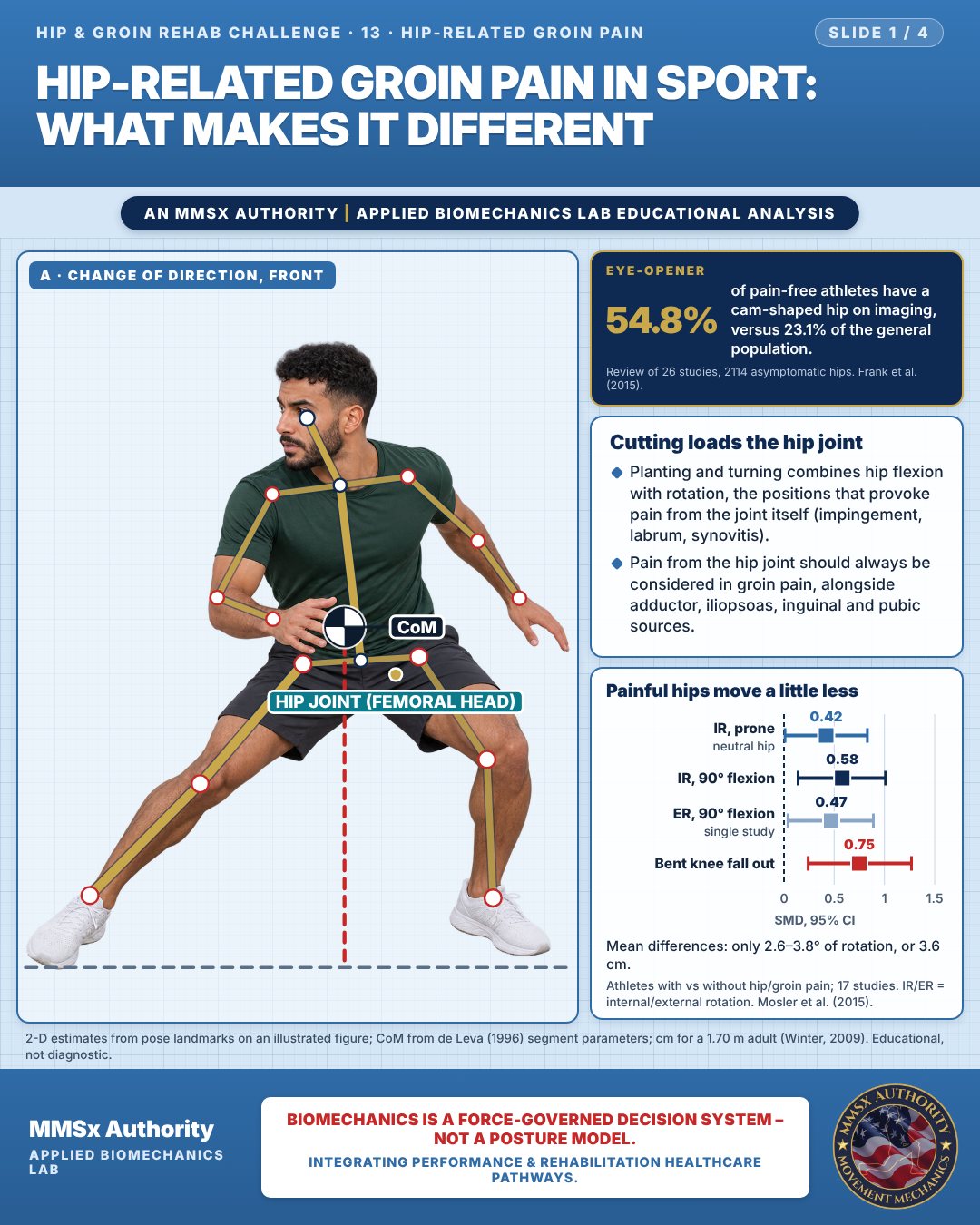
Cutting loads the hip joint
Planting and turning combines hip flexion with rotation, the positions that provoke pain from the joint itself (impingement, labrum, synovitis).
Pain from the hip joint should always be considered in groin pain, alongside adductor, iliopsoas, inguinal and pubic sources.
Painful hips move a little less
Mean differences: only 2.6–3.8° of rotation, or 3.6 cm.
Movement B: Kick follow-through (side view)
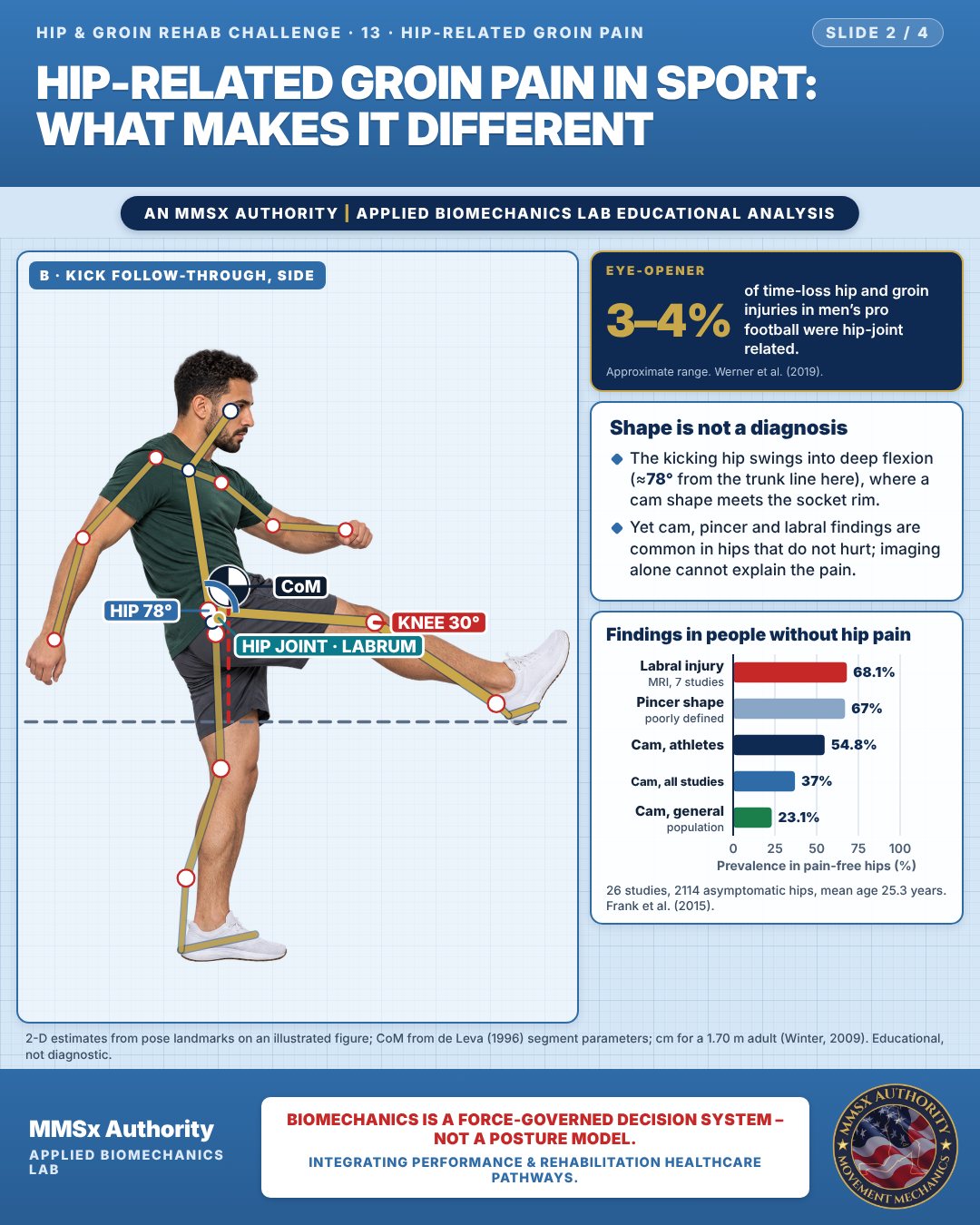
Shape is not a diagnosis
The kicking hip swings into deep flexion (≈78° from the trunk line here), where a cam shape meets the socket rim.
Yet cam, pincer and labral findings are common in hips that do not hurt; imaging alone cannot explain the pain.
Findings in people without hip pain
Movement C: Hand on groin (front view)
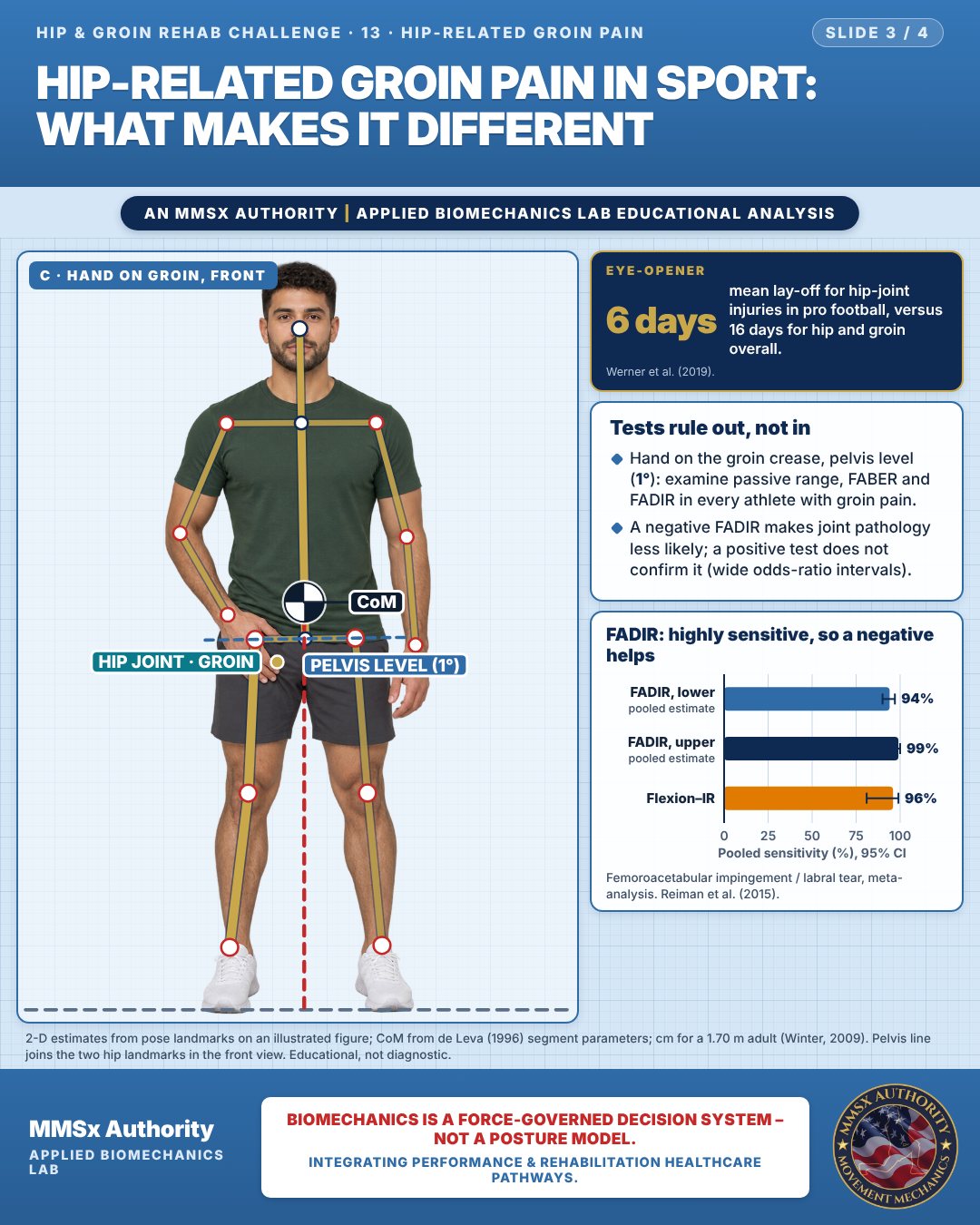
Tests rule out, not in
Hand on the groin crease, pelvis level (1°): examine passive range, FABER and FADIR in every athlete with groin pain.
A negative FADIR makes joint pathology less likely; a positive test does not confirm it (wide odds-ratio intervals).
FADIR: highly sensitive, so a negative helps
Decision pathway
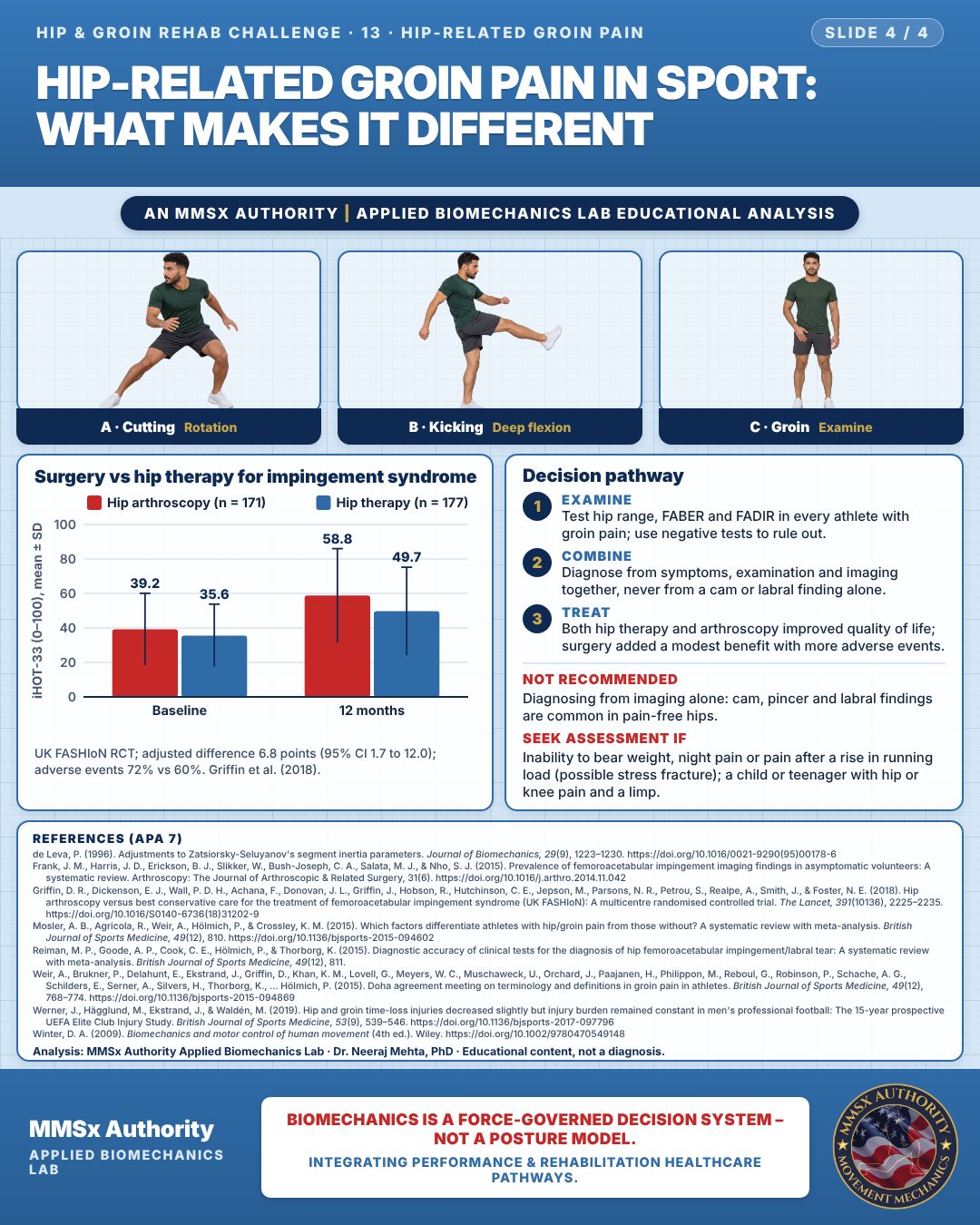
Surgery vs hip therapy for impingement syndrome
Examine
Test hip range, FABER and FADIR in every athlete with groin pain; use negative tests to rule out.
Combine
Diagnose from symptoms, examination and imaging together, never from a cam or labral finding alone.
Treat
Both hip therapy and arthroscopy improved quality of life; surgery added a modest benefit with more adverse events.
What the evidence supports
- Examine the hip in every athlete with groin pain (range of motion, FABER, FADIR) (Weir et al., 2015), and use provocation tests to rule out rather than rule in intra-articular pathology (Reiman et al., 2015).
- For femoroacetabular impingement syndrome, both hip arthroscopy and personalised physiotherapist-led hip therapy improved hip-related quality of life; arthroscopy was better by 6.8 iHOT-33 points at 12 months (Griffin et al., 2018).
- Not recommended: diagnosing from imaging alone; cam, pincer and labral findings are common in pain-free hips (Frank et al., 2015).
Myth and evidence
Myth“My scan shows a cam, so that explains my groin pain.”
EvidenceA cam deformity is present in 54.8% of pain-free athletes and labral changes in 68.1% of pain-free hips on MRI (Frank et al., 2015). The diagnosis rests on symptoms, examination and imaging together.
Cautions
Not recommended
Diagnosing from imaging alone: cam, pincer and labral findings are common in pain-free hips.
Seek assessment if
Inability to bear weight, night pain or pain after a rise in running load (possible stress fracture); a child or teenager with hip or knee pain and a limp.
Methods note
2-D estimates from pose landmarks on an illustrated figure; CoM from de Leva (1996) segment parameters; cm for a 1.70 m adult (Winter, 2009). Pelvis line joins the two hip landmarks in the front view. These are educational estimates, not a diagnosis.
References
- de Leva, P. (1996). Adjustments to Zatsiorsky-Seluyanov's segment inertia parameters. Journal of Biomechanics, 29(9), 1223–1230. https://doi.org/10.1016/0021-9290(95)00178-6
- Frank, J. M., Harris, J. D., Erickson, B. J., Slikker, W., Bush-Joseph, C. A., Salata, M. J., & Nho, S. J. (2015). Prevalence of femoroacetabular impingement imaging findings in asymptomatic volunteers: A systematic review. Arthroscopy: The Journal of Arthroscopic & Related Surgery, 31(6). https://doi.org/10.1016/j.arthro.2014.11.042
- Griffin, D. R., Dickenson, E. J., Wall, P. D. H., Achana, F., Donovan, J. L., Griffin, J., Hobson, R., Hutchinson, C. E., Jepson, M., Parsons, N. R., Petrou, S., Realpe, A., Smith, J., & Foster, N. E. (2018). Hip arthroscopy versus best conservative care for the treatment of femoroacetabular impingement syndrome (UK FASHIoN): A multicentre randomised controlled trial. The Lancet, 391(10136), 2225–2235. https://doi.org/10.1016/S0140-6736(18)31202-9
- Mosler, A. B., Agricola, R., Weir, A., Hölmich, P., & Crossley, K. M. (2015). Which factors differentiate athletes with hip/groin pain from those without? A systematic review with meta-analysis. British Journal of Sports Medicine, 49(12), 810. https://doi.org/10.1136/bjsports-2015-094602
- Reiman, M. P., Goode, A. P., Cook, C. E., Hölmich, P., & Thorborg, K. (2015). Diagnostic accuracy of clinical tests for the diagnosis of hip femoroacetabular impingement/labral tear: A systematic review with meta-analysis. British Journal of Sports Medicine, 49(12), 811.
- Weir, A., Brukner, P., Delahunt, E., Ekstrand, J., Griffin, D., Khan, K. M., Lovell, G., Meyers, W. C., Muschaweck, U., Orchard, J., Paajanen, H., Philippon, M., Reboul, G., Robinson, P., Schache, A. G., Schilders, E., Serner, A., Silvers, H., Thorborg, K., … Hölmich, P. (2015). Doha agreement meeting on terminology and definitions in groin pain in athletes. British Journal of Sports Medicine, 49(12), 768–774. https://doi.org/10.1136/bjsports-2015-094869
- Werner, J., Hägglund, M., Ekstrand, J., & Waldén, M. (2019). Hip and groin time-loss injuries decreased slightly but injury burden remained constant in men's professional football: The 15-year prospective UEFA Elite Club Injury Study. British Journal of Sports Medicine, 53(9), 539–546. https://doi.org/10.1136/bjsports-2017-097796
- Winter, D. A. (2009). Biomechanics and motor control of human movement (4th ed.). Wiley. https://doi.org/10.1002/9780470549148
Cite this article
Mehta, N. (2026, October 28). Hip-related groin pain in sport: what makes it different. MMSx Authority Applied Biomechanics Lab. https://mmsxauthority.org/edu/analysis/hip-groin/13-hip-related-groin-pain-in-sport-what-makes-it-different/
Part of the collection
Mehta, N. (2026). Hip and Groin Rehabilitation: 30 Evidence-Based Biomechanics Analyses [Collection]. MMSx Authority Applied Biomechanics Lab. Zenodo. https://doi.org/10.5281/zenodo.23735806
All Hip & Groin Rehab Challenge articles · Rehabilitation Library