Hip & Groin Rehab Challenge · 06
Lying on your side with outer hip pain: positions that compress the tendon
In gluteal tendinopathy, the gluteus medius and minimus tendons can be compressed against the greater trochanter by the overlying iliotibial band…
Key points
- Position. Sleep with pillows between knees and shins, or on the back, so the top knee cannot drop across.
- Protect. Avoid crossed legs, hanging on one hip and adduction stretches through the day.
- Load. Build progressive abductor exercise: education plus exercise gave 77–78% success (Mellor et al., 2018).
What it is
In gluteal tendinopathy, the gluteus medius and minimus tendons can be compressed against the greater trochanter by the overlying iliotibial band (ITB) when the hip moves into adduction. In side-lying, the lower hip takes direct pressure and the upper hip falls into flexion and adduction when the top knee drops across the body; a pillow between the knees and shins reduces upper-hip adduction (Grimaldi & Fearon, 2015).
How we analysed the movement
Three movements relevant to this topic were analysed from illustrated reference figures. Joint centres were located with two-dimensional pose estimation; hip and knee angles, pelvis level, the whole-body centre of mass and, where relevant, the hip lever (the horizontal distance from the hip joint to the upper-body centre of mass) and the resulting static hip moment were then calculated from standard segment parameters. The figures are educational estimates that show how position changes mechanical demand; they are not measurements of a patient. Every research value quoted below comes from the published source cited beside it.
Movement A: Top knee dropped (front view)
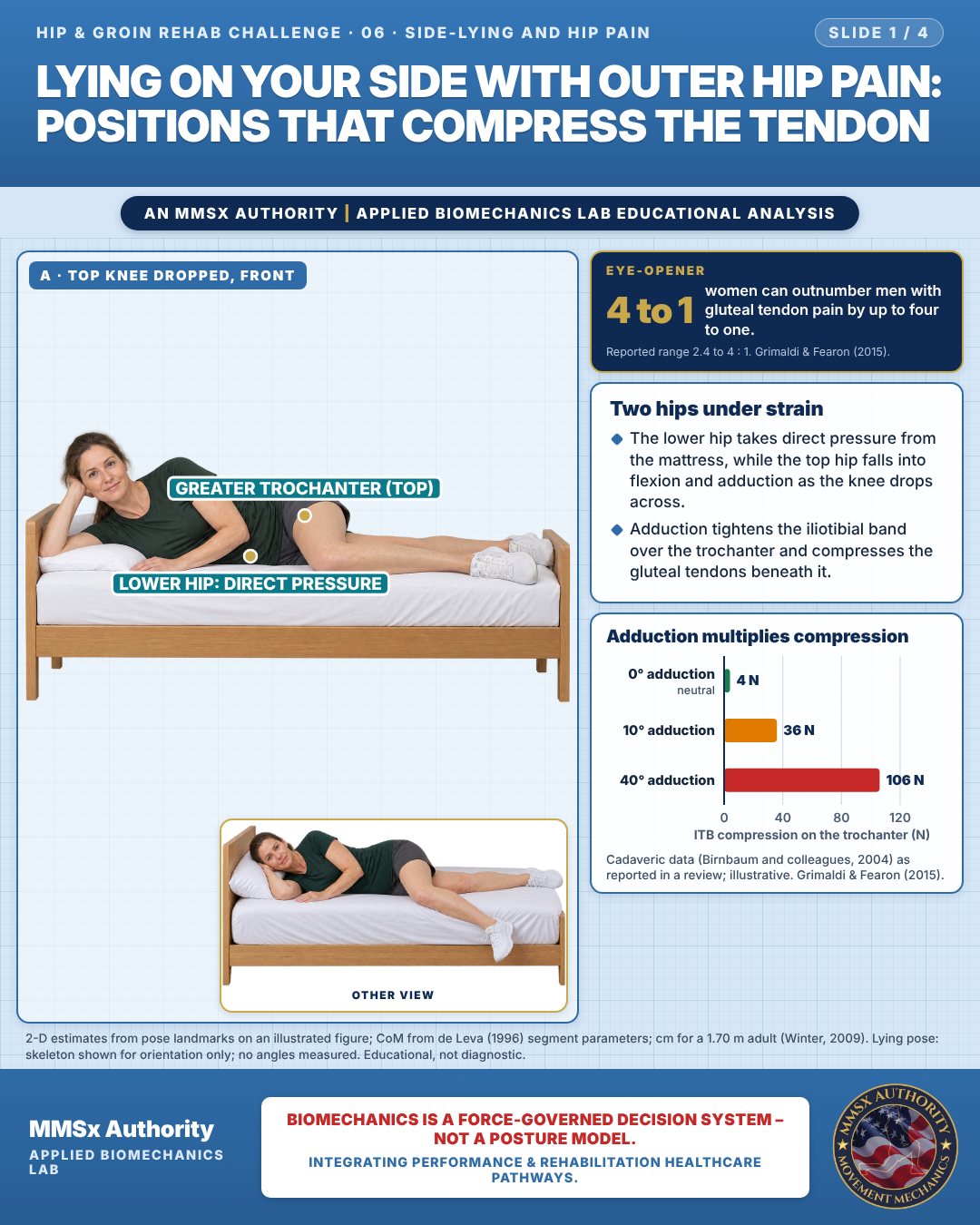
Two hips under strain
The lower hip takes direct pressure from the mattress, while the top hip falls into flexion and adduction as the knee drops across.
Adduction tightens the iliotibial band over the trochanter and compresses the gluteal tendons beneath it.
Adduction multiplies compression
Movement B: Pillow between knees (front view)
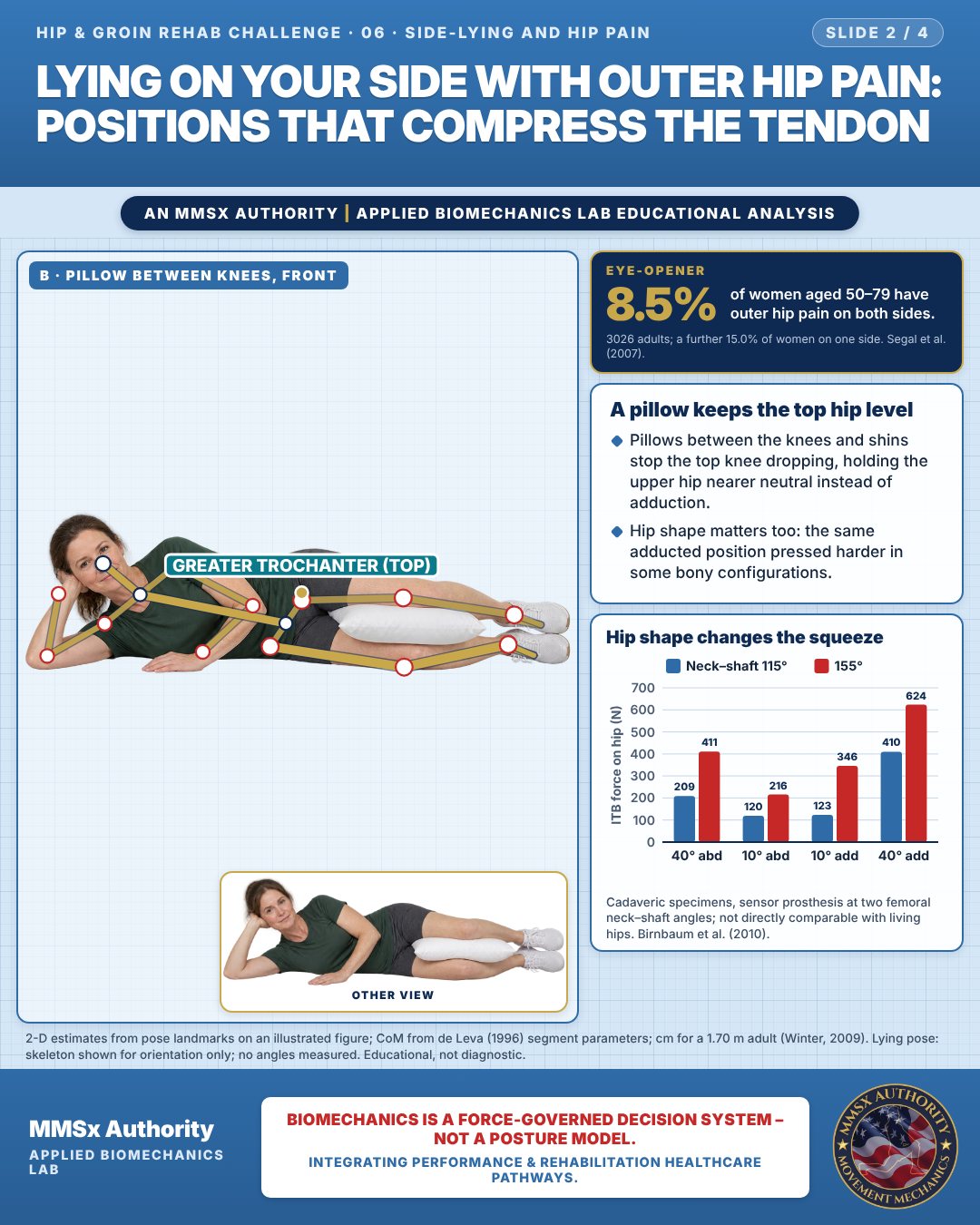
A pillow keeps the top hip level
Pillows between the knees and shins stop the top knee dropping, holding the upper hip nearer neutral instead of adduction.
Hip shape matters too: the same adducted position pressed harder in some bony configurations.
Hip shape changes the squeeze
Movement C: On the back (side view)
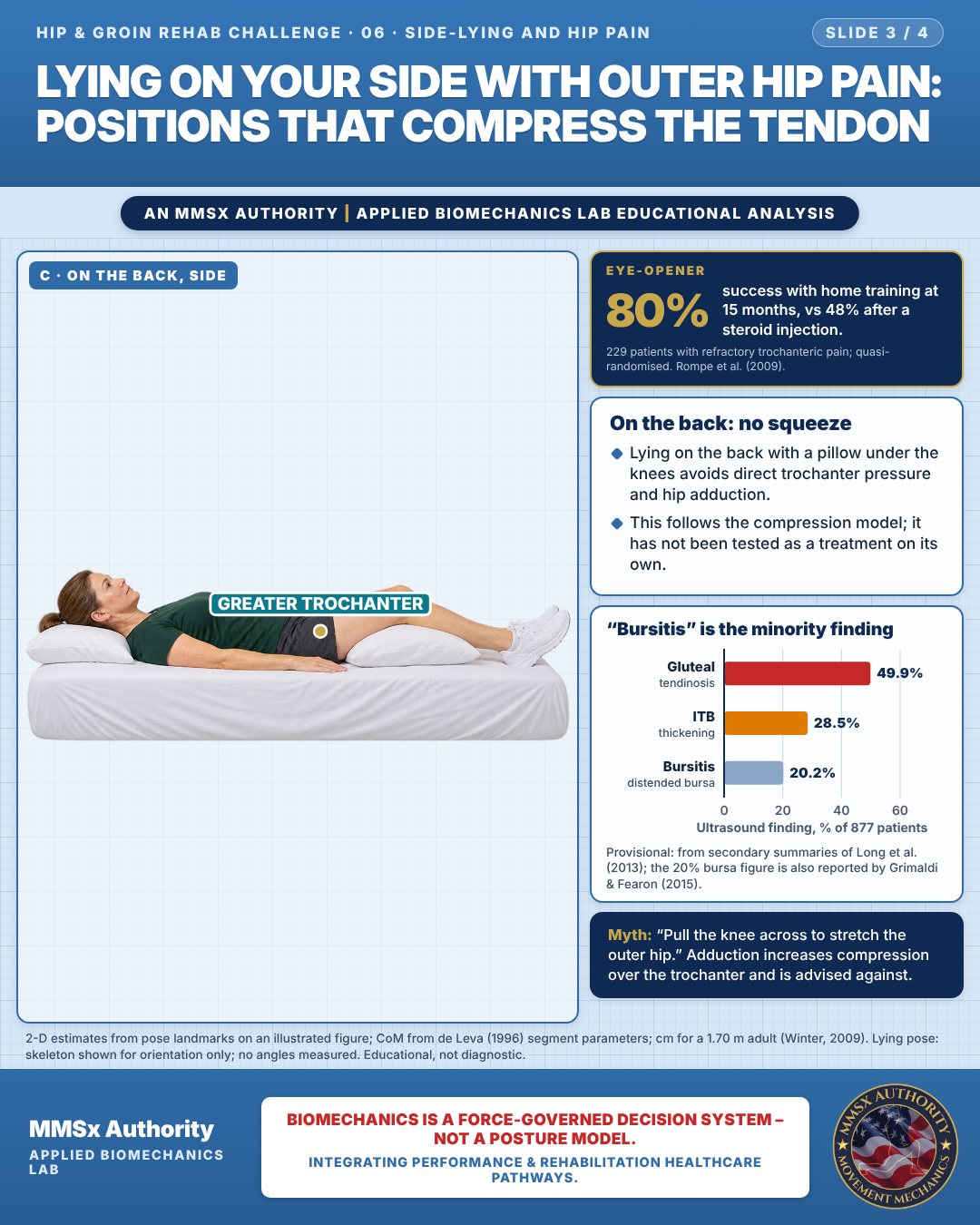
On the back: no squeeze
Lying on the back with a pillow under the knees avoids direct trochanter pressure and hip adduction.
This follows the compression model; it has not been tested as a treatment on its own.
“Bursitis” is the minority finding
Decision pathway
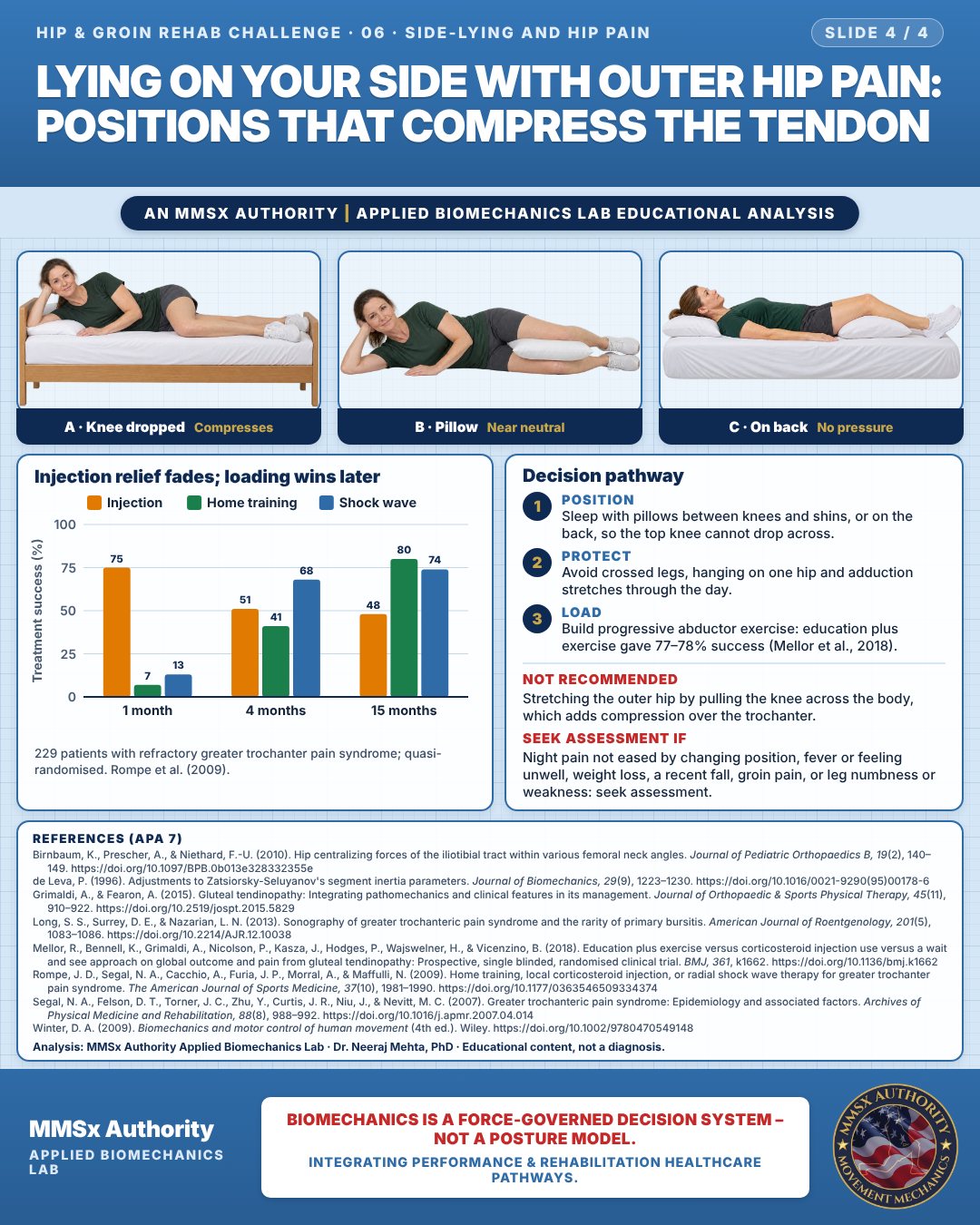
Injection relief fades; loading wins later
Position
Sleep with pillows between knees and shins, or on the back, so the top knee cannot drop across.
Protect
Avoid crossed legs, hanging on one hip and adduction stretches through the day.
Load
Build progressive abductor exercise: education plus exercise gave 77–78% success (Mellor et al., 2018).
What the evidence supports
- Load management advice for gluteal tendinopathy includes reducing positions of sustained hip adduction: in side-lying, both hips are compressed and the uppermost hip is flexed and adducted; pillows between the knees and shins reduce uppermost-hip adduction. Also avoid standing "hanging on one hip", standing or sitting with legs or knees crossed, and adduction stretches (Grimaldi & Fearon, 2015).
- Combine this education with progressive abductor loading: education plus exercise gave 77–78% global success at 8 and 52 weeks in the LEAP trial (Mellor et al., 2018).
Myth and evidence
Myth“Stretching the outer hip by pulling the knee across the body will release the tendon.”
EvidenceAdduction increases ITB compression over the trochanter (Grimaldi & Fearon, 2015; Birnbaum et al., 2010), and adduction stretches are among the positions advised against in gluteal tendinopathy (Grimaldi & Fearon, 2015).
Cautions
Not recommended
Stretching the outer hip by pulling the knee across the body, which adds compression over the trochanter.
Seek assessment if
Night pain not eased by changing position, fever or feeling unwell, weight loss, a recent fall, groin pain, or leg numbness or weakness: seek assessment.
Methods note
2-D estimates from pose landmarks on an illustrated figure; CoM from de Leva (1996) segment parameters; cm for a 1.70 m adult (Winter, 2009). Lying pose: skeleton shown for orientation only; no angles measured. These are educational estimates, not a diagnosis.
References
- Birnbaum, K., Prescher, A., & Niethard, F.-U. (2010). Hip centralizing forces of the iliotibial tract within various femoral neck angles. Journal of Pediatric Orthopaedics B, 19(2), 140–149. https://doi.org/10.1097/BPB.0b013e328332355e
- de Leva, P. (1996). Adjustments to Zatsiorsky-Seluyanov's segment inertia parameters. Journal of Biomechanics, 29(9), 1223–1230. https://doi.org/10.1016/0021-9290(95)00178-6
- Grimaldi, A., & Fearon, A. (2015). Gluteal tendinopathy: Integrating pathomechanics and clinical features in its management. Journal of Orthopaedic & Sports Physical Therapy, 45(11), 910–922. https://doi.org/10.2519/jospt.2015.5829
- Long, S. S., Surrey, D. E., & Nazarian, L. N. (2013). Sonography of greater trochanteric pain syndrome and the rarity of primary bursitis. American Journal of Roentgenology, 201(5), 1083–1086. https://doi.org/10.2214/AJR.12.10038
- Mellor, R., Bennell, K., Grimaldi, A., Nicolson, P., Kasza, J., Hodges, P., Wajswelner, H., & Vicenzino, B. (2018). Education plus exercise versus corticosteroid injection use versus a wait and see approach on global outcome and pain from gluteal tendinopathy: Prospective, single blinded, randomised clinical trial. BMJ, 361, k1662. https://doi.org/10.1136/bmj.k1662
- Rompe, J. D., Segal, N. A., Cacchio, A., Furia, J. P., Morral, A., & Maffulli, N. (2009). Home training, local corticosteroid injection, or radial shock wave therapy for greater trochanter pain syndrome. The American Journal of Sports Medicine, 37(10), 1981–1990. https://doi.org/10.1177/0363546509334374
- Segal, N. A., Felson, D. T., Torner, J. C., Zhu, Y., Curtis, J. R., Niu, J., & Nevitt, M. C. (2007). Greater trochanteric pain syndrome: Epidemiology and associated factors. Archives of Physical Medicine and Rehabilitation, 88(8), 988–992. https://doi.org/10.1016/j.apmr.2007.04.014
- Winter, D. A. (2009). Biomechanics and motor control of human movement (4th ed.). Wiley. https://doi.org/10.1002/9780470549148
Cite this article
Mehta, N. (2026, October 28). Lying on your side with outer hip pain: positions that compress the tendon. MMSx Authority Applied Biomechanics Lab. https://mmsxauthority.org/edu/analysis/hip-groin/06-lying-on-your-side-with-outer-hip-pain-positions-that-compress-the/
Part of the collection
Mehta, N. (2026). Hip and Groin Rehabilitation: 30 Evidence-Based Biomechanics Analyses [Collection]. MMSx Authority Applied Biomechanics Lab. Zenodo. https://doi.org/10.5281/zenodo.23735806
All Hip & Groin Rehab Challenge articles · Rehabilitation Library