Hip & Groin Rehab Challenge · 20
Hip extension strength: glutes, hip thrusts and the hinge
Hip extension strength is the capacity of gluteus maximus and the hamstrings to extend the hip.
Key points
- Start. Use single-leg bridges and deadlifts for moderate gluteus maximus demand while symptoms settle.
- Build. Add hip thrusts, squats or hinges by goal and tolerance; both grew the glutes.
- Specify. Train the lift you need to be strong in; strength gains were lift-specific.
What it is
Hip extension strength is the capacity of gluteus maximus and the hamstrings to extend the hip. The hip thrust loads hip extension with the knee bent and the trunk horizontal; the hinge (deadlift) loads hip extension with the trunk inclined and the knees slightly bent.
How we analysed the movement
Three movements relevant to this topic were analysed from illustrated reference figures. Joint centres were located with two-dimensional pose estimation; hip and knee angles, pelvis level, the whole-body centre of mass and, where relevant, the hip lever (the horizontal distance from the hip joint to the upper-body centre of mass) and the resulting static hip moment were then calculated from standard segment parameters. The figures are educational estimates that show how position changes mechanical demand; they are not measurements of a patient. Every research value quoted below comes from the published source cited beside it.
Movement A: Barbell hip thrust (side view)
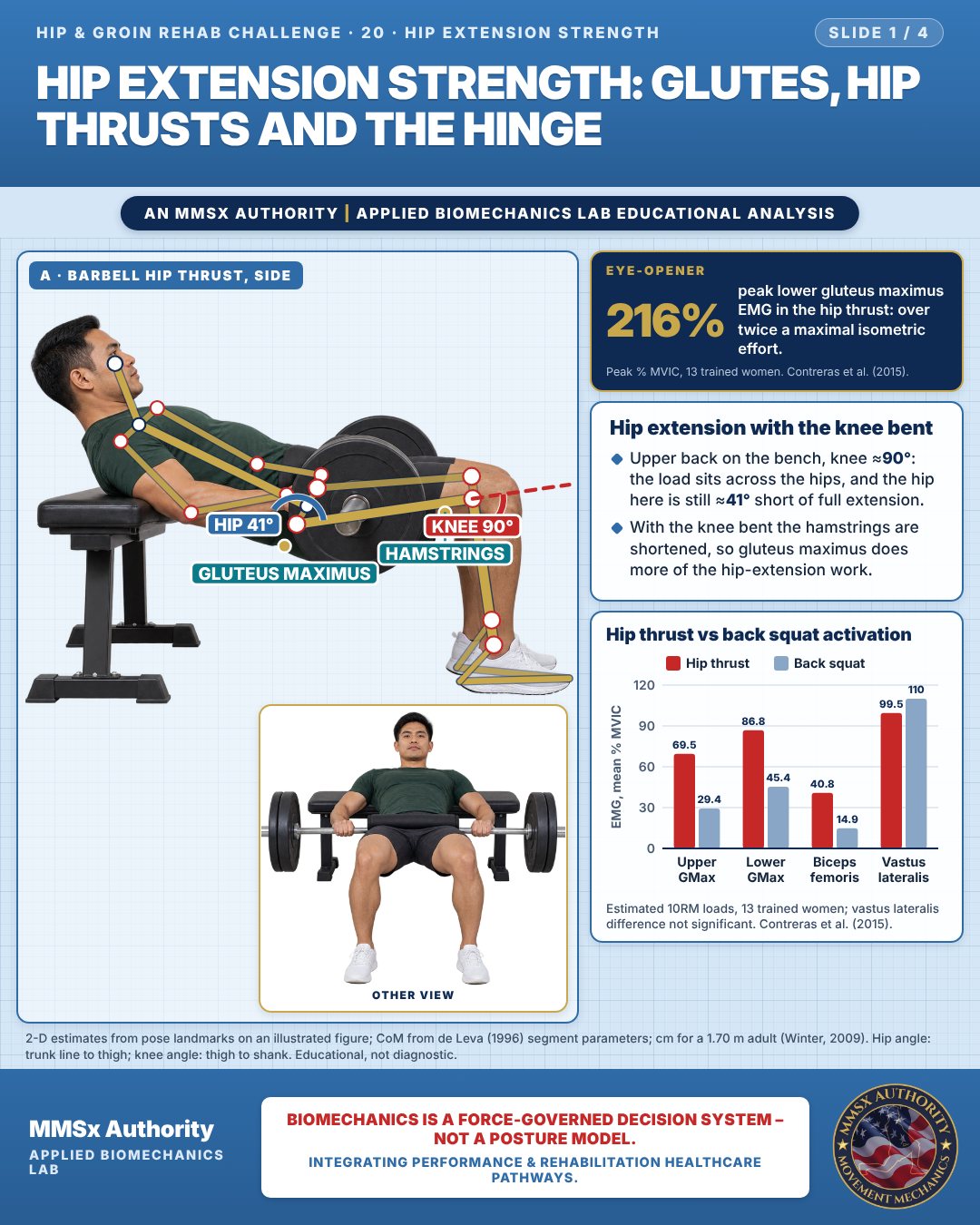
Hip extension with the knee bent
Upper back on the bench, knee ≈90°: the load sits across the hips, and the hip here is still ≈41° short of full extension.
With the knee bent the hamstrings are shortened, so gluteus maximus does more of the hip-extension work.
Hip thrust vs back squat activation
Movement B: Kettlebell hinge (side view)
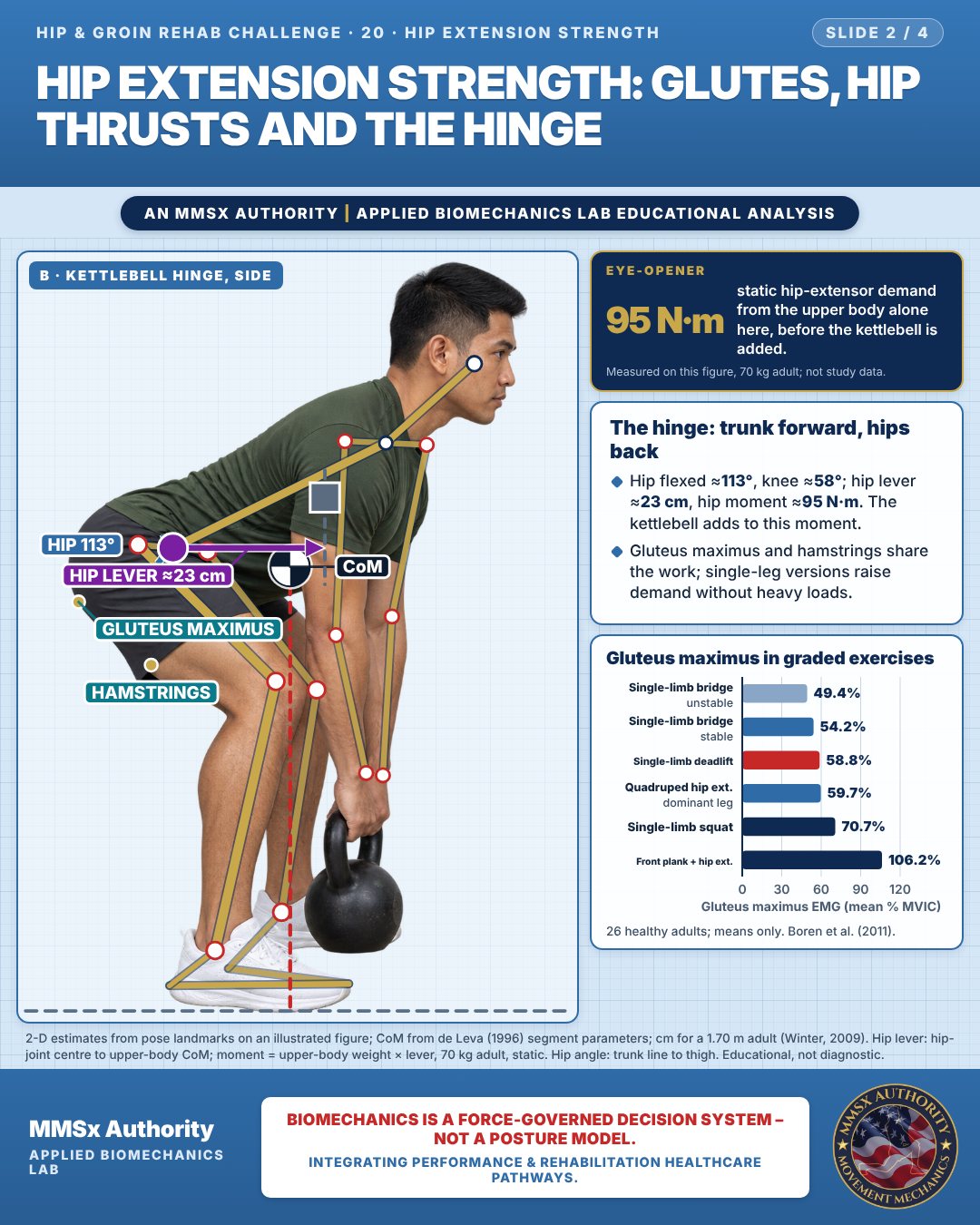
The hinge: trunk forward, hips back
Hip flexed ≈113°, knee ≈58°; hip lever ≈23 cm, hip moment ≈95 N·m. The kettlebell adds to this moment.
Gluteus maximus and hamstrings share the work; single-leg versions raise demand without heavy loads.
Gluteus maximus in graded exercises
Movement C: Single-leg bridge (side view)
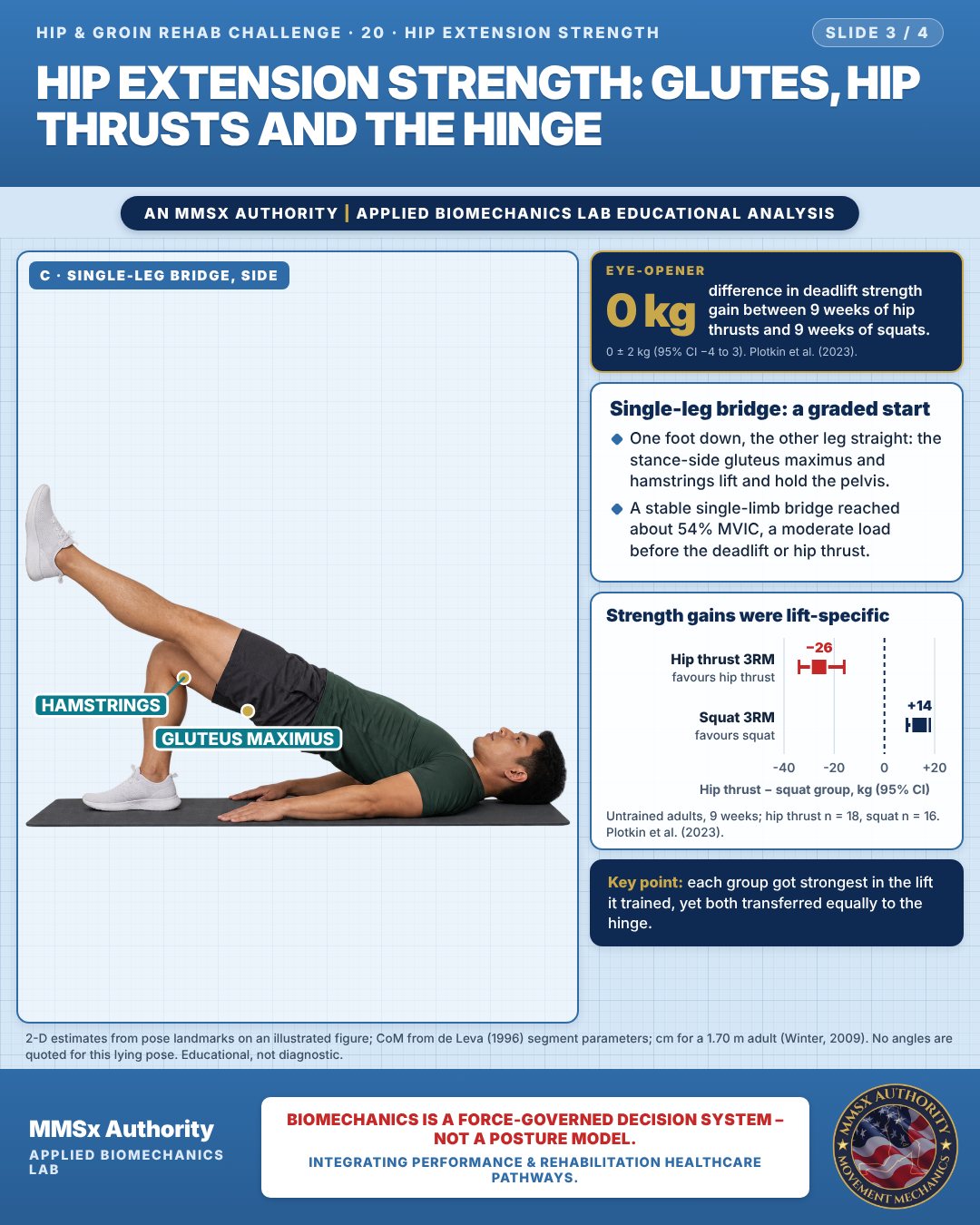
Single-leg bridge: a graded start
One foot down, the other leg straight: the stance-side gluteus maximus and hamstrings lift and hold the pelvis.
A stable single-limb bridge reached about 54% MVIC, a moderate load before the deadlift or hip thrust.
Strength gains were lift-specific
Decision pathway
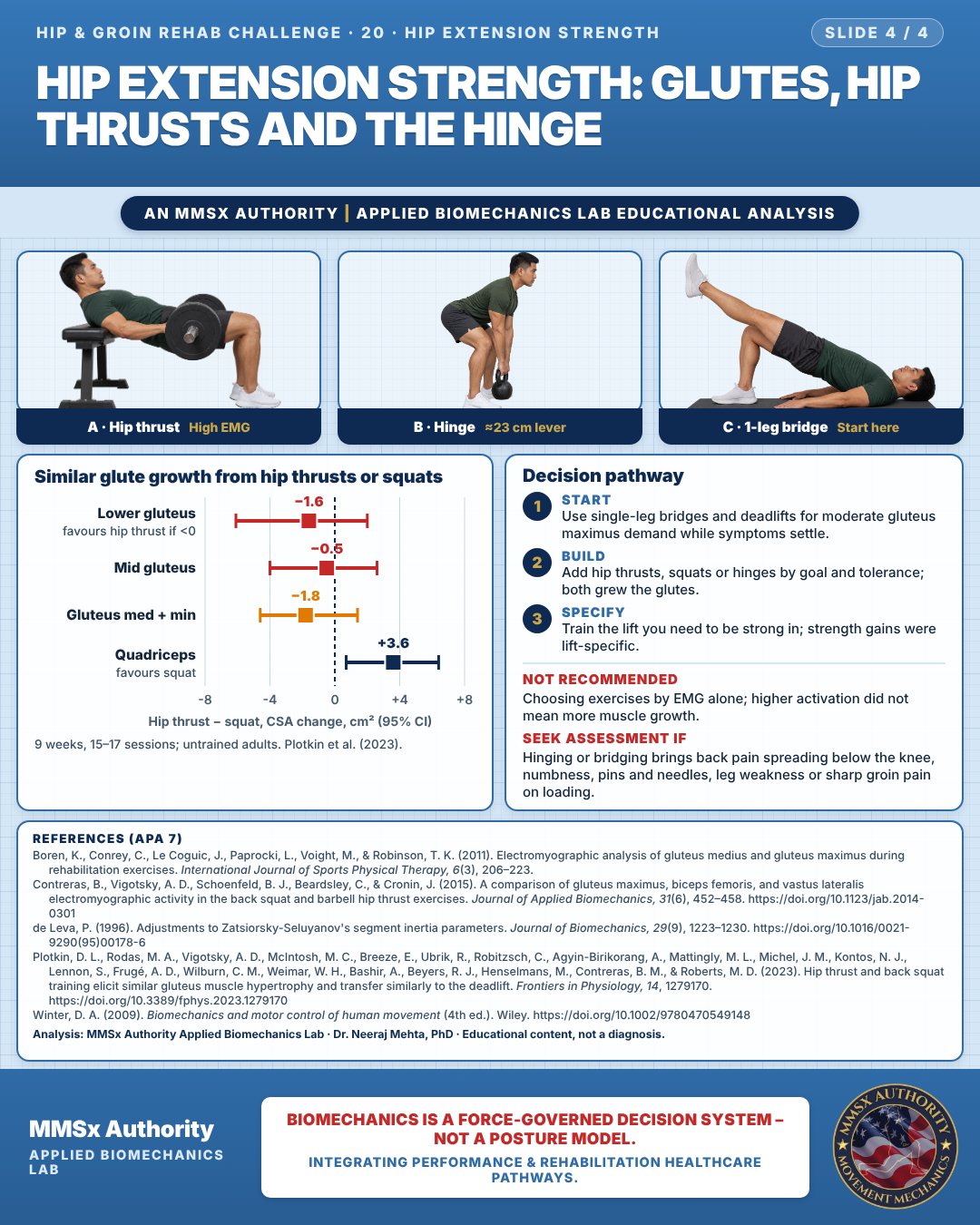
Similar glute growth from hip thrusts or squats
Start
Use single-leg bridges and deadlifts for moderate gluteus maximus demand while symptoms settle.
Build
Add hip thrusts, squats or hinges by goal and tolerance; both grew the glutes.
Specify
Train the lift you need to be strong in; strength gains were lift-specific.
What the evidence supports
- Both hip thrust and squat training build the gluteals; choose by goal, tolerance and specificity (strength gains were specific to the trained lift) (Plotkin et al., 2023).
- For graded hip-extension rehabilitation, single-leg bridges and single-leg deadlifts provide moderate gluteus maximus activation (49–59% MVIC) before higher-demand options (Boren et al., 2011).
Myth and evidence
Myth“The exercise with the highest EMG builds the most muscle.”
EvidenceThe hip thrust produced more than twice the mean upper gluteus maximus EMG of the squat (Contreras et al., 2015), yet 9 weeks of training gave similar gluteus hypertrophy with both exercises (Plotkin et al., 2023).
Cautions
Not recommended
Choosing exercises by EMG alone; higher activation did not mean more muscle growth.
Seek assessment if
Hinging or bridging brings back pain spreading below the knee, numbness, pins and needles, leg weakness or sharp groin pain on loading.
Methods note
2-D estimates from pose landmarks on an illustrated figure; CoM from de Leva (1996) segment parameters; cm for a 1.70 m adult (Winter, 2009). Hip angle: trunk line to thigh; knee angle: thigh to shank. Hip lever: hip-joint centre to upper-body CoM; moment = upper-body weight × lever, 70 kg adult, static. Hip angle: trunk line to thigh. No angles are quoted for this lying pose. These are educational estimates, not a diagnosis.
References
- Boren, K., Conrey, C., Le Coguic, J., Paprocki, L., Voight, M., & Robinson, T. K. (2011). Electromyographic analysis of gluteus medius and gluteus maximus during rehabilitation exercises. International Journal of Sports Physical Therapy, 6(3), 206–223.
- Contreras, B., Vigotsky, A. D., Schoenfeld, B. J., Beardsley, C., & Cronin, J. (2015). A comparison of gluteus maximus, biceps femoris, and vastus lateralis electromyographic activity in the back squat and barbell hip thrust exercises. Journal of Applied Biomechanics, 31(6), 452–458. https://doi.org/10.1123/jab.2014-0301
- de Leva, P. (1996). Adjustments to Zatsiorsky-Seluyanov's segment inertia parameters. Journal of Biomechanics, 29(9), 1223–1230. https://doi.org/10.1016/0021-9290(95)00178-6
- Plotkin, D. L., Rodas, M. A., Vigotsky, A. D., McIntosh, M. C., Breeze, E., Ubrik, R., Robitzsch, C., Agyin-Birikorang, A., Mattingly, M. L., Michel, J. M., Kontos, N. J., Lennon, S., Frugé, A. D., Wilburn, C. M., Weimar, W. H., Bashir, A., Beyers, R. J., Henselmans, M., Contreras, B. M., & Roberts, M. D. (2023). Hip thrust and back squat training elicit similar gluteus muscle hypertrophy and transfer similarly to the deadlift. Frontiers in Physiology, 14, 1279170. https://doi.org/10.3389/fphys.2023.1279170
- Winter, D. A. (2009). Biomechanics and motor control of human movement (4th ed.). Wiley. https://doi.org/10.1002/9780470549148
Cite this article
Mehta, N. (2026, October 28). Hip extension strength: glutes, hip thrusts and the hinge. MMSx Authority Applied Biomechanics Lab. https://mmsxauthority.org/edu/analysis/hip-groin/20-hip-extension-strength-glutes-hip-thrusts-and-the-hinge/
Part of the collection
Mehta, N. (2026). Hip and Groin Rehabilitation: 30 Evidence-Based Biomechanics Analyses [Collection]. MMSx Authority Applied Biomechanics Lab. Zenodo. https://doi.org/10.5281/zenodo.23735806
All Hip & Groin Rehab Challenge articles · Rehabilitation Library