Hip & Groin Rehab Challenge · 02
Hip osteoarthritis: why exercise is first-line treatment
Hip osteoarthritis (OA) is a whole-joint condition involving cartilage loss, bone remodelling, osteophytes and synovial change, which may cause…
Key points
- Explain. Exercise is a core treatment offered to everyone with OA (NICE, 2022).
- Tailor. Pick strength and aerobic work the person can do: chair rises, band side-steps, cycling.
- Progress. Build load gradually and keep going: benefits lasted 3–6 months after supervision ended.
What it is
Hip osteoarthritis (OA) is a whole-joint condition involving cartilage loss, bone remodelling, osteophytes and synovial change, which may cause activity-related groin/hip pain, stiffness and reduced function. Clinically, NICE diagnoses OA without imaging in people aged 45 or over with activity-related joint pain and no morning stiffness or morning stiffness lasting no longer than 30 minutes.
How we analysed the movement
Three movements relevant to this topic were analysed from illustrated reference figures. Joint centres were located with two-dimensional pose estimation; hip and knee angles, pelvis level, the whole-body centre of mass and, where relevant, the hip lever (the horizontal distance from the hip joint to the upper-body centre of mass) and the resulting static hip moment were then calculated from standard segment parameters. The figures are educational estimates that show how position changes mechanical demand; they are not measurements of a patient. Every research value quoted below comes from the published source cited beside it.
Movement A: Sit to stand (side view)
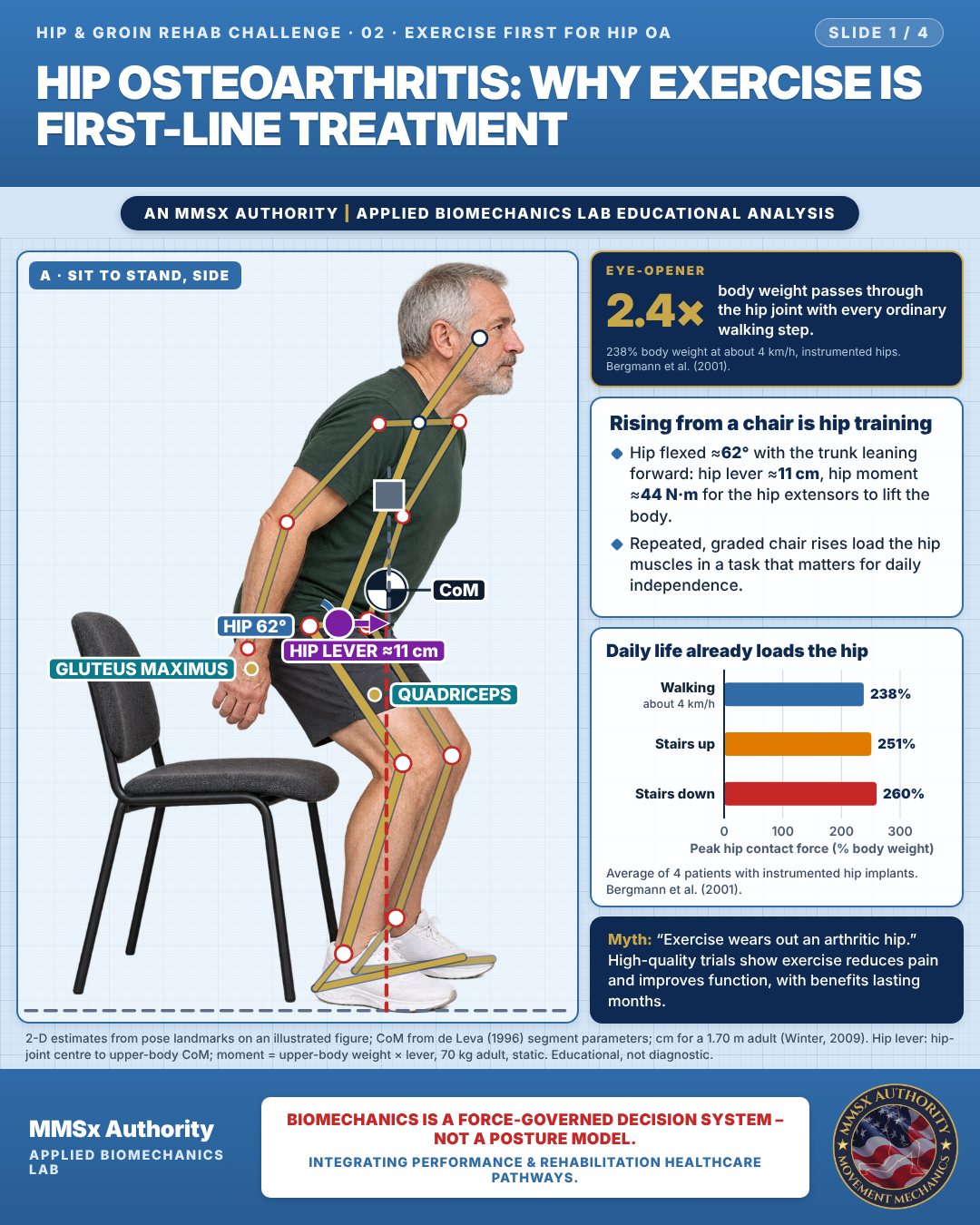
Rising from a chair is hip training
Hip flexed ≈62° with the trunk leaning forward: hip lever ≈11 cm, hip moment ≈44 N·m for the hip extensors to lift the body.
Repeated, graded chair rises load the hip muscles in a task that matters for daily independence.
Daily life already loads the hip
Movement B: Band side-step (front view)
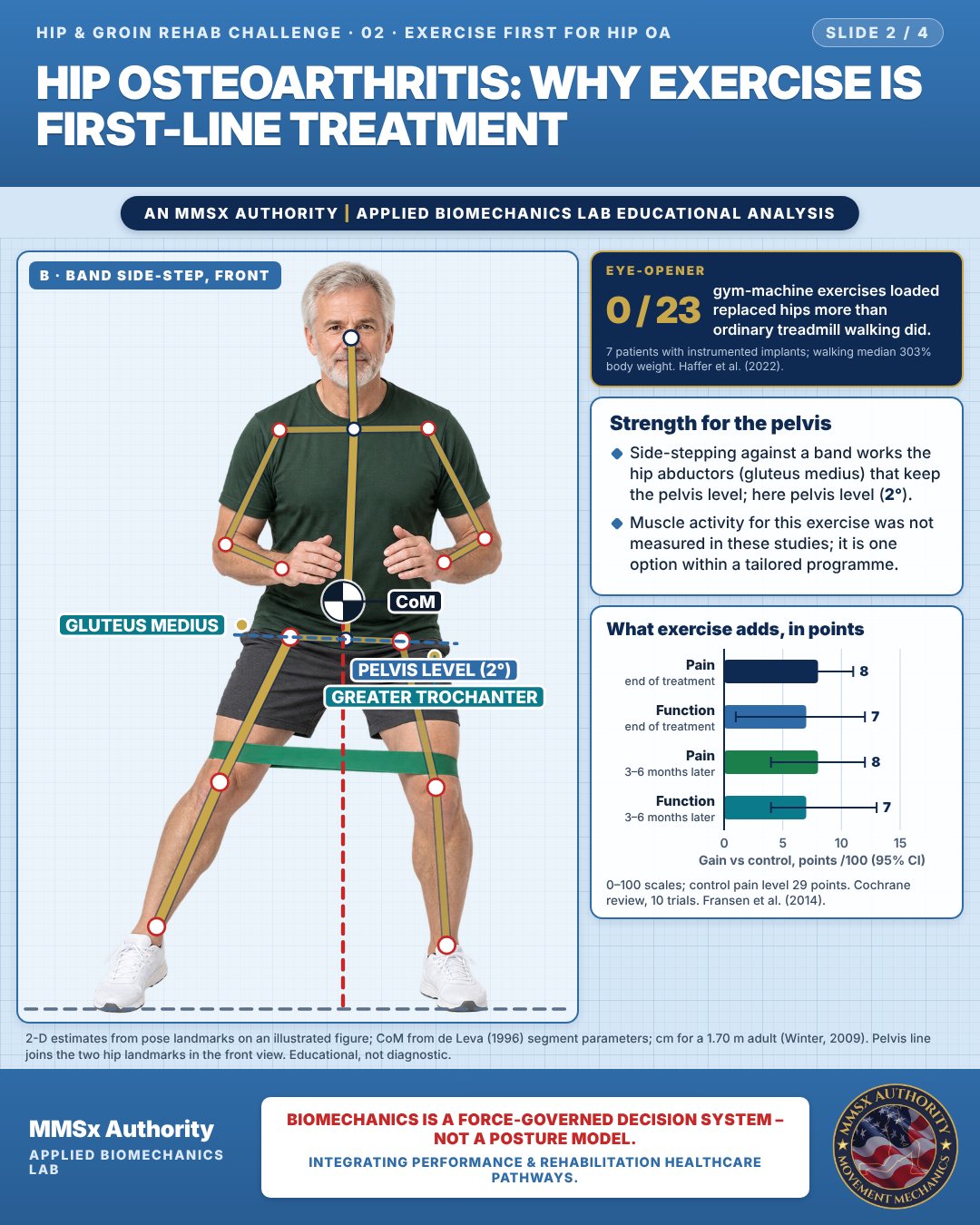
Strength for the pelvis
Side-stepping against a band works the hip abductors (gluteus medius) that keep the pelvis level; here pelvis level (2°).
Muscle activity for this exercise was not measured in these studies; it is one option within a tailored programme.
What exercise adds, in points
Movement C: Stationary bike (side view)
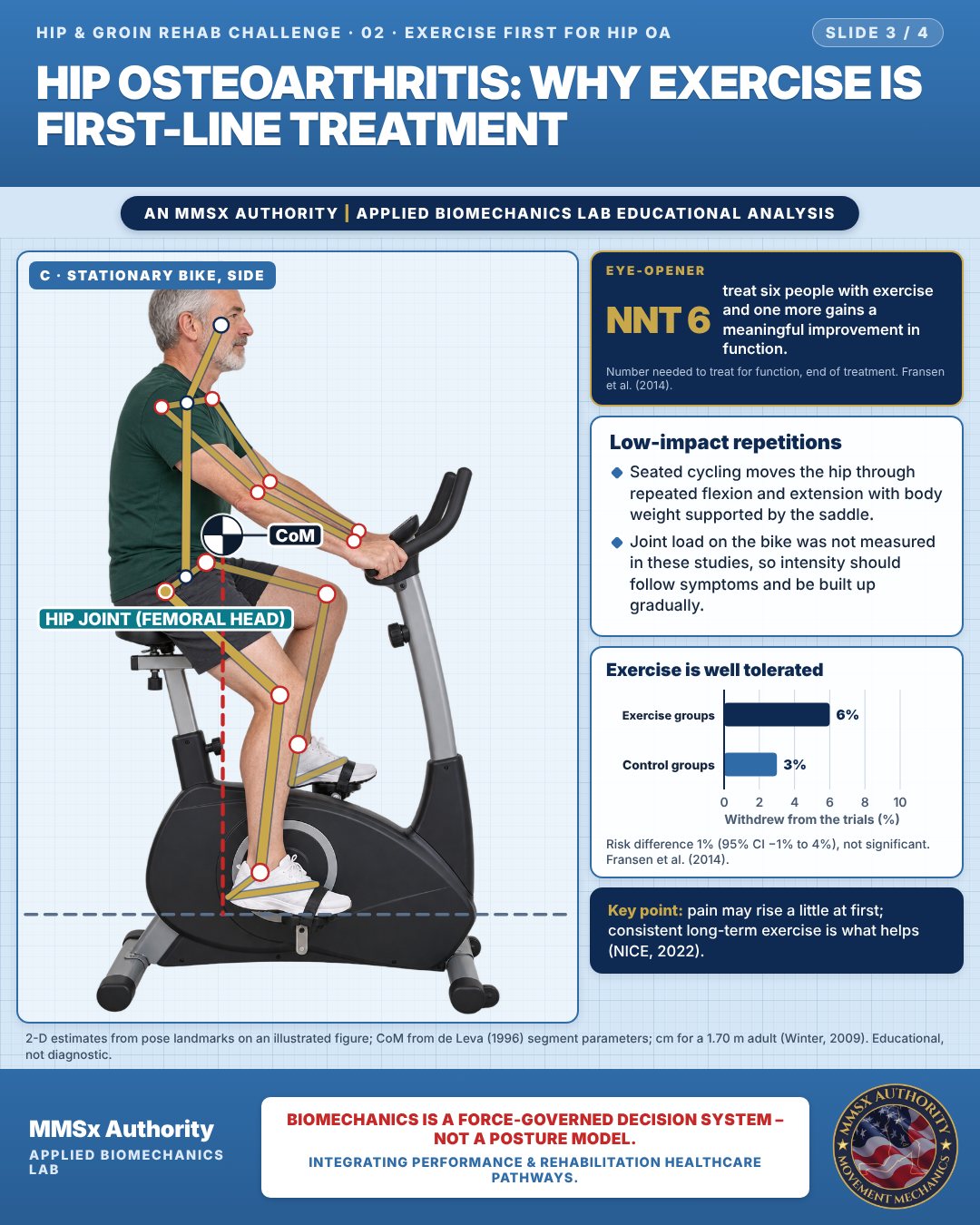
Low-impact repetitions
Seated cycling moves the hip through repeated flexion and extension with body weight supported by the saddle.
Joint load on the bike was not measured in these studies, so intensity should follow symptoms and be built up gradually.
Exercise is well tolerated
Decision pathway
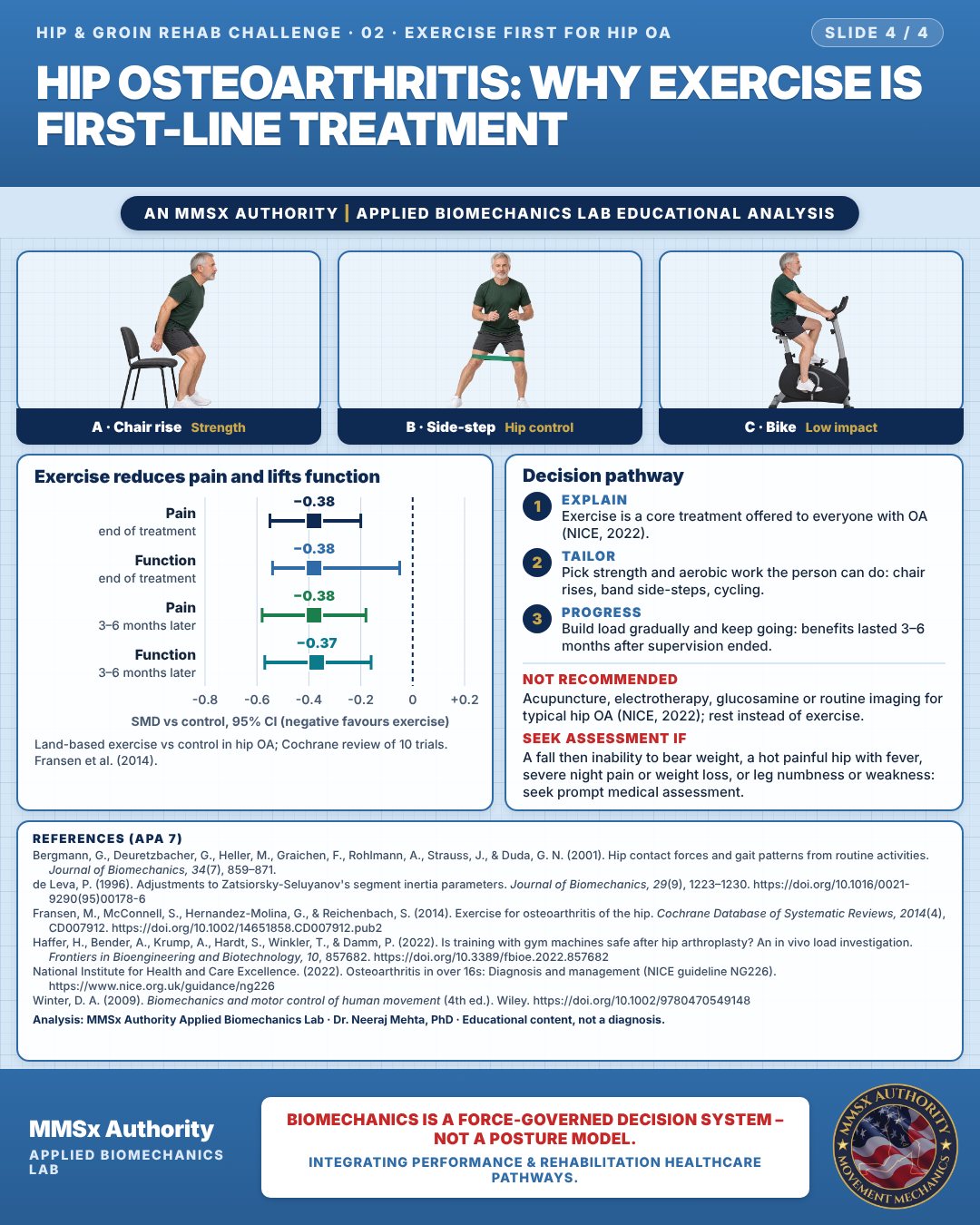
Exercise reduces pain and lifts function
Explain
Exercise is a core treatment offered to everyone with OA (NICE, 2022).
Tailor
Pick strength and aerobic work the person can do: chair rises, band side-steps, cycling.
Progress
Build load gradually and keep going: benefits lasted 3–6 months after supervision ended.
Cautions
Not recommended
Acupuncture, electrotherapy, glucosamine or routine imaging for typical hip OA (NICE, 2022); rest instead of exercise.
Seek assessment if
A fall then inability to bear weight, a hot painful hip with fever, severe night pain or weight loss, or leg numbness or weakness: seek prompt medical assessment.
Methods note
2-D estimates from pose landmarks on an illustrated figure; CoM from de Leva (1996) segment parameters; cm for a 1.70 m adult (Winter, 2009). Hip lever: hip-joint centre to upper-body CoM; moment = upper-body weight × lever, 70 kg adult, static. Pelvis line joins the two hip landmarks in the front view. These are educational estimates, not a diagnosis.
References
- Bergmann, G., Deuretzbacher, G., Heller, M., Graichen, F., Rohlmann, A., Strauss, J., & Duda, G. N. (2001). Hip contact forces and gait patterns from routine activities. Journal of Biomechanics, 34(7), 859–871.
- de Leva, P. (1996). Adjustments to Zatsiorsky-Seluyanov's segment inertia parameters. Journal of Biomechanics, 29(9), 1223–1230. https://doi.org/10.1016/0021-9290(95)00178-6
- Fransen, M., McConnell, S., Hernandez-Molina, G., & Reichenbach, S. (2014). Exercise for osteoarthritis of the hip. Cochrane Database of Systematic Reviews, 2014(4), CD007912. https://doi.org/10.1002/14651858.CD007912.pub2
- Haffer, H., Bender, A., Krump, A., Hardt, S., Winkler, T., & Damm, P. (2022). Is training with gym machines safe after hip arthroplasty? An in vivo load investigation. Frontiers in Bioengineering and Biotechnology, 10, 857682. https://doi.org/10.3389/fbioe.2022.857682
- National Institute for Health and Care Excellence. (2022). Osteoarthritis in over 16s: Diagnosis and management (NICE guideline NG226). https://www.nice.org.uk/guidance/ng226
- Winter, D. A. (2009). Biomechanics and motor control of human movement (4th ed.). Wiley. https://doi.org/10.1002/9780470549148
Cite this article
Mehta, N. (2026, October 28). Hip osteoarthritis: why exercise is first-line treatment. MMSx Authority Applied Biomechanics Lab. https://mmsxauthority.org/edu/analysis/hip-groin/02-hip-osteoarthritis-why-exercise-is-first-line-treatment/
Part of the collection
Mehta, N. (2026). Hip and Groin Rehabilitation: 30 Evidence-Based Biomechanics Analyses [Collection]. MMSx Authority Applied Biomechanics Lab. Zenodo. https://doi.org/10.5281/zenodo.23735806
All Hip & Groin Rehab Challenge articles · Rehabilitation Library