Hip & Groin Rehab Challenge · 28
Hip pain in women in midlife: tendons, hormones and load
Greater trochanteric pain syndrome (GTPS) is pain and tenderness over the outer hip (greater trochanter), most often due to gluteus medius and…
Key points
- Educate. Explain tendon load and pace the usual aggravators: side-lying, stairs and prolonged standing on one leg.
- Strengthen. Progress gluteal exercise and walking over about 8 weeks.
- Check the chain. Look for knee osteoarthritis and low back pain; hormone therapy is not an established treatment for outer hip pain.
What it is
Greater trochanteric pain syndrome (GTPS) is pain and tenderness over the outer hip (greater trochanter), most often due to gluteus medius and minimus tendinopathy, with or without bursitis. It is far more common in women than in men in midlife and later life, and it is typically aggravated by side-lying, stairs and prolonged single-leg loading (Segal et al., 2007; Mellor et al., 2018).
How we analysed the movement
Three movements relevant to this topic were analysed from illustrated reference figures. Joint centres were located with two-dimensional pose estimation; hip and knee angles, pelvis level, the whole-body centre of mass and, where relevant, the hip lever (the horizontal distance from the hip joint to the upper-body centre of mass) and the resulting static hip moment were then calculated from standard segment parameters. The figures are educational estimates that show how position changes mechanical demand; they are not measurements of a patient. Every research value quoted below comes from the published source cited beside it.
Movement A: Single-leg stance (front view)
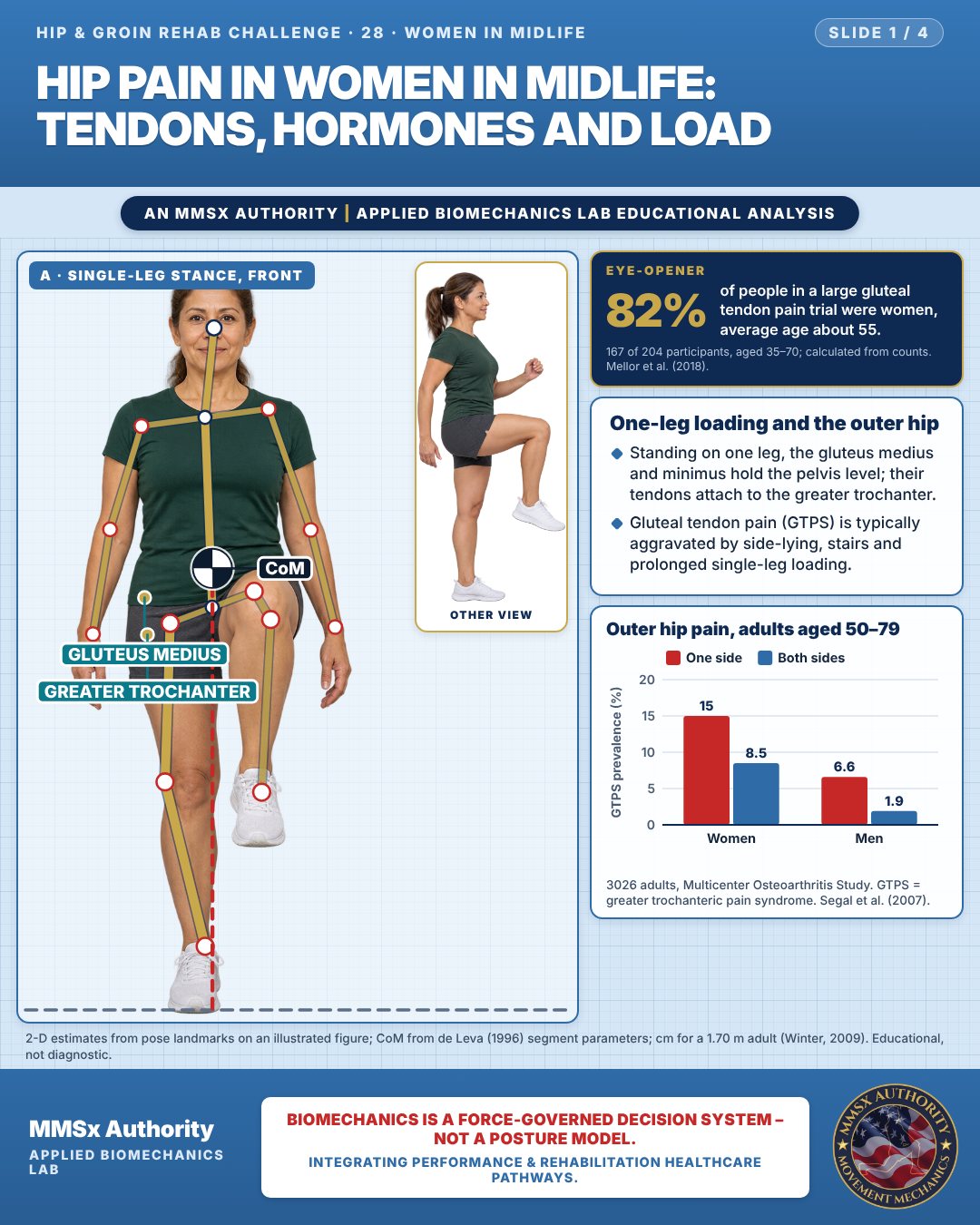
One-leg loading and the outer hip
Standing on one leg, the gluteus medius and minimus hold the pelvis level; their tendons attach to the greater trochanter.
Gluteal tendon pain (GTPS) is typically aggravated by side-lying, stairs and prolonged single-leg loading.
Outer hip pain, adults aged 50–79
Movement B: Glute bridge (side view)
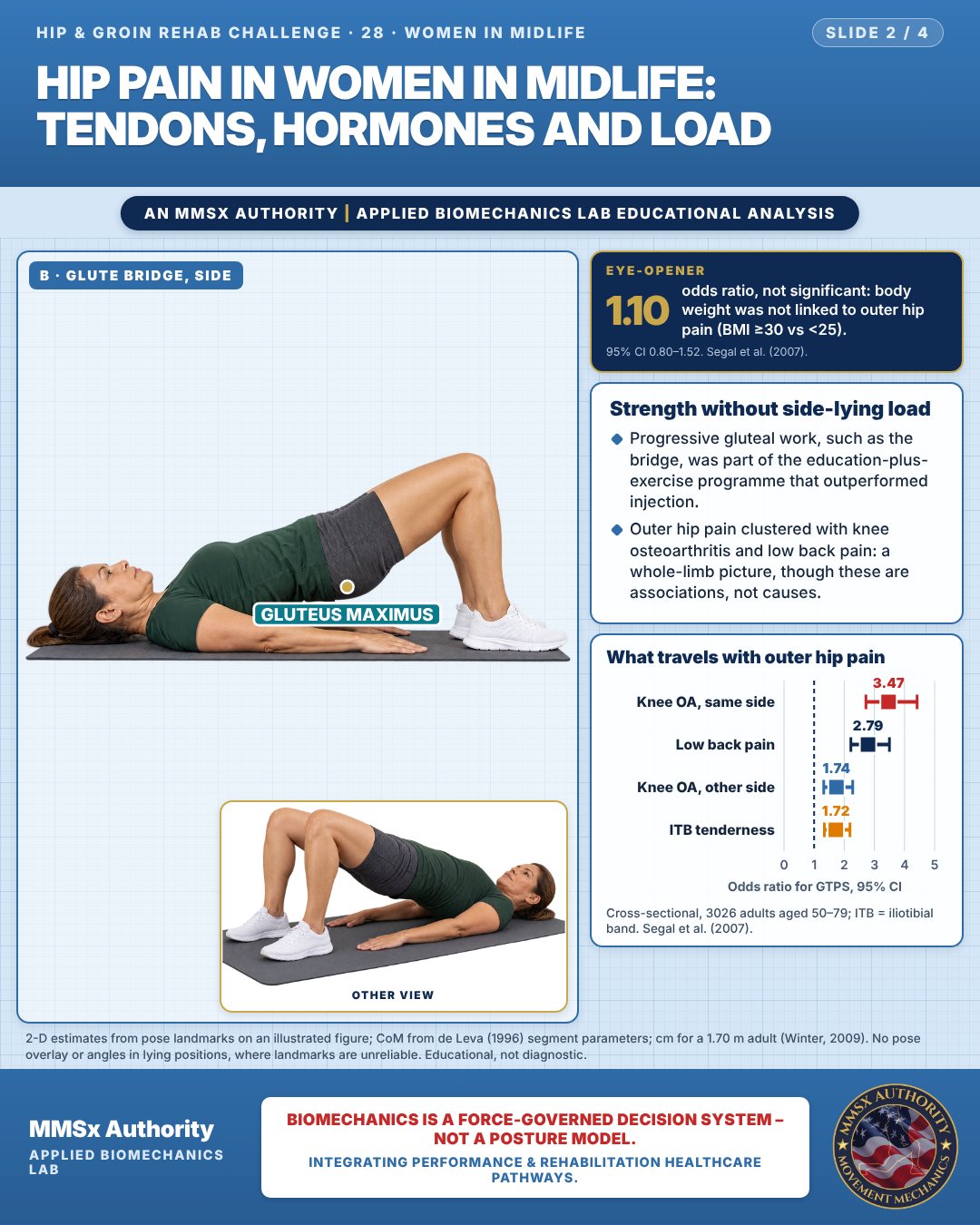
Strength without side-lying load
Progressive gluteal work, such as the bridge, was part of the education-plus-exercise programme that outperformed injection.
Outer hip pain clustered with knee osteoarthritis and low back pain: a whole-limb picture, though these are associations, not causes.
What travels with outer hip pain
Movement C: Brisk walk (side view)
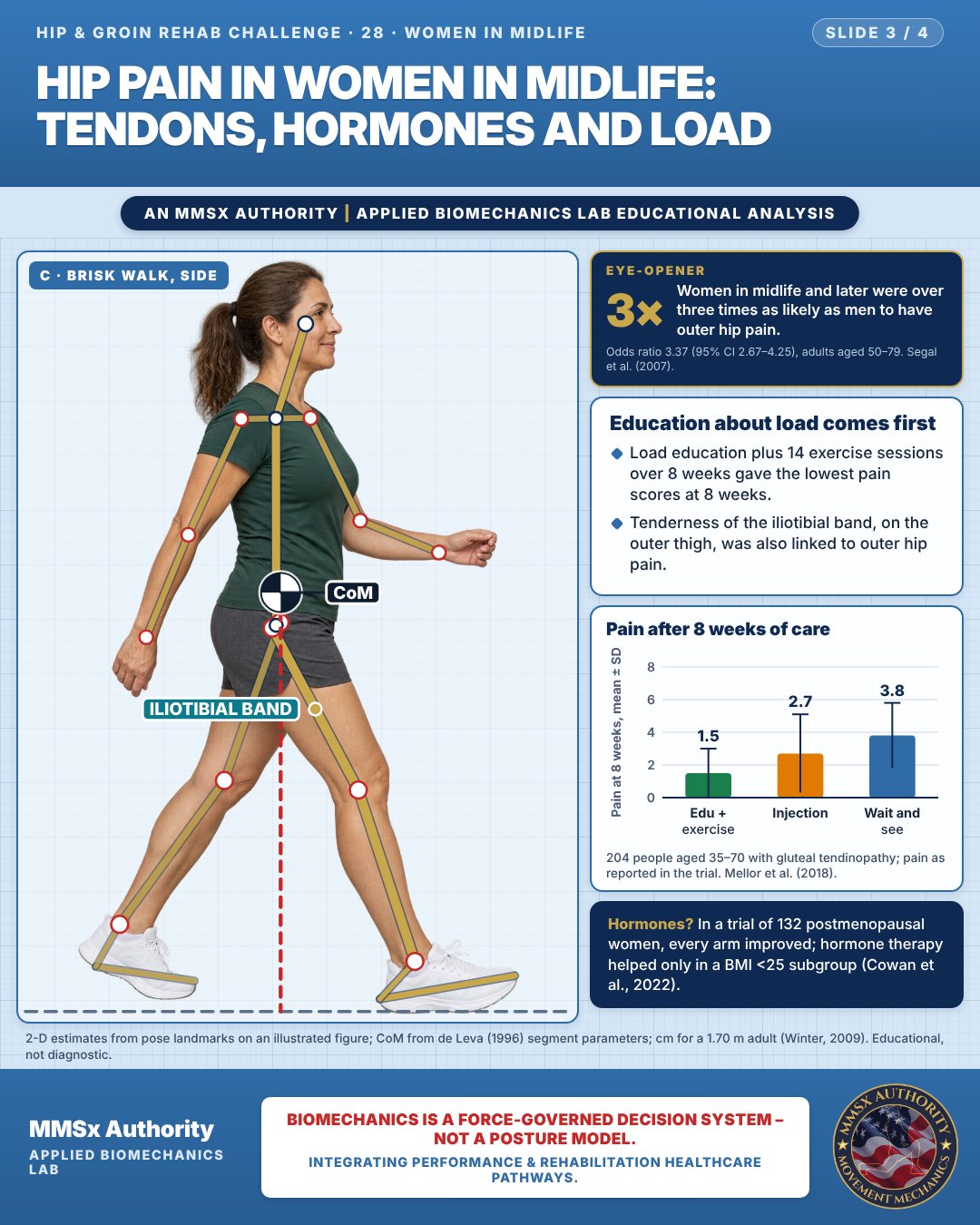
Education about load comes first
Load education plus 14 exercise sessions over 8 weeks gave the lowest pain scores at 8 weeks.
Tenderness of the iliotibial band, on the outer thigh, was also linked to outer hip pain.
Pain after 8 weeks of care
Decision pathway
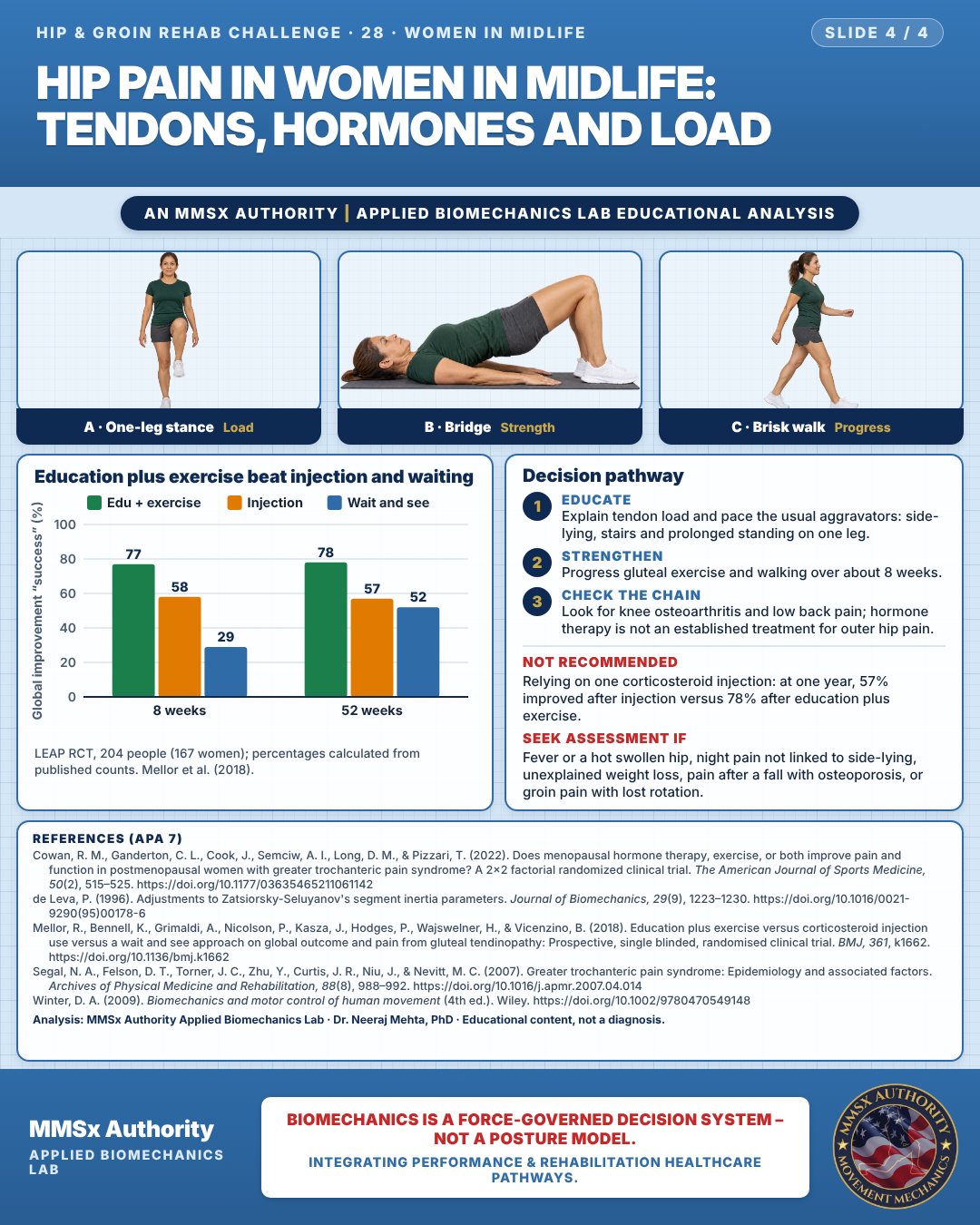
Education plus exercise beat injection and waiting
Educate
Explain tendon load and pace the usual aggravators: side-lying, stairs and prolonged standing on one leg.
Strengthen
Progress gluteal exercise and walking over about 8 weeks.
Check the chain
Look for knee osteoarthritis and low back pain; hormone therapy is not an established treatment for outer hip pain.
What the evidence supports
- Education about load management plus a progressive exercise programme is recommended over a corticosteroid injection or a wait-and-see approach for gluteal tendinopathy (Mellor et al., 2018).
- Address associated conditions such as knee OA and low back pain, which were strongly associated with GTPS (Segal et al., 2007).
- Hormone therapy should not be offered as a treatment for outer hip pain on current evidence; one trial showed a benefit only in a BMI subgroup (Cowan et al., 2022).
Myth and evidence
Myth“It's bursitis, so an injection is the best fix.”
EvidenceIn the LEAP trial, a single injection gave less global improvement than education plus exercise at 8 weeks (58% vs 77%) and at 52 weeks (57% vs 78%) (Mellor et al., 2018).
Cautions
Not recommended
Relying on one corticosteroid injection: at one year, 57% improved after injection versus 78% after education plus exercise.
Seek assessment if
Fever or a hot swollen hip, night pain not linked to side-lying, unexplained weight loss, pain after a fall with osteoporosis, or groin pain with lost rotation.
Methods note
2-D estimates from pose landmarks on an illustrated figure; CoM from de Leva (1996) segment parameters; cm for a 1.70 m adult (Winter, 2009). No pose overlay or angles in lying positions, where landmarks are unreliable. These are educational estimates, not a diagnosis.
References
- Cowan, R. M., Ganderton, C. L., Cook, J., Semciw, A. I., Long, D. M., & Pizzari, T. (2022). Does menopausal hormone therapy, exercise, or both improve pain and function in postmenopausal women with greater trochanteric pain syndrome? A 2x2 factorial randomized clinical trial. The American Journal of Sports Medicine, 50(2), 515–525. https://doi.org/10.1177/03635465211061142
- de Leva, P. (1996). Adjustments to Zatsiorsky-Seluyanov's segment inertia parameters. Journal of Biomechanics, 29(9), 1223–1230. https://doi.org/10.1016/0021-9290(95)00178-6
- Mellor, R., Bennell, K., Grimaldi, A., Nicolson, P., Kasza, J., Hodges, P., Wajswelner, H., & Vicenzino, B. (2018). Education plus exercise versus corticosteroid injection use versus a wait and see approach on global outcome and pain from gluteal tendinopathy: Prospective, single blinded, randomised clinical trial. BMJ, 361, k1662. https://doi.org/10.1136/bmj.k1662
- Segal, N. A., Felson, D. T., Torner, J. C., Zhu, Y., Curtis, J. R., Niu, J., & Nevitt, M. C. (2007). Greater trochanteric pain syndrome: Epidemiology and associated factors. Archives of Physical Medicine and Rehabilitation, 88(8), 988–992. https://doi.org/10.1016/j.apmr.2007.04.014
- Winter, D. A. (2009). Biomechanics and motor control of human movement (4th ed.). Wiley. https://doi.org/10.1002/9780470549148
Cite this article
Mehta, N. (2026, October 28). Hip pain in women in midlife: tendons, hormones and load. MMSx Authority Applied Biomechanics Lab. https://mmsxauthority.org/edu/analysis/hip-groin/28-hip-pain-in-women-in-midlife-tendons-hormones-and-load/
Part of the collection
Mehta, N. (2026). Hip and Groin Rehabilitation: 30 Evidence-Based Biomechanics Analyses [Collection]. MMSx Authority Applied Biomechanics Lab. Zenodo. https://doi.org/10.5281/zenodo.23735806
All Hip & Groin Rehab Challenge articles · Rehabilitation Library