Hip & Groin Rehab Challenge · 21
Sitting and hip pain: flexion, pressure and tolerance
Sitting-related hip pain is groin or front-of-hip pain provoked or worsened by sustained or deep hip flexion (low, soft seats.
Key points
- Adjust. Use a firmer, higher seat with hips level with or above the knees, a cushion and regular breaks.
- Strengthen. Pair seat changes with progressive hip strengthening rather than avoiding sitting altogether.
- Assess. If groin pain with deep flexion persists for months despite load changes, seek a specialist hip assessment.
What it is
Sitting-related hip pain is groin or front-of-hip pain provoked or worsened by sustained or deep hip flexion (low, soft seats; getting into a car). It is a typical, though not specific, complaint in intra-articular hip conditions such as femoroacetabular impingement (FAI) and labral pathology, because deep flexion combined with adduction and internal rotation brings the femoral neck close to the acetabular rim (Clohisy et al., 2009; Reiman et al., 2015).
How we analysed the movement
Three movements relevant to this topic were analysed from illustrated reference figures. Joint centres were located with two-dimensional pose estimation; hip and knee angles, pelvis level, the whole-body centre of mass and, where relevant, the hip lever (the horizontal distance from the hip joint to the upper-body centre of mass) and the resulting static hip moment were then calculated from standard segment parameters. The figures are educational estimates that show how position changes mechanical demand; they are not measurements of a patient. Every research value quoted below comes from the published source cited beside it.
Movement A: Low soft sofa (side view)
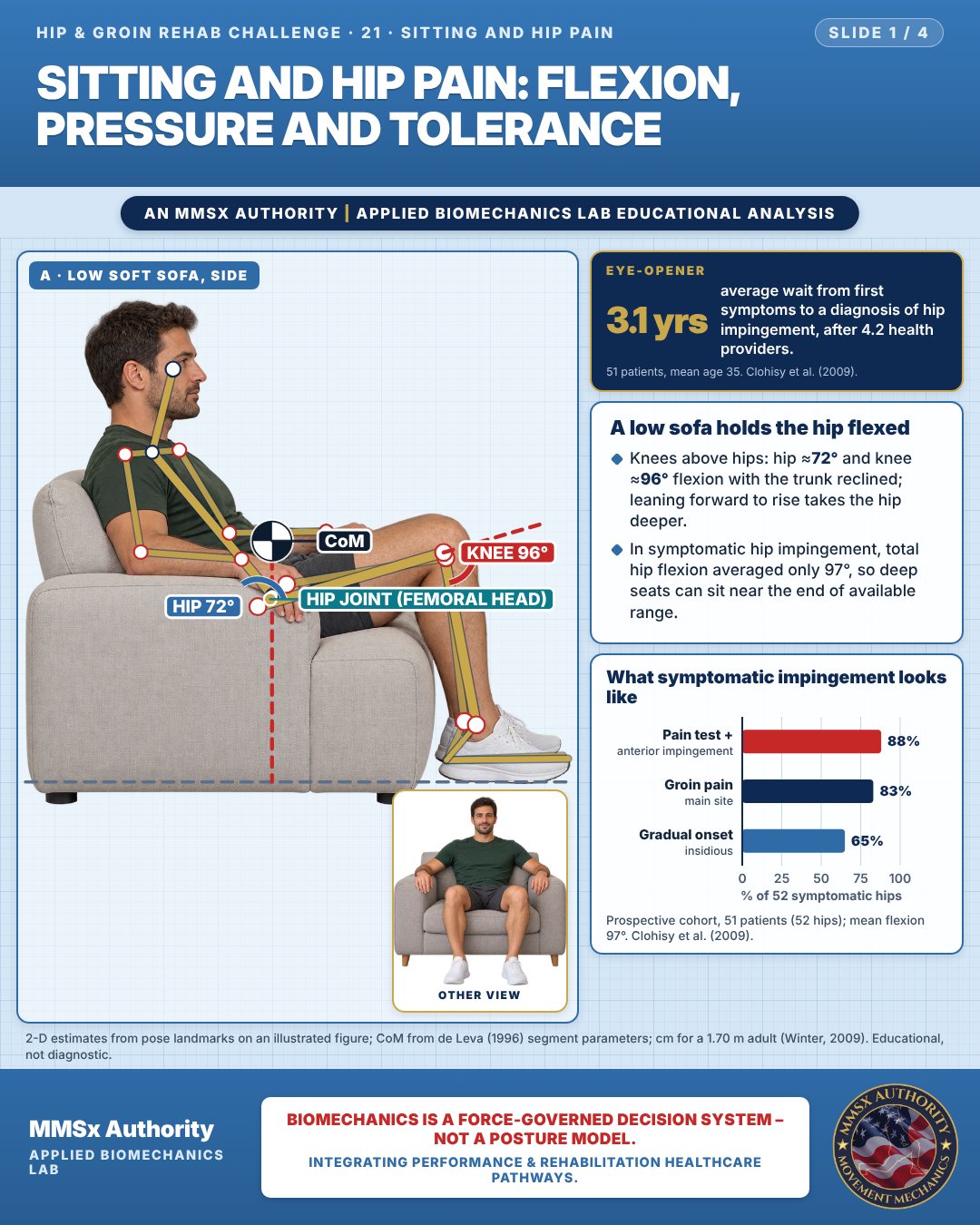
A low sofa holds the hip flexed
Knees above hips: hip ≈72° and knee ≈96° flexion with the trunk reclined; leaning forward to rise takes the hip deeper.
In symptomatic hip impingement, total hip flexion averaged only 97°, so deep seats can sit near the end of available range.
What symptomatic impingement looks like
Movement B: Firm upright chair (side view)
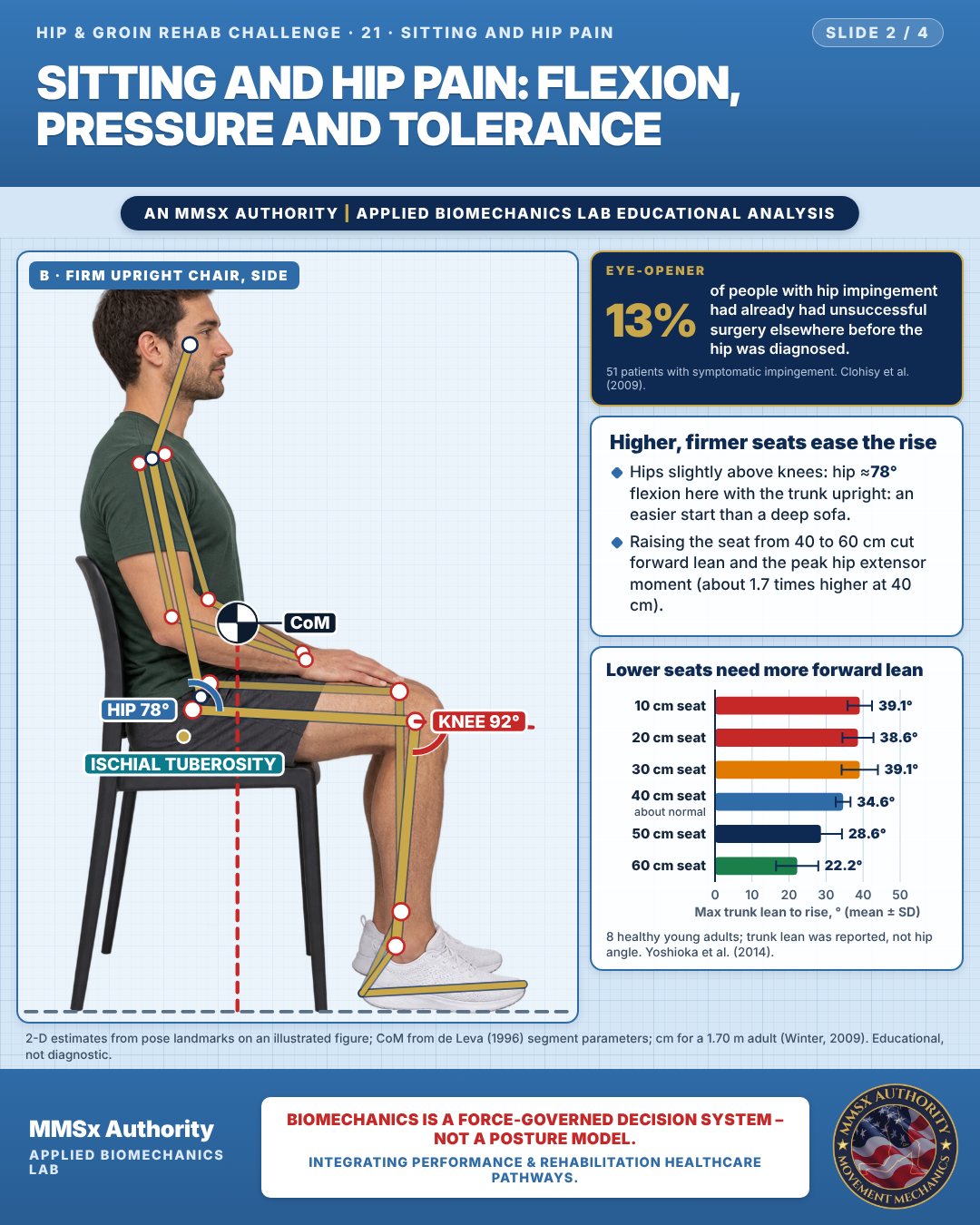
Higher, firmer seats ease the rise
Hips slightly above knees: hip ≈78° flexion here with the trunk upright: an easier start than a deep sofa.
Raising the seat from 40 to 60 cm cut forward lean and the peak hip extensor moment (about 1.7 times higher at 40 cm).
Lower seats need more forward lean
Movement C: Getting into a car (side view)
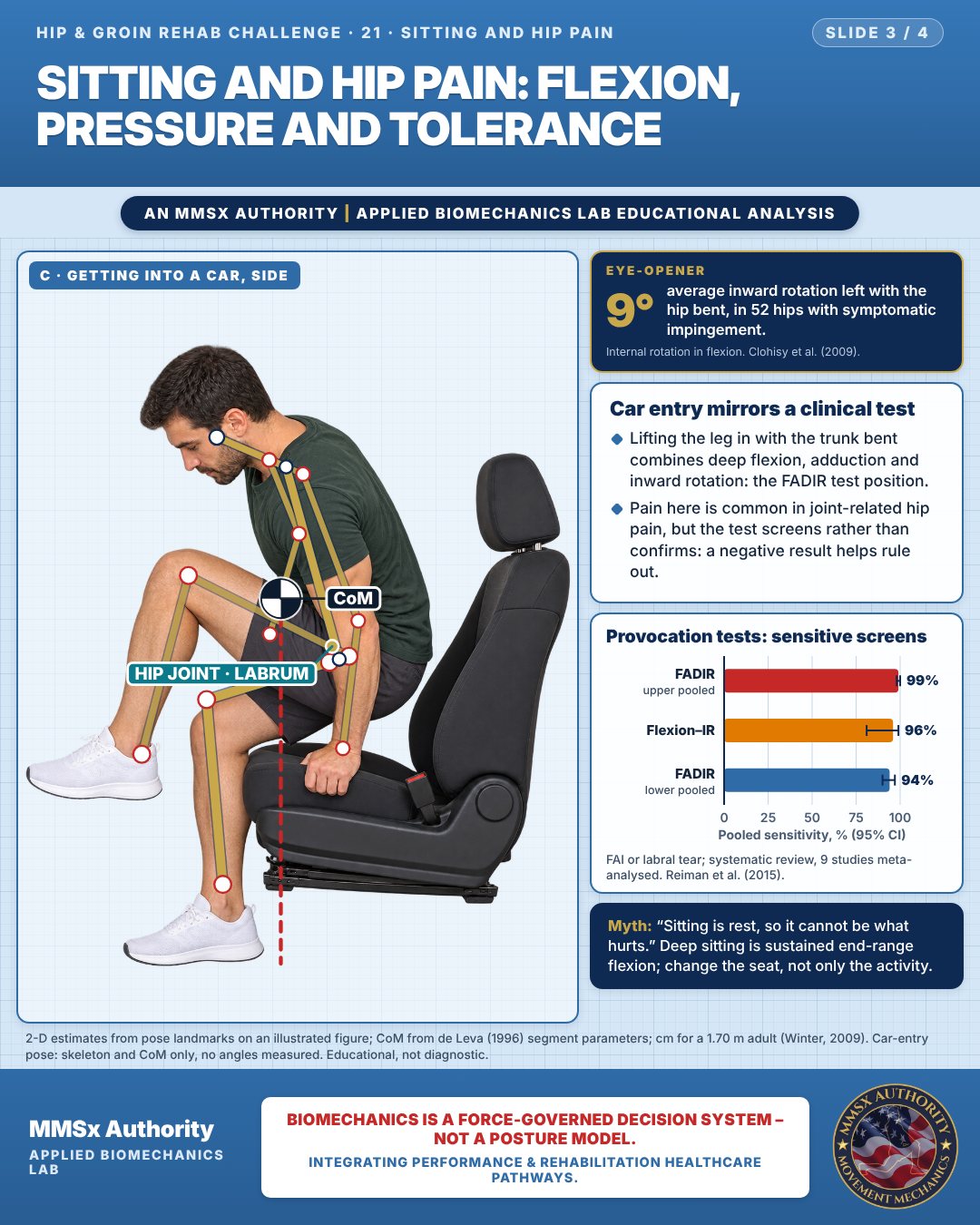
Car entry mirrors a clinical test
Lifting the leg in with the trunk bent combines deep flexion, adduction and inward rotation: the FADIR test position.
Pain here is common in joint-related hip pain, but the test screens rather than confirms: a negative result helps rule out.
Provocation tests: sensitive screens
Decision pathway
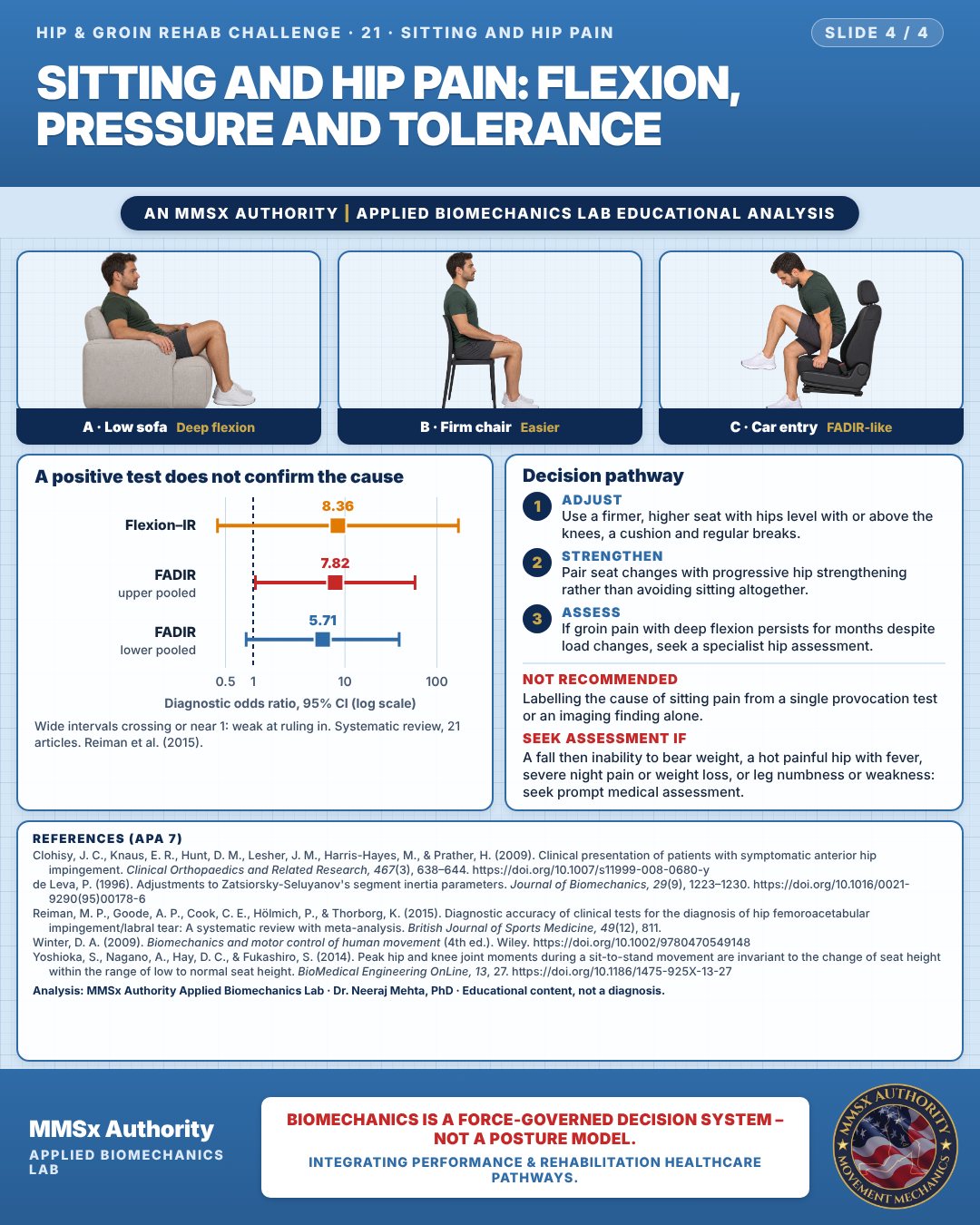
A positive test does not confirm the cause
Adjust
Use a firmer, higher seat with hips level with or above the knees, a cushion and regular breaks.
Strengthen
Pair seat changes with progressive hip strengthening rather than avoiding sitting altogether.
Assess
If groin pain with deep flexion persists for months despite load changes, seek a specialist hip assessment.
What the evidence supports
- Practical seat set-up follows the mechanics above: a firmer, higher seat with the hips level with or above the knees reduces forward lean and the hip extensor demand to rise (Yoshioka et al., 2014).
Myth and evidence
Myth“Sitting is rest, so it can't be what is hurting my hip.”
EvidenceDeep sitting is a sustained end-range flexion position. People with symptomatic FAI averaged only 97° of hip flexion (Clohisy et al., 2009), and low seats demand more forward lean to rise (Yoshioka et al., 2014). The fix is seat height and load management, not complete avoidance of sitting.
Cautions
Not recommended
Labelling the cause of sitting pain from a single provocation test or an imaging finding alone.
Seek assessment if
A fall then inability to bear weight, a hot painful hip with fever, severe night pain or weight loss, or leg numbness or weakness: seek prompt medical assessment.
Methods note
2-D estimates from pose landmarks on an illustrated figure; CoM from de Leva (1996) segment parameters; cm for a 1.70 m adult (Winter, 2009). Car-entry pose: skeleton and CoM only, no angles measured. These are educational estimates, not a diagnosis.
References
- Clohisy, J. C., Knaus, E. R., Hunt, D. M., Lesher, J. M., Harris-Hayes, M., & Prather, H. (2009). Clinical presentation of patients with symptomatic anterior hip impingement. Clinical Orthopaedics and Related Research, 467(3), 638–644. https://doi.org/10.1007/s11999-008-0680-y
- de Leva, P. (1996). Adjustments to Zatsiorsky-Seluyanov's segment inertia parameters. Journal of Biomechanics, 29(9), 1223–1230. https://doi.org/10.1016/0021-9290(95)00178-6
- Reiman, M. P., Goode, A. P., Cook, C. E., Hölmich, P., & Thorborg, K. (2015). Diagnostic accuracy of clinical tests for the diagnosis of hip femoroacetabular impingement/labral tear: A systematic review with meta-analysis. British Journal of Sports Medicine, 49(12), 811.
- Winter, D. A. (2009). Biomechanics and motor control of human movement (4th ed.). Wiley. https://doi.org/10.1002/9780470549148
- Yoshioka, S., Nagano, A., Hay, D. C., & Fukashiro, S. (2014). Peak hip and knee joint moments during a sit-to-stand movement are invariant to the change of seat height within the range of low to normal seat height. BioMedical Engineering OnLine, 13, 27. https://doi.org/10.1186/1475-925X-13-27
Cite this article
Mehta, N. (2026, October 28). Sitting and hip pain: flexion, pressure and tolerance. MMSx Authority Applied Biomechanics Lab. https://mmsxauthority.org/edu/analysis/hip-groin/21-sitting-and-hip-pain-flexion-pressure-and-tolerance/
Part of the collection
Mehta, N. (2026). Hip and Groin Rehabilitation: 30 Evidence-Based Biomechanics Analyses [Collection]. MMSx Authority Applied Biomechanics Lab. Zenodo. https://doi.org/10.5281/zenodo.23735806
All Hip & Groin Rehab Challenge articles · Rehabilitation Library