Hip & Groin Rehab Challenge · 10
Deep squat hip pain: depth, stance width and hip shape
Feet close and toes straight: as depth increases the flexed hips also move towards adduction and internal rotation, the impingement direction. People…
Key points
- Cap. Limit depth for now, for example to a box at parallel, and keep strength work going.
- Adjust. Vary stance width and foot angle to find a pain-free path.
- Progress. Lower the box as symptoms allow; build strength, control and range.
What it is
In a deep squat the hip moves into high flexion. When flexion is combined with adduction and internal rotation, the femoral head–neck junction approaches the acetabular rim — the position used in impingement tests. Hip bone shape (cam or pincer morphology), stance width and foot angle change how close the hip comes to that position; pain in deep squatting is one of the typical motion-related symptoms of FAI syndrome.
How we analysed the movement
Three movements relevant to this topic were analysed from illustrated reference figures. Joint centres were located with two-dimensional pose estimation; hip and knee angles, pelvis level, the whole-body centre of mass and, where relevant, the hip lever (the horizontal distance from the hip joint to the upper-body centre of mass) and the resulting static hip moment were then calculated from standard segment parameters. The figures are educational estimates that show how position changes mechanical demand; they are not measurements of a patient. Every research value quoted below comes from the published source cited beside it.
Movement A: Narrow squat (front view)
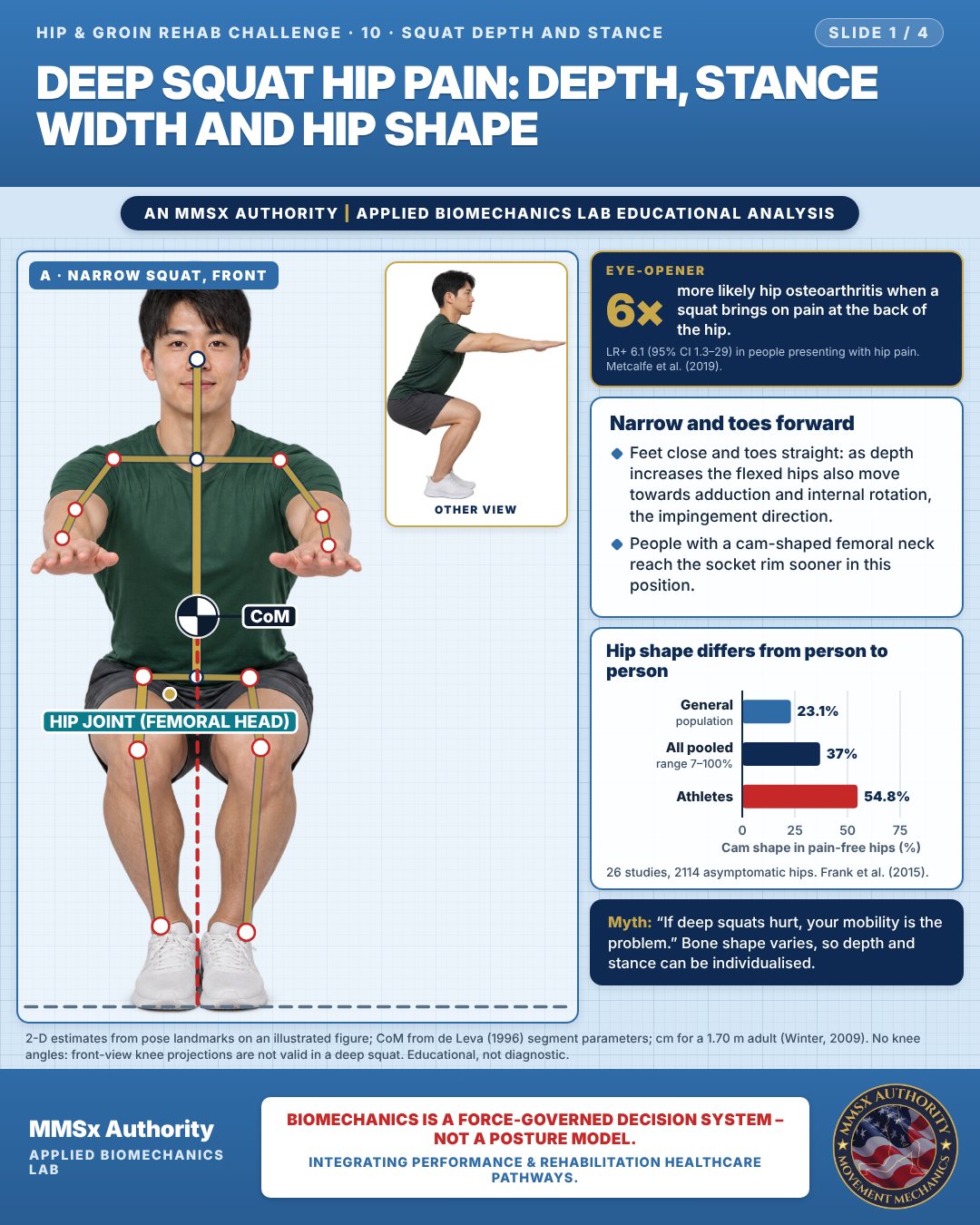
Narrow and toes forward
Feet close and toes straight: as depth increases the flexed hips also move towards adduction and internal rotation, the impingement direction.
People with a cam-shaped femoral neck reach the socket rim sooner in this position.
Hip shape differs from person to person
Movement B: Wide squat, toes out (front view)
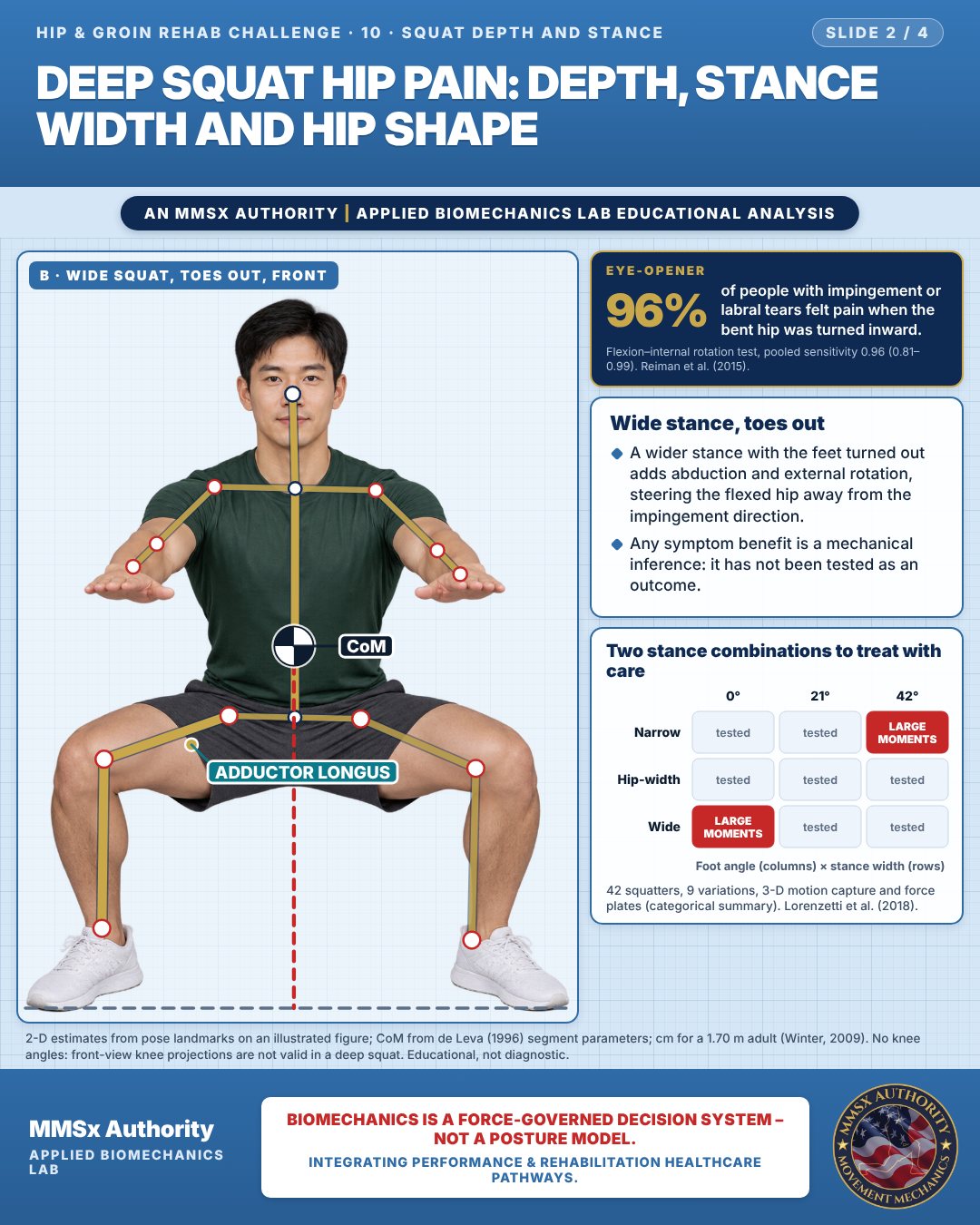
Wide stance, toes out
A wider stance with the feet turned out adds abduction and external rotation, steering the flexed hip away from the impingement direction.
Any symptom benefit is a mechanical inference: it has not been tested as an outcome.
Two stance combinations to treat with care
Movement C: Box squat (side view)
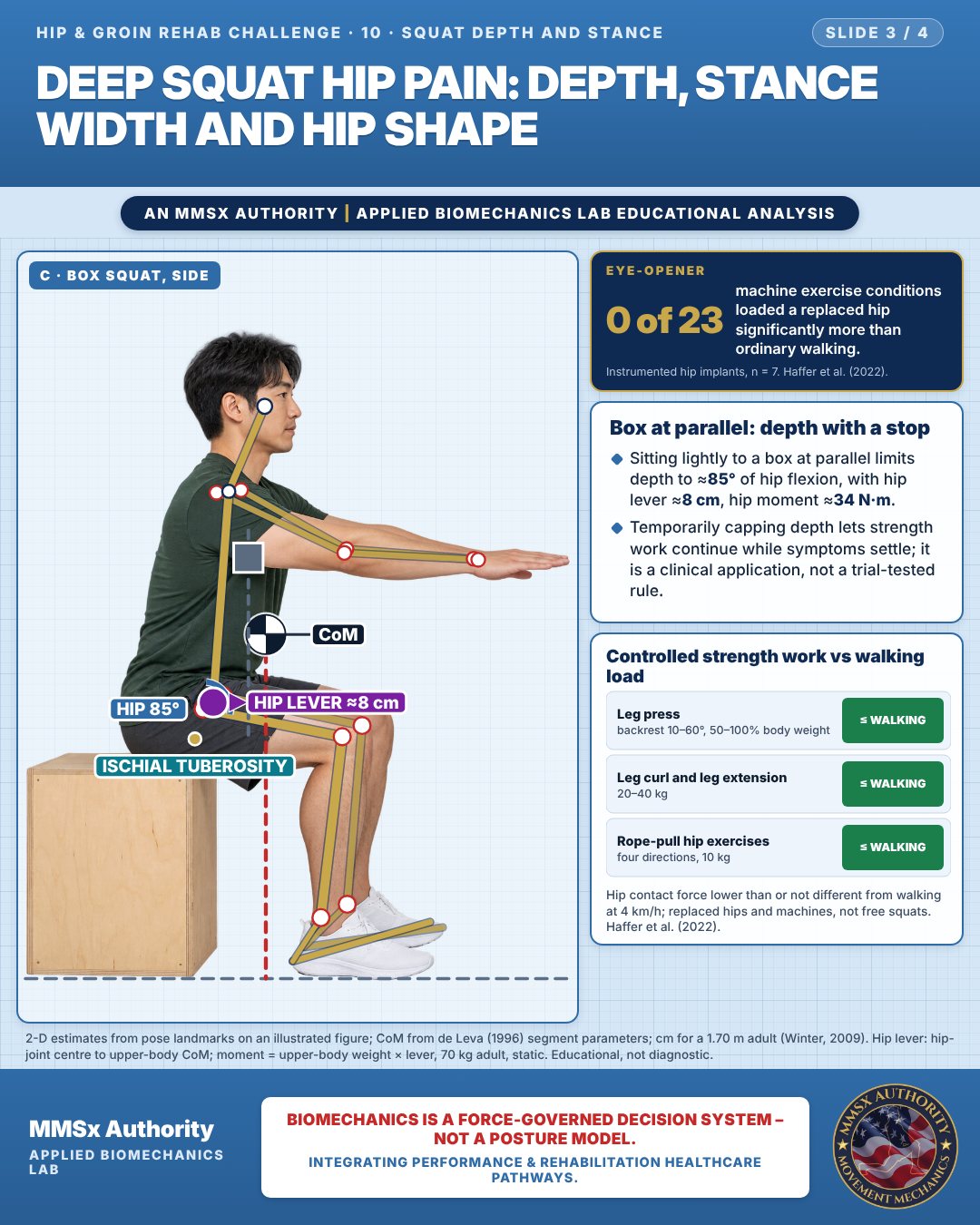
Box at parallel: depth with a stop
Sitting lightly to a box at parallel limits depth to ≈85° of hip flexion, with hip lever ≈8 cm, hip moment ≈34 N·m.
Temporarily capping depth lets strength work continue while symptoms settle; it is a clinical application, not a trial-tested rule.
Controlled strength work vs walking load
Decision pathway
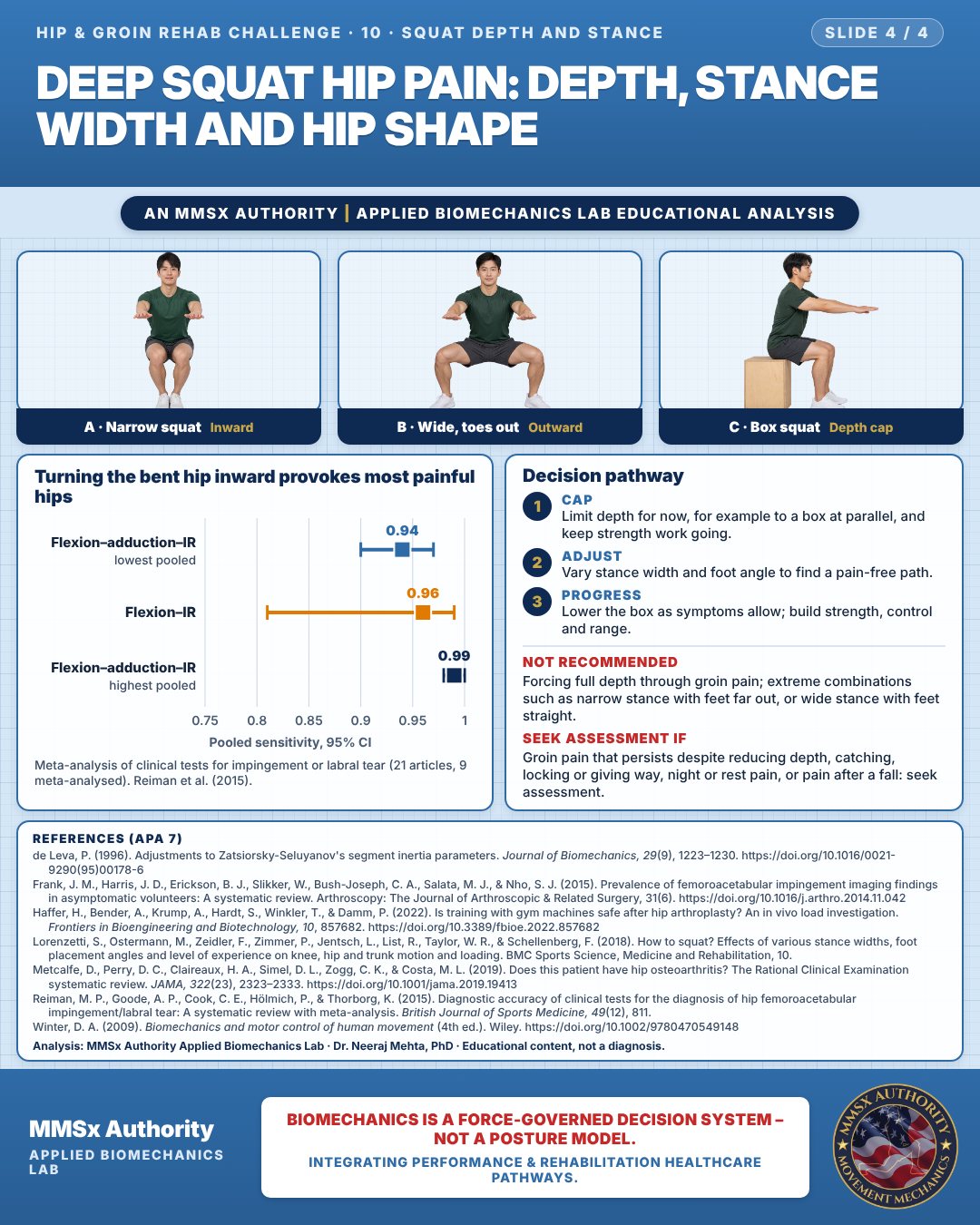
Turning the bent hip inward provokes most painful hips
Cap
Limit depth for now, for example to a box at parallel, and keep strength work going.
Adjust
Vary stance width and foot angle to find a pain-free path.
Progress
Lower the box as symptoms allow; build strength, control and range.
Myth and evidence
Myth“Everyone should squat as deep as possible with feet narrow and straight — if it hurts, your mobility is the problem.”
EvidenceHip shape varies (cam morphology in 23–55% of pain-free people; Frank et al., 2015), and flexion with adduction and internal rotation is the provocative direction (Reiman et al., 2015). Depth and stance can be individualised.
Cautions
Not recommended
Forcing full depth through groin pain; extreme combinations such as narrow stance with feet far out, or wide stance with feet straight.
Seek assessment if
Groin pain that persists despite reducing depth, catching, locking or giving way, night or rest pain, or pain after a fall: seek assessment.
Methods note
2-D estimates from pose landmarks on an illustrated figure; CoM from de Leva (1996) segment parameters; cm for a 1.70 m adult (Winter, 2009). No knee angles: front-view knee projections are not valid in a deep squat. Hip lever: hip-joint centre to upper-body CoM; moment = upper-body weight × lever, 70 kg adult, static. These are educational estimates, not a diagnosis.
References
- de Leva, P. (1996). Adjustments to Zatsiorsky-Seluyanov's segment inertia parameters. Journal of Biomechanics, 29(9), 1223–1230. https://doi.org/10.1016/0021-9290(95)00178-6
- Frank, J. M., Harris, J. D., Erickson, B. J., Slikker, W., Bush-Joseph, C. A., Salata, M. J., & Nho, S. J. (2015). Prevalence of femoroacetabular impingement imaging findings in asymptomatic volunteers: A systematic review. Arthroscopy: The Journal of Arthroscopic & Related Surgery, 31(6). https://doi.org/10.1016/j.arthro.2014.11.042
- Haffer, H., Bender, A., Krump, A., Hardt, S., Winkler, T., & Damm, P. (2022). Is training with gym machines safe after hip arthroplasty? An in vivo load investigation. Frontiers in Bioengineering and Biotechnology, 10, 857682. https://doi.org/10.3389/fbioe.2022.857682
- Lorenzetti, S., Ostermann, M., Zeidler, F., Zimmer, P., Jentsch, L., List, R., Taylor, W. R., & Schellenberg, F. (2018). How to squat? Effects of various stance widths, foot placement angles and level of experience on knee, hip and trunk motion and loading. BMC Sports Science, Medicine and Rehabilitation, 10.
- Metcalfe, D., Perry, D. C., Claireaux, H. A., Simel, D. L., Zogg, C. K., & Costa, M. L. (2019). Does this patient have hip osteoarthritis? The Rational Clinical Examination systematic review. JAMA, 322(23), 2323–2333. https://doi.org/10.1001/jama.2019.19413
- Reiman, M. P., Goode, A. P., Cook, C. E., Hölmich, P., & Thorborg, K. (2015). Diagnostic accuracy of clinical tests for the diagnosis of hip femoroacetabular impingement/labral tear: A systematic review with meta-analysis. British Journal of Sports Medicine, 49(12), 811.
- Winter, D. A. (2009). Biomechanics and motor control of human movement (4th ed.). Wiley. https://doi.org/10.1002/9780470549148
Cite this article
Mehta, N. (2026, October 28). Deep squat hip pain: depth, stance width and hip shape. MMSx Authority Applied Biomechanics Lab. https://mmsxauthority.org/edu/analysis/hip-groin/10-deep-squat-hip-pain-depth-stance-width-and-hip-shape/
Part of the collection
Mehta, N. (2026). Hip and Groin Rehabilitation: 30 Evidence-Based Biomechanics Analyses [Collection]. MMSx Authority Applied Biomechanics Lab. Zenodo. https://doi.org/10.5281/zenodo.23735806
All Hip & Groin Rehab Challenge articles · Rehabilitation Library