Hip & Groin Rehab Challenge · 04
Hip osteoarthritis and walking: how load through the joint changes with speed
Each walking step loads the hip joint through body weight plus the pull of the hip muscles (mainly the abductors that keep the pelvis level), so the…
Key points
- Pace. Adjust walking speed to symptoms: slower walking lowers the peak force on the hip.
- Support. Use a stick or crutches on painful days; crutches cut hip force by 12–17%.
- Build. Keep walking and exercising, and support weight loss where needed (NICE, 2022).
What it is
Each walking step loads the hip joint through body weight plus the pull of the hip muscles (mainly the abductors that keep the pelvis level), so the joint contact force is a multiple of body weight. In hip osteoarthritis, people typically walk more slowly with shorter steps. Walking speed, stride and walking aids change how much and how often the joint is loaded (Bergmann et al., 1993; Constantinou et al., 2014).
How we analysed the movement
Three movements relevant to this topic were analysed from illustrated reference figures. Joint centres were located with two-dimensional pose estimation; hip and knee angles, pelvis level, the whole-body centre of mass and, where relevant, the hip lever (the horizontal distance from the hip joint to the upper-body centre of mass) and the resulting static hip moment were then calculated from standard segment parameters. The figures are educational estimates that show how position changes mechanical demand; they are not measurements of a patient. Every research value quoted below comes from the published source cited beside it.
Movement A: Slow walk (side view)
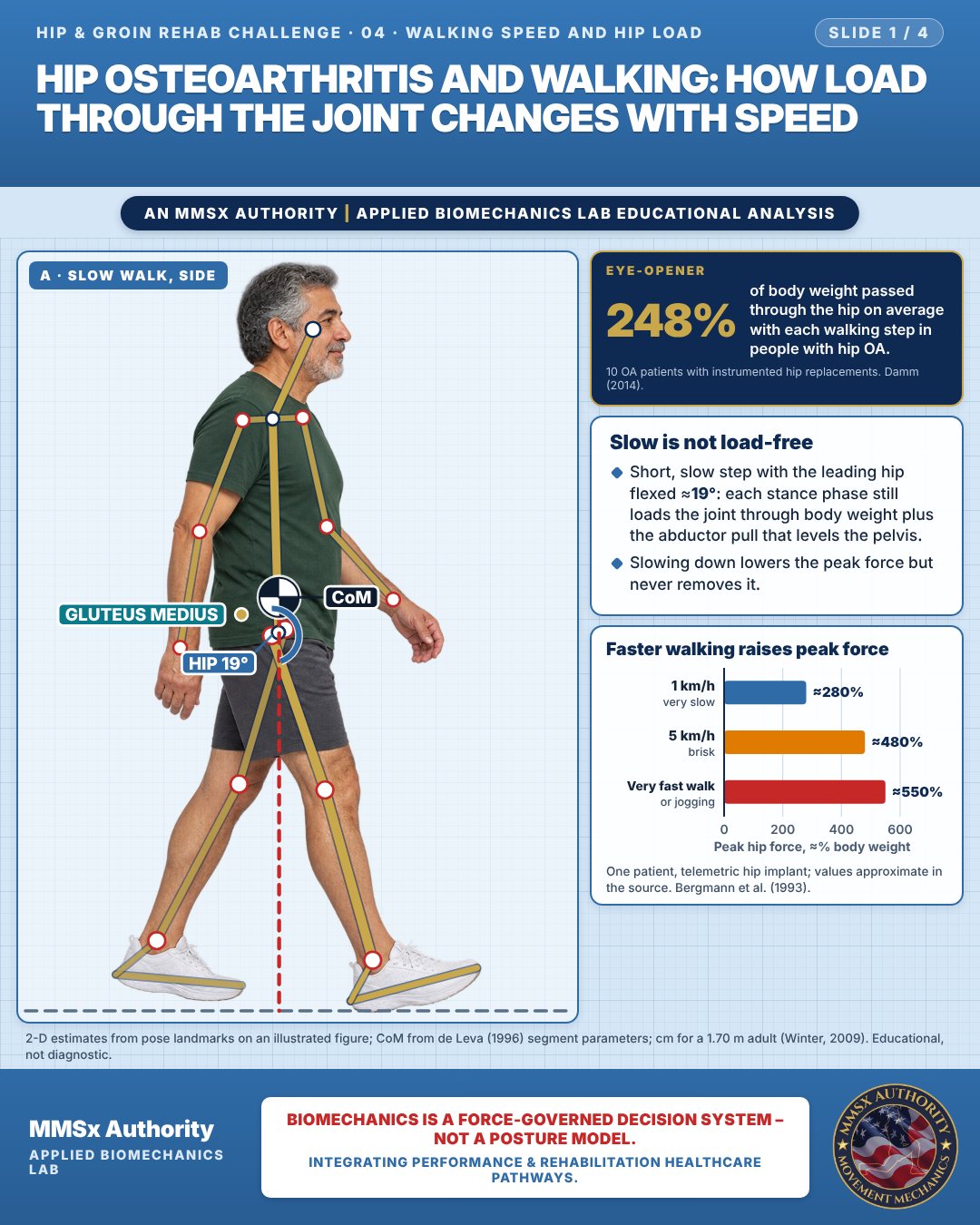
Slow is not load-free
Short, slow step with the leading hip flexed ≈19°: each stance phase still loads the joint through body weight plus the abductor pull that levels the pelvis.
Slowing down lowers the peak force but never removes it.
Faster walking raises peak force
Movement B: Brisk walk (side view)
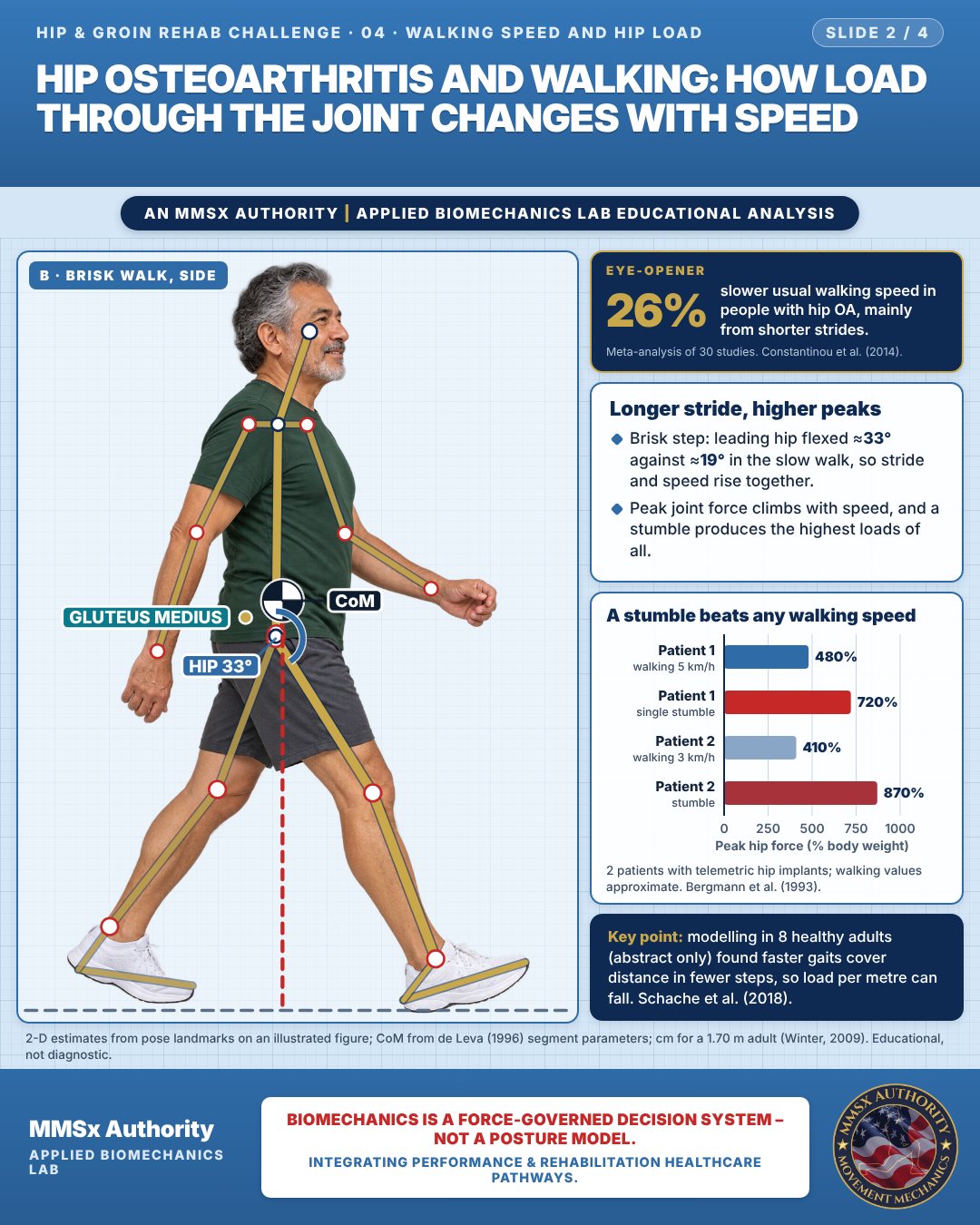
Longer stride, higher peaks
Brisk step: leading hip flexed ≈33° against ≈19° in the slow walk, so stride and speed rise together.
Peak joint force climbs with speed, and a stumble produces the highest loads of all.
A stumble beats any walking speed
Movement C: Walking with a stick (side view)
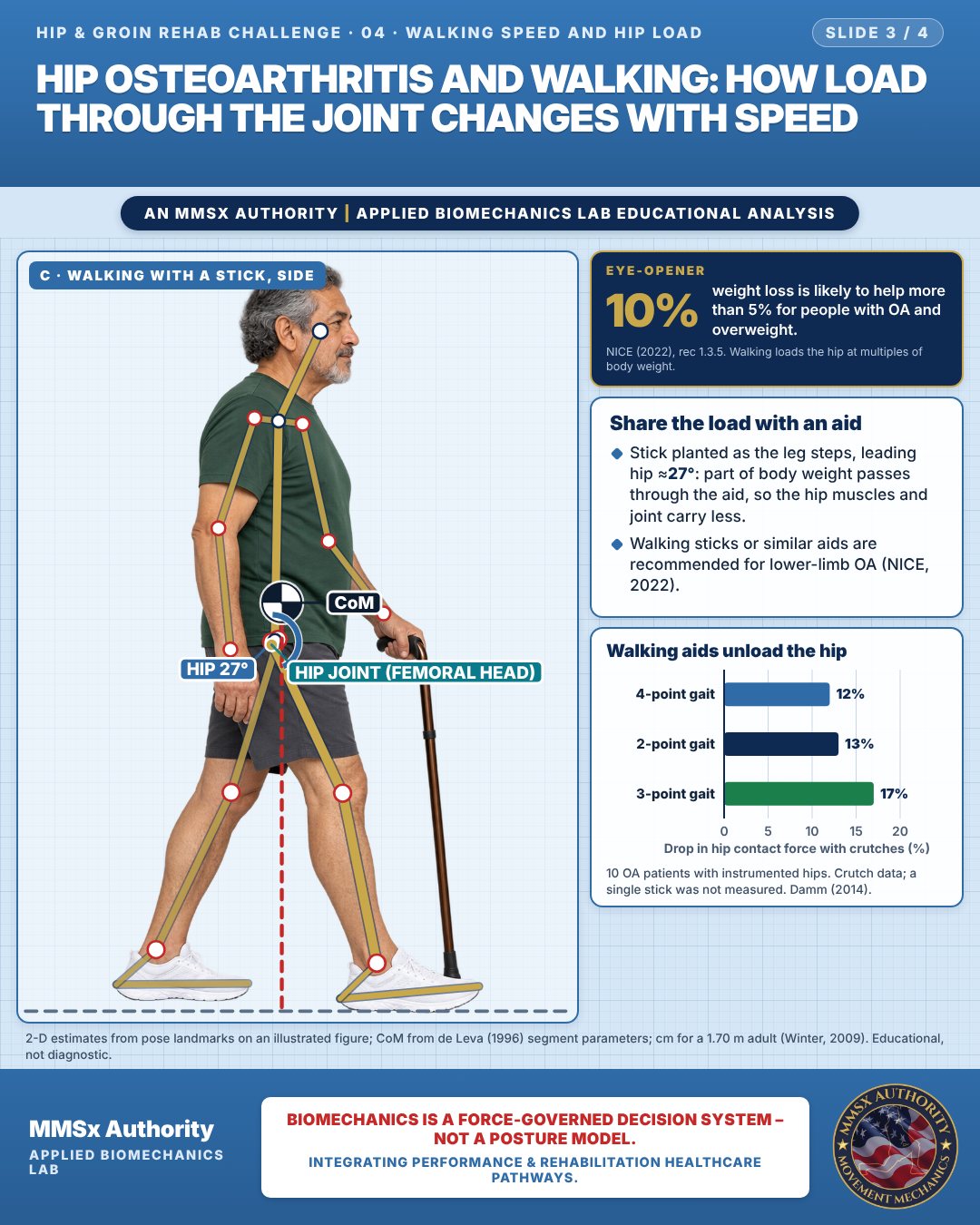
Share the load with an aid
Stick planted as the leg steps, leading hip ≈27°: part of body weight passes through the aid, so the hip muscles and joint carry less.
Walking sticks or similar aids are recommended for lower-limb OA (NICE, 2022).
Walking aids unload the hip
Decision pathway
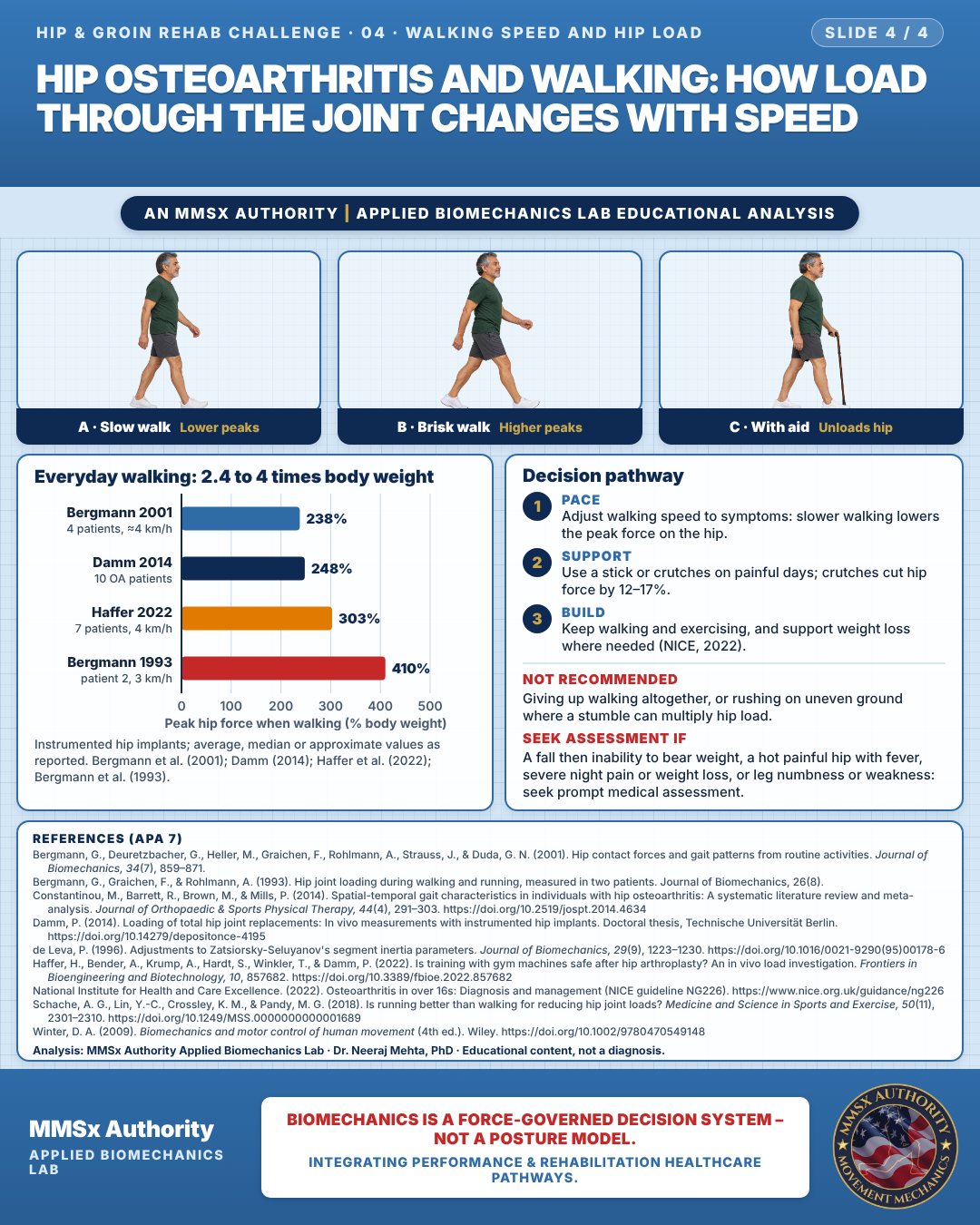
Everyday walking: 2.4 to 4 times body weight
Pace
Adjust walking speed to symptoms: slower walking lowers the peak force on the hip.
Support
Use a stick or crutches on painful days; crutches cut hip force by 12–17%.
Build
Keep walking and exercising, and support weight loss where needed (NICE, 2022).
What the evidence supports
- Walking pace can be adjusted to symptoms: slower walking lowers peak force (Bergmann et al., 1993).
Cautions
Not recommended
Giving up walking altogether, or rushing on uneven ground where a stumble can multiply hip load.
Seek assessment if
A fall then inability to bear weight, a hot painful hip with fever, severe night pain or weight loss, or leg numbness or weakness: seek prompt medical assessment.
Methods note
2-D estimates from pose landmarks on an illustrated figure; CoM from de Leva (1996) segment parameters; cm for a 1.70 m adult (Winter, 2009). These are educational estimates, not a diagnosis.
References
- Bergmann, G., Deuretzbacher, G., Heller, M., Graichen, F., Rohlmann, A., Strauss, J., & Duda, G. N. (2001). Hip contact forces and gait patterns from routine activities. Journal of Biomechanics, 34(7), 859–871.
- Bergmann, G., Graichen, F., & Rohlmann, A. (1993). Hip joint loading during walking and running, measured in two patients. Journal of Biomechanics, 26(8).
- Constantinou, M., Barrett, R., Brown, M., & Mills, P. (2014). Spatial-temporal gait characteristics in individuals with hip osteoarthritis: A systematic literature review and meta-analysis. Journal of Orthopaedic & Sports Physical Therapy, 44(4), 291–303. https://doi.org/10.2519/jospt.2014.4634
- Damm, P. (2014). Loading of total hip joint replacements: In vivo measurements with instrumented hip implants. Doctoral thesis, Technische Universität Berlin. https://doi.org/10.14279/depositonce-4195
- de Leva, P. (1996). Adjustments to Zatsiorsky-Seluyanov's segment inertia parameters. Journal of Biomechanics, 29(9), 1223–1230. https://doi.org/10.1016/0021-9290(95)00178-6
- Haffer, H., Bender, A., Krump, A., Hardt, S., Winkler, T., & Damm, P. (2022). Is training with gym machines safe after hip arthroplasty? An in vivo load investigation. Frontiers in Bioengineering and Biotechnology, 10, 857682. https://doi.org/10.3389/fbioe.2022.857682
- National Institute for Health and Care Excellence. (2022). Osteoarthritis in over 16s: Diagnosis and management (NICE guideline NG226). https://www.nice.org.uk/guidance/ng226
- Schache, A. G., Lin, Y.-C., Crossley, K. M., & Pandy, M. G. (2018). Is running better than walking for reducing hip joint loads? Medicine and Science in Sports and Exercise, 50(11), 2301–2310. https://doi.org/10.1249/MSS.0000000000001689
- Winter, D. A. (2009). Biomechanics and motor control of human movement (4th ed.). Wiley. https://doi.org/10.1002/9780470549148
Cite this article
Mehta, N. (2026, October 28). Hip osteoarthritis and walking: how load through the joint changes with speed. MMSx Authority Applied Biomechanics Lab. https://mmsxauthority.org/edu/analysis/hip-groin/04-hip-osteoarthritis-and-walking-how-load-through-the-joint-changes-with/
Part of the collection
Mehta, N. (2026). Hip and Groin Rehabilitation: 30 Evidence-Based Biomechanics Analyses [Collection]. MMSx Authority Applied Biomechanics Lab. Zenodo. https://doi.org/10.5281/zenodo.23735806
All Hip & Groin Rehab Challenge articles · Rehabilitation Library