Hip & Groin Rehab Challenge · 22
Getting up from a chair: the hip strength test of daily life
Sitting tall, feet behind the knees: hip ≈ 84° and knee ≈ 94° flexion, the start of the five-times sit-to-stand test. Timing five rises and comparing…
Key points
- Measure. Time five rises with arms crossed and compare with age references; over 15 s indicates low strength.
- Scale. Start from a higher seat or with hand support, then lower the seat and remove the hands.
- Train. Progressive resistance training improves strength and chair rising in older adults.
What it is
Sit-to-stand is the transfer from sitting to standing. It requires forward trunk lean to bring the body's centre of mass over the feet, then hip and knee extensor effort to lift it. Timed chair-rise tests (for example five repetitions with arms crossed) are standard clinical measures of lower-limb strength and function in older adults (Bohannon, 2006; Cruz-Jentoft et al., 2019).
How we analysed the movement
Three movements relevant to this topic were analysed from illustrated reference figures. Joint centres were located with two-dimensional pose estimation; hip and knee angles, pelvis level, the whole-body centre of mass and, where relevant, the hip lever (the horizontal distance from the hip joint to the upper-body centre of mass) and the resulting static hip moment were then calculated from standard segment parameters. The figures are educational estimates that show how position changes mechanical demand; they are not measurements of a patient. Every research value quoted below comes from the published source cited beside it.
Movement A: Seated start (side view)
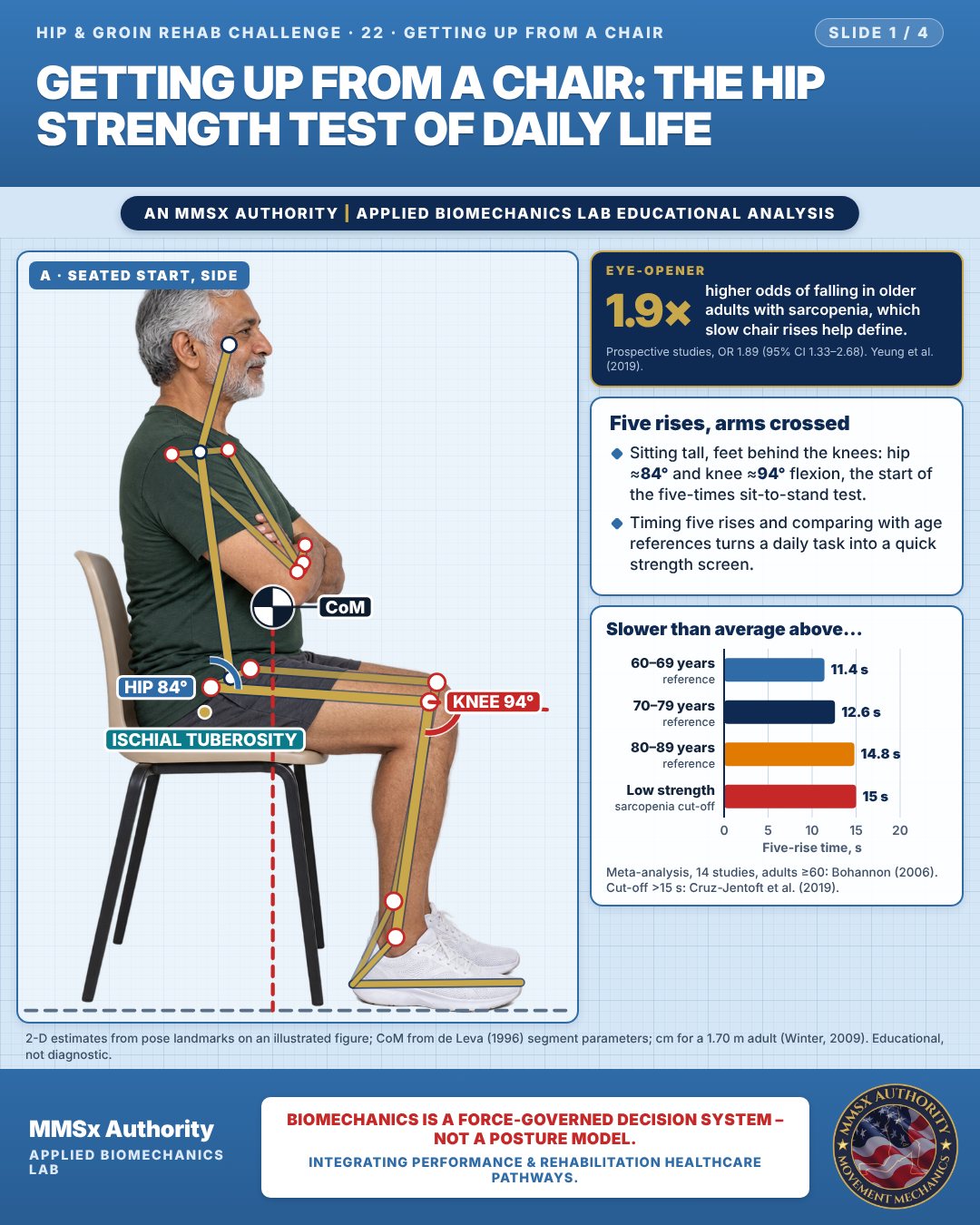
Five rises, arms crossed
Sitting tall, feet behind the knees: hip ≈84° and knee ≈94° flexion, the start of the five-times sit-to-stand test.
Timing five rises and comparing with age references turns a daily task into a quick strength screen.
Slower than average above…
Movement B: Lift-off (side view)
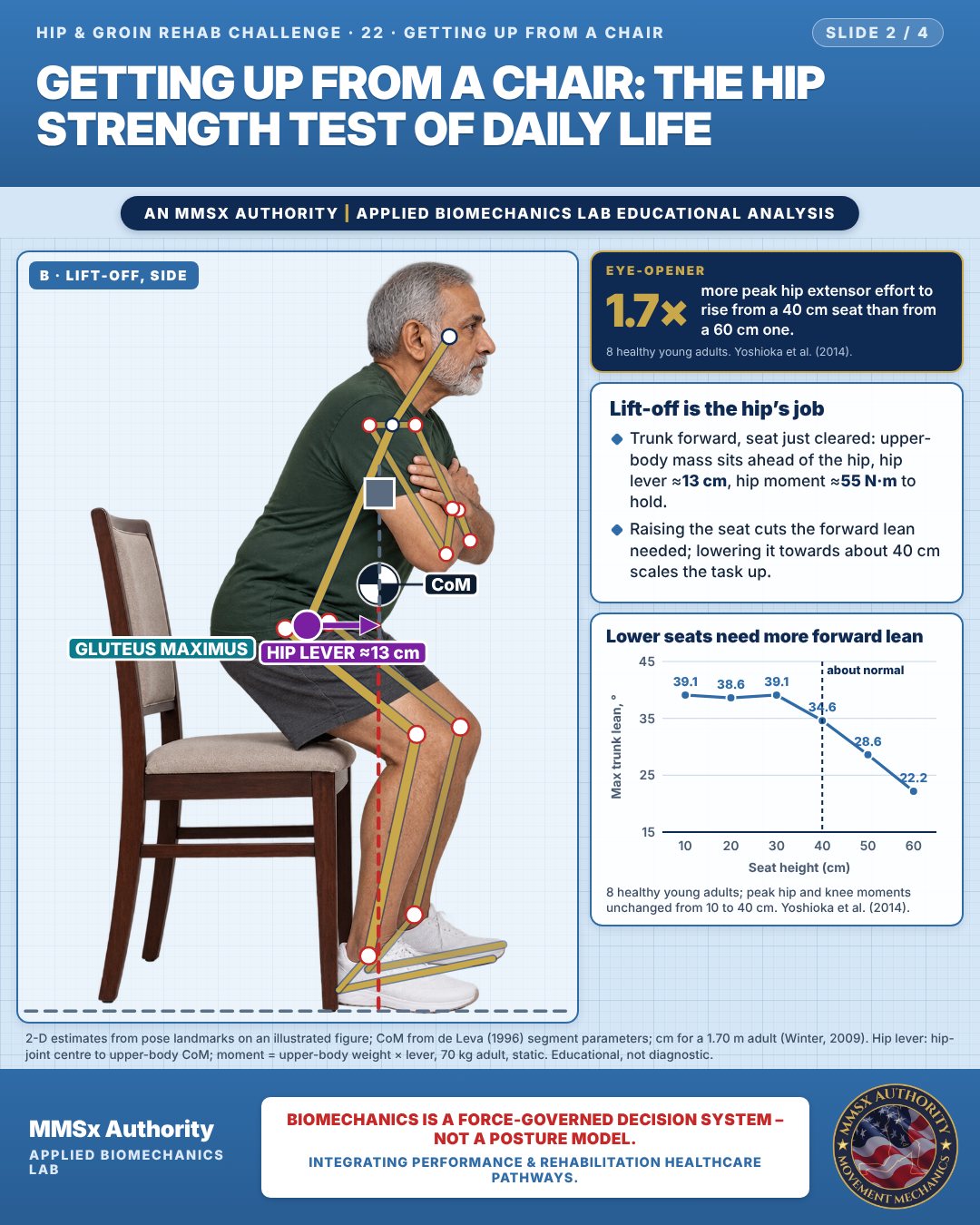
Lift-off is the hip’s job
Trunk forward, seat just cleared: upper-body mass sits ahead of the hip, hip lever ≈13 cm, hip moment ≈55 N·m to hold.
Raising the seat cuts the forward lean needed; lowering it towards about 40 cm scales the task up.
Lower seats need more forward lean
Movement C: Hands push-off (side view)
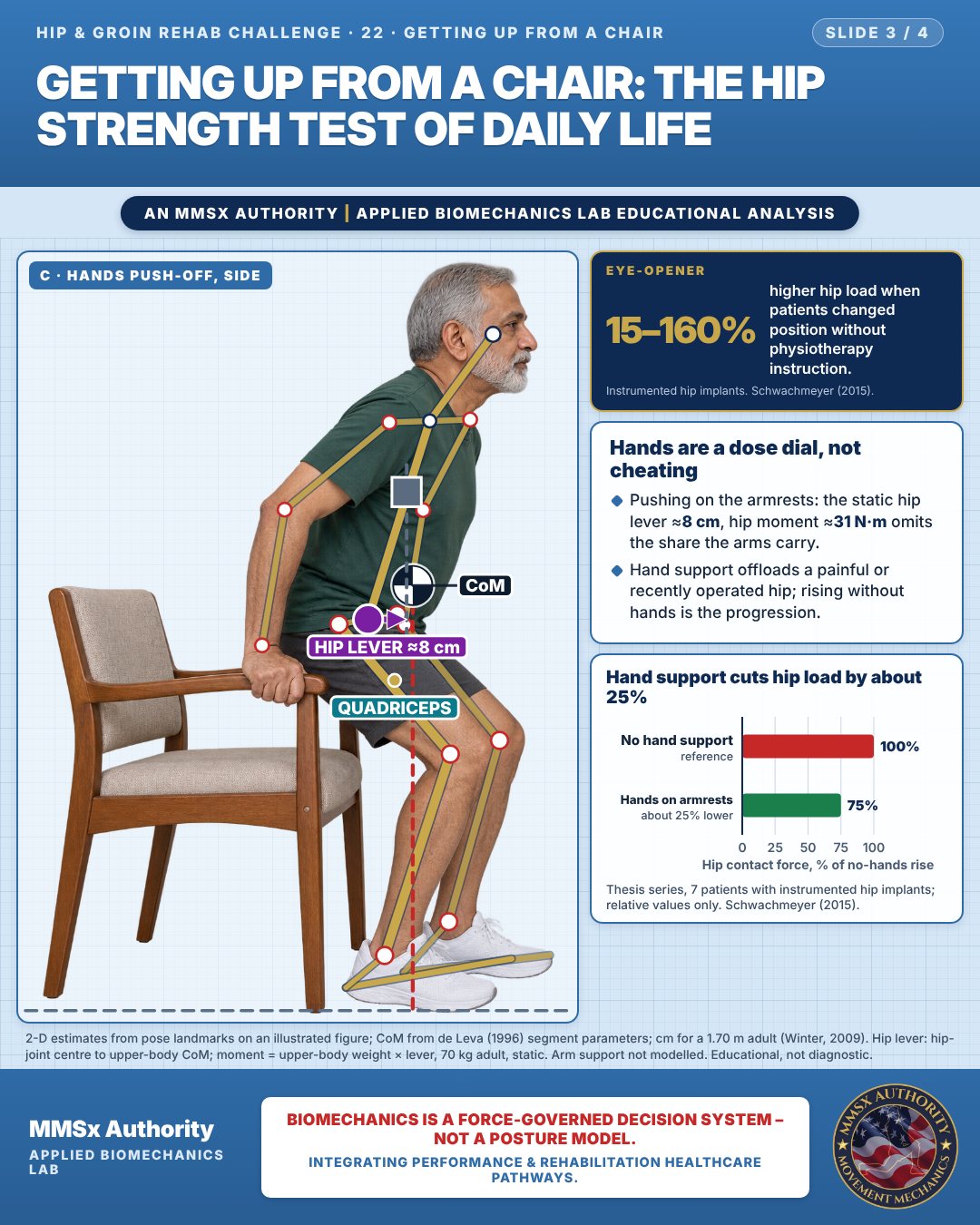
Hands are a dose dial, not cheating
Pushing on the armrests: the static hip lever ≈8 cm, hip moment ≈31 N·m omits the share the arms carry.
Hand support offloads a painful or recently operated hip; rising without hands is the progression.
Hand support cuts hip load by about 25%
Decision pathway
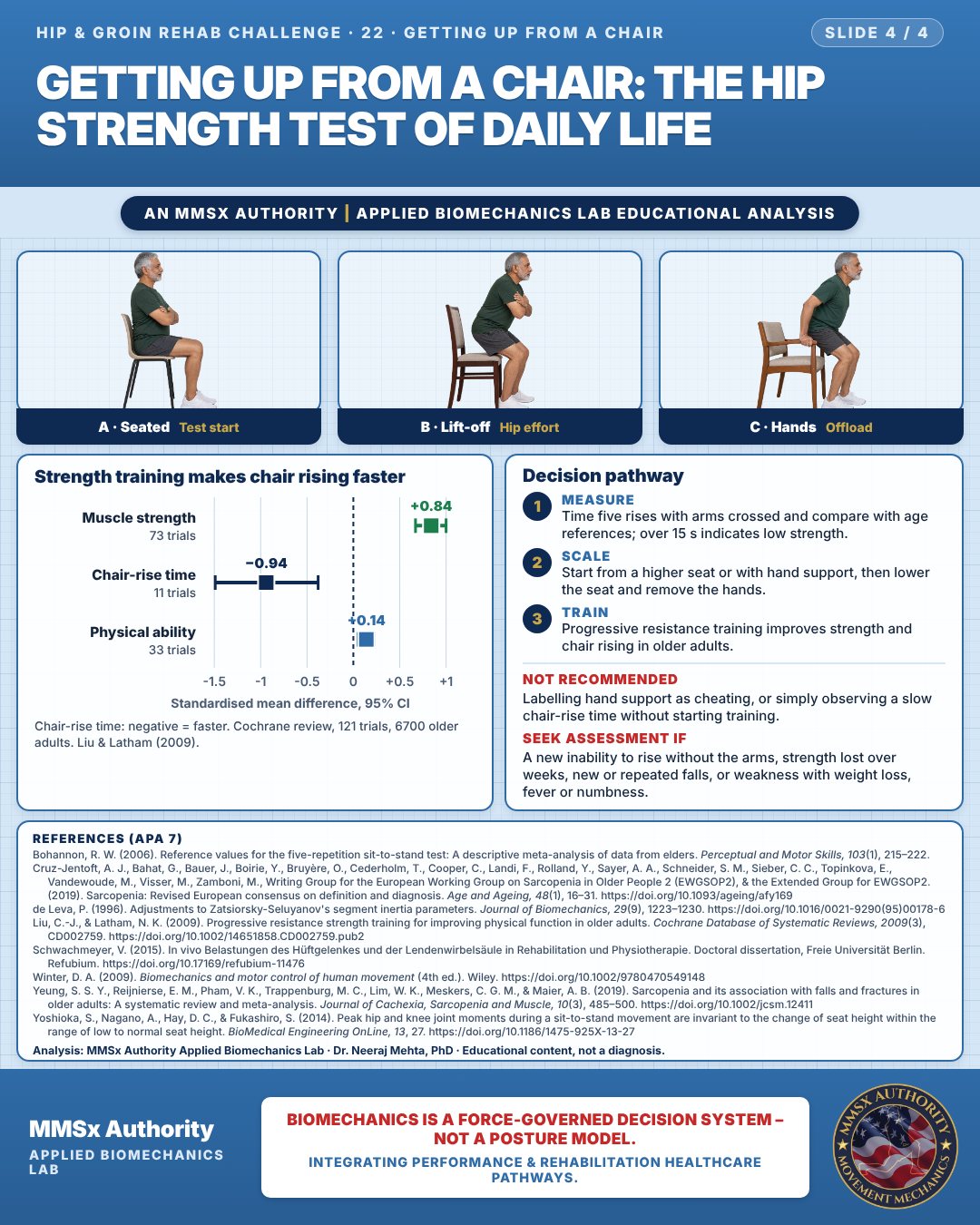
Strength training makes chair rising faster
Measure
Time five rises with arms crossed and compare with age references; over 15 s indicates low strength.
Scale
Start from a higher seat or with hand support, then lower the seat and remove the hands.
Train
Progressive resistance training improves strength and chair rising in older adults.
What the evidence supports
- Measure: use a timed chair-rise test and compare with age references (Bohannon, 2006); a five-rise time over 15 s indicates low strength in the sarcopenia consensus (Cruz-Jentoft et al., 2019).
- Train: progressive resistance training improves strength and chair rising in older adults (Liu & Latham, 2009). Scale the task with seat height (Yoshioka et al., 2014) and hand support (Schwachmeyer, 2015), then progress to lower seats without hands.
Myth and evidence
Myth“Using your hands to get up is cheating.”
EvidenceHand support reduced hip contact force by about 25% in patients with instrumented implants (Schwachmeyer, 2015), so it is a useful dose-reduction tool. What matters is progression: chair-rise performance is highly trainable in older adults (Liu & Latham, 2009).
Cautions
Not recommended
Labelling hand support as cheating, or simply observing a slow chair-rise time without starting training.
Seek assessment if
A new inability to rise without the arms, strength lost over weeks, new or repeated falls, or weakness with weight loss, fever or numbness.
Methods note
2-D estimates from pose landmarks on an illustrated figure; CoM from de Leva (1996) segment parameters; cm for a 1.70 m adult (Winter, 2009). Hip lever: hip-joint centre to upper-body CoM; moment = upper-body weight × lever, 70 kg adult, static. Arm support not modelled. These are educational estimates, not a diagnosis.
References
- Bohannon, R. W. (2006). Reference values for the five-repetition sit-to-stand test: A descriptive meta-analysis of data from elders. Perceptual and Motor Skills, 103(1), 215–222.
- Cruz-Jentoft, A. J., Bahat, G., Bauer, J., Boirie, Y., Bruyère, O., Cederholm, T., Cooper, C., Landi, F., Rolland, Y., Sayer, A. A., Schneider, S. M., Sieber, C. C., Topinkova, E., Vandewoude, M., Visser, M., Zamboni, M., Writing Group for the European Working Group on Sarcopenia in Older People 2 (EWGSOP2), & the Extended Group for EWGSOP2. (2019). Sarcopenia: Revised European consensus on definition and diagnosis. Age and Ageing, 48(1), 16–31. https://doi.org/10.1093/ageing/afy169
- de Leva, P. (1996). Adjustments to Zatsiorsky-Seluyanov's segment inertia parameters. Journal of Biomechanics, 29(9), 1223–1230. https://doi.org/10.1016/0021-9290(95)00178-6
- Liu, C.-J., & Latham, N. K. (2009). Progressive resistance strength training for improving physical function in older adults. Cochrane Database of Systematic Reviews, 2009(3), CD002759. https://doi.org/10.1002/14651858.CD002759.pub2
- Schwachmeyer, V. (2015). In vivo Belastungen des Hüftgelenkes und der Lendenwirbelsäule in Rehabilitation und Physiotherapie. Doctoral dissertation, Freie Universität Berlin. Refubium. https://doi.org/10.17169/refubium-11476
- Winter, D. A. (2009). Biomechanics and motor control of human movement (4th ed.). Wiley. https://doi.org/10.1002/9780470549148
- Yeung, S. S. Y., Reijnierse, E. M., Pham, V. K., Trappenburg, M. C., Lim, W. K., Meskers, C. G. M., & Maier, A. B. (2019). Sarcopenia and its association with falls and fractures in older adults: A systematic review and meta-analysis. Journal of Cachexia, Sarcopenia and Muscle, 10(3), 485–500. https://doi.org/10.1002/jcsm.12411
- Yoshioka, S., Nagano, A., Hay, D. C., & Fukashiro, S. (2014). Peak hip and knee joint moments during a sit-to-stand movement are invariant to the change of seat height within the range of low to normal seat height. BioMedical Engineering OnLine, 13, 27. https://doi.org/10.1186/1475-925X-13-27
Cite this article
Mehta, N. (2026, October 28). Getting up from a chair: the hip strength test of daily life. MMSx Authority Applied Biomechanics Lab. https://mmsxauthority.org/edu/analysis/hip-groin/22-getting-up-from-a-chair-the-hip-strength-test-of-daily-life/
Part of the collection
Mehta, N. (2026). Hip and Groin Rehabilitation: 30 Evidence-Based Biomechanics Analyses [Collection]. MMSx Authority Applied Biomechanics Lab. Zenodo. https://doi.org/10.5281/zenodo.23735806
All Hip & Groin Rehab Challenge articles · Rehabilitation Library