Hip & Groin Rehab Challenge · 07
Crossing your legs and outer hip pain: why hip adduction matters
Hip adduction moves the thigh towards and across the midline. Movement analysis, verified research data and a decision pathway.
Key points
- Spot. Notice sustained adduction: crossed legs, knees together or hanging on one hip.
- Swap. Sit knees hip-width apart, stand evenly, and use a pillow between the knees in side-lying.
- Load. Build abductor strength and control progressively; education plus exercise comes first.
What it is
Hip adduction moves the thigh towards and across the midline. Crossing the legs when sitting, or standing with the weight on one leg and the hip pushed out sideways ("hanging on one hip"), places the hip in adduction, which tensions the iliotibial band over the greater trochanter and compresses the gluteal tendons (Grimaldi & Fearon, 2015).
How we analysed the movement
Three movements relevant to this topic were analysed from illustrated reference figures. Joint centres were located with two-dimensional pose estimation; hip and knee angles, pelvis level, the whole-body centre of mass and, where relevant, the hip lever (the horizontal distance from the hip joint to the upper-body centre of mass) and the resulting static hip moment were then calculated from standard segment parameters. The figures are educational estimates that show how position changes mechanical demand; they are not measurements of a patient. Every research value quoted below comes from the published source cited beside it.
Movement A: Legs crossed (front view)
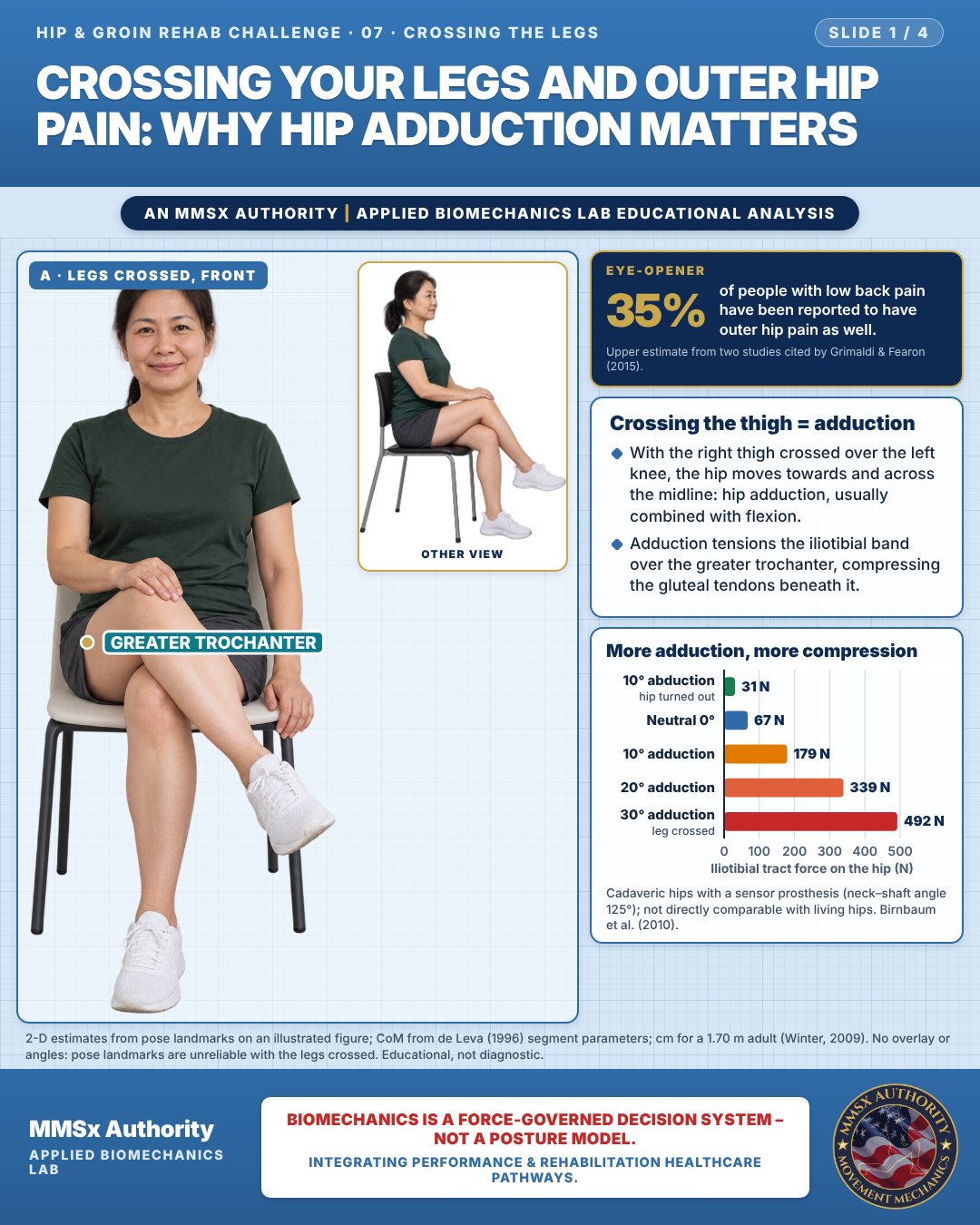
Crossing the thigh = adduction
With the right thigh crossed over the left knee, the hip moves towards and across the midline: hip adduction, usually combined with flexion.
Adduction tensions the iliotibial band over the greater trochanter, compressing the gluteal tendons beneath it.
More adduction, more compression
Movement B: Hanging on one hip (front view)
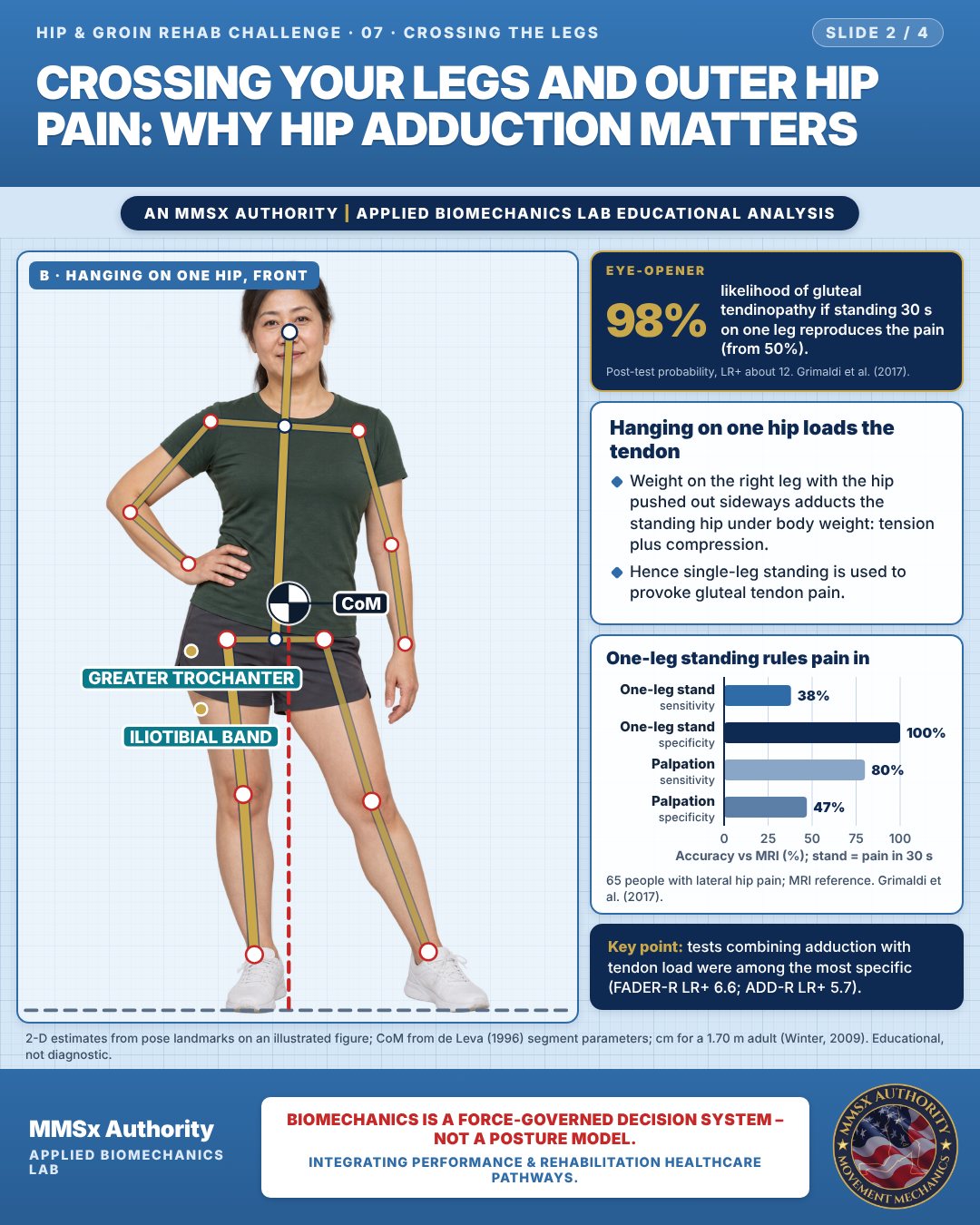
Hanging on one hip loads the tendon
Weight on the right leg with the hip pushed out sideways adducts the standing hip under body weight: tension plus compression.
Hence single-leg standing is used to provoke gluteal tendon pain.
One-leg standing rules pain in
Movement C: Knees apart (front view)
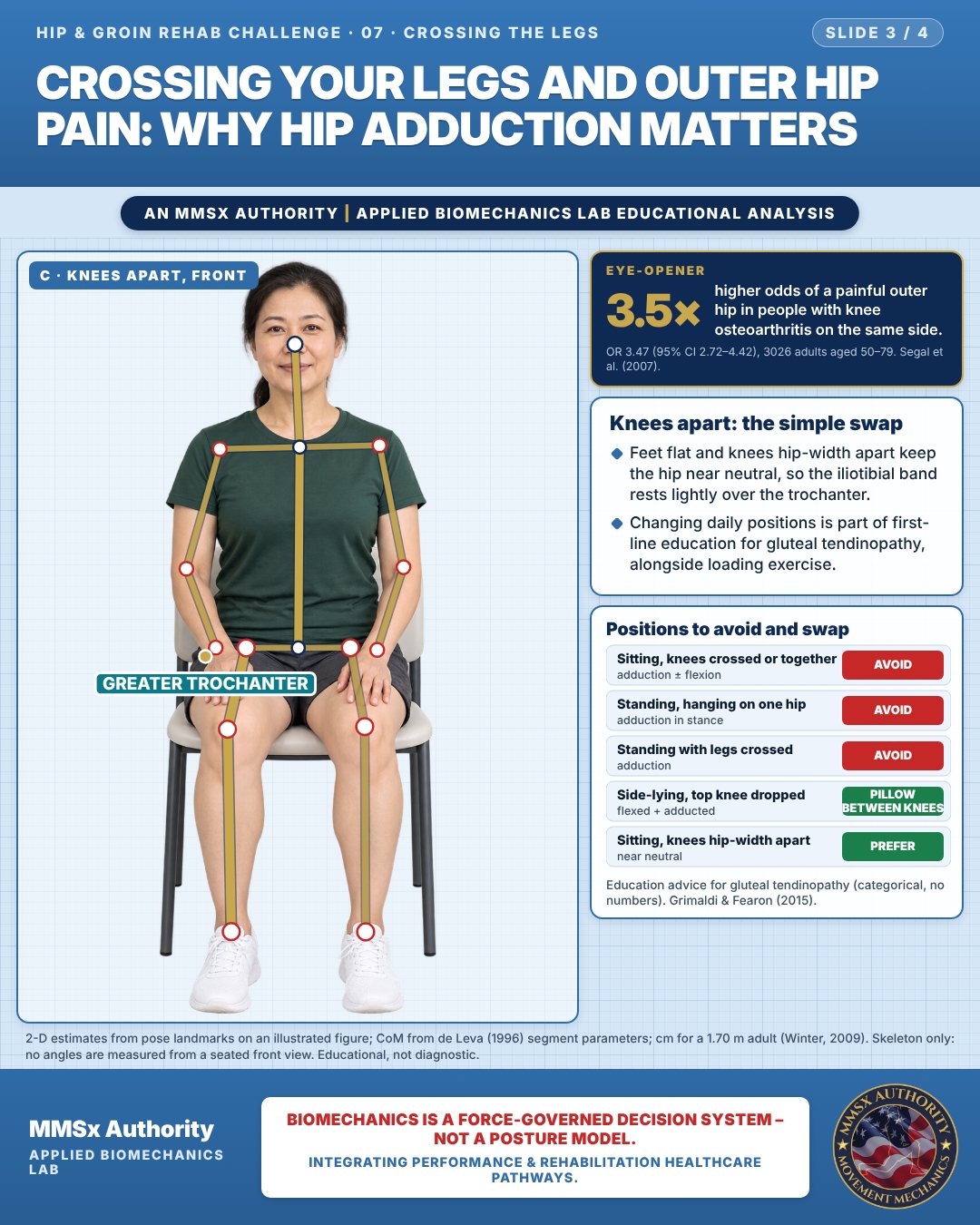
Knees apart: the simple swap
Feet flat and knees hip-width apart keep the hip near neutral, so the iliotibial band rests lightly over the trochanter.
Changing daily positions is part of first-line education for gluteal tendinopathy, alongside loading exercise.
Positions to avoid and swap
Decision pathway
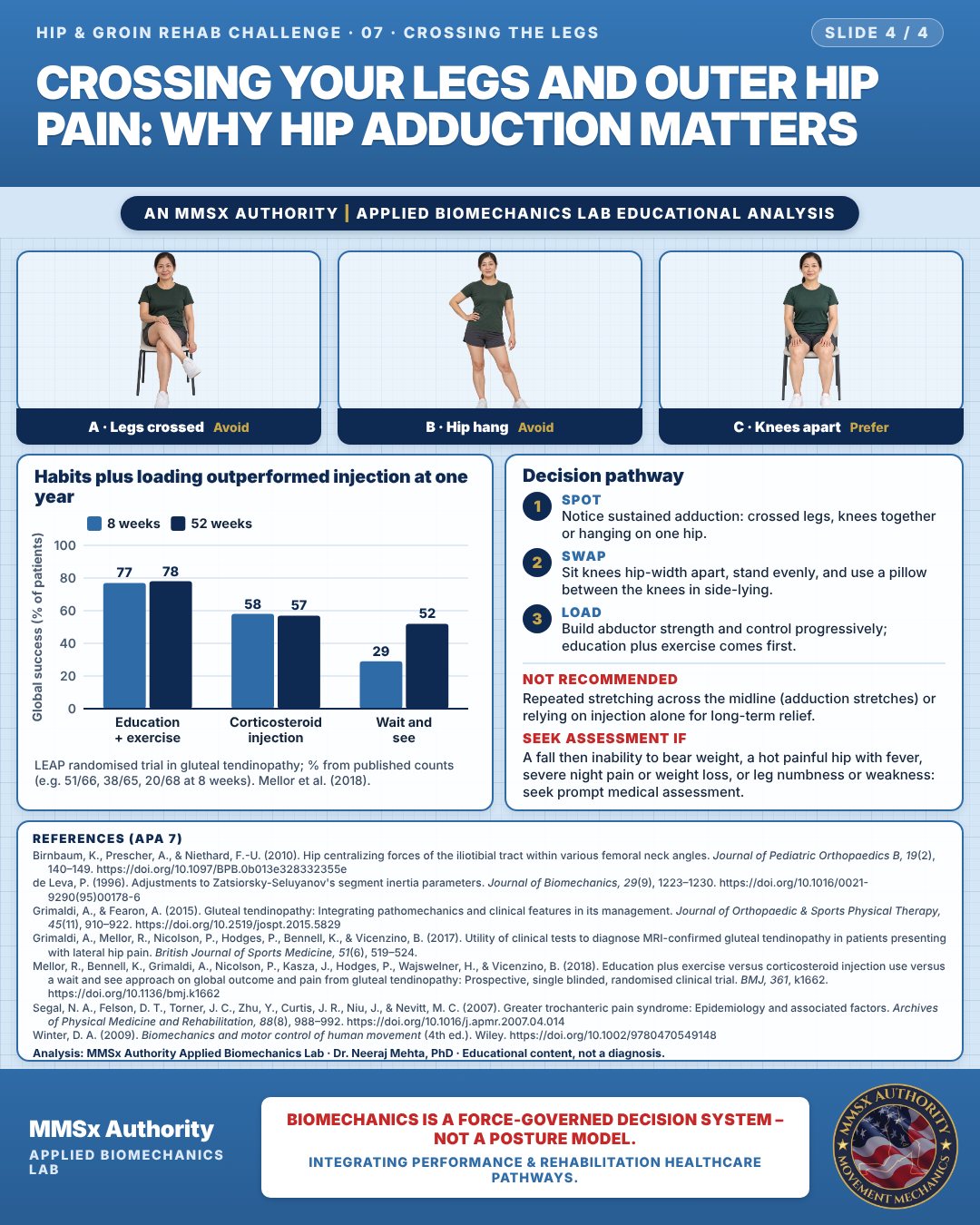
Habits plus loading outperformed injection at one year
Spot
Notice sustained adduction: crossed legs, knees together or hanging on one hip.
Swap
Sit knees hip-width apart, stand evenly, and use a pillow between the knees in side-lying.
Load
Build abductor strength and control progressively; education plus exercise comes first.
What the evidence supports
- Avoid sustained hip adduction (crossed legs, knees together, hanging on one hip, adduction stretches) and build abductor strength and control of adduction during function (Grimaldi & Fearon, 2015; Mellor et al., 2018).
Myth and evidence
Myth“Crossing your legs is harmless; it just stretches tight hip muscles.”
EvidenceHip adduction increases iliotibial tract force over the trochanter several-fold in cadaveric measurements (Birnbaum et al., 2010), and it is one of the positions specifically advised against in gluteal tendinopathy (Grimaldi & Fearon, 2015).
Cautions
Not recommended
Repeated stretching across the midline (adduction stretches) or relying on injection alone for long-term relief.
Seek assessment if
A fall then inability to bear weight, a hot painful hip with fever, severe night pain or weight loss, or leg numbness or weakness: seek prompt medical assessment.
Methods note
2-D estimates from pose landmarks on an illustrated figure; CoM from de Leva (1996) segment parameters; cm for a 1.70 m adult (Winter, 2009). No overlay or angles: pose landmarks are unreliable with the legs crossed. Skeleton only: no angles are measured from a seated front view. These are educational estimates, not a diagnosis.
References
- Birnbaum, K., Prescher, A., & Niethard, F.-U. (2010). Hip centralizing forces of the iliotibial tract within various femoral neck angles. Journal of Pediatric Orthopaedics B, 19(2), 140–149. https://doi.org/10.1097/BPB.0b013e328332355e
- de Leva, P. (1996). Adjustments to Zatsiorsky-Seluyanov's segment inertia parameters. Journal of Biomechanics, 29(9), 1223–1230. https://doi.org/10.1016/0021-9290(95)00178-6
- Grimaldi, A., & Fearon, A. (2015). Gluteal tendinopathy: Integrating pathomechanics and clinical features in its management. Journal of Orthopaedic & Sports Physical Therapy, 45(11), 910–922. https://doi.org/10.2519/jospt.2015.5829
- Grimaldi, A., Mellor, R., Nicolson, P., Hodges, P., Bennell, K., & Vicenzino, B. (2017). Utility of clinical tests to diagnose MRI-confirmed gluteal tendinopathy in patients presenting with lateral hip pain. British Journal of Sports Medicine, 51(6), 519–524.
- Mellor, R., Bennell, K., Grimaldi, A., Nicolson, P., Kasza, J., Hodges, P., Wajswelner, H., & Vicenzino, B. (2018). Education plus exercise versus corticosteroid injection use versus a wait and see approach on global outcome and pain from gluteal tendinopathy: Prospective, single blinded, randomised clinical trial. BMJ, 361, k1662. https://doi.org/10.1136/bmj.k1662
- Segal, N. A., Felson, D. T., Torner, J. C., Zhu, Y., Curtis, J. R., Niu, J., & Nevitt, M. C. (2007). Greater trochanteric pain syndrome: Epidemiology and associated factors. Archives of Physical Medicine and Rehabilitation, 88(8), 988–992. https://doi.org/10.1016/j.apmr.2007.04.014
- Winter, D. A. (2009). Biomechanics and motor control of human movement (4th ed.). Wiley. https://doi.org/10.1002/9780470549148
Cite this article
Mehta, N. (2026, October 28). Crossing your legs and outer hip pain: why hip adduction matters. MMSx Authority Applied Biomechanics Lab. https://mmsxauthority.org/edu/analysis/hip-groin/07-crossing-your-legs-and-outer-hip-pain-why-hip-adduction-matters/
Part of the collection
Mehta, N. (2026). Hip and Groin Rehabilitation: 30 Evidence-Based Biomechanics Analyses [Collection]. MMSx Authority Applied Biomechanics Lab. Zenodo. https://doi.org/10.5281/zenodo.23735806
All Hip & Groin Rehab Challenge articles · Rehabilitation Library