Hip & Groin Rehab Challenge · 01
Hip pain: joint, tendon, muscle or referred from the back?
Hand pressed on the front hip crease, pelvis level ( 1°): pain here usually comes from the hip joint (osteoarthritis, impingement, labrum). “Hip…
Key points
- Locate. Note where the pain sits: groin, bony outer hip, or low back and buttock.
- Screen. Examine the hip, lumbar spine and SI joint together; leg pain alone does not prove a spinal source.
- Treat. Match care to the source: exercise for hip OA, load management for gluteal tendons.
What it is
"Hip pain" is a location, not a diagnosis. Pain around the hip can arise from the hip joint itself (for example osteoarthritis, femoroacetabular impingement, labral pathology — usually felt in the groin/front of the hip), from the tendons and bursae over the greater trochanter (greater trochanteric pain syndrome — the bony outer hip), from muscles and tendons around the groin, or be referred from the lumbar spine or sacroiliac joint (felt in the low back and buttock). Groin pain points towards the hip joint, and pain can spread below the knee in hip osteoarthritis (Khan et al., 2004; Sembrano & Polly, 2009).
How we analysed the movement
Three movements relevant to this topic were analysed from illustrated reference figures. Joint centres were located with two-dimensional pose estimation; hip and knee angles, pelvis level, the whole-body centre of mass and, where relevant, the hip lever (the horizontal distance from the hip joint to the upper-body centre of mass) and the resulting static hip moment were then calculated from standard segment parameters. The figures are educational estimates that show how position changes mechanical demand; they are not measurements of a patient. Every research value quoted below comes from the published source cited beside it.
Movement A: Hand on groin (front view)
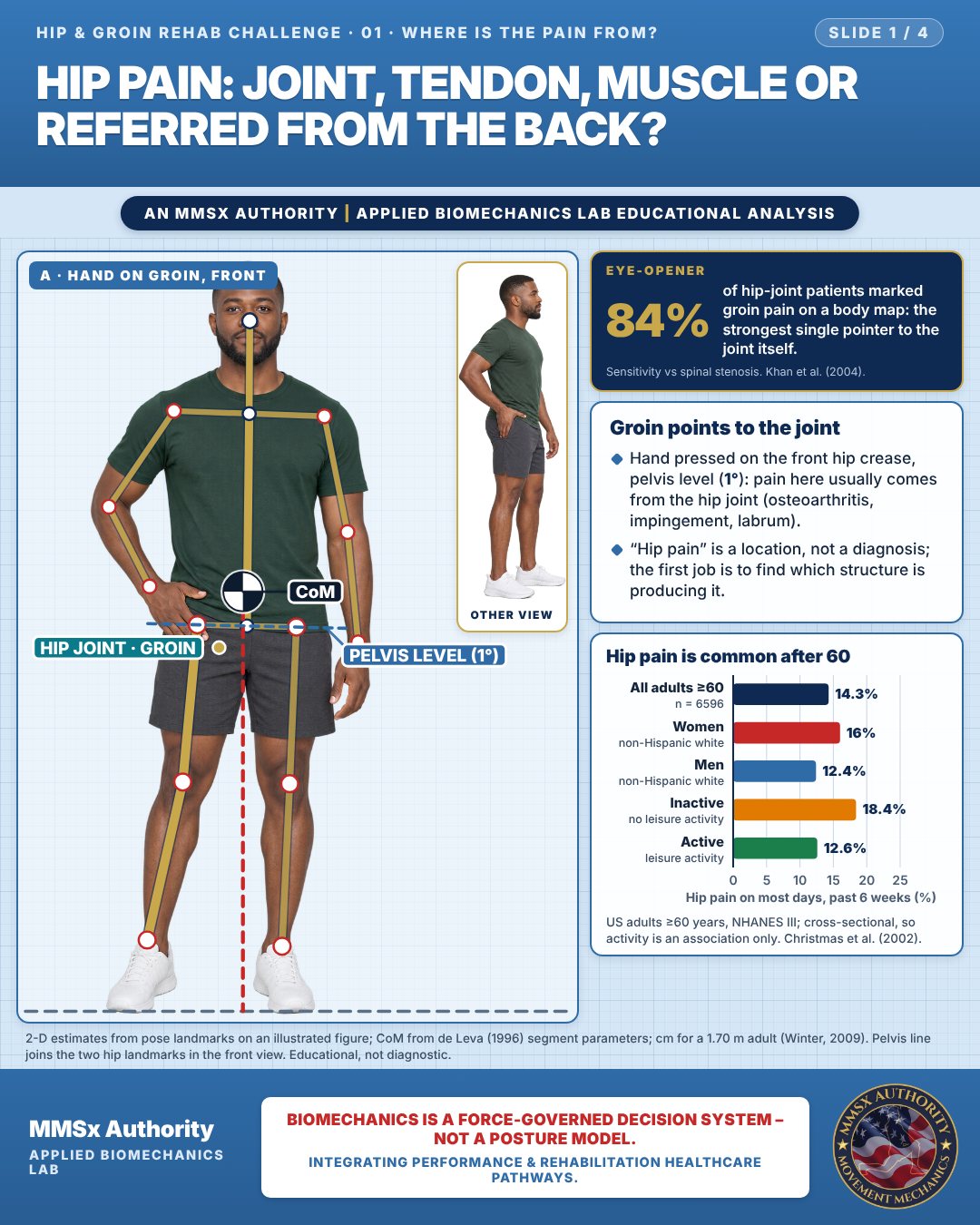
Groin points to the joint
Hand pressed on the front hip crease, pelvis level (1°): pain here usually comes from the hip joint (osteoarthritis, impingement, labrum).
“Hip pain” is a location, not a diagnosis; the first job is to find which structure is producing it.
Hip pain is common after 60
Movement B: Hand on outer hip (front view)
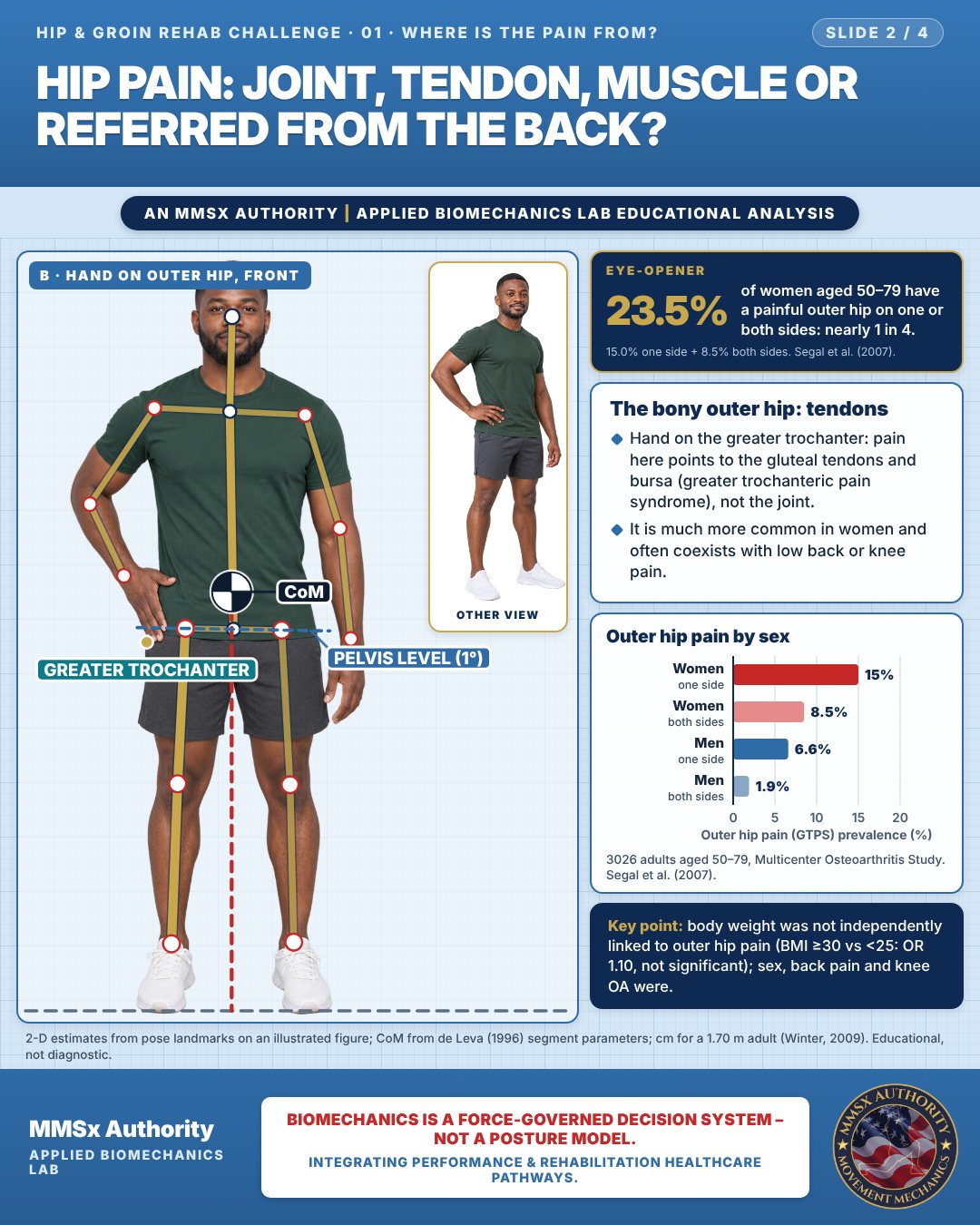
The bony outer hip: tendons
Hand on the greater trochanter: pain here points to the gluteal tendons and bursa (greater trochanteric pain syndrome), not the joint.
It is much more common in women and often coexists with low back or knee pain.
Outer hip pain by sex
Movement C: Hand on low back (rear view)
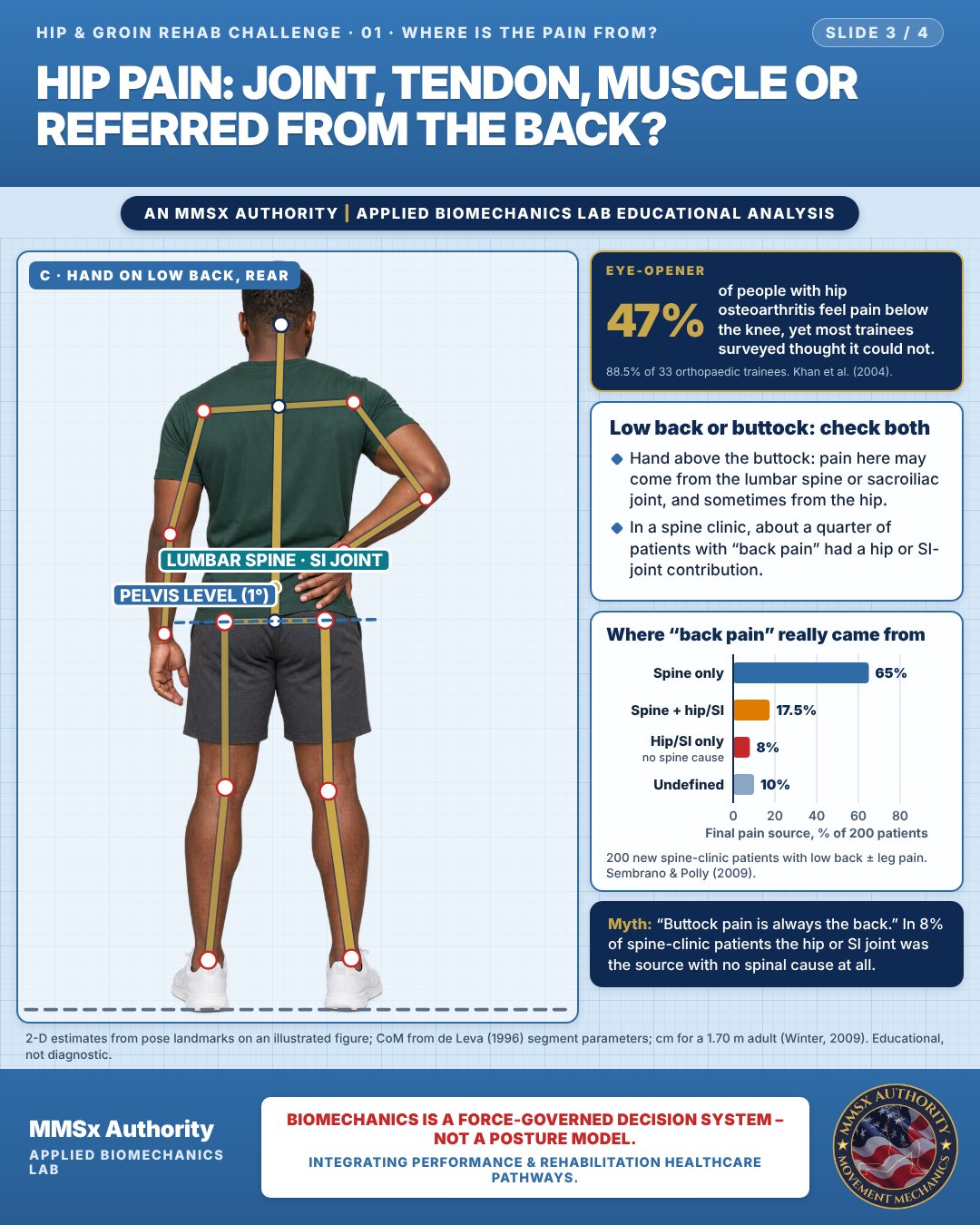
Low back or buttock: check both
Hand above the buttock: pain here may come from the lumbar spine or sacroiliac joint, and sometimes from the hip.
In a spine clinic, about a quarter of patients with “back pain” had a hip or SI-joint contribution.
Where “back pain” really came from
Decision pathway
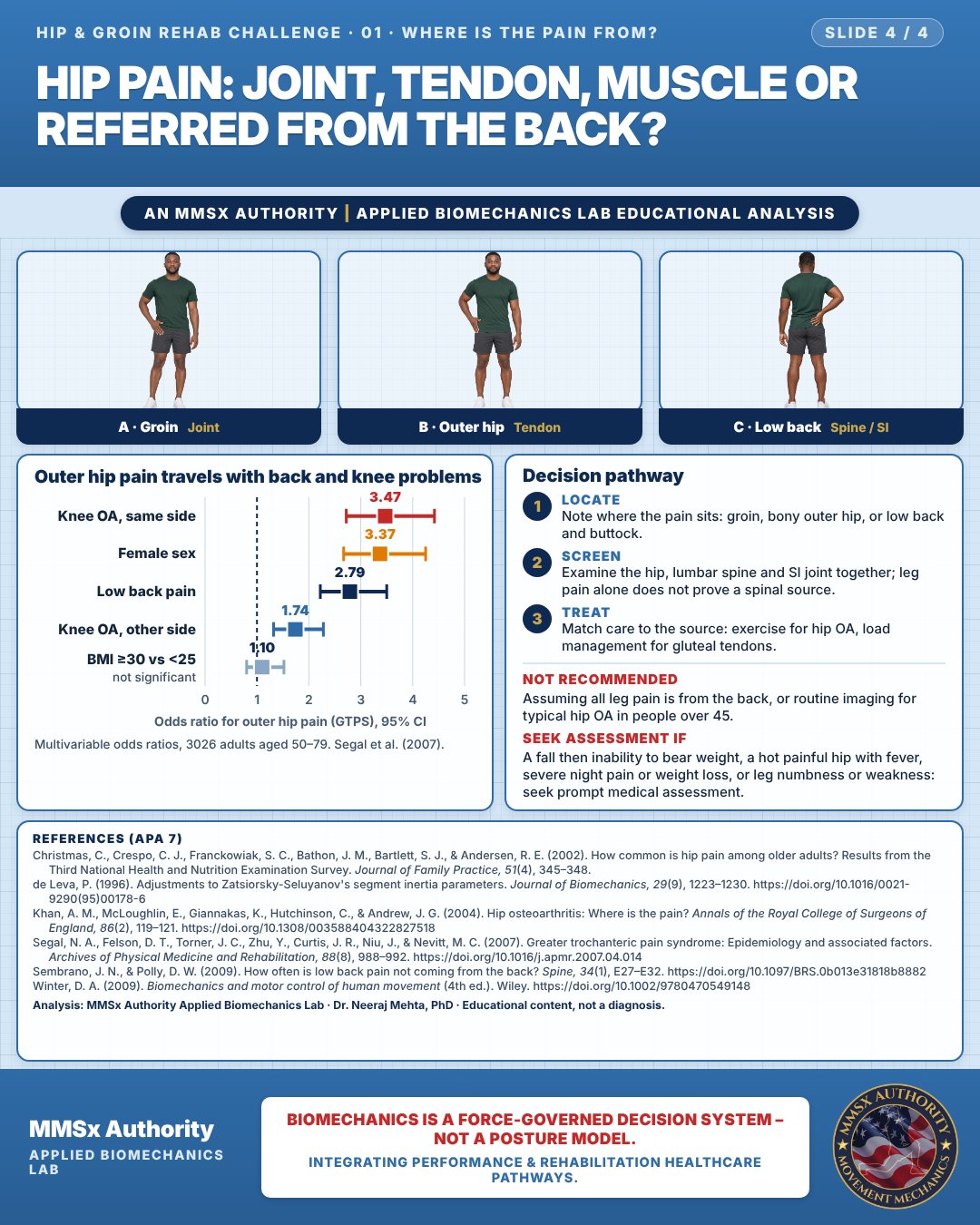
Outer hip pain travels with back and knee problems
Locate
Note where the pain sits: groin, bony outer hip, or low back and buttock.
Screen
Examine the hip, lumbar spine and SI joint together; leg pain alone does not prove a spinal source.
Treat
Match care to the source: exercise for hip OA, load management for gluteal tendons.
What the evidence supports
- Because groin, outer-hip, buttock and leg pain overlap, assessment should include the lumbar spine, SI joint and hip; in a spine-clinic series up to 25% of low back pain had a hip or SI contribution (Sembrano & Polly, 2009).
Myth and evidence
Myth“If the pain goes down the leg, it must be coming from the back.”
EvidenceIn hip osteoarthritis, 47% of patients had pain below the knee, yet 88.5% of orthopaedic trainees believed hip pain does not radiate there (Khan et al., 2004). Conversely, up to a quarter of "low back pain" in a spine clinic had a hip or SI joint contribution (Sembrano & Polly, 2009).
Cautions
Not recommended
Assuming all leg pain is from the back, or routine imaging for typical hip OA in people over 45.
Seek assessment if
A fall then inability to bear weight, a hot painful hip with fever, severe night pain or weight loss, or leg numbness or weakness: seek prompt medical assessment.
Methods note
2-D estimates from pose landmarks on an illustrated figure; CoM from de Leva (1996) segment parameters; cm for a 1.70 m adult (Winter, 2009). Pelvis line joins the two hip landmarks in the front view. These are educational estimates, not a diagnosis.
References
- Christmas, C., Crespo, C. J., Franckowiak, S. C., Bathon, J. M., Bartlett, S. J., & Andersen, R. E. (2002). How common is hip pain among older adults? Results from the Third National Health and Nutrition Examination Survey. Journal of Family Practice, 51(4), 345–348.
- de Leva, P. (1996). Adjustments to Zatsiorsky-Seluyanov's segment inertia parameters. Journal of Biomechanics, 29(9), 1223–1230. https://doi.org/10.1016/0021-9290(95)00178-6
- Khan, A. M., McLoughlin, E., Giannakas, K., Hutchinson, C., & Andrew, J. G. (2004). Hip osteoarthritis: Where is the pain? Annals of the Royal College of Surgeons of England, 86(2), 119–121. https://doi.org/10.1308/003588404322827518
- Segal, N. A., Felson, D. T., Torner, J. C., Zhu, Y., Curtis, J. R., Niu, J., & Nevitt, M. C. (2007). Greater trochanteric pain syndrome: Epidemiology and associated factors. Archives of Physical Medicine and Rehabilitation, 88(8), 988–992. https://doi.org/10.1016/j.apmr.2007.04.014
- Sembrano, J. N., & Polly, D. W. (2009). How often is low back pain not coming from the back? Spine, 34(1), E27–E32. https://doi.org/10.1097/BRS.0b013e31818b8882
- Winter, D. A. (2009). Biomechanics and motor control of human movement (4th ed.). Wiley. https://doi.org/10.1002/9780470549148
Cite this article
Mehta, N. (2026, October 28). Hip pain: joint, tendon, muscle or referred from the back? MMSx Authority Applied Biomechanics Lab. https://mmsxauthority.org/edu/analysis/hip-groin/01-hip-pain-joint-tendon-muscle-or-referred-from-the-back/
Part of the collection
Mehta, N. (2026). Hip and Groin Rehabilitation: 30 Evidence-Based Biomechanics Analyses [Collection]. MMSx Authority Applied Biomechanics Lab. Zenodo. https://doi.org/10.5281/zenodo.23735806
All Hip & Groin Rehab Challenge articles · Rehabilitation Library