Hip & Groin Rehab Challenge · 29
Hip pain that is not the hip: lower back and nerve referral
Referred "hip" pain is pain felt in the buttock, hip or thigh that originates elsewhere, most often from the lumbar spine (facet or disc problems, or…
Key points
- Examine both. Check hip internal rotation, gait and groin pain, and test the lumbar spine in the same visit.
- Test the nerve. Use the slump and straight leg raise together; a positive slump test suggests a nerve-related source.
- Clarify. If the source stays uncertain, specialist assessment may include a diagnostic hip injection; treat each source found.
What it is
Referred "hip" pain is pain felt in the buttock, hip or thigh that originates elsewhere, most often from the lumbar spine (facet or disc problems, or nerve root irritation causing radicular pain). Hip and spine disorders frequently coexist, so the task is to weigh the evidence for each source rather than to choose one by default (Brown et al., 2004).
How we analysed the movement
Three movements relevant to this topic were analysed from illustrated reference figures. Joint centres were located with two-dimensional pose estimation; hip and knee angles, pelvis level, the whole-body centre of mass and, where relevant, the hip lever (the horizontal distance from the hip joint to the upper-body centre of mass) and the resulting static hip moment were then calculated from standard segment parameters. The figures are educational estimates that show how position changes mechanical demand; they are not measurements of a patient. Every research value quoted below comes from the published source cited beside it.
Movement A: Forward bend (side view)
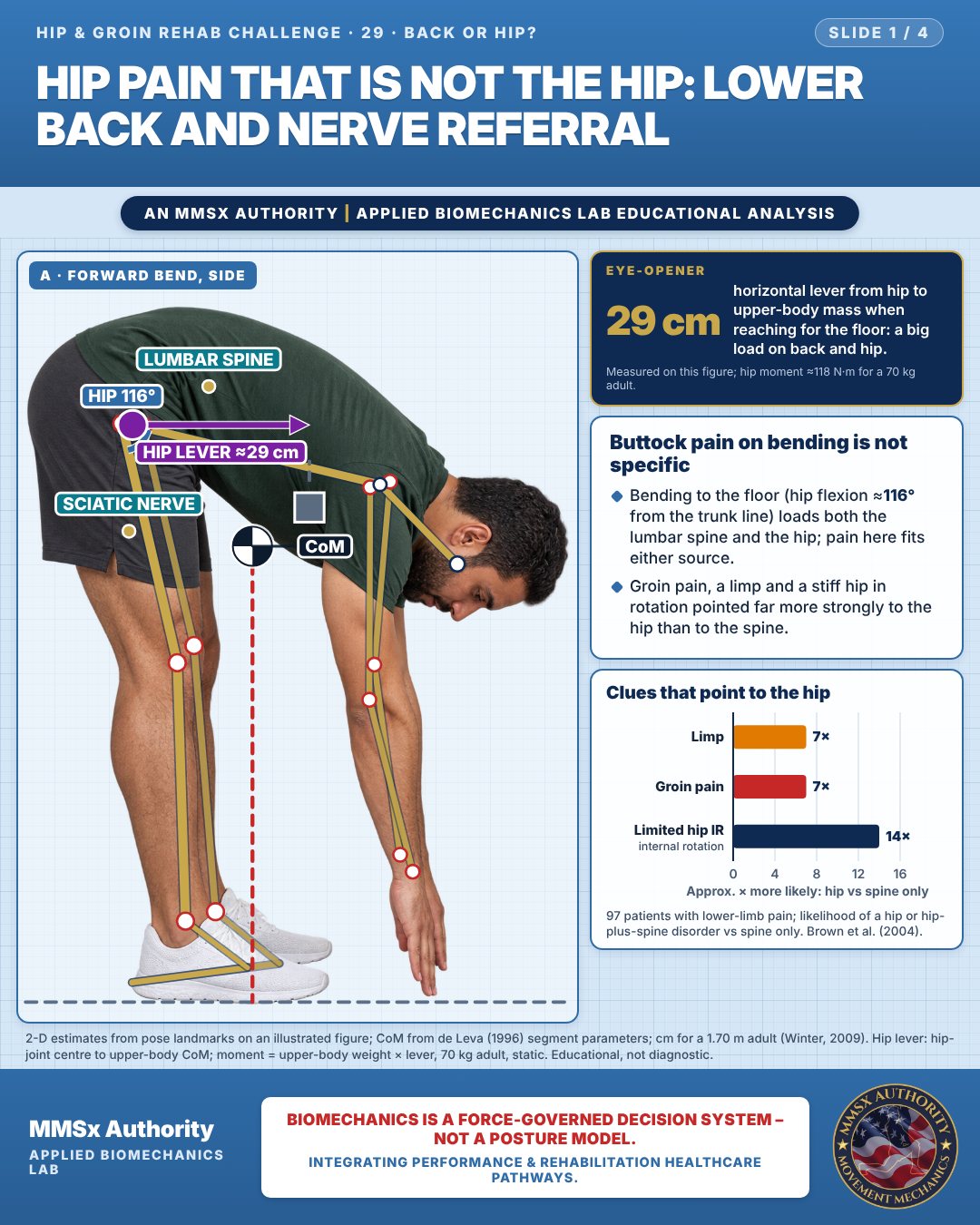
Buttock pain on bending is not specific
Bending to the floor (hip flexion ≈116° from the trunk line) loads both the lumbar spine and the hip; pain here fits either source.
Groin pain, a limp and a stiff hip in rotation pointed far more strongly to the hip than to the spine.
Clues that point to the hip
Movement B: Slump sitting (side view)
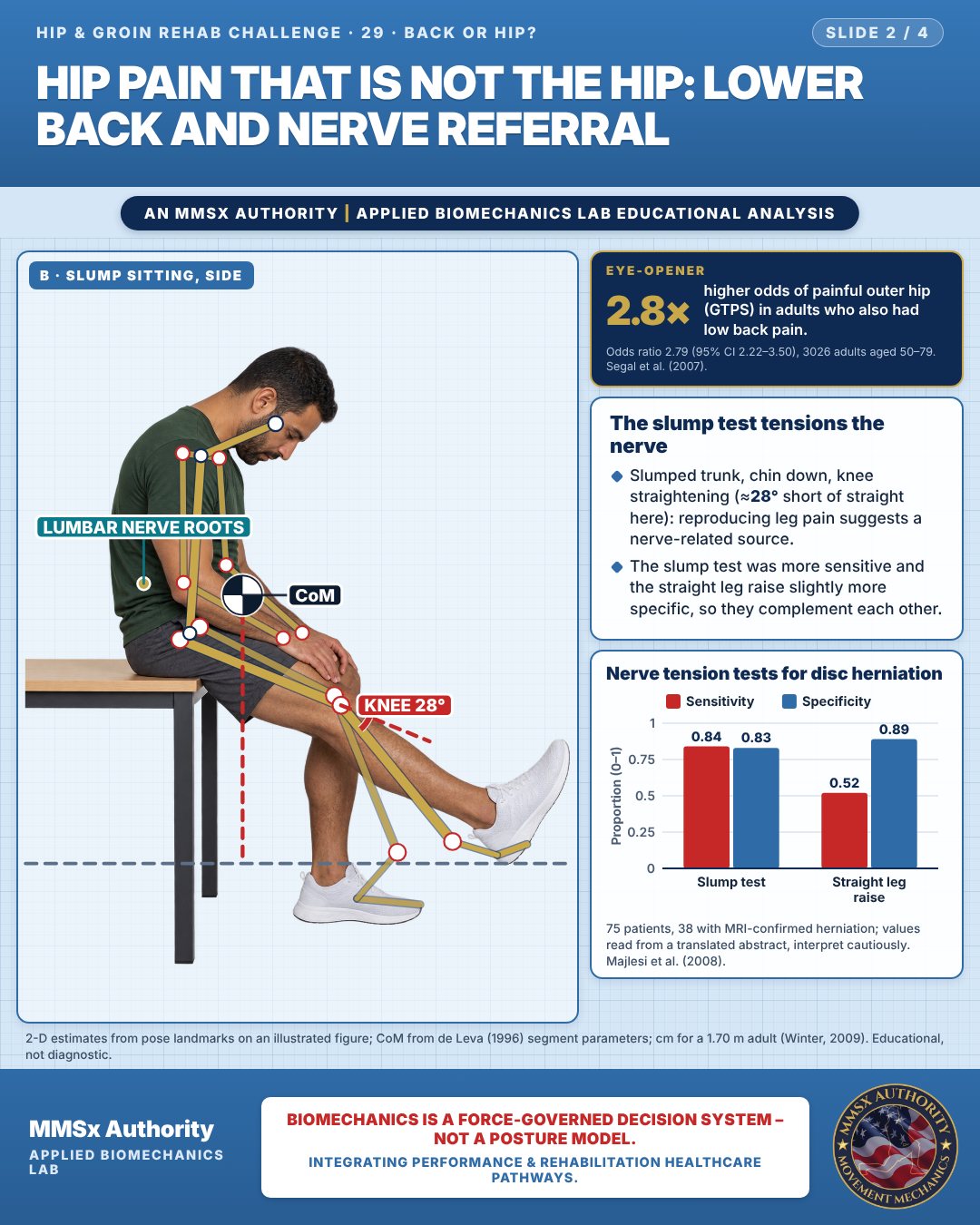
The slump test tensions the nerve
Slumped trunk, chin down, knee straightening (≈28° short of straight here): reproducing leg pain suggests a nerve-related source.
The slump test was more sensitive and the straight leg raise slightly more specific, so they complement each other.
Nerve tension tests for disc herniation
Movement C: Hand on buttock (rear view)
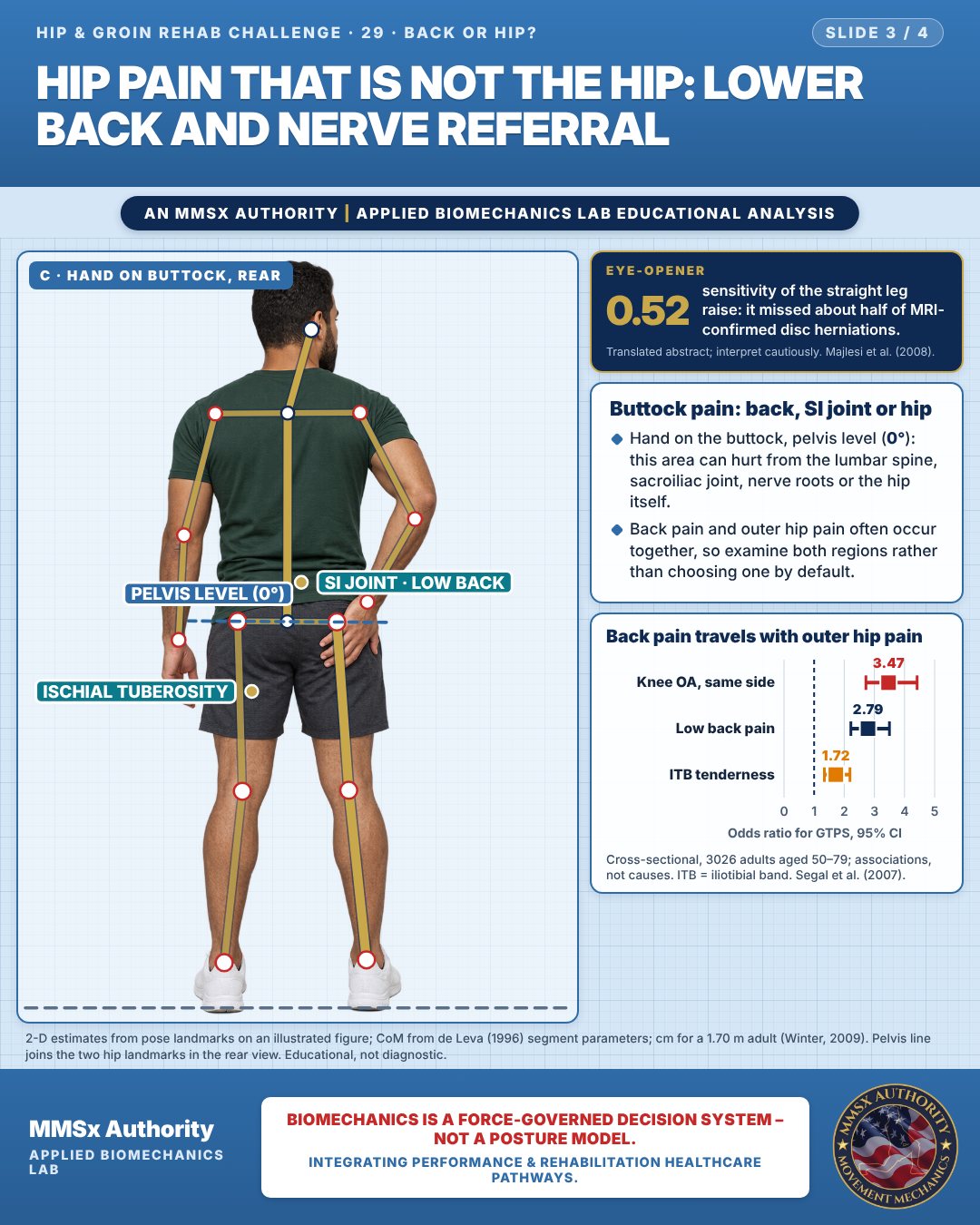
Buttock pain: back, SI joint or hip
Hand on the buttock, pelvis level (0°): this area can hurt from the lumbar spine, sacroiliac joint, nerve roots or the hip itself.
Back pain and outer hip pain often occur together, so examine both regions rather than choosing one by default.
Back pain travels with outer hip pain
Decision pathway
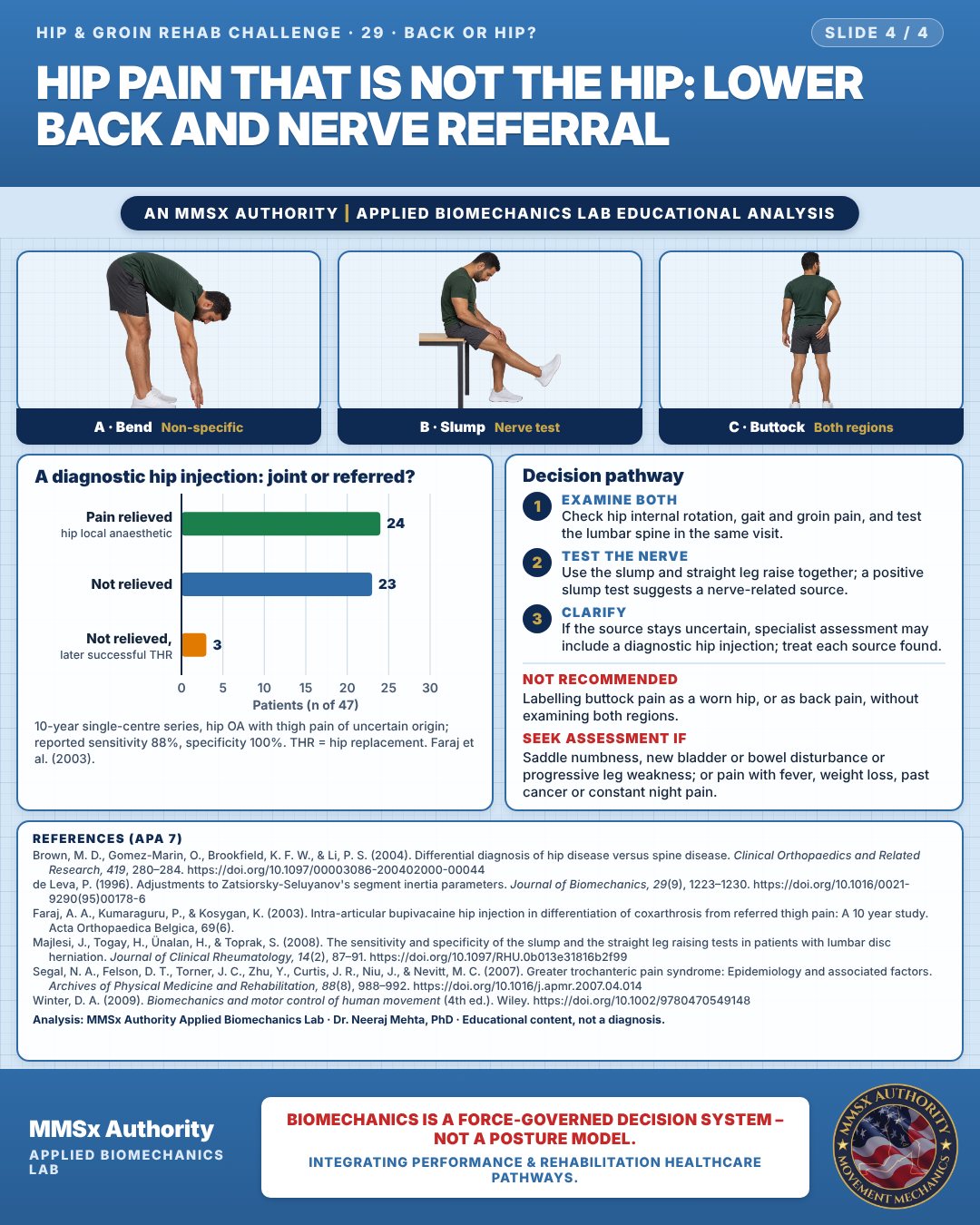
A diagnostic hip injection: joint or referred?
Examine both
Check hip internal rotation, gait and groin pain, and test the lumbar spine in the same visit.
Test the nerve
Use the slump and straight leg raise together; a positive slump test suggests a nerve-related source.
Clarify
If the source stays uncertain, specialist assessment may include a diagnostic hip injection; treat each source found.
What the evidence supports
- Examine both regions: check hip internal rotation, gait and groin pain (Brown et al., 2004), and neural tension with the slump and straight leg raise tests (Majlesi et al., 2008).
- When the source remains uncertain, specialist assessment may include a diagnostic hip injection (Faraj et al., 2003).
- Treat the identified source; when back pain and outer hip pain coexist, address both (Segal et al., 2007).
Myth and evidence
Myth“Pain in the buttock means the hip joint is worn out.”
EvidenceButtock pain is common to both regions, whereas groin pain, a limp and limited internal rotation pointed much more strongly to the hip (Brown et al., 2004). A positive slump test (sensitivity 0.84) suggests a nerve-related source instead (Majlesi et al., 2008).
Cautions
Not recommended
Labelling buttock pain as a worn hip, or as back pain, without examining both regions.
Seek assessment if
Saddle numbness, new bladder or bowel disturbance or progressive leg weakness; or pain with fever, weight loss, past cancer or constant night pain.
Methods note
2-D estimates from pose landmarks on an illustrated figure; CoM from de Leva (1996) segment parameters; cm for a 1.70 m adult (Winter, 2009). Hip lever: hip-joint centre to upper-body CoM; moment = upper-body weight × lever, 70 kg adult, static. Pelvis line joins the two hip landmarks in the rear view. These are educational estimates, not a diagnosis.
References
- Brown, M. D., Gomez-Marin, O., Brookfield, K. F. W., & Li, P. S. (2004). Differential diagnosis of hip disease versus spine disease. Clinical Orthopaedics and Related Research, 419, 280–284. https://doi.org/10.1097/00003086-200402000-00044
- de Leva, P. (1996). Adjustments to Zatsiorsky-Seluyanov's segment inertia parameters. Journal of Biomechanics, 29(9), 1223–1230. https://doi.org/10.1016/0021-9290(95)00178-6
- Faraj, A. A., Kumaraguru, P., & Kosygan, K. (2003). Intra-articular bupivacaine hip injection in differentiation of coxarthrosis from referred thigh pain: A 10 year study. Acta Orthopaedica Belgica, 69(6).
- Majlesi, J., Togay, H., Ünalan, H., & Toprak, S. (2008). The sensitivity and specificity of the slump and the straight leg raising tests in patients with lumbar disc herniation. Journal of Clinical Rheumatology, 14(2), 87–91. https://doi.org/10.1097/RHU.0b013e31816b2f99
- Segal, N. A., Felson, D. T., Torner, J. C., Zhu, Y., Curtis, J. R., Niu, J., & Nevitt, M. C. (2007). Greater trochanteric pain syndrome: Epidemiology and associated factors. Archives of Physical Medicine and Rehabilitation, 88(8), 988–992. https://doi.org/10.1016/j.apmr.2007.04.014
- Winter, D. A. (2009). Biomechanics and motor control of human movement (4th ed.). Wiley. https://doi.org/10.1002/9780470549148
Cite this article
Mehta, N. (2026, October 28). Hip pain that is not the hip: lower back and nerve referral. MMSx Authority Applied Biomechanics Lab. https://mmsxauthority.org/edu/analysis/hip-groin/29-hip-pain-that-is-not-the-hip-lower-back-and-nerve-referral/
Part of the collection
Mehta, N. (2026). Hip and Groin Rehabilitation: 30 Evidence-Based Biomechanics Analyses [Collection]. MMSx Authority Applied Biomechanics Lab. Zenodo. https://doi.org/10.5281/zenodo.23735806
All Hip & Groin Rehab Challenge articles · Rehabilitation Library