Hip & Groin Rehab Challenge · 24
Hip pain in runners: load, cadence and stride
Running-related hip pain covers several conditions, including gluteal and hip flexor tendinopathy, hip-related groin pain and, less commonly, femoral…
Key points
- Shorten. Raise step rate by 5–10% at the same speed to land closer under the hips.
- Control. Train hip abductor strength and pelvic control alongside progressive hip strengthening.
- Monitor. Track deep groin pain run by run; pain that builds each run needs imaging before running on.
What it is
Running-related hip pain covers several conditions, including gluteal and hip flexor tendinopathy, hip-related groin pain and, less commonly, femoral neck stress fracture. Running form variables that change hip load include step rate (cadence), stride length (where the foot lands relative to the body) and frontal-plane control (pelvic drop, narrow or crossover foot placement) (Heiderscheit et al., 2011; Bramah et al., 2018).
How we analysed the movement
Three movements relevant to this topic were analysed from illustrated reference figures. Joint centres were located with two-dimensional pose estimation; hip and knee angles, pelvis level, the whole-body centre of mass and, where relevant, the hip lever (the horizontal distance from the hip joint to the upper-body centre of mass) and the resulting static hip moment were then calculated from standard segment parameters. The figures are educational estimates that show how position changes mechanical demand; they are not measurements of a patient. Every research value quoted below comes from the published source cited beside it.
Movement A: Overstride (side view)
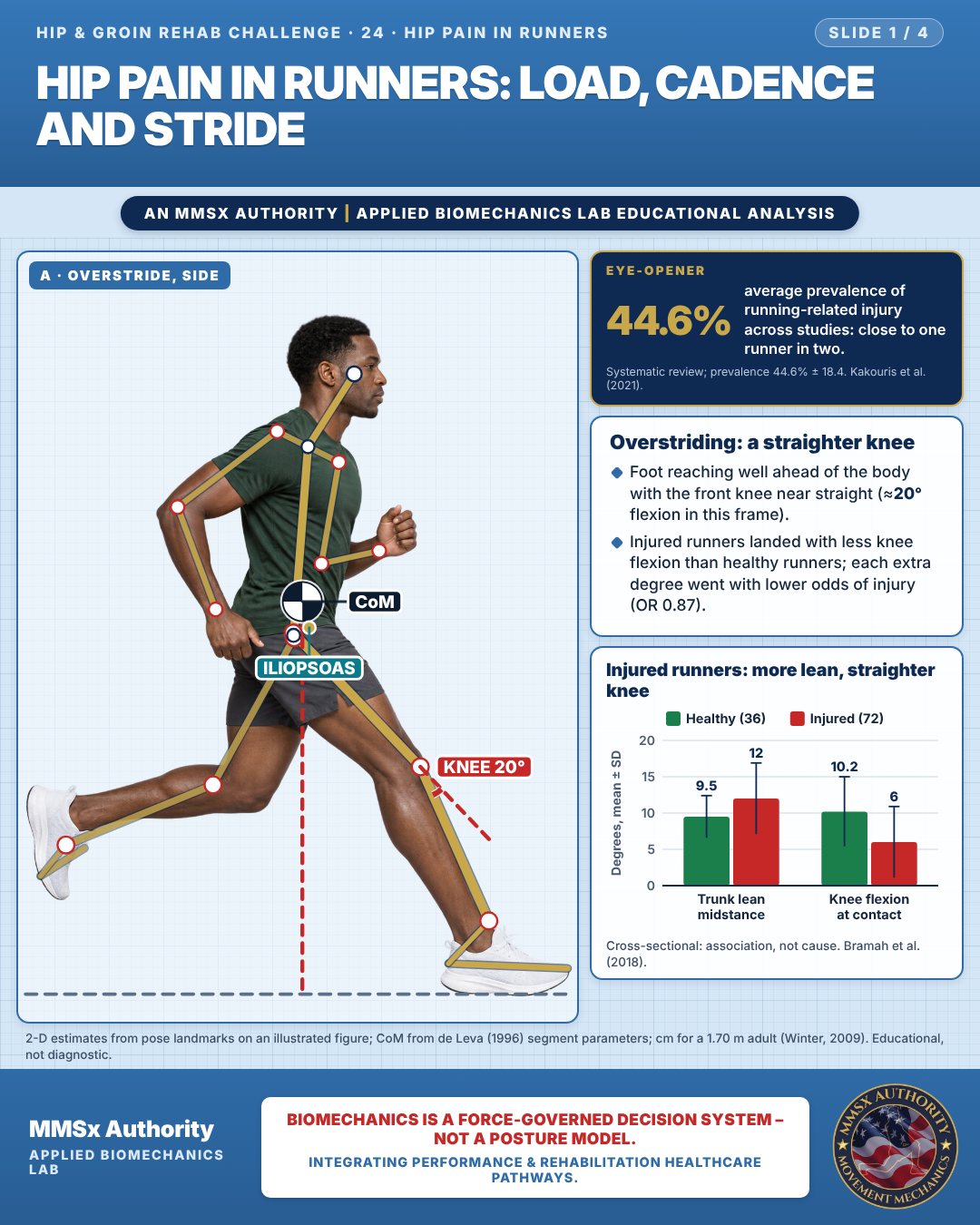
Overstriding: a straighter knee
Foot reaching well ahead of the body with the front knee near straight (≈20° flexion in this frame).
Injured runners landed with less knee flexion than healthy runners; each extra degree went with lower odds of injury (OR 0.87).
Injured runners: more lean, straighter knee
Movement B: Shorter stride (side view)
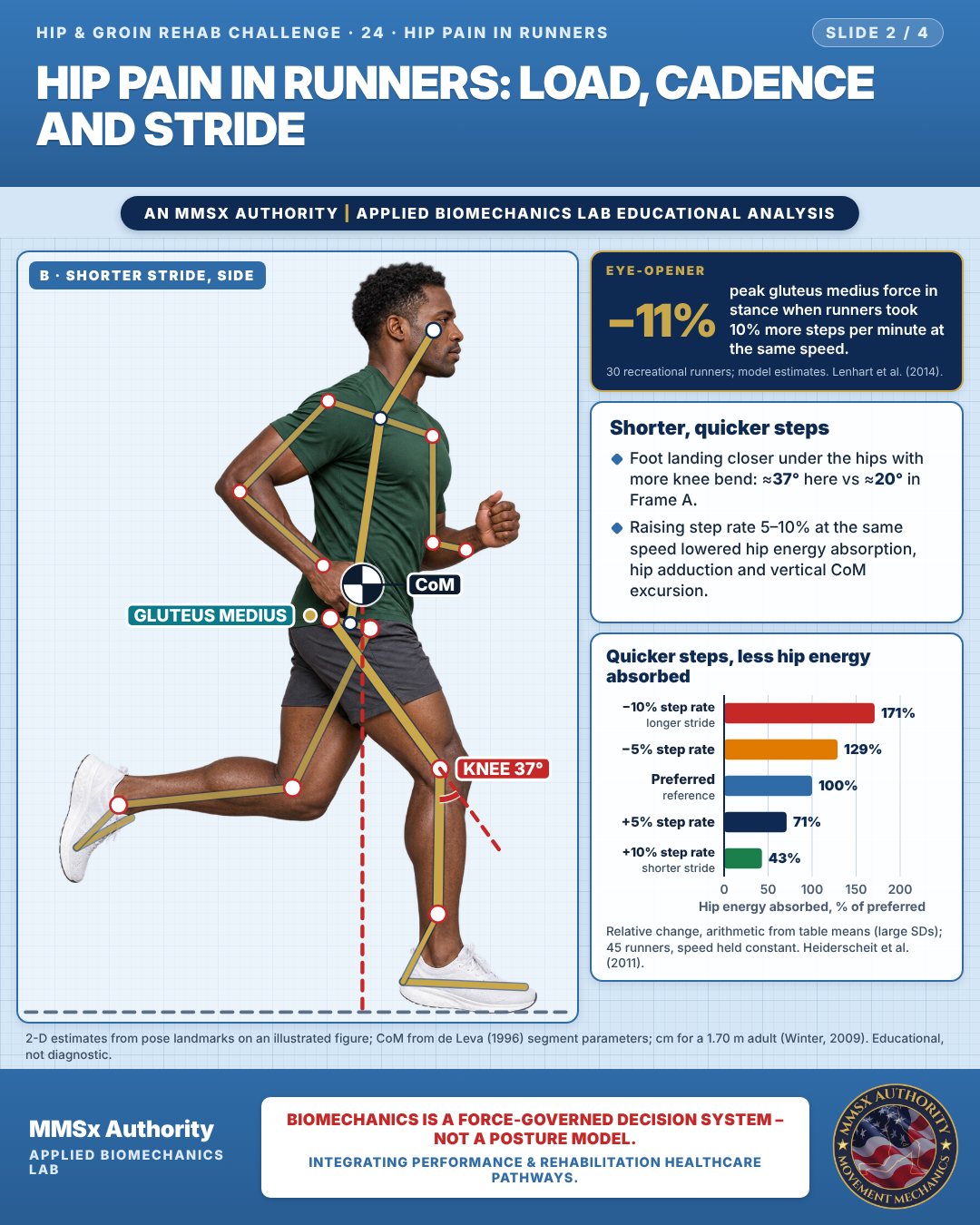
Shorter, quicker steps
Foot landing closer under the hips with more knee bend: ≈37° here vs ≈20° in Frame A.
Raising step rate 5–10% at the same speed lowered hip energy absorption, hip adduction and vertical CoM excursion.
Quicker steps, less hip energy absorbed
Movement C: Crossover gait (front view)
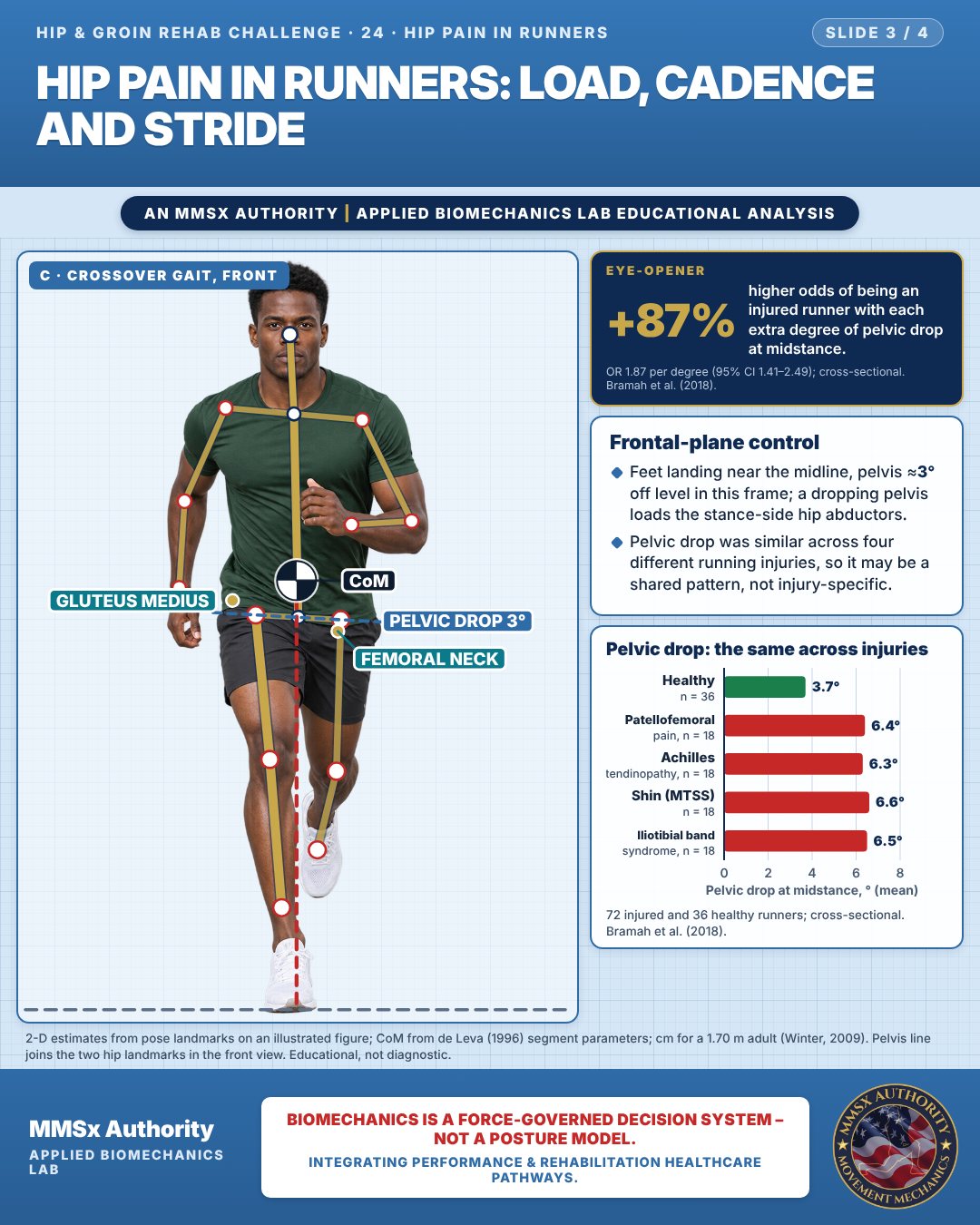
Frontal-plane control
Feet landing near the midline, pelvis ≈3° off level in this frame; a dropping pelvis loads the stance-side hip abductors.
Pelvic drop was similar across four different running injuries, so it may be a shared pattern, not injury-specific.
Pelvic drop: the same across injuries
Decision pathway
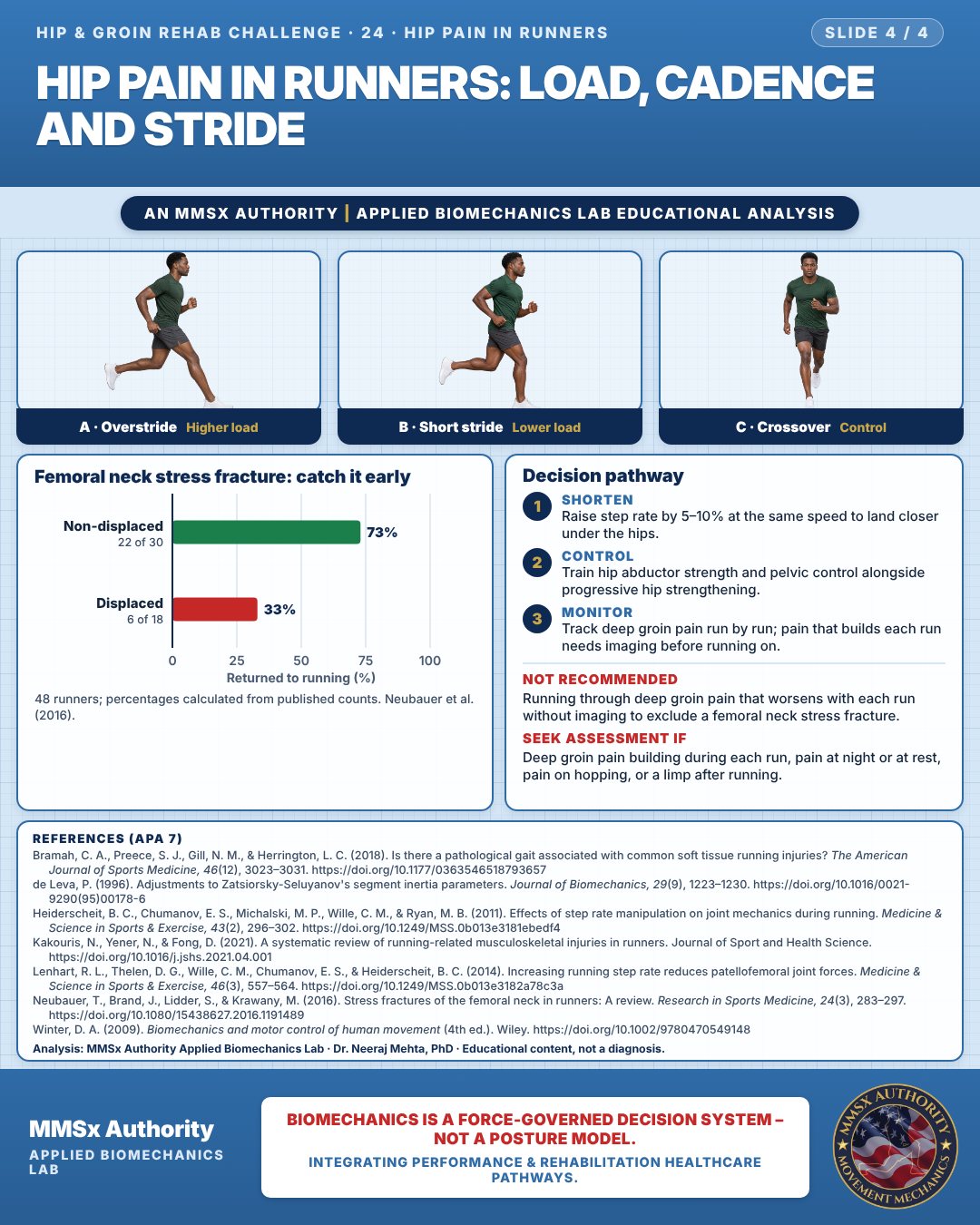
Femoral neck stress fracture: catch it early
Shorten
Raise step rate by 5–10% at the same speed to land closer under the hips.
Control
Train hip abductor strength and pelvic control alongside progressive hip strengthening.
Monitor
Track deep groin pain run by run; pain that builds each run needs imaging before running on.
What the evidence supports
- Gait retraining options with mechanical support: increasing step rate by 5–10% reduces hip energy absorption, hip adduction and centre-of-mass excursion (Heiderscheit et al., 2011), and reduces stance-phase gluteal and patellofemoral loads (Lenhart et al., 2014).
- Address frontal-plane control (pelvic drop) and overstriding, which were associated with injury (Bramah et al., 2018), alongside progressive hip strengthening.
- Not recommended: running through deep groin pain that worsens with each run; it needs imaging to exclude a femoral neck stress fracture (Neubauer et al., 2016).
Myth and evidence
Myth“Longer strides make you faster and are easier on the body.”
EvidenceAt the same speed, a 10% lower step rate (longer stride) increased energy absorbed at every joint, including the hip (Heiderscheit et al., 2011), and a straighter knee at foot contact was associated with injury (Bramah et al., 2018).
Cautions
Not recommended
Running through deep groin pain that worsens with each run without imaging to exclude a femoral neck stress fracture.
Seek assessment if
Deep groin pain building during each run, pain at night or at rest, pain on hopping, or a limp after running.
Methods note
2-D estimates from pose landmarks on an illustrated figure; CoM from de Leva (1996) segment parameters; cm for a 1.70 m adult (Winter, 2009). Pelvis line joins the two hip landmarks in the front view. These are educational estimates, not a diagnosis.
References
- Bramah, C. A., Preece, S. J., Gill, N. M., & Herrington, L. C. (2018). Is there a pathological gait associated with common soft tissue running injuries? The American Journal of Sports Medicine, 46(12), 3023–3031. https://doi.org/10.1177/0363546518793657
- de Leva, P. (1996). Adjustments to Zatsiorsky-Seluyanov's segment inertia parameters. Journal of Biomechanics, 29(9), 1223–1230. https://doi.org/10.1016/0021-9290(95)00178-6
- Heiderscheit, B. C., Chumanov, E. S., Michalski, M. P., Wille, C. M., & Ryan, M. B. (2011). Effects of step rate manipulation on joint mechanics during running. Medicine & Science in Sports & Exercise, 43(2), 296–302. https://doi.org/10.1249/MSS.0b013e3181ebedf4
- Kakouris, N., Yener, N., & Fong, D. (2021). A systematic review of running-related musculoskeletal injuries in runners. Journal of Sport and Health Science. https://doi.org/10.1016/j.jshs.2021.04.001
- Lenhart, R. L., Thelen, D. G., Wille, C. M., Chumanov, E. S., & Heiderscheit, B. C. (2014). Increasing running step rate reduces patellofemoral joint forces. Medicine & Science in Sports & Exercise, 46(3), 557–564. https://doi.org/10.1249/MSS.0b013e3182a78c3a
- Neubauer, T., Brand, J., Lidder, S., & Krawany, M. (2016). Stress fractures of the femoral neck in runners: A review. Research in Sports Medicine, 24(3), 283–297. https://doi.org/10.1080/15438627.2016.1191489
- Winter, D. A. (2009). Biomechanics and motor control of human movement (4th ed.). Wiley. https://doi.org/10.1002/9780470549148
Cite this article
Mehta, N. (2026, October 28). Hip pain in runners: load, cadence and stride. MMSx Authority Applied Biomechanics Lab. https://mmsxauthority.org/edu/analysis/hip-groin/24-hip-pain-in-runners-load-cadence-and-stride/
Part of the collection
Mehta, N. (2026). Hip and Groin Rehabilitation: 30 Evidence-Based Biomechanics Analyses [Collection]. MMSx Authority Applied Biomechanics Lab. Zenodo. https://doi.org/10.5281/zenodo.23735806
All Hip & Groin Rehab Challenge articles · Rehabilitation Library