Hip & Groin Rehab Challenge · 30
Hip red flags: when hip or groin pain needs urgent medical care
Hip red flags are features of hip or groin pain that suggest a serious, time-sensitive cause rather than a musculoskeletal load problem.
Key points
- After a fall. Cannot bear weight: urgent assessment; MRI if X-rays are normal but doubt persists.
- Hot hip. Hot, painful hip, fever or not: same-day review and joint aspiration.
- Runner’s groin. Groin pain building with running: image first; 73% of non-displaced vs 33% of displaced stress fractures ran again.
What it is
Hip red flags are features of hip or groin pain that suggest a serious, time-sensitive cause rather than a musculoskeletal load problem. The main ones are fracture (including occult and stress fractures), septic arthritis or bone infection, tumour, and, in children and adolescents, conditions of the growing hip. They call for prompt medical assessment, not exercise management (Kocher et al., 1999; Margaretten et al., 2007).
How we analysed the movement
Three movements relevant to this topic were analysed from illustrated reference figures. Joint centres were located with two-dimensional pose estimation; hip and knee angles, pelvis level, the whole-body centre of mass and, where relevant, the hip lever (the horizontal distance from the hip joint to the upper-body centre of mass) and the resulting static hip moment were then calculated from standard segment parameters. The figures are educational estimates that show how position changes mechanical demand; they are not measurements of a patient. Every research value quoted below comes from the published source cited beside it.
Movement A: Cannot bear weight (front view)
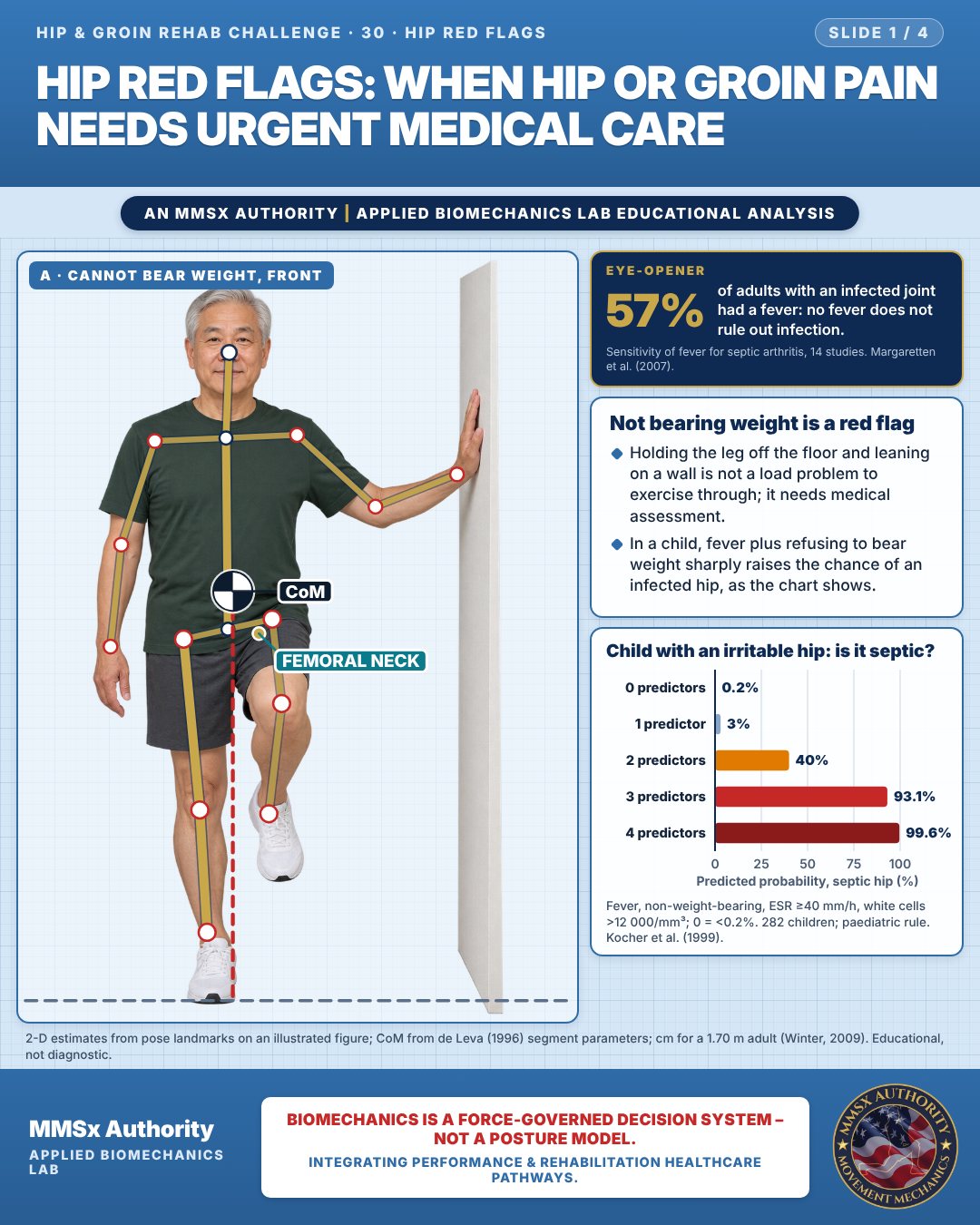
Not bearing weight is a red flag
Holding the leg off the floor and leaning on a wall is not a load problem to exercise through; it needs medical assessment.
In a child, fever plus refusing to bear weight sharply raises the chance of an infected hip, as the chart shows.
Child with an irritable hip: is it septic?
Movement B: Night pain in bed (side view)
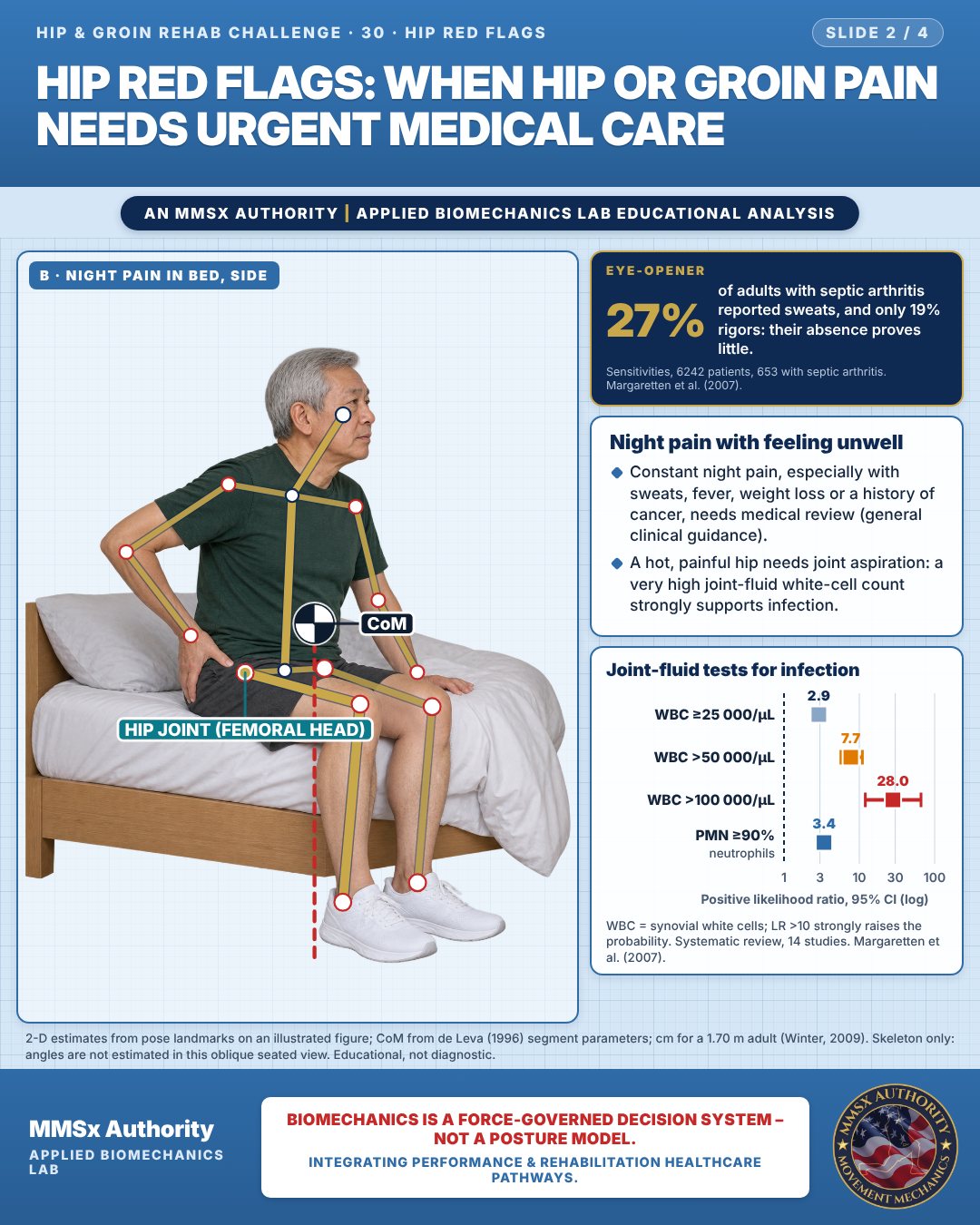
Night pain with feeling unwell
Constant night pain, especially with sweats, fever, weight loss or a history of cancer, needs medical review (general clinical guidance).
A hot, painful hip needs joint aspiration: a very high joint-fluid white-cell count strongly supports infection.
Joint-fluid tests for infection
Movement C: After a fall (front view)
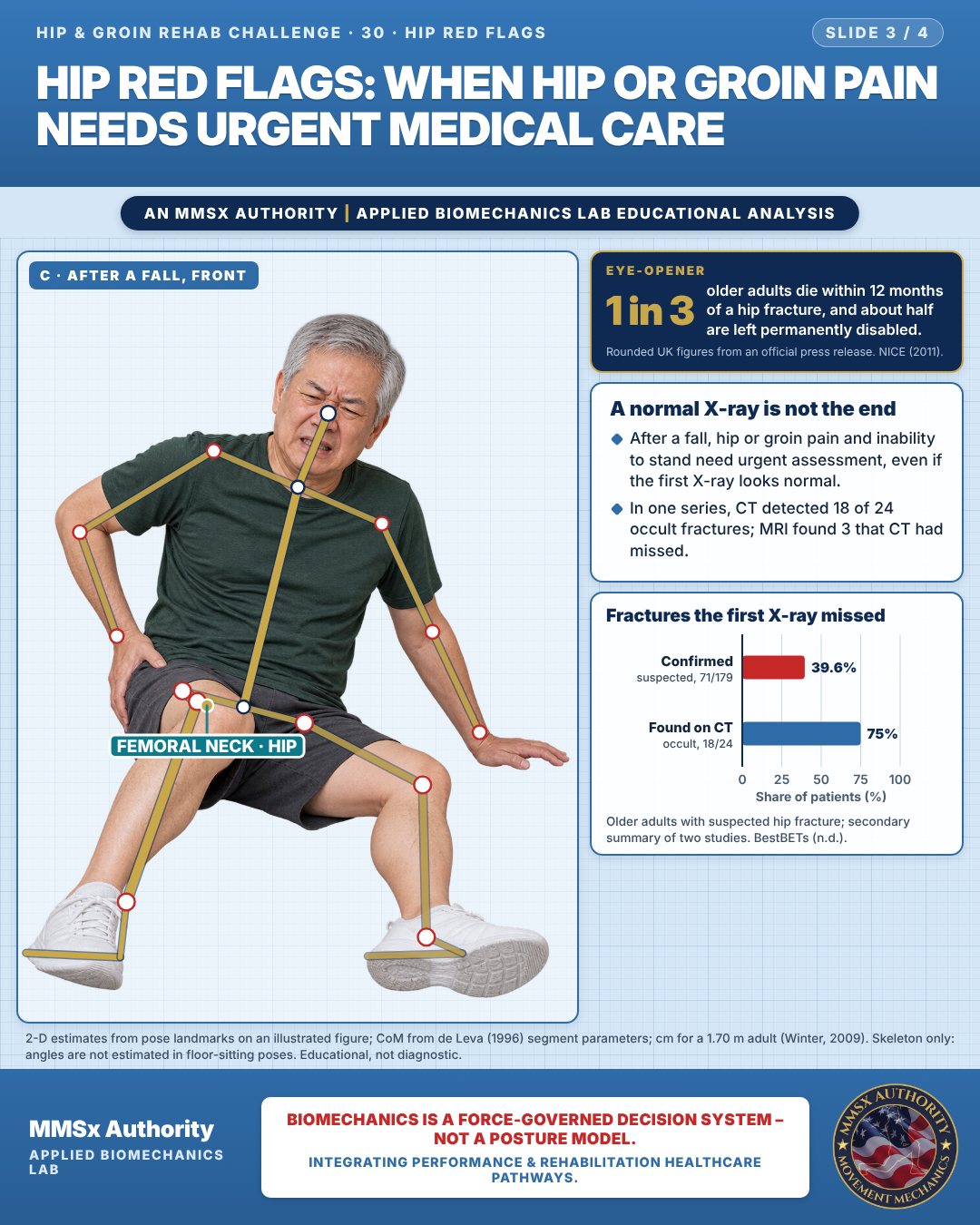
A normal X-ray is not the end
After a fall, hip or groin pain and inability to stand need urgent assessment, even if the first X-ray looks normal.
In one series, CT detected 18 of 24 occult fractures; MRI found 3 that CT had missed.
Fractures the first X-ray missed
Decision pathway
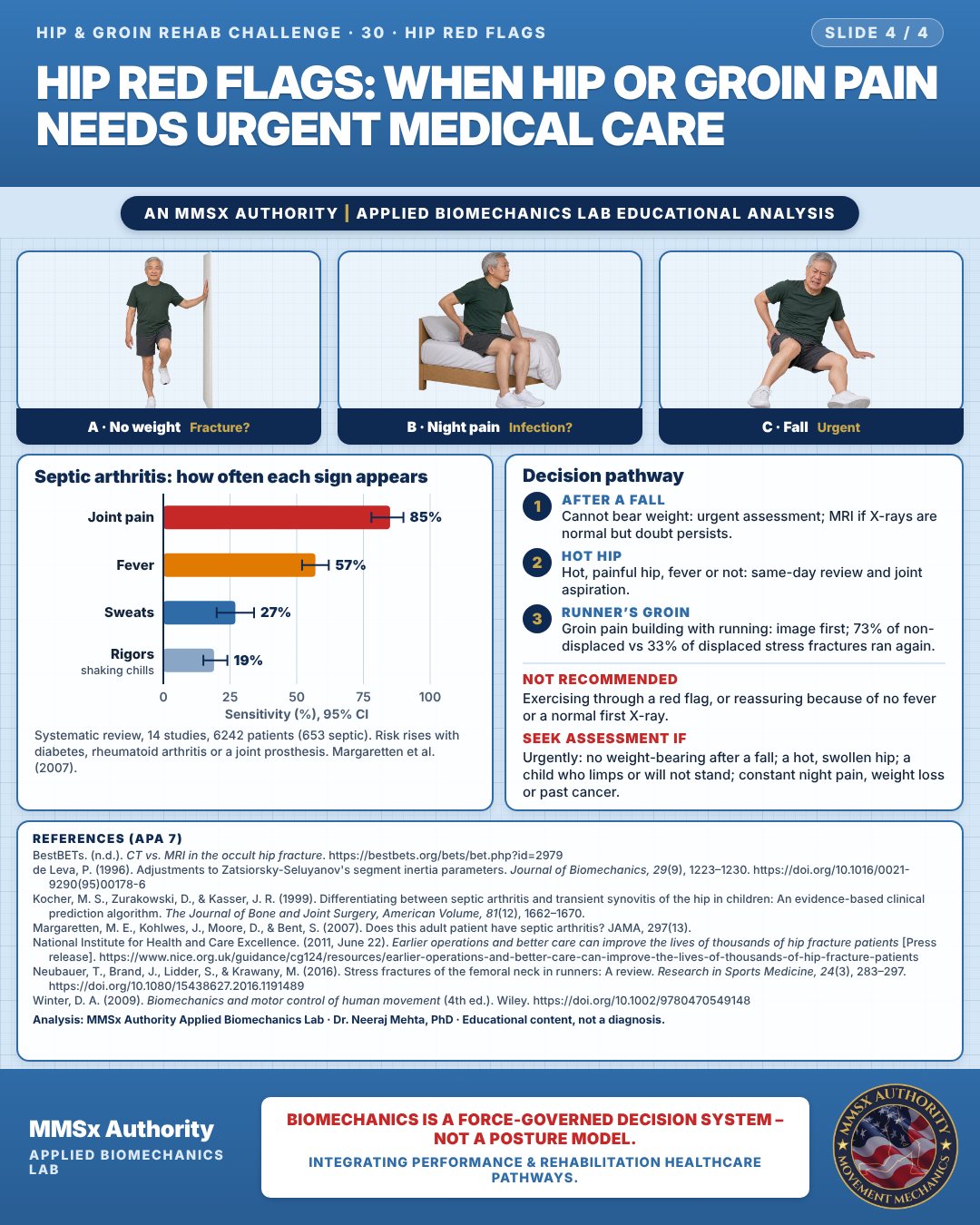
Septic arthritis: how often each sign appears
After a fall
Cannot bear weight: urgent assessment; MRI if X-rays are normal but doubt persists.
Hot hip
Hot, painful hip, fever or not: same-day review and joint aspiration.
Runner’s groin
Groin pain building with running: image first; 73% of non-displaced vs 33% of displaced stress fractures ran again.
What the evidence supports
- Hot, painful hip with or without fever: joint aspiration and synovial fluid analysis (Margaretten et al., 2007); in children, apply the four-predictor assessment (Kocher et al., 1999);
- Deep groin pain building with running: imaging for femoral neck stress fracture before further running (Neubauer et al., 2016).
Myth and evidence
Myth“No fever means it can't be an infection.”
EvidenceFever was present in only 57% of adults with septic arthritis (Margaretten et al., 2007). A second myth is "a normal X-ray rules out a fracture": about 1% of hip fractures in people over 60 were occult on first radiographs (BestBETs, n.d.).
Cautions
Not recommended
Exercising through a red flag, or reassuring because of no fever or a normal first X-ray.
Seek assessment if
Urgently: no weight-bearing after a fall; a hot, swollen hip; a child who limps or will not stand; constant night pain, weight loss or past cancer.
Methods note
2-D estimates from pose landmarks on an illustrated figure; CoM from de Leva (1996) segment parameters; cm for a 1.70 m adult (Winter, 2009). Skeleton only: angles are not estimated in this oblique seated view. Skeleton only: angles are not estimated in floor-sitting poses. These are educational estimates, not a diagnosis.
References
- BestBETs. (n.d.). CT vs. MRI in the occult hip fracture. https://bestbets.org/bets/bet.php?id=2979
- de Leva, P. (1996). Adjustments to Zatsiorsky-Seluyanov's segment inertia parameters. Journal of Biomechanics, 29(9), 1223–1230. https://doi.org/10.1016/0021-9290(95)00178-6
- Kocher, M. S., Zurakowski, D., & Kasser, J. R. (1999). Differentiating between septic arthritis and transient synovitis of the hip in children: An evidence-based clinical prediction algorithm. The Journal of Bone and Joint Surgery, American Volume, 81(12), 1662–1670.
- Margaretten, M. E., Kohlwes, J., Moore, D., & Bent, S. (2007). Does this adult patient have septic arthritis? JAMA, 297(13).
- National Institute for Health and Care Excellence. (2011, June 22). Earlier operations and better care can improve the lives of thousands of hip fracture patients [Press release]. https://www.nice.org.uk/guidance/cg124/resources/earlier-operations-and-better-care-can-improve-the-lives-of-thousands-of-hip-fracture-patients
- Neubauer, T., Brand, J., Lidder, S., & Krawany, M. (2016). Stress fractures of the femoral neck in runners: A review. Research in Sports Medicine, 24(3), 283–297. https://doi.org/10.1080/15438627.2016.1191489
- Winter, D. A. (2009). Biomechanics and motor control of human movement (4th ed.). Wiley. https://doi.org/10.1002/9780470549148
Cite this article
Mehta, N. (2026, October 28). Hip red flags: when hip or groin pain needs urgent medical care. MMSx Authority Applied Biomechanics Lab. https://mmsxauthority.org/edu/analysis/hip-groin/30-hip-red-flags-when-hip-or-groin-pain-needs-urgent-medical-care/
Part of the collection
Mehta, N. (2026). Hip and Groin Rehabilitation: 30 Evidence-Based Biomechanics Analyses [Collection]. MMSx Authority Applied Biomechanics Lab. Zenodo. https://doi.org/10.5281/zenodo.23735806
All Hip & Groin Rehab Challenge articles · Rehabilitation Library