Hip & Groin Rehab Challenge · 05
Pain on the outer hip: gluteal tendinopathy explained
Gluteal tendinopathy is a painful, load-related condition of the gluteus medius and/or gluteus minimus tendons where they attach to the greater trochanter.
Key points
- Educate. Explain tendon compression; avoid hanging on one hip, crossed legs and adduction stretches.
- Load. Start with isometric abductor work such as the wall press, then progress strength and control.
- Review. An injection may ease pain short term, but global success at one year was higher with exercise.
What it is
Gluteal tendinopathy is a painful, load-related condition of the gluteus medius and/or gluteus minimus tendons where they attach to the greater trochanter. It is the main cause of greater trochanteric pain syndrome (GTPS) and presents as lateral hip pain that is often provoked by single-leg loading, lying on the side and positions of hip adduction. Clinical diagnosis was confirmed with MRI in the key trials (Mellor et al., 2018; Grimaldi et al., 2017).
How we analysed the movement
Three movements relevant to this topic were analysed from illustrated reference figures. Joint centres were located with two-dimensional pose estimation; hip and knee angles, pelvis level, the whole-body centre of mass and, where relevant, the hip lever (the horizontal distance from the hip joint to the upper-body centre of mass) and the resulting static hip moment were then calculated from standard segment parameters. The figures are educational estimates that show how position changes mechanical demand; they are not measurements of a patient. Every research value quoted below comes from the published source cited beside it.
Movement A: Hand on outer hip (front view)
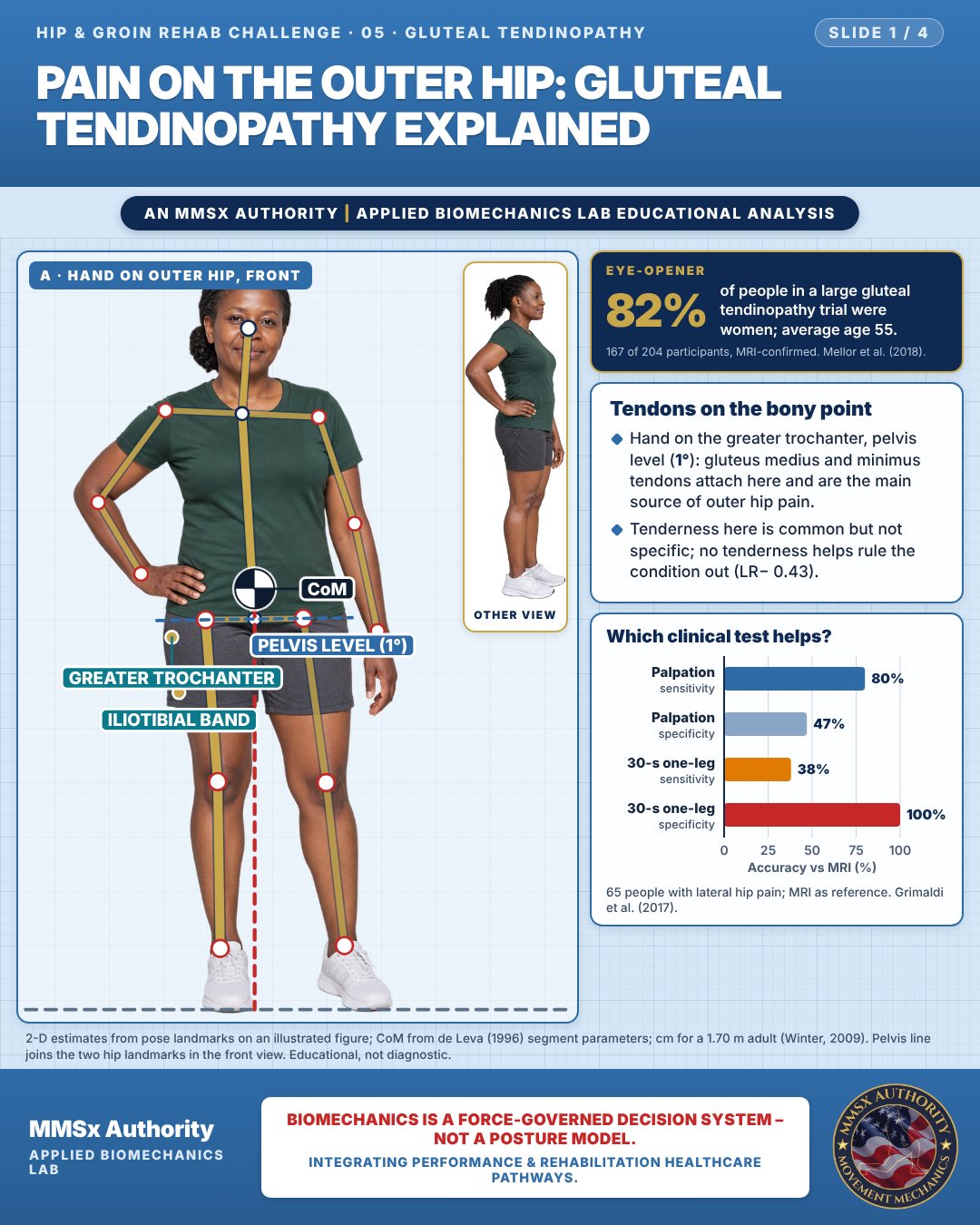
Tendons on the bony point
Hand on the greater trochanter, pelvis level (1°): gluteus medius and minimus tendons attach here and are the main source of outer hip pain.
Tenderness here is common but not specific; no tenderness helps rule the condition out (LR− 0.43).
Which clinical test helps?
Movement B: Hanging on one hip (front view)
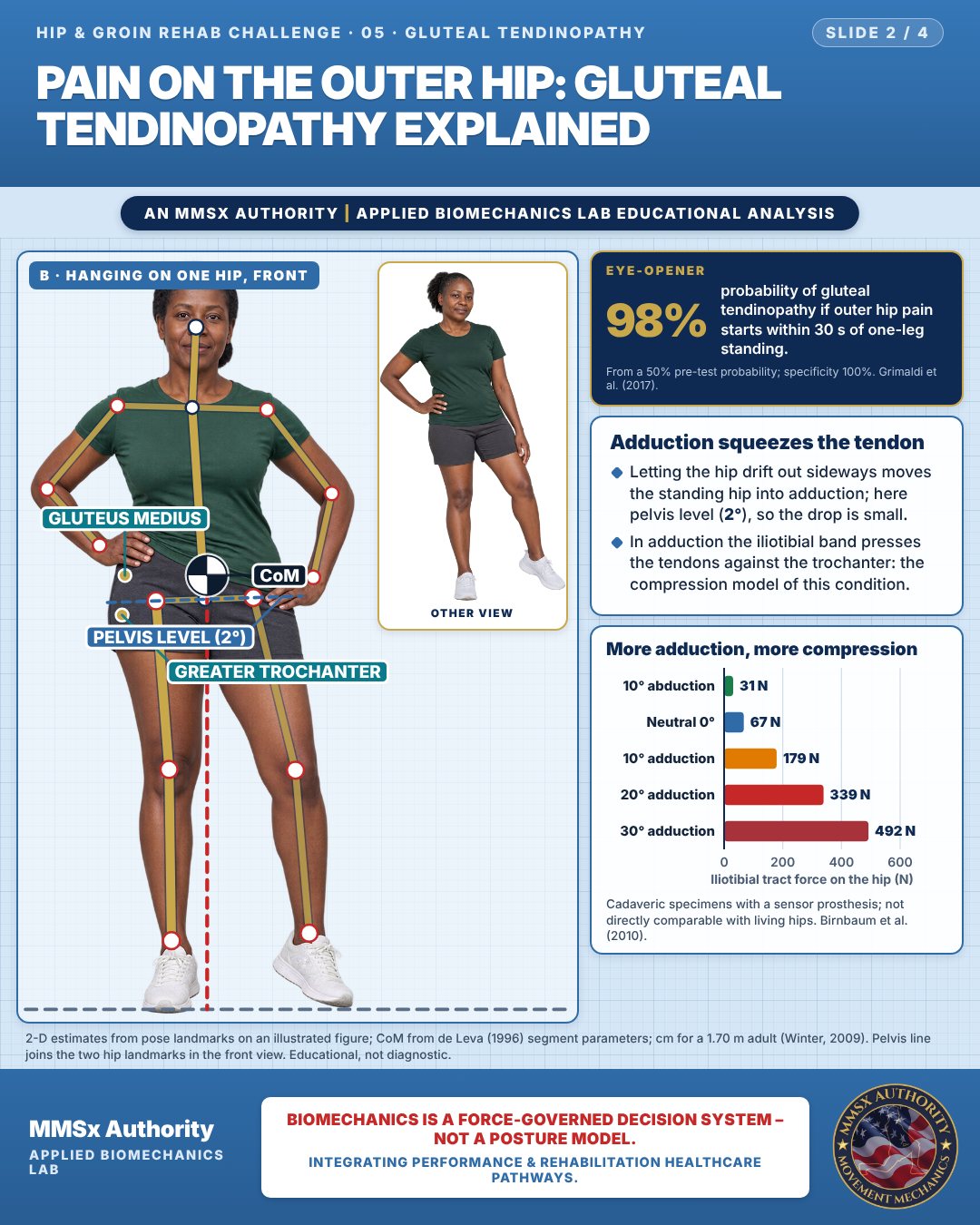
Adduction squeezes the tendon
Letting the hip drift out sideways moves the standing hip into adduction; here pelvis level (2°), so the drop is small.
In adduction the iliotibial band presses the tendons against the trochanter: the compression model of this condition.
More adduction, more compression
Movement C: Wall press (front view)
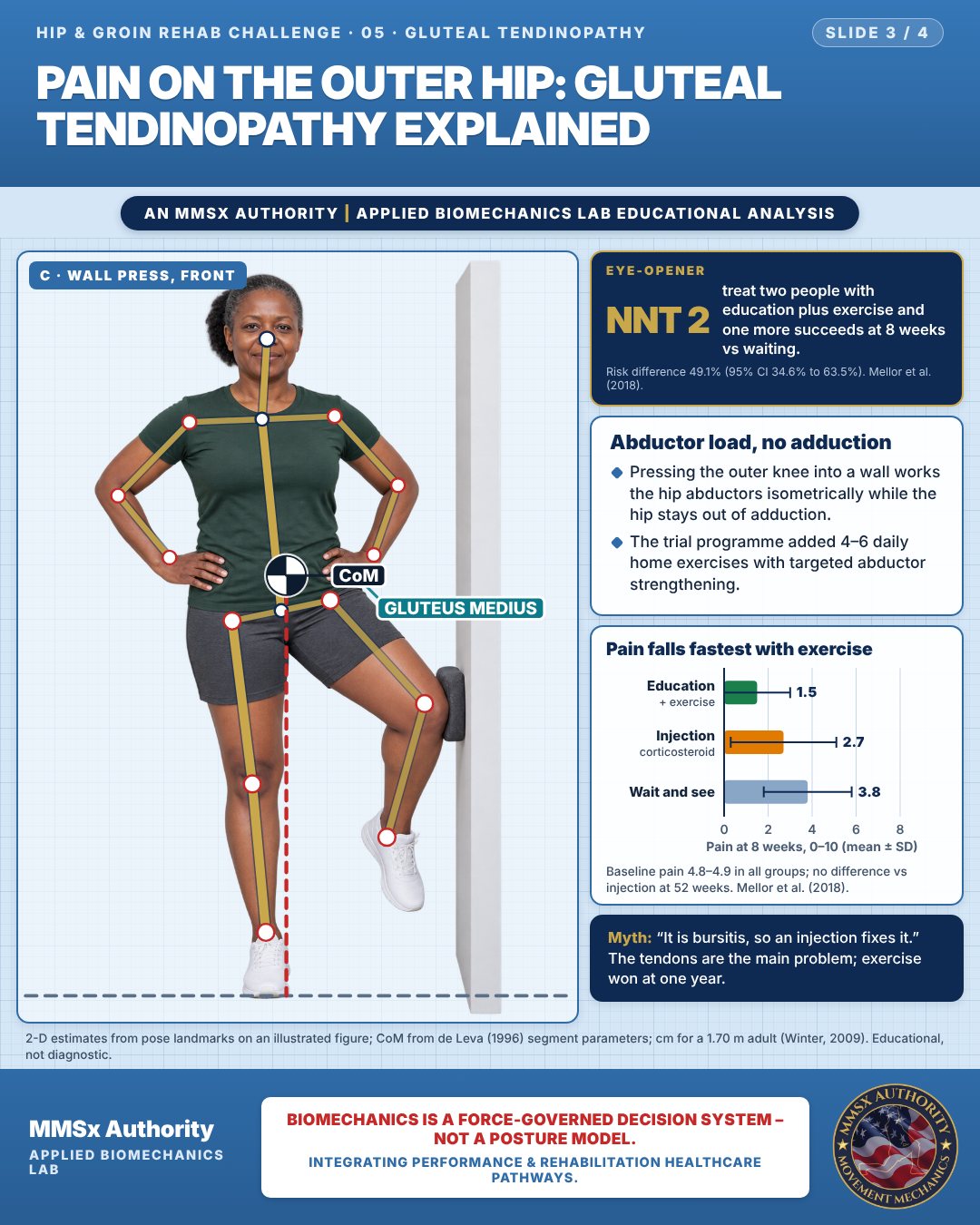
Abductor load, no adduction
Pressing the outer knee into a wall works the hip abductors isometrically while the hip stays out of adduction.
The trial programme added 4–6 daily home exercises with targeted abductor strengthening.
Pain falls fastest with exercise
Decision pathway
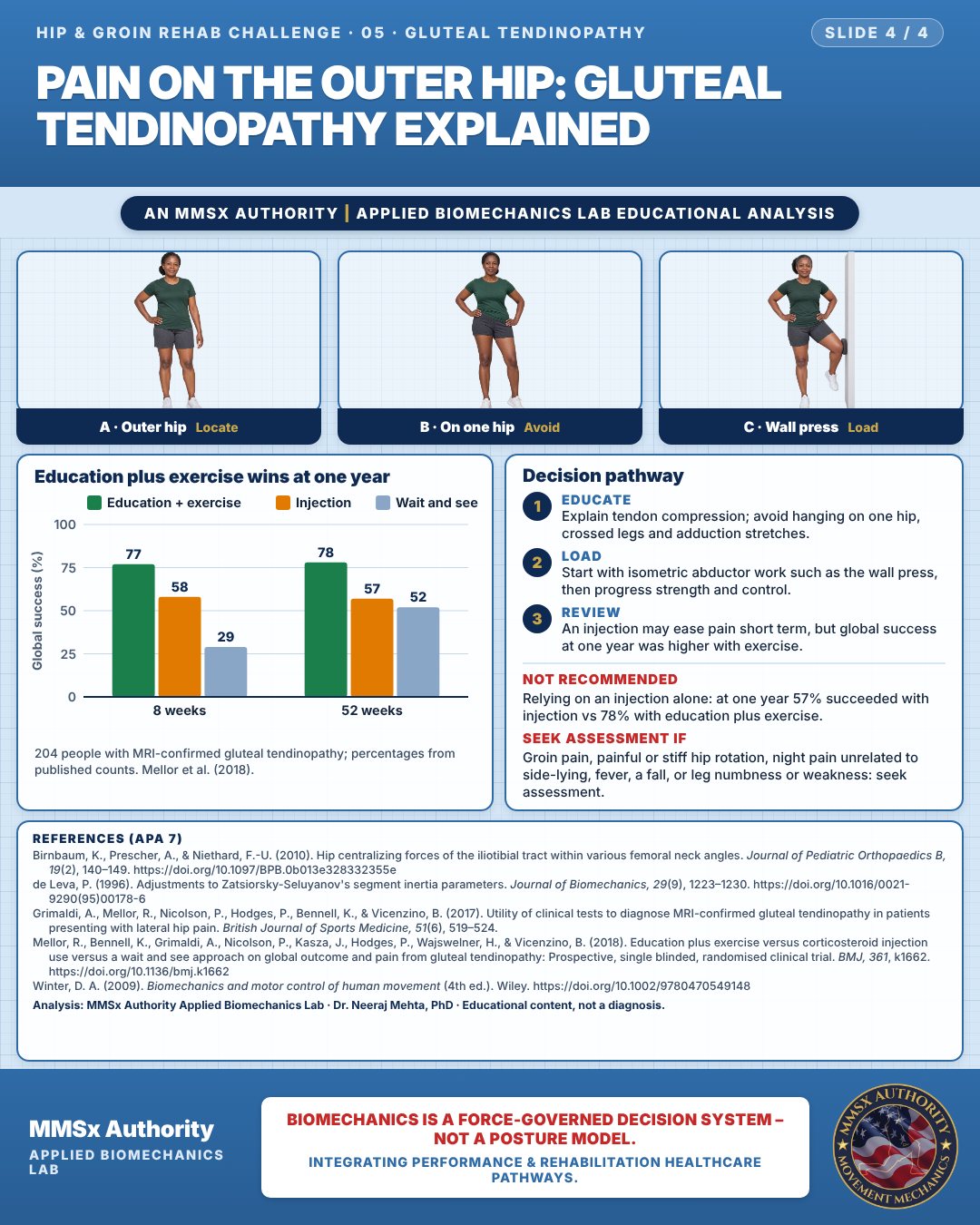
Education plus exercise wins at one year
Educate
Explain tendon compression; avoid hanging on one hip, crossed legs and adduction stretches.
Load
Start with isometric abductor work such as the wall press, then progress strength and control.
Review
An injection may ease pain short term, but global success at one year was higher with exercise.
What the evidence supports
- Education plus exercise is the best-supported first-line approach: education about tendon care, "appropriate amounts and gradual progression of tendon loading", and avoiding movements and positions that compress the gluteus medius and minimus tendons against the greater trochanter; plus a daily home programme of 4–6 exercises with targeted hip abductor strengthening and dynamic control of adduction during function (Mellor et al., 2018). Isometric abduction against a wall is consistent with this approach of loading the abductors without adduction.
- Corticosteroid injection gave short-term benefit but a worse one-year global outcome than education plus exercise (Mellor et al., 2018).
- Wait and see was the least effective option at 8 weeks (Mellor et al., 2018).
Myth and evidence
Myth“Outer hip pain is bursitis, so an injection fixes it.”
EvidenceThe main pathology is in the gluteal tendons, and at one year education plus exercise gave more people a successful outcome (78%) than a corticosteroid injection (57%) (Mellor et al., 2018).
Cautions
Not recommended
Relying on an injection alone: at one year 57% succeeded with injection vs 78% with education plus exercise.
Seek assessment if
Groin pain, painful or stiff hip rotation, night pain unrelated to side-lying, fever, a fall, or leg numbness or weakness: seek assessment.
Methods note
2-D estimates from pose landmarks on an illustrated figure; CoM from de Leva (1996) segment parameters; cm for a 1.70 m adult (Winter, 2009). Pelvis line joins the two hip landmarks in the front view. These are educational estimates, not a diagnosis.
References
- Birnbaum, K., Prescher, A., & Niethard, F.-U. (2010). Hip centralizing forces of the iliotibial tract within various femoral neck angles. Journal of Pediatric Orthopaedics B, 19(2), 140–149. https://doi.org/10.1097/BPB.0b013e328332355e
- de Leva, P. (1996). Adjustments to Zatsiorsky-Seluyanov's segment inertia parameters. Journal of Biomechanics, 29(9), 1223–1230. https://doi.org/10.1016/0021-9290(95)00178-6
- Grimaldi, A., Mellor, R., Nicolson, P., Hodges, P., Bennell, K., & Vicenzino, B. (2017). Utility of clinical tests to diagnose MRI-confirmed gluteal tendinopathy in patients presenting with lateral hip pain. British Journal of Sports Medicine, 51(6), 519–524.
- Mellor, R., Bennell, K., Grimaldi, A., Nicolson, P., Kasza, J., Hodges, P., Wajswelner, H., & Vicenzino, B. (2018). Education plus exercise versus corticosteroid injection use versus a wait and see approach on global outcome and pain from gluteal tendinopathy: Prospective, single blinded, randomised clinical trial. BMJ, 361, k1662. https://doi.org/10.1136/bmj.k1662
- Winter, D. A. (2009). Biomechanics and motor control of human movement (4th ed.). Wiley. https://doi.org/10.1002/9780470549148
Cite this article
Mehta, N. (2026, October 28). Pain on the outer hip: gluteal tendinopathy explained. MMSx Authority Applied Biomechanics Lab. https://mmsxauthority.org/edu/analysis/hip-groin/05-pain-on-the-outer-hip-gluteal-tendinopathy-explained/
Part of the collection
Mehta, N. (2026). Hip and Groin Rehabilitation: 30 Evidence-Based Biomechanics Analyses [Collection]. MMSx Authority Applied Biomechanics Lab. Zenodo. https://doi.org/10.5281/zenodo.23735806
All Hip & Groin Rehab Challenge articles · Rehabilitation Library