Hip & Groin Rehab Challenge · 25
Hip mobility: rotation range and what it means for function
Hip rotation range is the arc of internal (inward) and external (outward) rotation of the femur in the acetabulum, usually measured with the hip and…
Key points
- Measure. Measure internal rotation at 90° of flexion on both sides and track it over time.
- Compare. Compare with the other side and the person’s own history, not a single textbook number.
- Move. Use rotation work within an exercise programme, as one component rather than a stand-alone cure.
What it is
Hip rotation range is the arc of internal (inward) and external (outward) rotation of the femur in the acetabulum, usually measured with the hip and knee bent to 90° (sitting or lying). It varies widely between healthy people and by sex and age, and loss of internal rotation is one of the earliest clinical signs of intra-articular hip conditions such as osteoarthritis and femoroacetabular impingement (Svenningsen et al., 1989; Altman et al., 1991).
How we analysed the movement
Three movements relevant to this topic were analysed from illustrated reference figures. Joint centres were located with two-dimensional pose estimation; hip and knee angles, pelvis level, the whole-body centre of mass and, where relevant, the hip lever (the horizontal distance from the hip joint to the upper-body centre of mass) and the resulting static hip moment were then calculated from standard segment parameters. The figures are educational estimates that show how position changes mechanical demand; they are not measurements of a patient. Every research value quoted below comes from the published source cited beside it.
Movement A: 90/90 sit (front view)
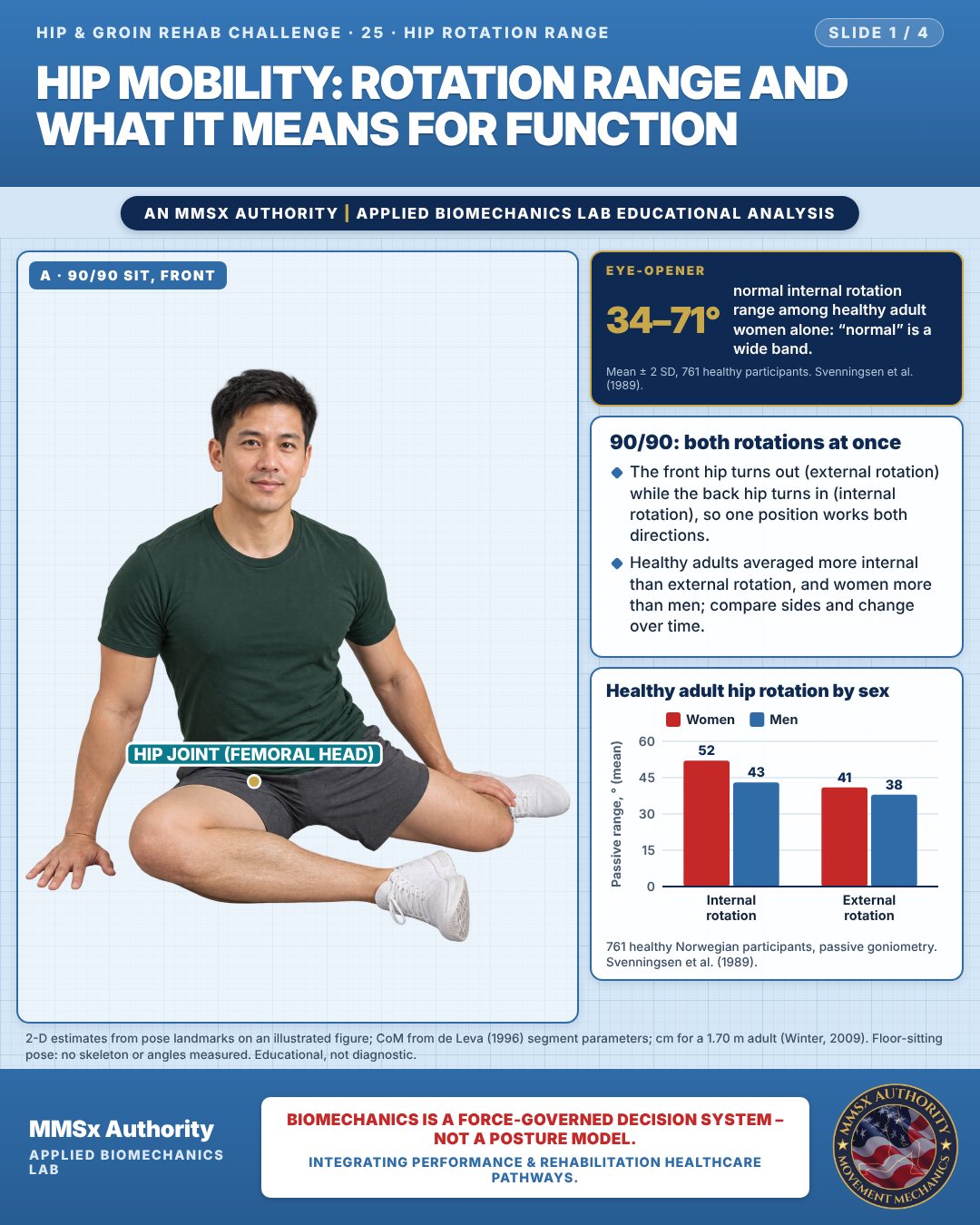
90/90: both rotations at once
The front hip turns out (external rotation) while the back hip turns in (internal rotation), so one position works both directions.
Healthy adults averaged more internal than external rotation, and women more than men; compare sides and change over time.
Healthy adult hip rotation by sex
Movement B: Figure-four stretch (front view)
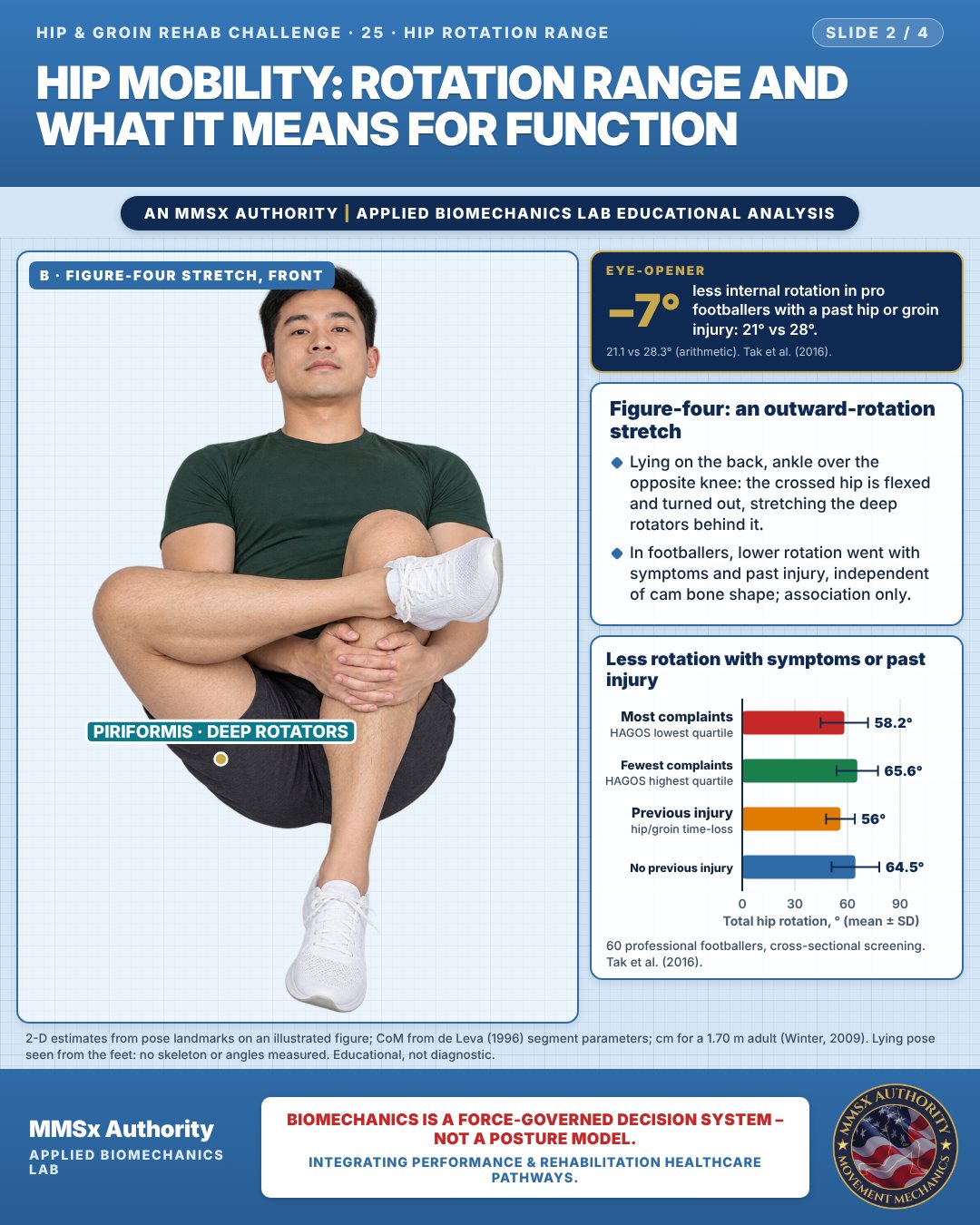
Figure-four: an outward-rotation stretch
Lying on the back, ankle over the opposite knee: the crossed hip is flexed and turned out, stretching the deep rotators behind it.
In footballers, lower rotation went with symptoms and past injury, independent of cam bone shape; association only.
Less rotation with symptoms or past injury
Movement C: Seated rotation (front view)
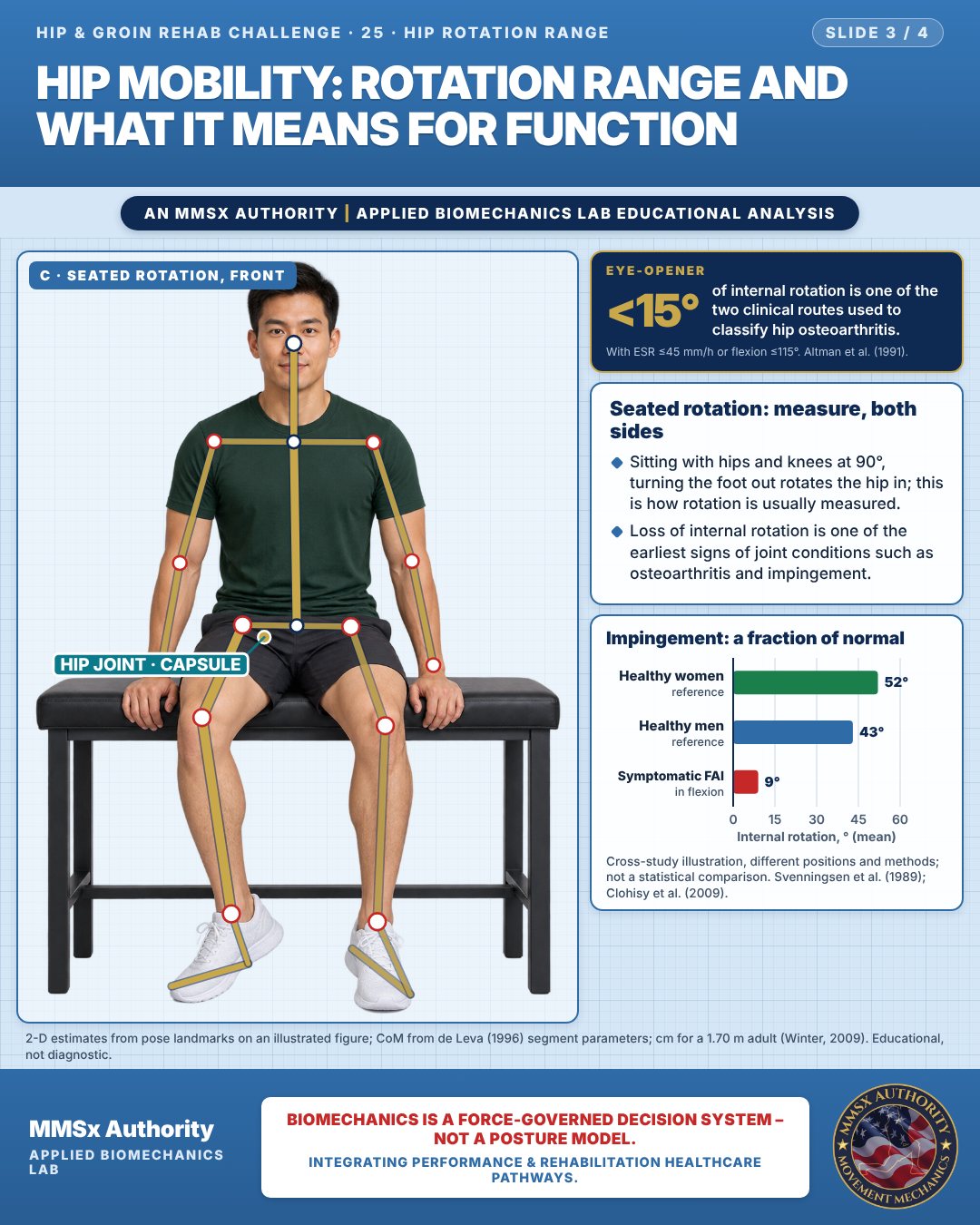
Seated rotation: measure, both sides
Sitting with hips and knees at 90°, turning the foot out rotates the hip in; this is how rotation is usually measured.
Loss of internal rotation is one of the earliest signs of joint conditions such as osteoarthritis and impingement.
Impingement: a fraction of normal
Decision pathway
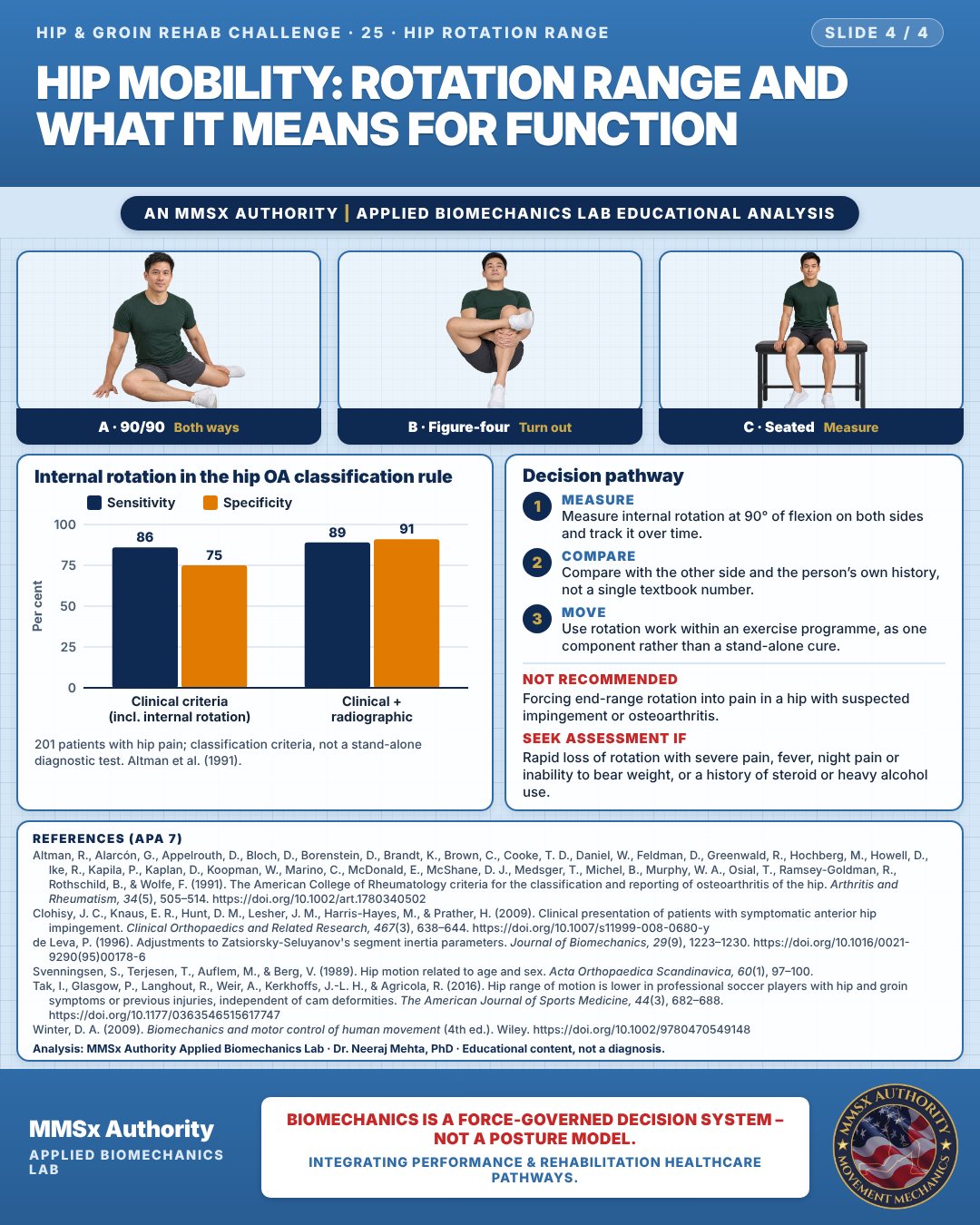
Internal rotation in the hip OA classification rule
Measure
Measure internal rotation at 90° of flexion on both sides and track it over time.
Compare
Compare with the other side and the person’s own history, not a single textbook number.
Move
Use rotation work within an exercise programme, as one component rather than a stand-alone cure.
What the evidence supports
- Measure internal rotation at 90° of flexion, both sides, and track it over time; in footballers, lower internal and total rotation was associated with symptoms and past injury (Tak et al., 2016).
Cautions
Not recommended
Forcing end-range rotation into pain in a hip with suspected impingement or osteoarthritis.
Seek assessment if
Rapid loss of rotation with severe pain, fever, night pain or inability to bear weight, or a history of steroid or heavy alcohol use.
Methods note
2-D estimates from pose landmarks on an illustrated figure; CoM from de Leva (1996) segment parameters; cm for a 1.70 m adult (Winter, 2009). Floor-sitting pose: no skeleton or angles measured. Lying pose seen from the feet: no skeleton or angles measured. These are educational estimates, not a diagnosis.
References
- Altman, R., Alarcón, G., Appelrouth, D., Bloch, D., Borenstein, D., Brandt, K., Brown, C., Cooke, T. D., Daniel, W., Feldman, D., Greenwald, R., Hochberg, M., Howell, D., Ike, R., Kapila, P., Kaplan, D., Koopman, W., Marino, C., McDonald, E., McShane, D. J., Medsger, T., Michel, B., Murphy, W. A., Osial, T., Ramsey-Goldman, R., Rothschild, B., & Wolfe, F. (1991). The American College of Rheumatology criteria for the classification and reporting of osteoarthritis of the hip. Arthritis and Rheumatism, 34(5), 505–514. https://doi.org/10.1002/art.1780340502
- Clohisy, J. C., Knaus, E. R., Hunt, D. M., Lesher, J. M., Harris-Hayes, M., & Prather, H. (2009). Clinical presentation of patients with symptomatic anterior hip impingement. Clinical Orthopaedics and Related Research, 467(3), 638–644. https://doi.org/10.1007/s11999-008-0680-y
- de Leva, P. (1996). Adjustments to Zatsiorsky-Seluyanov's segment inertia parameters. Journal of Biomechanics, 29(9), 1223–1230. https://doi.org/10.1016/0021-9290(95)00178-6
- Svenningsen, S., Terjesen, T., Auflem, M., & Berg, V. (1989). Hip motion related to age and sex. Acta Orthopaedica Scandinavica, 60(1), 97–100.
- Tak, I., Glasgow, P., Langhout, R., Weir, A., Kerkhoffs, J.-L. H., & Agricola, R. (2016). Hip range of motion is lower in professional soccer players with hip and groin symptoms or previous injuries, independent of cam deformities. The American Journal of Sports Medicine, 44(3), 682–688. https://doi.org/10.1177/0363546515617747
- Winter, D. A. (2009). Biomechanics and motor control of human movement (4th ed.). Wiley. https://doi.org/10.1002/9780470549148
Cite this article
Mehta, N. (2026, October 28). Hip mobility: rotation range and what it means for function. MMSx Authority Applied Biomechanics Lab. https://mmsxauthority.org/edu/analysis/hip-groin/25-hip-mobility-rotation-range-and-what-it-means-for-function/
Part of the collection
Mehta, N. (2026). Hip and Groin Rehabilitation: 30 Evidence-Based Biomechanics Analyses [Collection]. MMSx Authority Applied Biomechanics Lab. Zenodo. https://doi.org/10.5281/zenodo.23735806
All Hip & Groin Rehab Challenge articles · Rehabilitation Library