Hip & Groin Rehab Challenge · 27
Hip fracture in older adults: falls, strength and recovery
A hip (proximal femoral) fracture is a break of the upper femur — the femoral neck or the trochanteric region — usually after a low-energy fall in an…
Key points
- Operate & mobilise. Surgery on the day of or after admission, then physiotherapy and getting up from the next day.
- Rebuild. Continue structured exercise after discharge and include progressive resistance work for larger mobility gains.
- Prevent. Practise balance and functional exercise, such as tandem stance and chair rises, to cut further falls.
What it is
A hip (proximal femoral) fracture is a break of the upper femur — the femoral neck or the trochanteric region — usually after a low-energy fall in an older adult with reduced bone and muscle strength. It is treated surgically in almost all cases, followed by early mobilisation and multidisciplinary rehabilitation.
How we analysed the movement
Three movements relevant to this topic were analysed from illustrated reference figures. Joint centres were located with two-dimensional pose estimation; hip and knee angles, pelvis level, the whole-body centre of mass and, where relevant, the hip lever (the horizontal distance from the hip joint to the upper-body centre of mass) and the resulting static hip moment were then calculated from standard segment parameters. The figures are educational estimates that show how position changes mechanical demand; they are not measurements of a patient. Every research value quoted below comes from the published source cited beside it.
Movement A: Tandem stance (side view)
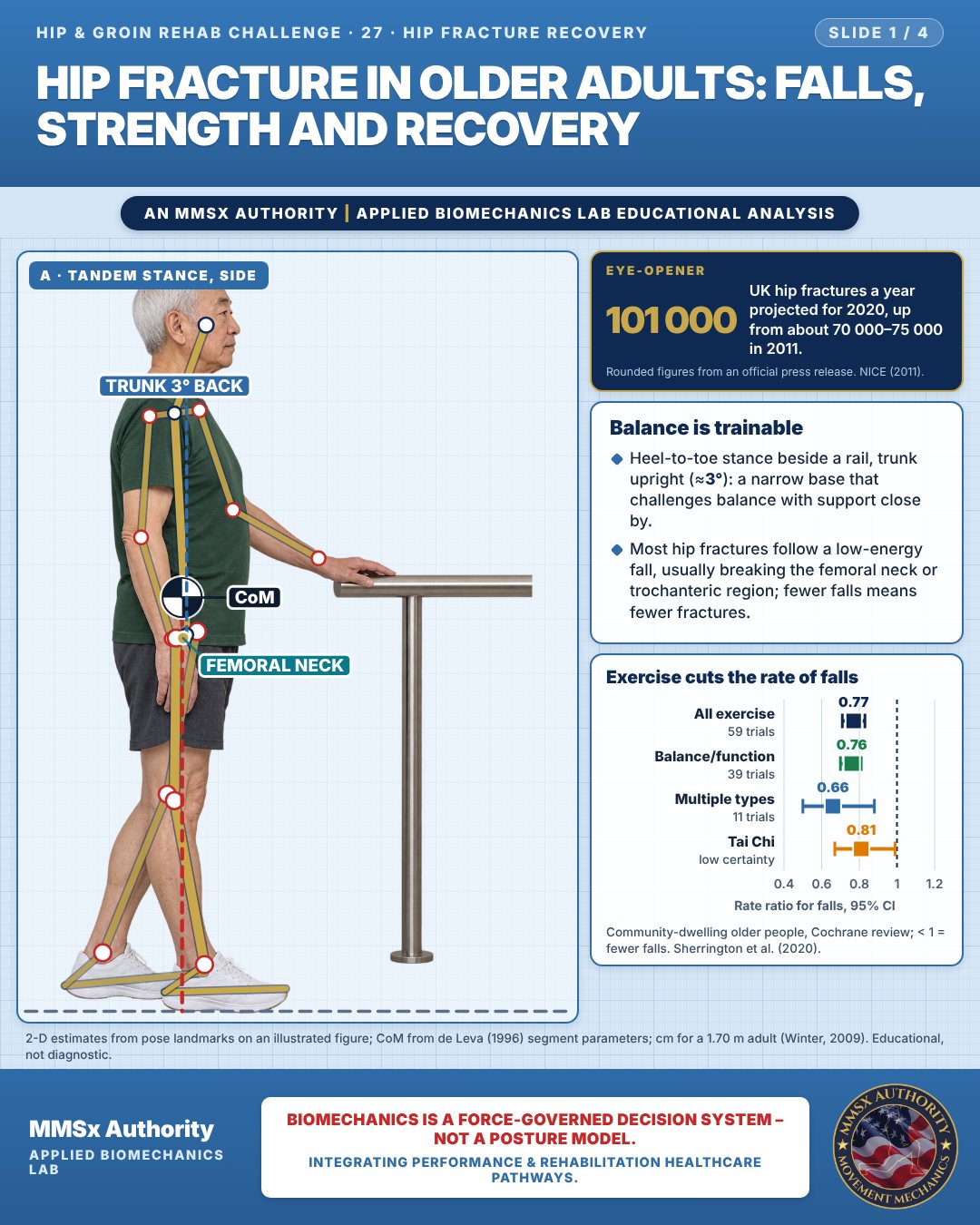
Balance is trainable
Heel-to-toe stance beside a rail, trunk upright (≈3°): a narrow base that challenges balance with support close by.
Most hip fractures follow a low-energy fall, usually breaking the femoral neck or trochanteric region; fewer falls means fewer fractures.
Exercise cuts the rate of falls
Movement B: Walking frame (side view)
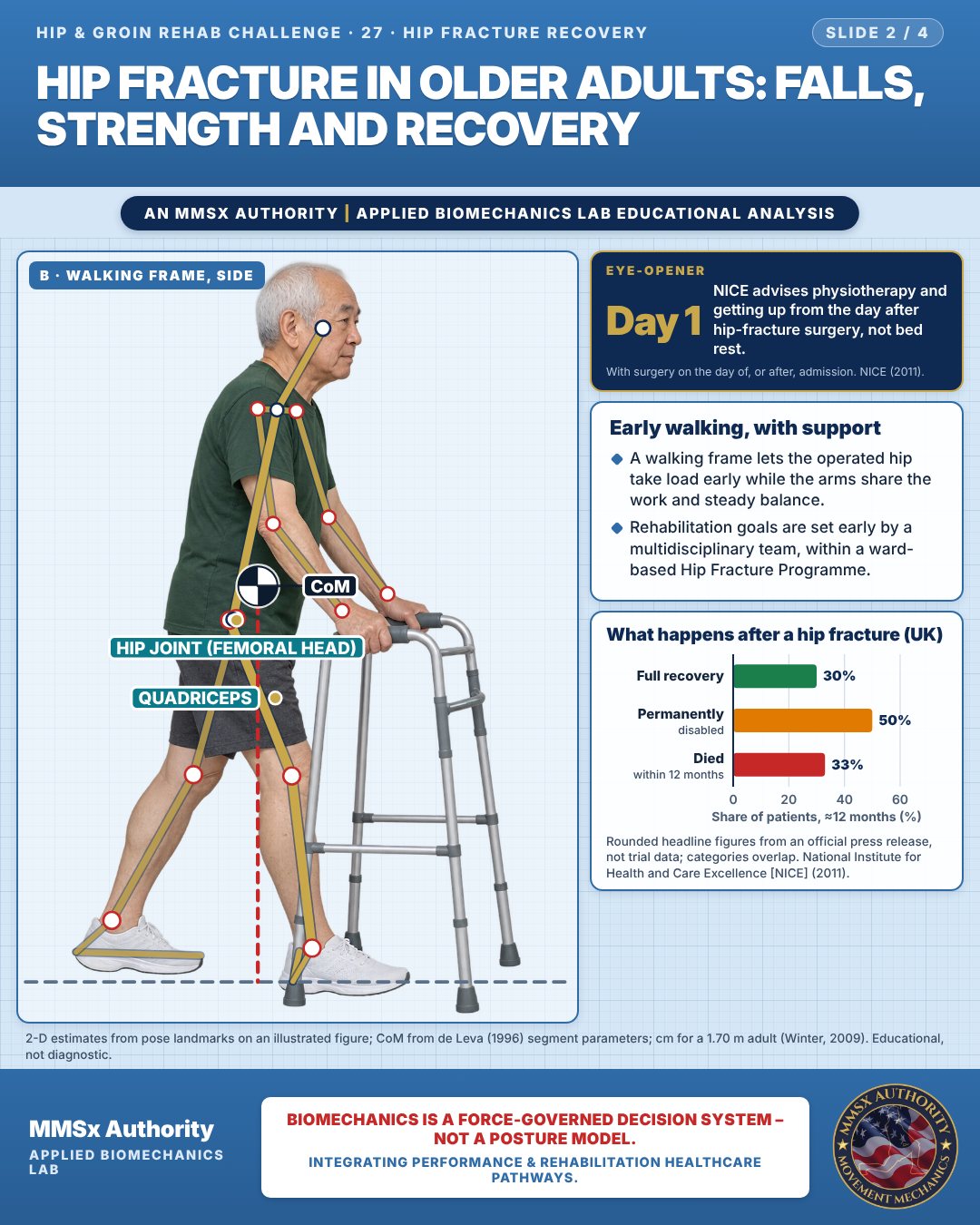
Early walking, with support
A walking frame lets the operated hip take load early while the arms share the work and steady balance.
Rehabilitation goals are set early by a multidisciplinary team, within a ward-based Hip Fracture Programme.
What happens after a hip fracture (UK)
Movement C: Rising from chair (side view)
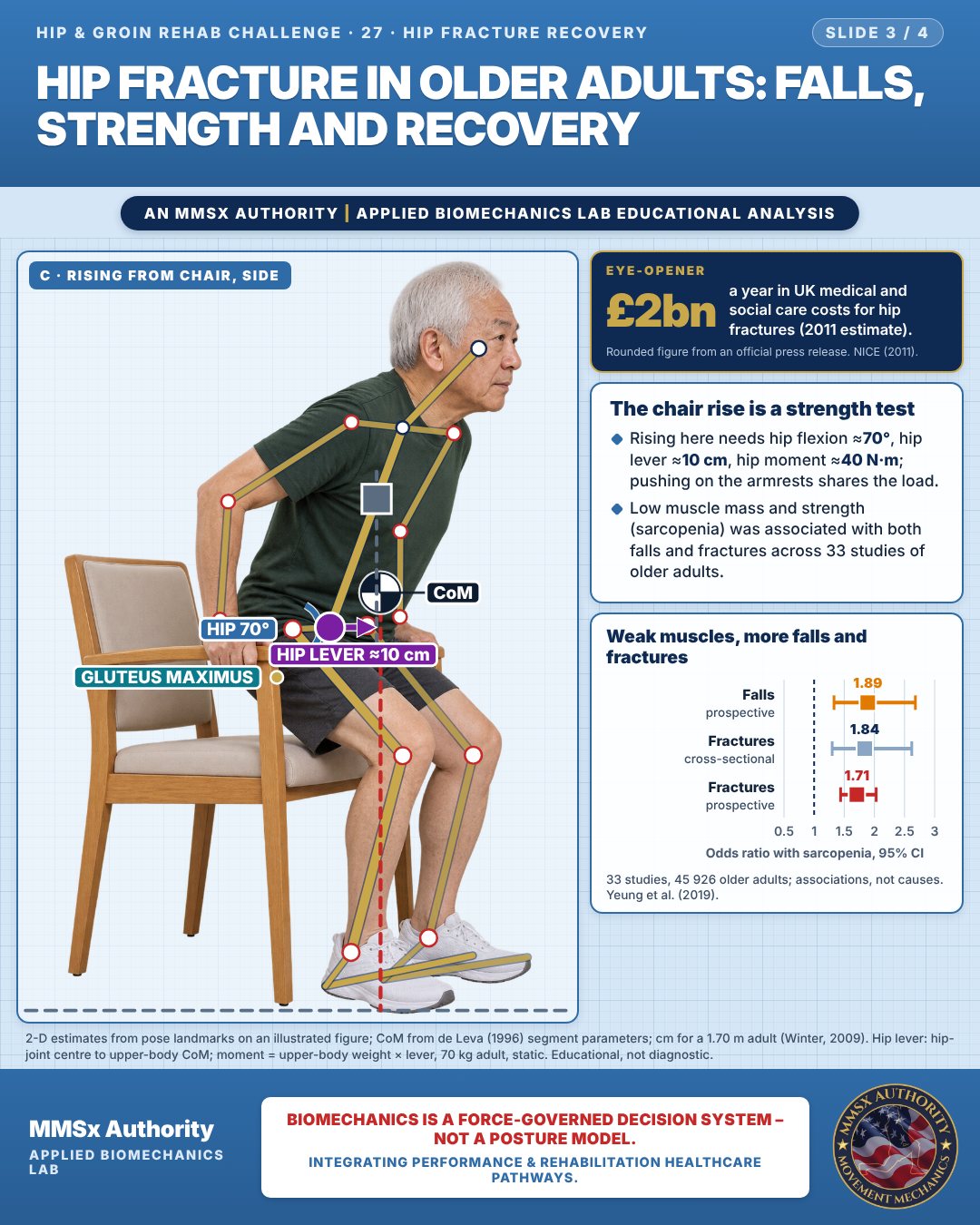
The chair rise is a strength test
Rising here needs hip flexion ≈70°, hip lever ≈10 cm, hip moment ≈40 N·m; pushing on the armrests shares the load.
Low muscle mass and strength (sarcopenia) was associated with both falls and fractures across 33 studies of older adults.
Weak muscles, more falls and fractures
Decision pathway
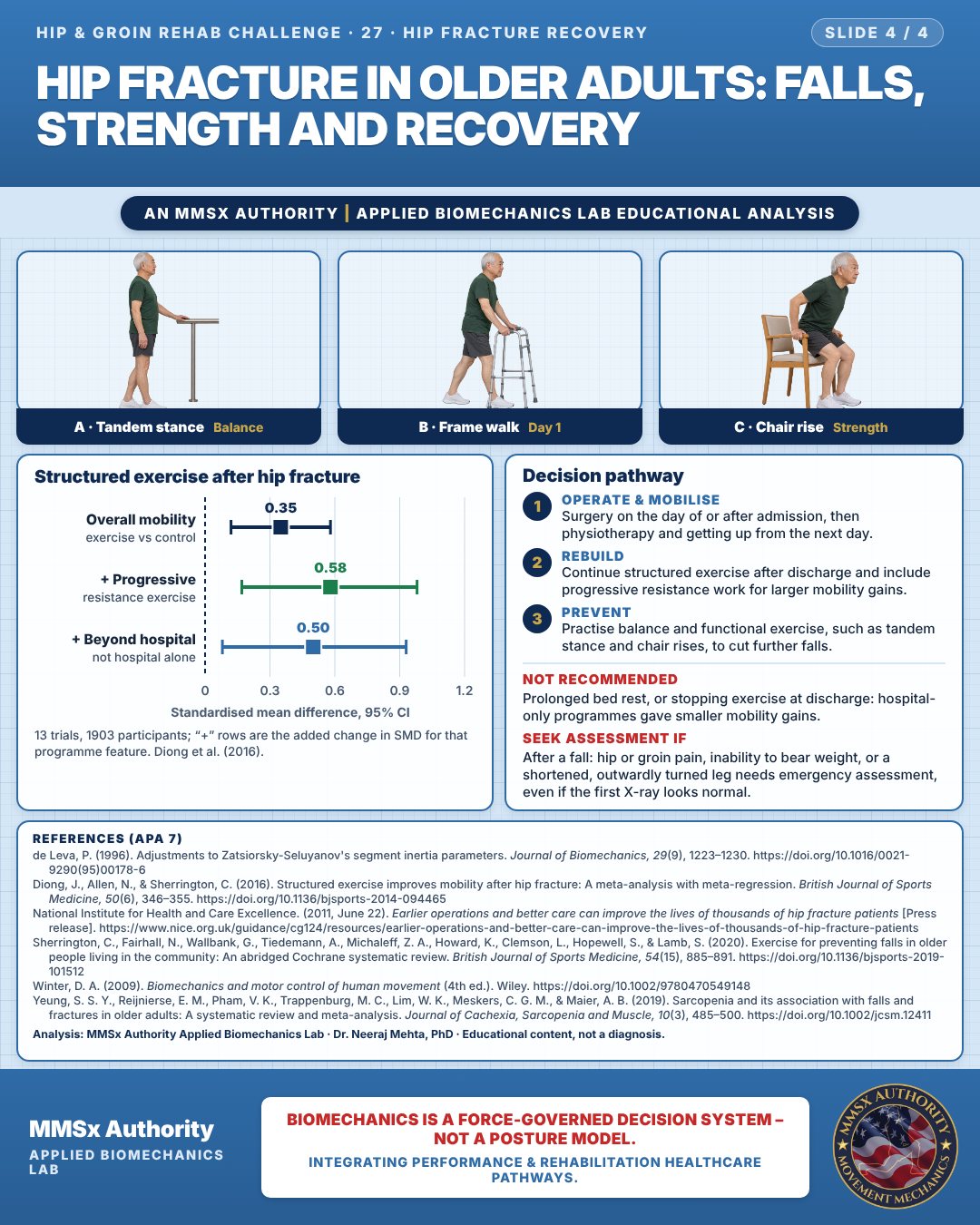
Structured exercise after hip fracture
Operate & mobilise
Surgery on the day of or after admission, then physiotherapy and getting up from the next day.
Rebuild
Continue structured exercise after discharge and include progressive resistance work for larger mobility gains.
Prevent
Practise balance and functional exercise, such as tandem stance and chair rises, to cut further falls.
What the evidence supports
- Continue structured exercise after discharge and include progressive resistance training (Diong et al., 2016).
Cautions
Not recommended
Prolonged bed rest, or stopping exercise at discharge: hospital-only programmes gave smaller mobility gains.
Seek assessment if
After a fall: hip or groin pain, inability to bear weight, or a shortened, outwardly turned leg needs emergency assessment, even if the first X-ray looks normal.
Methods note
2-D estimates from pose landmarks on an illustrated figure; CoM from de Leva (1996) segment parameters; cm for a 1.70 m adult (Winter, 2009). Hip lever: hip-joint centre to upper-body CoM; moment = upper-body weight × lever, 70 kg adult, static. These are educational estimates, not a diagnosis.
References
- de Leva, P. (1996). Adjustments to Zatsiorsky-Seluyanov's segment inertia parameters. Journal of Biomechanics, 29(9), 1223–1230. https://doi.org/10.1016/0021-9290(95)00178-6
- Diong, J., Allen, N., & Sherrington, C. (2016). Structured exercise improves mobility after hip fracture: A meta-analysis with meta-regression. British Journal of Sports Medicine, 50(6), 346–355. https://doi.org/10.1136/bjsports-2014-094465
- National Institute for Health and Care Excellence. (2011, June 22). Earlier operations and better care can improve the lives of thousands of hip fracture patients [Press release]. https://www.nice.org.uk/guidance/cg124/resources/earlier-operations-and-better-care-can-improve-the-lives-of-thousands-of-hip-fracture-patients
- Sherrington, C., Fairhall, N., Wallbank, G., Tiedemann, A., Michaleff, Z. A., Howard, K., Clemson, L., Hopewell, S., & Lamb, S. (2020). Exercise for preventing falls in older people living in the community: An abridged Cochrane systematic review. British Journal of Sports Medicine, 54(15), 885–891. https://doi.org/10.1136/bjsports-2019-101512
- Winter, D. A. (2009). Biomechanics and motor control of human movement (4th ed.). Wiley. https://doi.org/10.1002/9780470549148
- Yeung, S. S. Y., Reijnierse, E. M., Pham, V. K., Trappenburg, M. C., Lim, W. K., Meskers, C. G. M., & Maier, A. B. (2019). Sarcopenia and its association with falls and fractures in older adults: A systematic review and meta-analysis. Journal of Cachexia, Sarcopenia and Muscle, 10(3), 485–500. https://doi.org/10.1002/jcsm.12411
Cite this article
Mehta, N. (2026, October 28). Hip fracture in older adults: falls, strength and recovery. MMSx Authority Applied Biomechanics Lab. https://mmsxauthority.org/edu/analysis/hip-groin/27-hip-fracture-in-older-adults-falls-strength-and-recovery/
Part of the collection
Mehta, N. (2026). Hip and Groin Rehabilitation: 30 Evidence-Based Biomechanics Analyses [Collection]. MMSx Authority Applied Biomechanics Lab. Zenodo. https://doi.org/10.5281/zenodo.23735806
All Hip & Groin Rehab Challenge articles · Rehabilitation Library