Hip & Groin Rehab Challenge · 11
Hip flexor pain: the iliopsoas at the front of the hip
Iliopsoas-related groin pain is defined clinically by iliopsoas tenderness. Movement analysis, verified research data and a decision pathway.
Key points
- Classify. Examine for adductor, iliopsoas, inguinal, pubic and hip-joint sources; the hip joint should always be considered.
- Grade. Start with short levers and small hip angles, then longer levers and sustained holds as pain allows.
- Progress. Add speed last: the sprint knee drive asks the iliopsoas for far more force than jogging.
What it is
Iliopsoas-related groin pain is defined clinically by iliopsoas tenderness; it is more likely if there is pain on resisted hip flexion and/or pain on stretching the hip flexors (Doha agreement; Weir et al., 2015). The iliopsoas (iliacus and psoas major) is the main hip flexor and crosses the front of the hip joint.
How we analysed the movement
Three movements relevant to this topic were analysed from illustrated reference figures. Joint centres were located with two-dimensional pose estimation; hip and knee angles, pelvis level, the whole-body centre of mass and, where relevant, the hip lever (the horizontal distance from the hip joint to the upper-body centre of mass) and the resulting static hip moment were then calculated from standard segment parameters. The figures are educational estimates that show how position changes mechanical demand; they are not measurements of a patient. Every research value quoted below comes from the published source cited beside it.
Movement A: Kneeling hip stretch (side view)
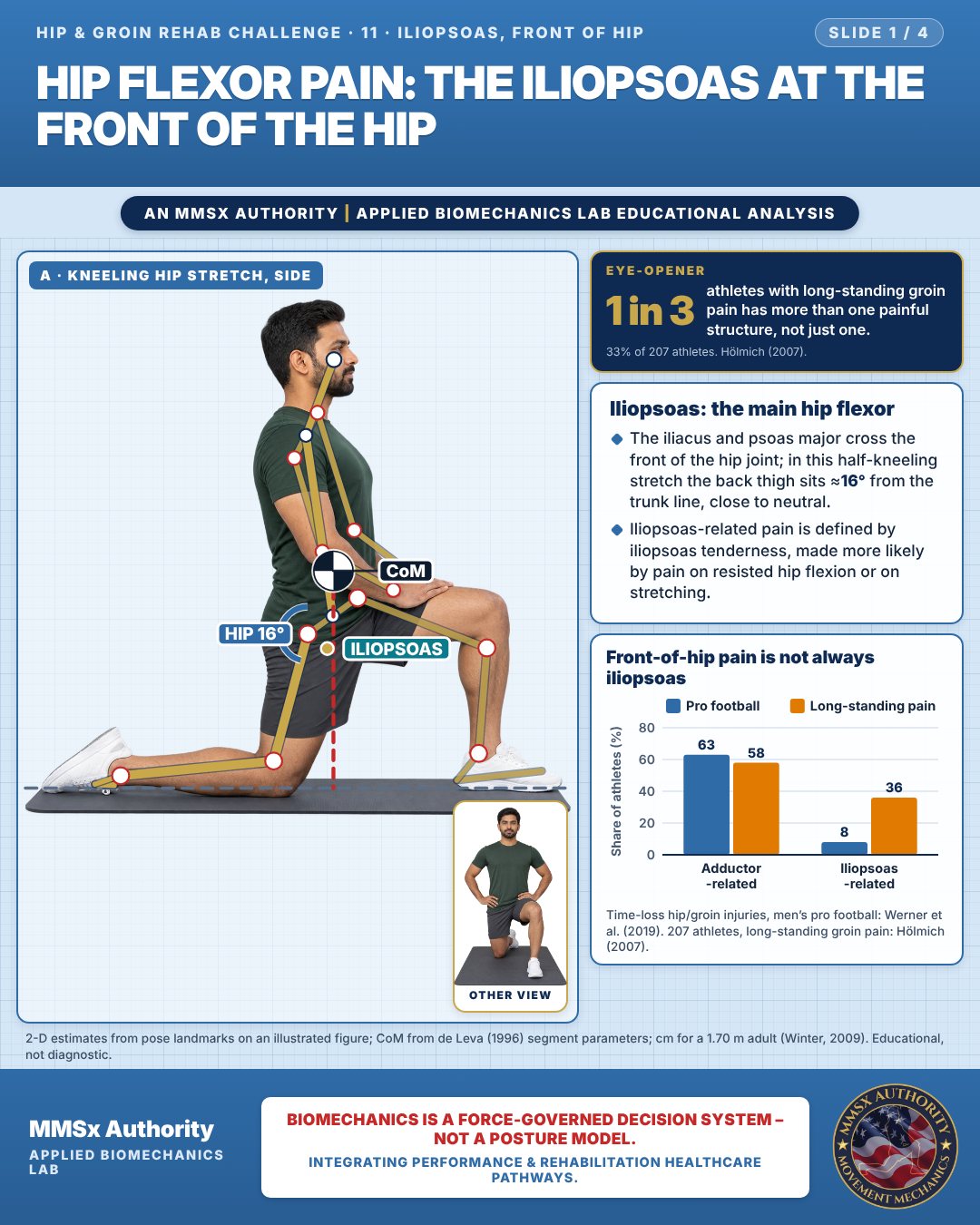
Iliopsoas: the main hip flexor
The iliacus and psoas major cross the front of the hip joint; in this half-kneeling stretch the back thigh sits ≈16° from the trunk line, close to neutral.
Iliopsoas-related pain is defined by iliopsoas tenderness, made more likely by pain on resisted hip flexion or on stretching.
Front-of-hip pain is not always iliopsoas
Movement B: Knee raise hold (side view)
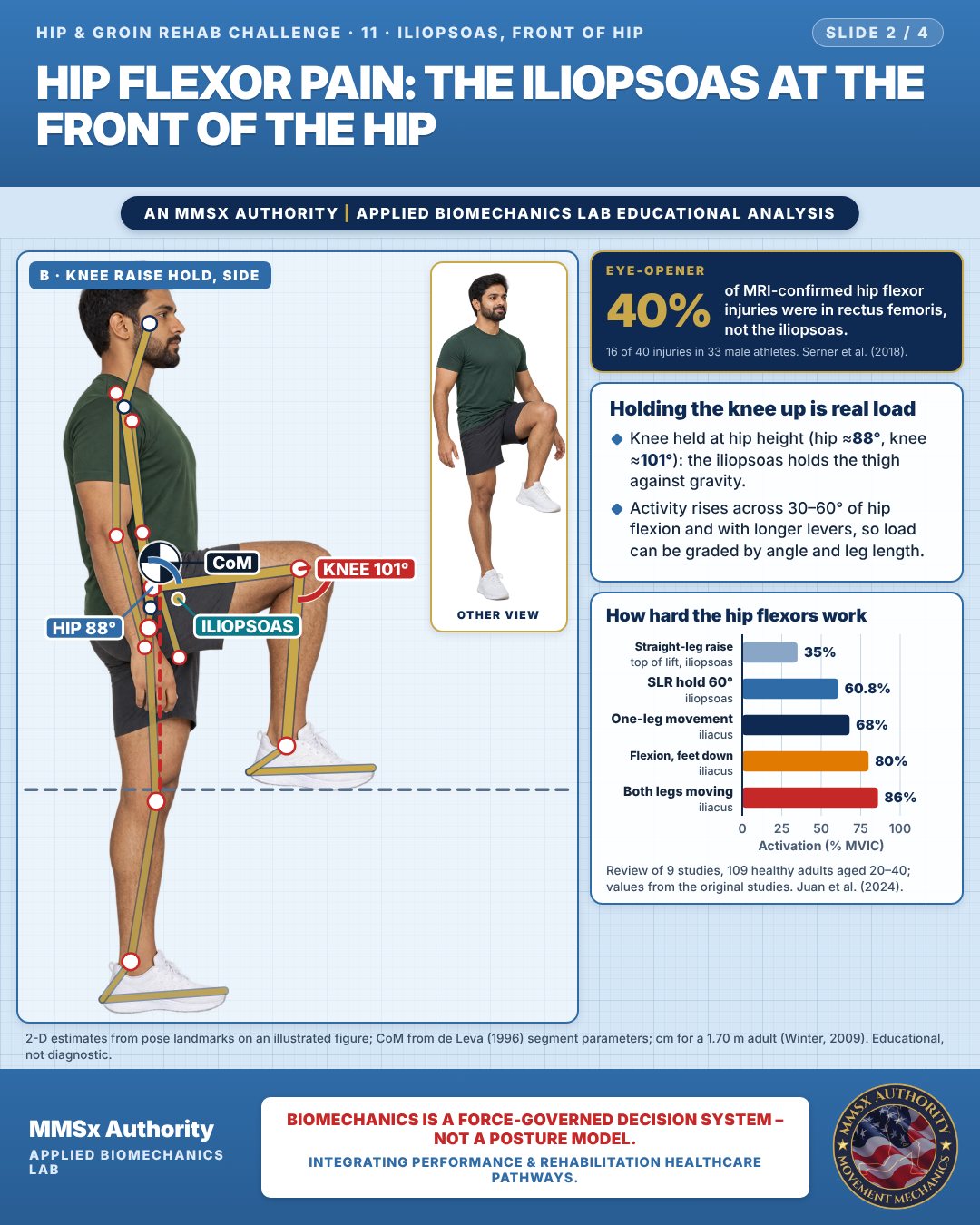
Holding the knee up is real load
Knee held at hip height (hip ≈88°, knee ≈101°): the iliopsoas holds the thigh against gravity.
Activity rises across 30–60° of hip flexion and with longer levers, so load can be graded by angle and leg length.
How hard the hip flexors work
Movement C: Sprint knee drive (side view)
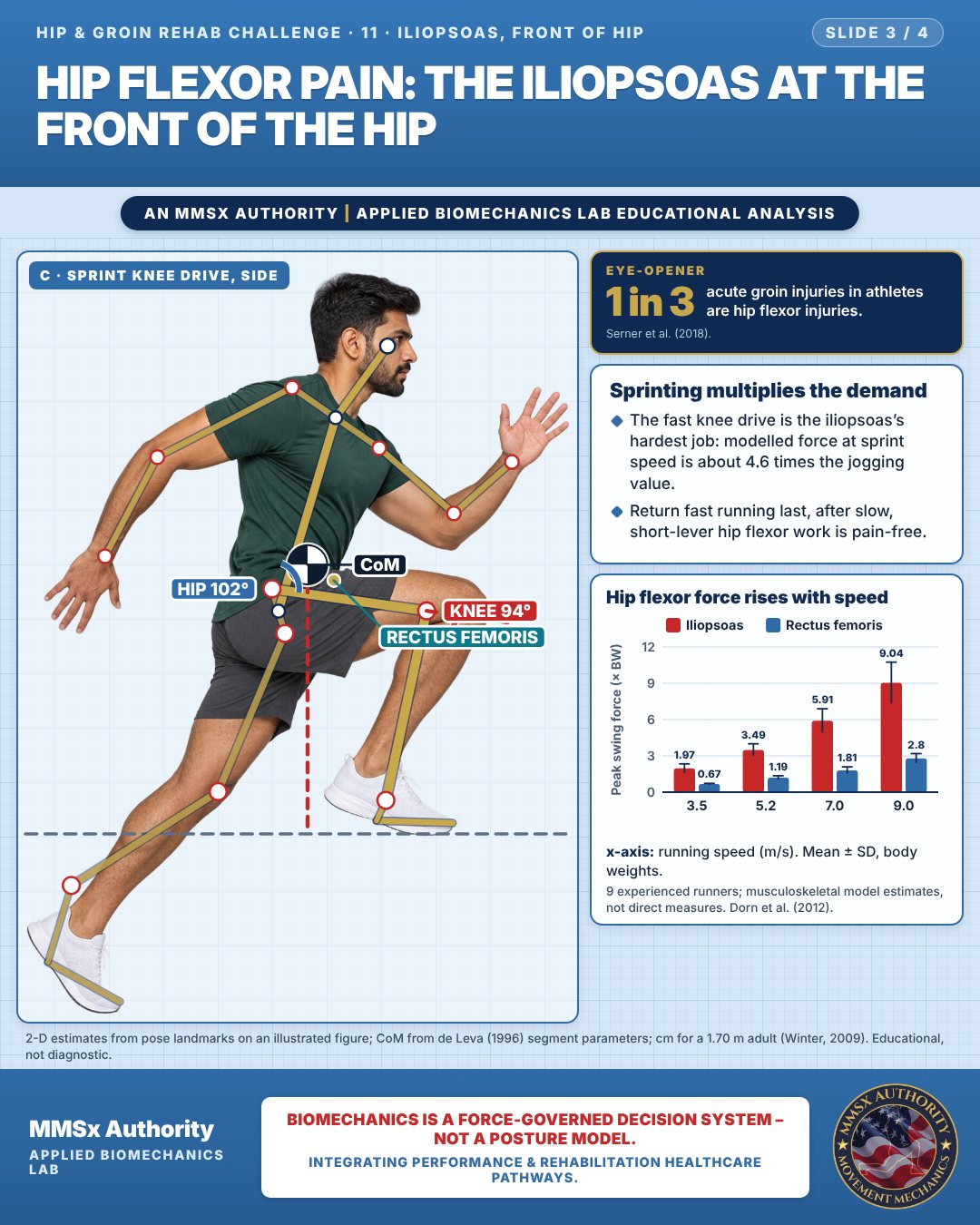
Sprinting multiplies the demand
The fast knee drive is the iliopsoas’s hardest job: modelled force at sprint speed is about 4.6 times the jogging value.
Return fast running last, after slow, short-lever hip flexor work is pain-free.
Hip flexor force rises with speed
x-axis: running speed (m/s). Mean ± SD, body weights.
Decision pathway
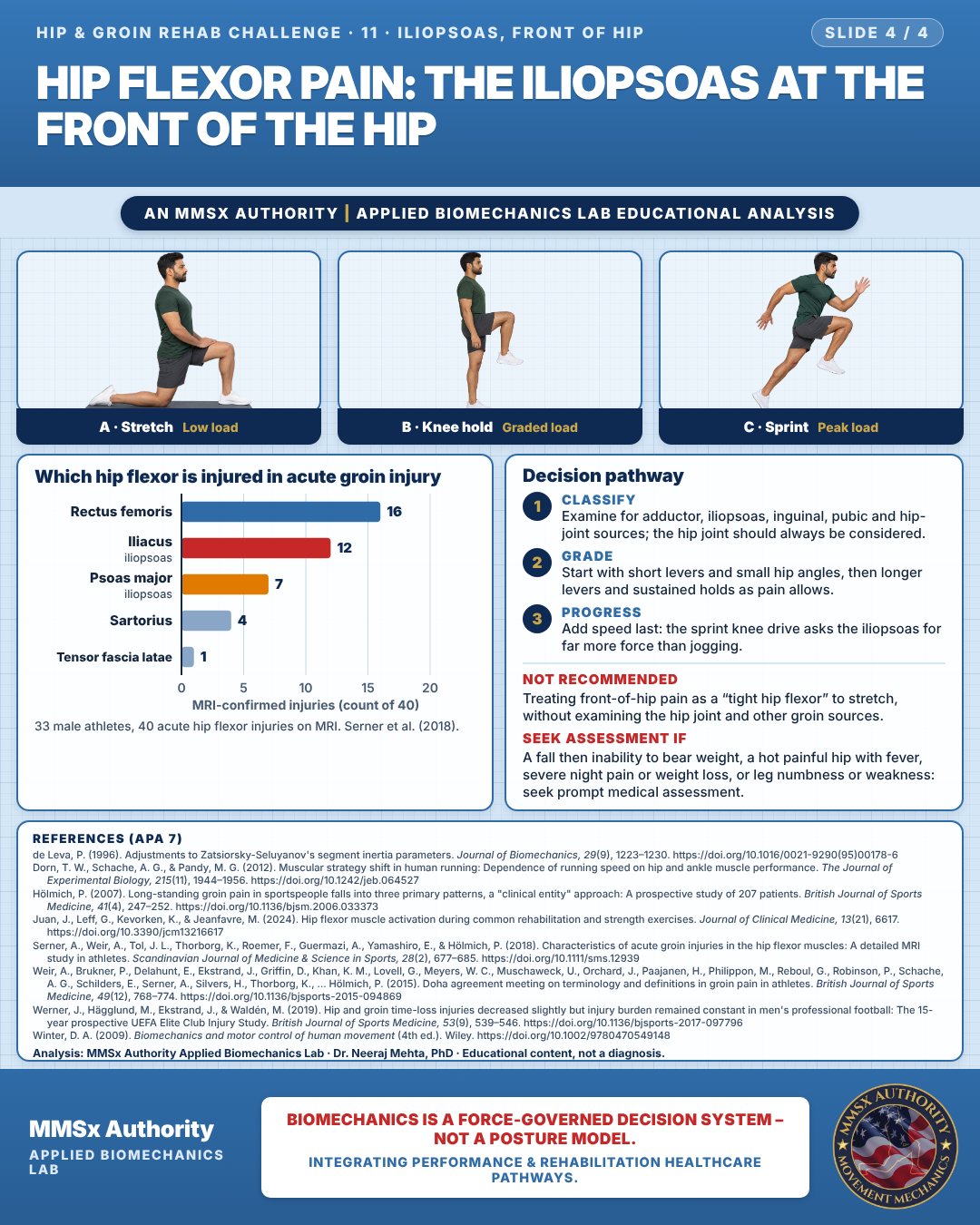
Which hip flexor is injured in acute groin injury
Classify
Examine for adductor, iliopsoas, inguinal, pubic and hip-joint sources; the hip joint should always be considered.
Grade
Start with short levers and small hip angles, then longer levers and sustained holds as pain allows.
Progress
Add speed last: the sprint knee drive asks the iliopsoas for far more force than jogging.
What the evidence supports
- Classify first: the Doha agreement recommends history and clinical examination to place the athlete in a defined entity (adductor-, iliopsoas-, inguinal-, pubic- or hip-related) and states that pain from the hip joint "should always be considered" (Weir et al., 2015).
- Not recommended: treating front-of-hip pain as a "tight hip flexor" without examining the hip joint and the other groin entities (Weir et al., 2015; Hölmich, 2007).
Myth and evidence
Myth“Pain at the front of the hip is always a tight hip flexor.”
EvidenceIliopsoas-related injury was only 8% of time-loss hip and groin injuries in professional football (Werner et al., 2019), one athlete in three with long-standing groin pain has more than one painful entity (Hölmich, 2007), and the hip joint should always be considered (Weir et al., 2015).
Cautions
Not recommended
Treating front-of-hip pain as a “tight hip flexor” to stretch, without examining the hip joint and other groin sources.
Seek assessment if
A fall then inability to bear weight, a hot painful hip with fever, severe night pain or weight loss, or leg numbness or weakness: seek prompt medical assessment.
Methods note
2-D estimates from pose landmarks on an illustrated figure; CoM from de Leva (1996) segment parameters; cm for a 1.70 m adult (Winter, 2009). These are educational estimates, not a diagnosis.
References
- de Leva, P. (1996). Adjustments to Zatsiorsky-Seluyanov's segment inertia parameters. Journal of Biomechanics, 29(9), 1223–1230. https://doi.org/10.1016/0021-9290(95)00178-6
- Dorn, T. W., Schache, A. G., & Pandy, M. G. (2012). Muscular strategy shift in human running: Dependence of running speed on hip and ankle muscle performance. The Journal of Experimental Biology, 215(11), 1944–1956. https://doi.org/10.1242/jeb.064527
- Hölmich, P. (2007). Long-standing groin pain in sportspeople falls into three primary patterns, a "clinical entity" approach: A prospective study of 207 patients. British Journal of Sports Medicine, 41(4), 247–252. https://doi.org/10.1136/bjsm.2006.033373
- Juan, J., Leff, G., Kevorken, K., & Jeanfavre, M. (2024). Hip flexor muscle activation during common rehabilitation and strength exercises. Journal of Clinical Medicine, 13(21), 6617. https://doi.org/10.3390/jcm13216617
- Serner, A., Weir, A., Tol, J. L., Thorborg, K., Roemer, F., Guermazi, A., Yamashiro, E., & Hölmich, P. (2018). Characteristics of acute groin injuries in the hip flexor muscles: A detailed MRI study in athletes. Scandinavian Journal of Medicine & Science in Sports, 28(2), 677–685. https://doi.org/10.1111/sms.12939
- Weir, A., Brukner, P., Delahunt, E., Ekstrand, J., Griffin, D., Khan, K. M., Lovell, G., Meyers, W. C., Muschaweck, U., Orchard, J., Paajanen, H., Philippon, M., Reboul, G., Robinson, P., Schache, A. G., Schilders, E., Serner, A., Silvers, H., Thorborg, K., … Hölmich, P. (2015). Doha agreement meeting on terminology and definitions in groin pain in athletes. British Journal of Sports Medicine, 49(12), 768–774. https://doi.org/10.1136/bjsports-2015-094869
- Werner, J., Hägglund, M., Ekstrand, J., & Waldén, M. (2019). Hip and groin time-loss injuries decreased slightly but injury burden remained constant in men's professional football: The 15-year prospective UEFA Elite Club Injury Study. British Journal of Sports Medicine, 53(9), 539–546. https://doi.org/10.1136/bjsports-2017-097796
- Winter, D. A. (2009). Biomechanics and motor control of human movement (4th ed.). Wiley. https://doi.org/10.1002/9780470549148
Cite this article
Mehta, N. (2026, October 28). Hip flexor pain: the iliopsoas at the front of the hip. MMSx Authority Applied Biomechanics Lab. https://mmsxauthority.org/edu/analysis/hip-groin/11-hip-flexor-pain-the-iliopsoas-at-the-front-of-the-hip/
Part of the collection
Mehta, N. (2026). Hip and Groin Rehabilitation: 30 Evidence-Based Biomechanics Analyses [Collection]. MMSx Authority Applied Biomechanics Lab. Zenodo. https://doi.org/10.5281/zenodo.23735806
All Hip & Groin Rehab Challenge articles · Rehabilitation Library