Hip & Groin Rehab Challenge · 16
Pubic bone pain: osteitis pubis and pubic-related groin pain
Pubic-related groin pain is defined by local tenderness of the pubic symphysis and the immediately adjacent bone (Weir et al., 2015).
Key points
- Examine. Classify by examination: pubic-related pain means local tenderness of the symphysis and adjacent bone.
- Monitor. Track squeeze strength and squeeze pain as running and kicking are rebuilt.
- Load. Conservative care is reported most; injections and surgery rest only on case reports.
What it is
Pubic-related groin pain is defined by local tenderness of the pubic symphysis and the immediately adjacent bone (Weir et al., 2015). The Doha agreement chose not to use "osteitis pubis" in its classification (Weir et al., 2015).
How we analysed the movement
Three movements relevant to this topic were analysed from illustrated reference figures. Joint centres were located with two-dimensional pose estimation; hip and knee angles, pelvis level, the whole-body centre of mass and, where relevant, the hip lever (the horizontal distance from the hip joint to the upper-body centre of mass) and the resulting static hip moment were then calculated from standard segment parameters. The figures are educational estimates that show how position changes mechanical demand; they are not measurements of a patient. Every research value quoted below comes from the published source cited beside it.
Movement A: Standing (front view)
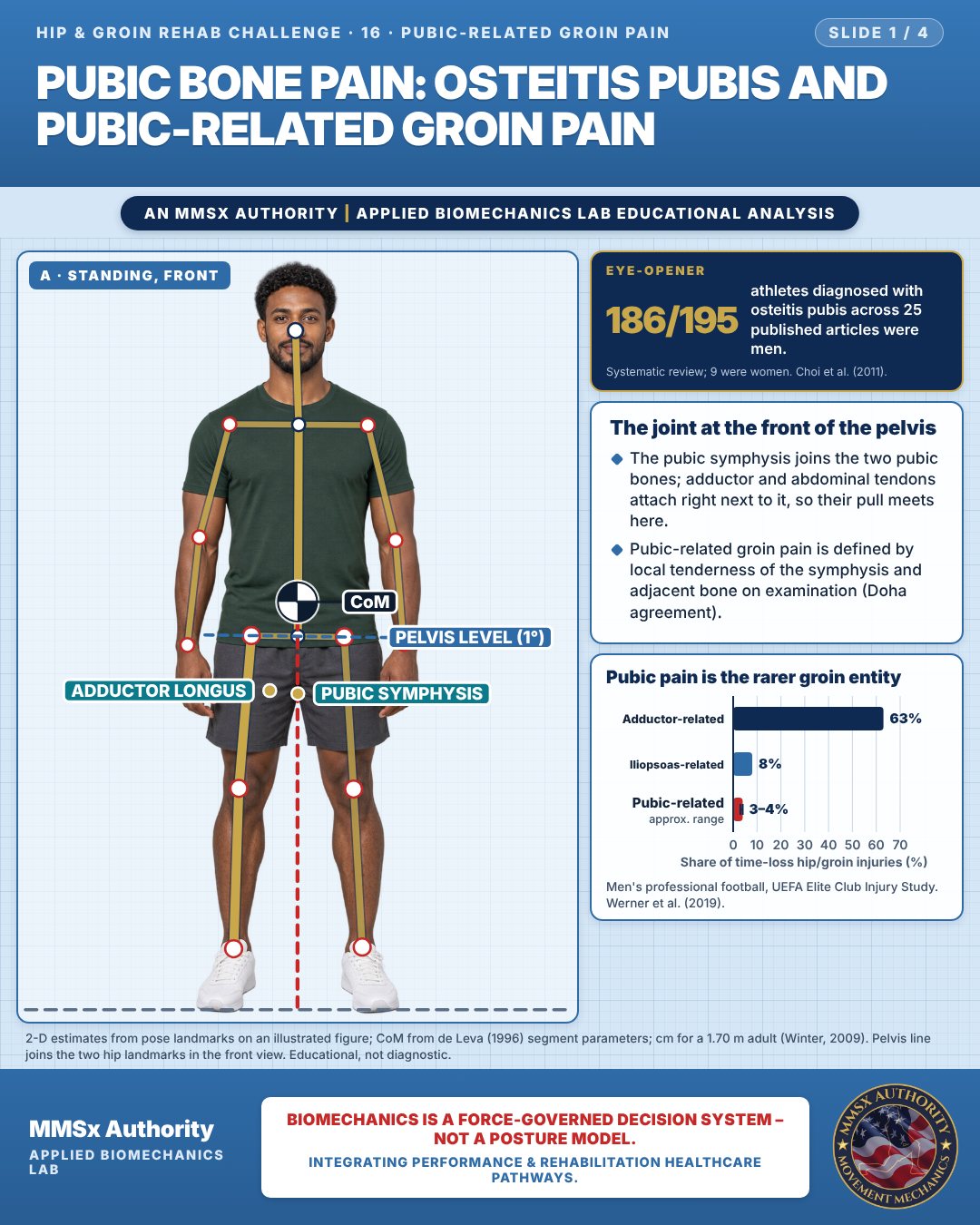
The joint at the front of the pelvis
The pubic symphysis joins the two pubic bones; adductor and abdominal tendons attach right next to it, so their pull meets here.
Pubic-related groin pain is defined by local tenderness of the symphysis and adjacent bone on examination (Doha agreement).
Pubic pain is the rarer groin entity
Movement B: One-leg stance (front view)
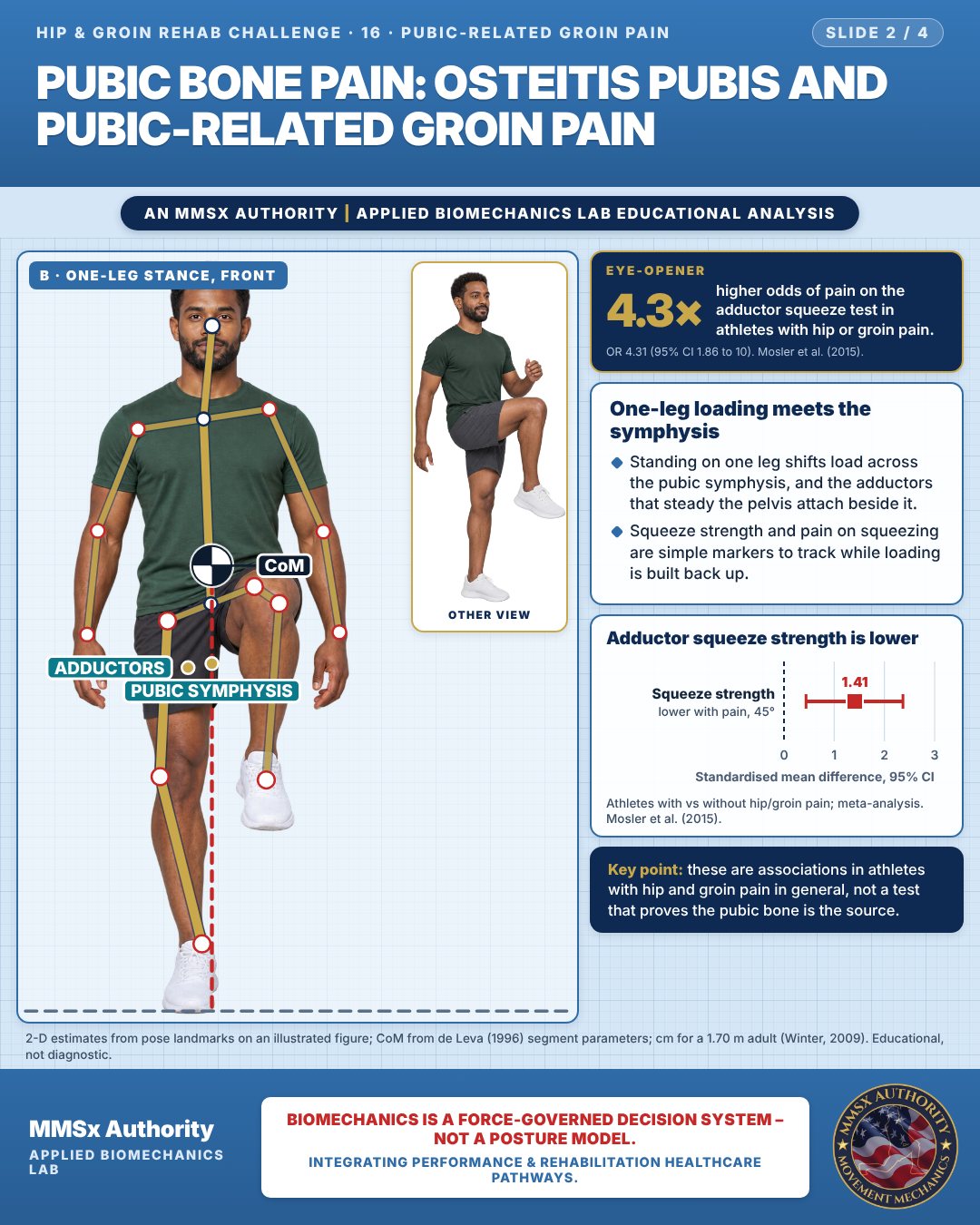
One-leg loading meets the symphysis
Standing on one leg shifts load across the pubic symphysis, and the adductors that steady the pelvis attach beside it.
Squeeze strength and pain on squeezing are simple markers to track while loading is built back up.
Adductor squeeze strength is lower
Movement C: Running stride (side view)
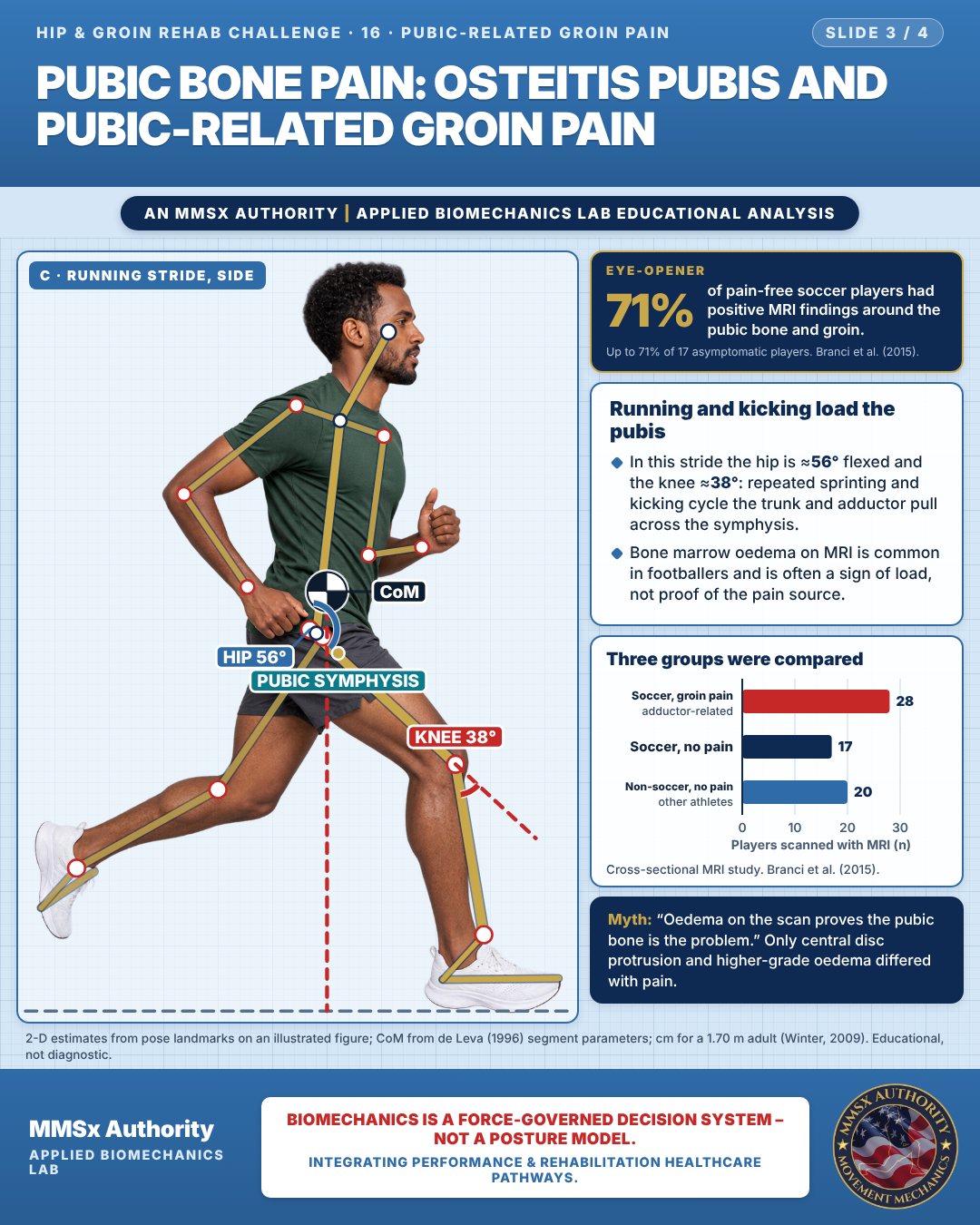
Running and kicking load the pubis
In this stride the hip is ≈56° flexed and the knee ≈38°: repeated sprinting and kicking cycle the trunk and adductor pull across the symphysis.
Bone marrow oedema on MRI is common in footballers and is often a sign of load, not proof of the pain source.
Three groups were compared
Decision pathway
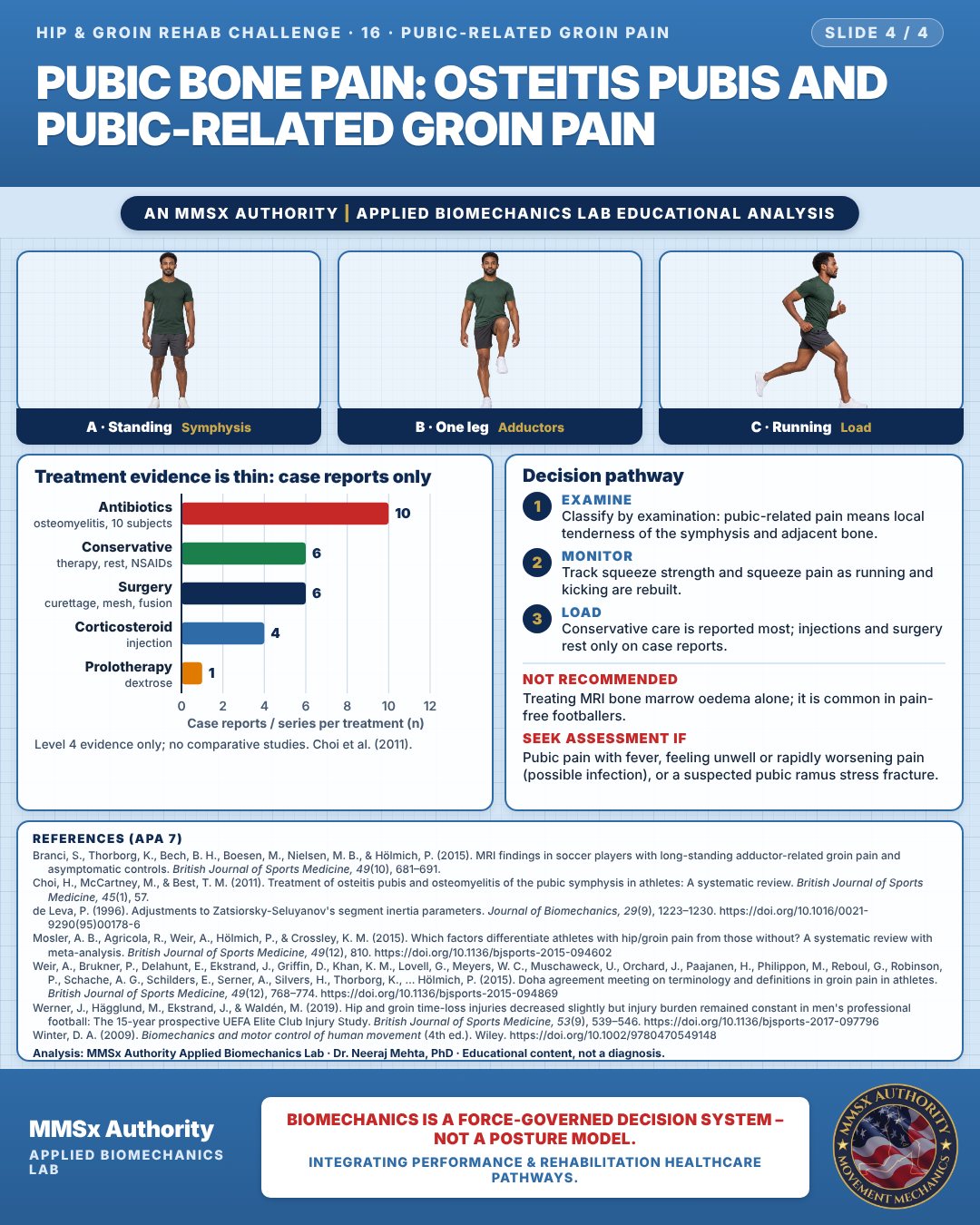
Treatment evidence is thin: case reports only
Examine
Classify by examination: pubic-related pain means local tenderness of the symphysis and adjacent bone.
Monitor
Track squeeze strength and squeeze pain as running and kicking are rebuilt.
Load
Conservative care is reported most; injections and surgery rest only on case reports.
What the evidence supports
- Classify by examination (Weir et al., 2015). Conservative measures (physical therapy, rest, anti-inflammatory drugs), injections and surgery have been reported, but only in case reports and case series (level 4); comparative studies are needed (Choi et al., 2011).
- Not recommended: treating MRI bone marrow oedema alone; it is common in pain-free footballers (Branci et al., 2015).
Cautions
Not recommended
Treating MRI bone marrow oedema alone; it is common in pain-free footballers.
Seek assessment if
Pubic pain with fever, feeling unwell or rapidly worsening pain (possible infection), or a suspected pubic ramus stress fracture.
Methods note
2-D estimates from pose landmarks on an illustrated figure; CoM from de Leva (1996) segment parameters; cm for a 1.70 m adult (Winter, 2009). Pelvis line joins the two hip landmarks in the front view. These are educational estimates, not a diagnosis.
References
- Branci, S., Thorborg, K., Bech, B. H., Boesen, M., Nielsen, M. B., & Hölmich, P. (2015). MRI findings in soccer players with long-standing adductor-related groin pain and asymptomatic controls. British Journal of Sports Medicine, 49(10), 681–691.
- Choi, H., McCartney, M., & Best, T. M. (2011). Treatment of osteitis pubis and osteomyelitis of the pubic symphysis in athletes: A systematic review. British Journal of Sports Medicine, 45(1), 57.
- de Leva, P. (1996). Adjustments to Zatsiorsky-Seluyanov's segment inertia parameters. Journal of Biomechanics, 29(9), 1223–1230. https://doi.org/10.1016/0021-9290(95)00178-6
- Mosler, A. B., Agricola, R., Weir, A., Hölmich, P., & Crossley, K. M. (2015). Which factors differentiate athletes with hip/groin pain from those without? A systematic review with meta-analysis. British Journal of Sports Medicine, 49(12), 810. https://doi.org/10.1136/bjsports-2015-094602
- Weir, A., Brukner, P., Delahunt, E., Ekstrand, J., Griffin, D., Khan, K. M., Lovell, G., Meyers, W. C., Muschaweck, U., Orchard, J., Paajanen, H., Philippon, M., Reboul, G., Robinson, P., Schache, A. G., Schilders, E., Serner, A., Silvers, H., Thorborg, K., … Hölmich, P. (2015). Doha agreement meeting on terminology and definitions in groin pain in athletes. British Journal of Sports Medicine, 49(12), 768–774. https://doi.org/10.1136/bjsports-2015-094869
- Werner, J., Hägglund, M., Ekstrand, J., & Waldén, M. (2019). Hip and groin time-loss injuries decreased slightly but injury burden remained constant in men's professional football: The 15-year prospective UEFA Elite Club Injury Study. British Journal of Sports Medicine, 53(9), 539–546. https://doi.org/10.1136/bjsports-2017-097796
- Winter, D. A. (2009). Biomechanics and motor control of human movement (4th ed.). Wiley. https://doi.org/10.1002/9780470549148
Cite this article
Mehta, N. (2026, October 28). Pubic bone pain: osteitis pubis and pubic-related groin pain. MMSx Authority Applied Biomechanics Lab. https://mmsxauthority.org/edu/analysis/hip-groin/16-pubic-bone-pain-osteitis-pubis-and-pubic-related-groin-pain/
Part of the collection
Mehta, N. (2026). Hip and Groin Rehabilitation: 30 Evidence-Based Biomechanics Analyses [Collection]. MMSx Authority Applied Biomechanics Lab. Zenodo. https://doi.org/10.5281/zenodo.23735806
All Hip & Groin Rehab Challenge articles · Rehabilitation Library