Hip & Groin Rehab Challenge · 15
Sports hernia (inguinal-related groin pain): what the term really means
Inguinal-related groin pain is pain located in the inguinal canal region with tenderness of the inguinal canal and no palpable inguinal hernia (Weir…
Key points
- Check. Feel for a hernia: a true lump needs a surgeon; canal tenderness without one is inguinal-related pain.
- Rehabilitate. Physiotherapy first; surgery is not always required, and MRI mainly excludes other causes.
- Refer. If conservative care fails, surgical repair is an option; in one trial more athletes returned by 3 months.
What it is
Inguinal-related groin pain is pain located in the inguinal canal region with tenderness of the inguinal canal and no palpable inguinal hernia (Weir et al., 2015). The British Hernia Society consensus preferred the term "inguinal disruption" because no true hernia is present, and proposed that it can be diagnosed when at least three of five clinical signs are present (Sheen et al., 2014). The Doha agreement recommends against the terms "sports hernia" and "sportsman's hernia" (Weir et al., 2015).
How we analysed the movement
Three movements relevant to this topic were analysed from illustrated reference figures. Joint centres were located with two-dimensional pose estimation; hip and knee angles, pelvis level, the whole-body centre of mass and, where relevant, the hip lever (the horizontal distance from the hip joint to the upper-body centre of mass) and the resulting static hip moment were then calculated from standard segment parameters. The figures are educational estimates that show how position changes mechanical demand; they are not measurements of a patient. Every research value quoted below comes from the published source cited beside it.
Movement A: Cough, hand on groin (front view)
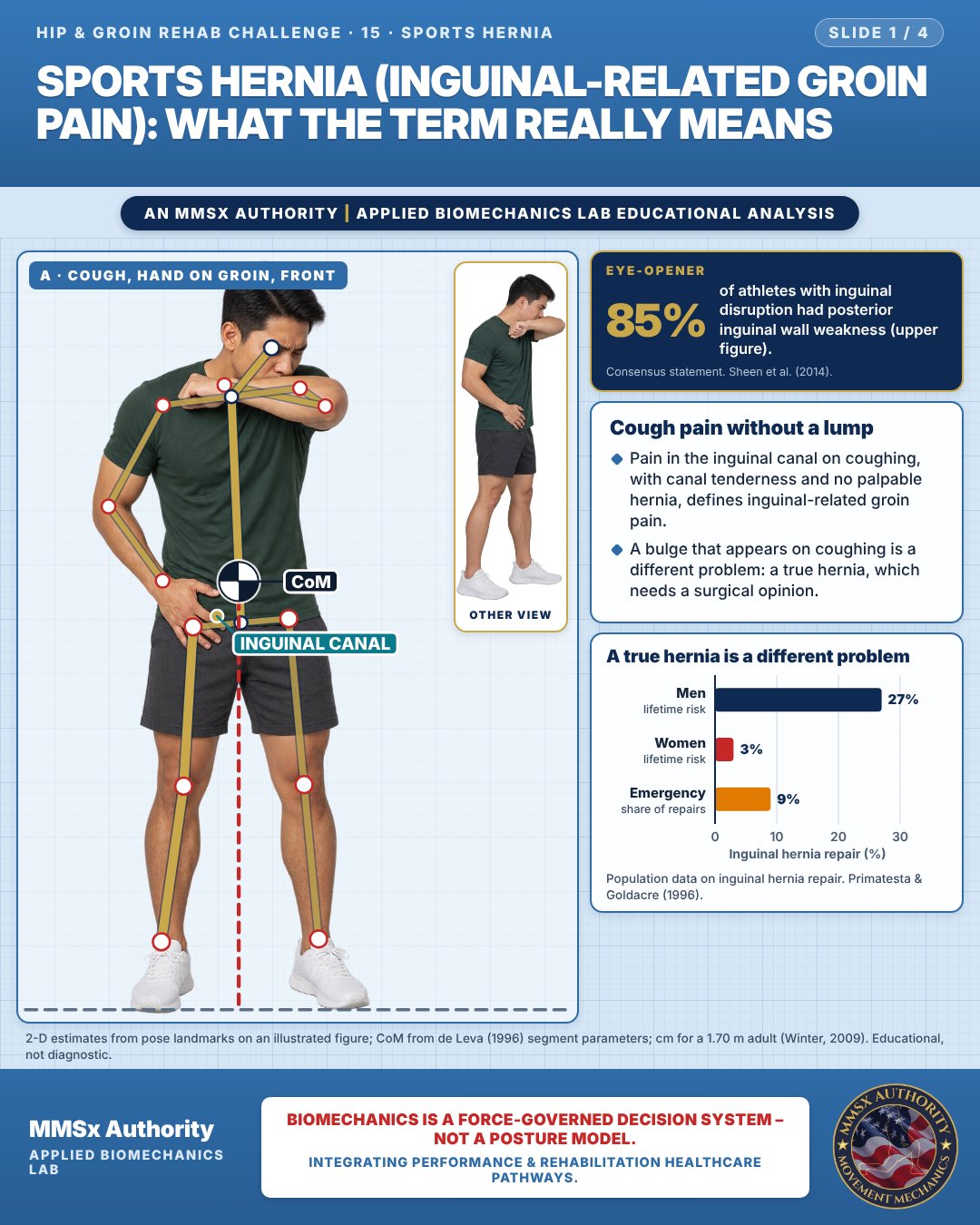
Cough pain without a lump
Pain in the inguinal canal on coughing, with canal tenderness and no palpable hernia, defines inguinal-related groin pain.
A bulge that appears on coughing is a different problem: a true hernia, which needs a surgical opinion.
A true hernia is a different problem
Movement B: Trunk curl, lying (front view)
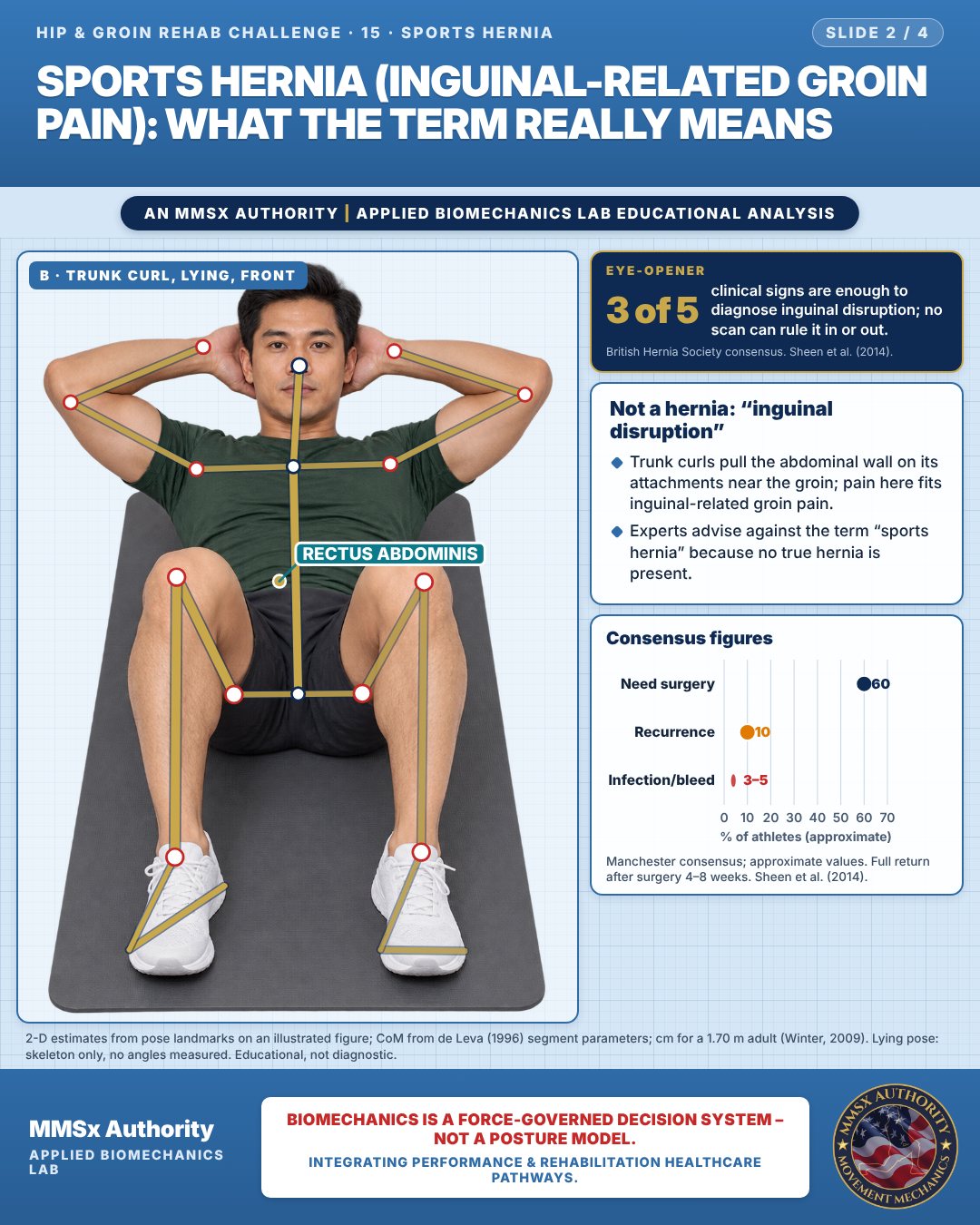
Not a hernia: “inguinal disruption”
Trunk curls pull the abdominal wall on its attachments near the groin; pain here fits inguinal-related groin pain.
Experts advise against the term “sports hernia” because no true hernia is present.
Consensus figures
Movement C: Sprint start (side view)
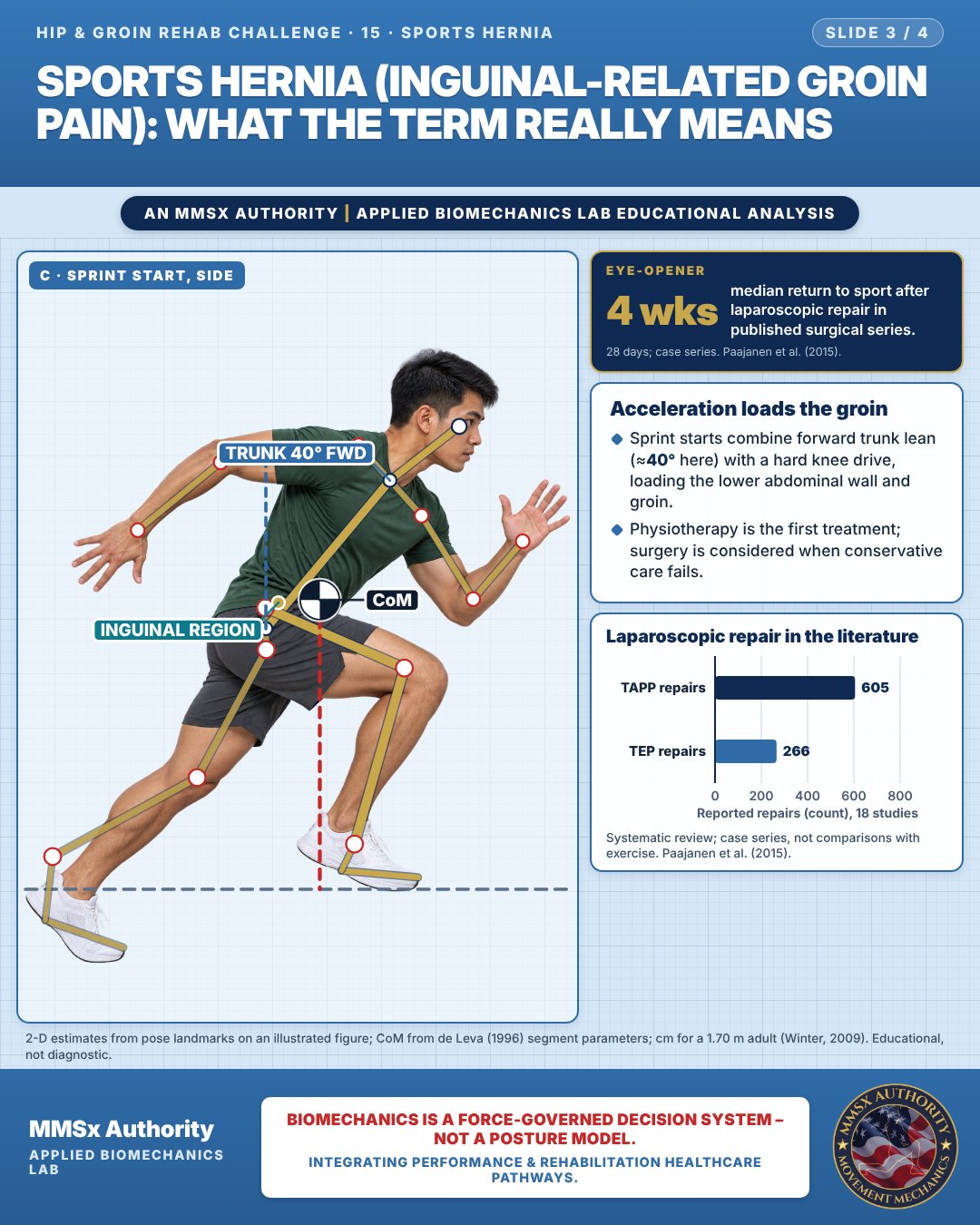
Acceleration loads the groin
Sprint starts combine forward trunk lean (≈40° here) with a hard knee drive, loading the lower abdominal wall and groin.
Physiotherapy is the first treatment; surgery is considered when conservative care fails.
Laparoscopic repair in the literature
Decision pathway
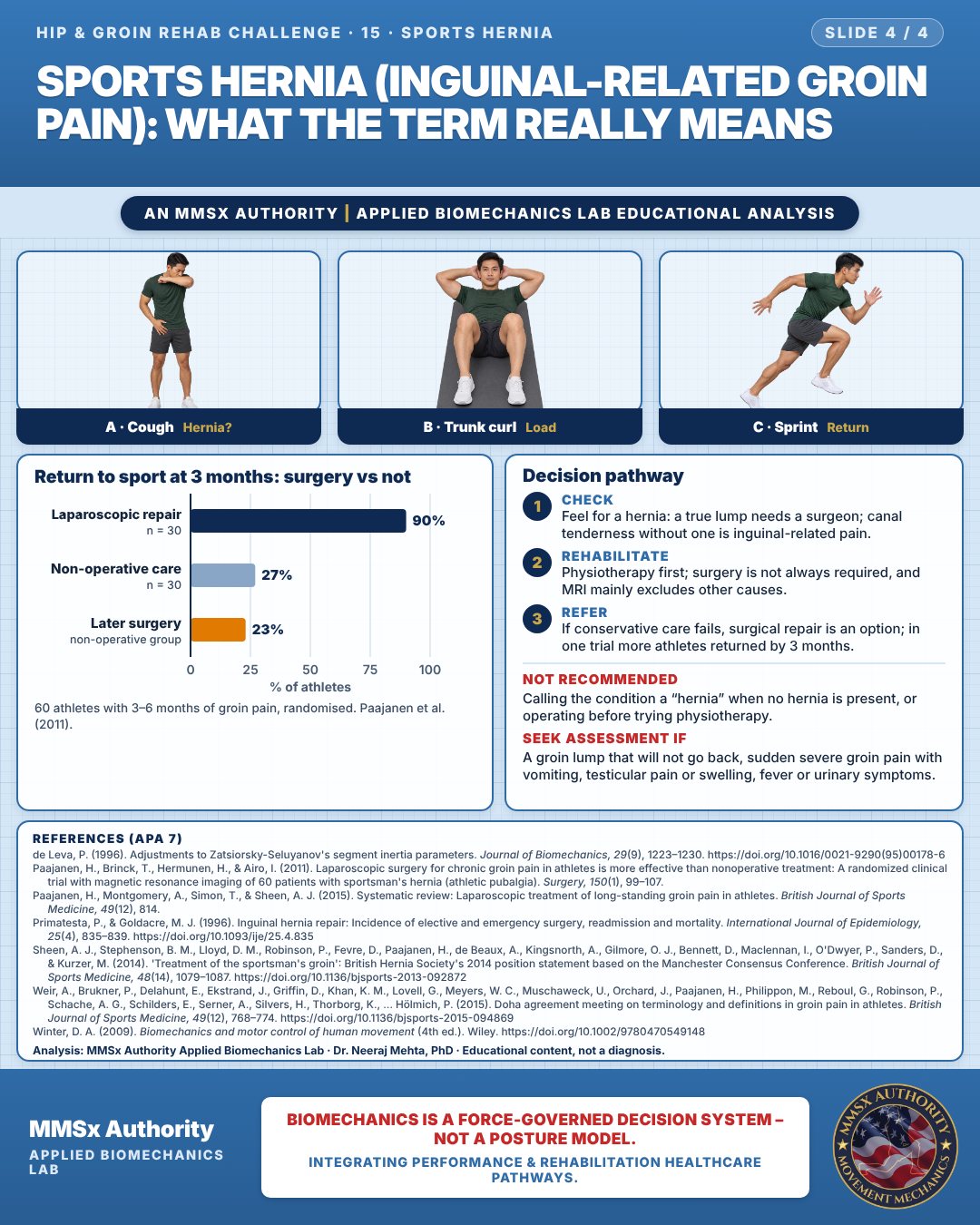
Return to sport at 3 months: surgery vs not
Check
Feel for a hernia: a true lump needs a surgeon; canal tenderness without one is inguinal-related pain.
Rehabilitate
Physiotherapy first; surgery is not always required, and MRI mainly excludes other causes.
Refer
If conservative care fails, surgical repair is an option; in one trial more athletes returned by 3 months.
What the evidence supports
- Physiotherapy is the initial treatment; "surgery is not always required" (Sheen et al., 2014).
- MRI is the preferred imaging, mainly to exclude other pathology; no imaging can definitively rule inguinal disruption in or out (Sheen et al., 2014).
- When conservative care fails, surgery repairs the posterior wall and releases abnormal tension; no operative technique was shown to be superior (Sheen et al., 2014). In one randomised trial, laparoscopic repair returned more athletes to sport at 3 months than non-operative care (Paajanen et al., 2011).
- Not recommended: calling the condition a "hernia" when no hernia is present (Weir et al., 2015; Sheen et al., 2014).
Myth and evidence
Myth“A sports hernia is a hernia.”
EvidenceIn inguinal-related groin pain there is no palpable hernia (Weir et al., 2015); the British Hernia Society consensus replaced the term with "inguinal disruption" because no true hernia exists (Sheen et al., 2014).
Cautions
Not recommended
Calling the condition a “hernia” when no hernia is present, or operating before trying physiotherapy.
Seek assessment if
A groin lump that will not go back, sudden severe groin pain with vomiting, testicular pain or swelling, fever or urinary symptoms.
Methods note
2-D estimates from pose landmarks on an illustrated figure; CoM from de Leva (1996) segment parameters; cm for a 1.70 m adult (Winter, 2009). Lying pose: skeleton only, no angles measured. These are educational estimates, not a diagnosis.
References
- de Leva, P. (1996). Adjustments to Zatsiorsky-Seluyanov's segment inertia parameters. Journal of Biomechanics, 29(9), 1223–1230. https://doi.org/10.1016/0021-9290(95)00178-6
- Paajanen, H., Brinck, T., Hermunen, H., & Airo, I. (2011). Laparoscopic surgery for chronic groin pain in athletes is more effective than nonoperative treatment: A randomized clinical trial with magnetic resonance imaging of 60 patients with sportsman's hernia (athletic pubalgia). Surgery, 150(1), 99–107.
- Paajanen, H., Montgomery, A., Simon, T., & Sheen, A. J. (2015). Systematic review: Laparoscopic treatment of long-standing groin pain in athletes. British Journal of Sports Medicine, 49(12), 814.
- Primatesta, P., & Goldacre, M. J. (1996). Inguinal hernia repair: Incidence of elective and emergency surgery, readmission and mortality. International Journal of Epidemiology, 25(4), 835–839. https://doi.org/10.1093/ije/25.4.835
- Sheen, A. J., Stephenson, B. M., Lloyd, D. M., Robinson, P., Fevre, D., Paajanen, H., de Beaux, A., Kingsnorth, A., Gilmore, O. J., Bennett, D., Maclennan, I., O'Dwyer, P., Sanders, D., & Kurzer, M. (2014). 'Treatment of the sportsman's groin': British Hernia Society's 2014 position statement based on the Manchester Consensus Conference. British Journal of Sports Medicine, 48(14), 1079–1087. https://doi.org/10.1136/bjsports-2013-092872
- Weir, A., Brukner, P., Delahunt, E., Ekstrand, J., Griffin, D., Khan, K. M., Lovell, G., Meyers, W. C., Muschaweck, U., Orchard, J., Paajanen, H., Philippon, M., Reboul, G., Robinson, P., Schache, A. G., Schilders, E., Serner, A., Silvers, H., Thorborg, K., … Hölmich, P. (2015). Doha agreement meeting on terminology and definitions in groin pain in athletes. British Journal of Sports Medicine, 49(12), 768–774. https://doi.org/10.1136/bjsports-2015-094869
- Winter, D. A. (2009). Biomechanics and motor control of human movement (4th ed.). Wiley. https://doi.org/10.1002/9780470549148
Cite this article
Mehta, N. (2026, October 28). Sports hernia (inguinal-related groin pain): what the term really means. MMSx Authority Applied Biomechanics Lab. https://mmsxauthority.org/edu/analysis/hip-groin/15-sports-hernia-inguinal-related-groin-pain-what-the-term-really-means/
Part of the collection
Mehta, N. (2026). Hip and Groin Rehabilitation: 30 Evidence-Based Biomechanics Analyses [Collection]. MMSx Authority Applied Biomechanics Lab. Zenodo. https://doi.org/10.5281/zenodo.23735806
All Hip & Groin Rehab Challenge articles · Rehabilitation Library