Shoulder Rehab Challenge · 49
Is your shoulder rehabilitation working? Track function alongside pain
Patient-reported outcome measures (PROMs) such as the Shoulder Pain and Disability Index (SPADI, 0–100, higher = worse), the Disabilities of the Arm,…
Key points
- Questionnaire. Record SPADI, QuickDASH or Oxford score every 2–4 weeks (Grade A).
- Measure. Measure range with an inclinometer or app and strength with a dynamometer (Grade A).
- Judge. Trust change beyond the MDC over several tests; refer if severe after 12 weeks of care.
What it is
Patient-reported outcome measures (PROMs) such as the Shoulder Pain and Disability Index (SPADI, 0–100, higher = worse), the Disabilities of the Arm, Shoulder and Hand (DASH, 0–100, higher = worse) and the Oxford Shoulder Score (OSS, 0–48, higher = better) quantify pain and function. A change is worth acting on when it exceeds both measurement error (minimal detectable change, MDC) and the minimal clinically important difference (MCID).
How we analysed the movement
Three movements relevant to this topic were analysed from illustrated reference figures. Joint centres were located with two-dimensional pose estimation; arm elevation and elbow angles, shoulder level, the whole-body centre of mass and, where relevant, the arm lever (the horizontal distance from the shoulder joint to the centre of mass of the arm, with any hand load) and the resulting shoulder moment were then calculated from standard segment parameters. The figures are educational estimates that show how position changes mechanical demand; they are not measurements of a patient. Every research value quoted below comes from the published source cited beside it.
Movement A: High-shelf reach (side view)
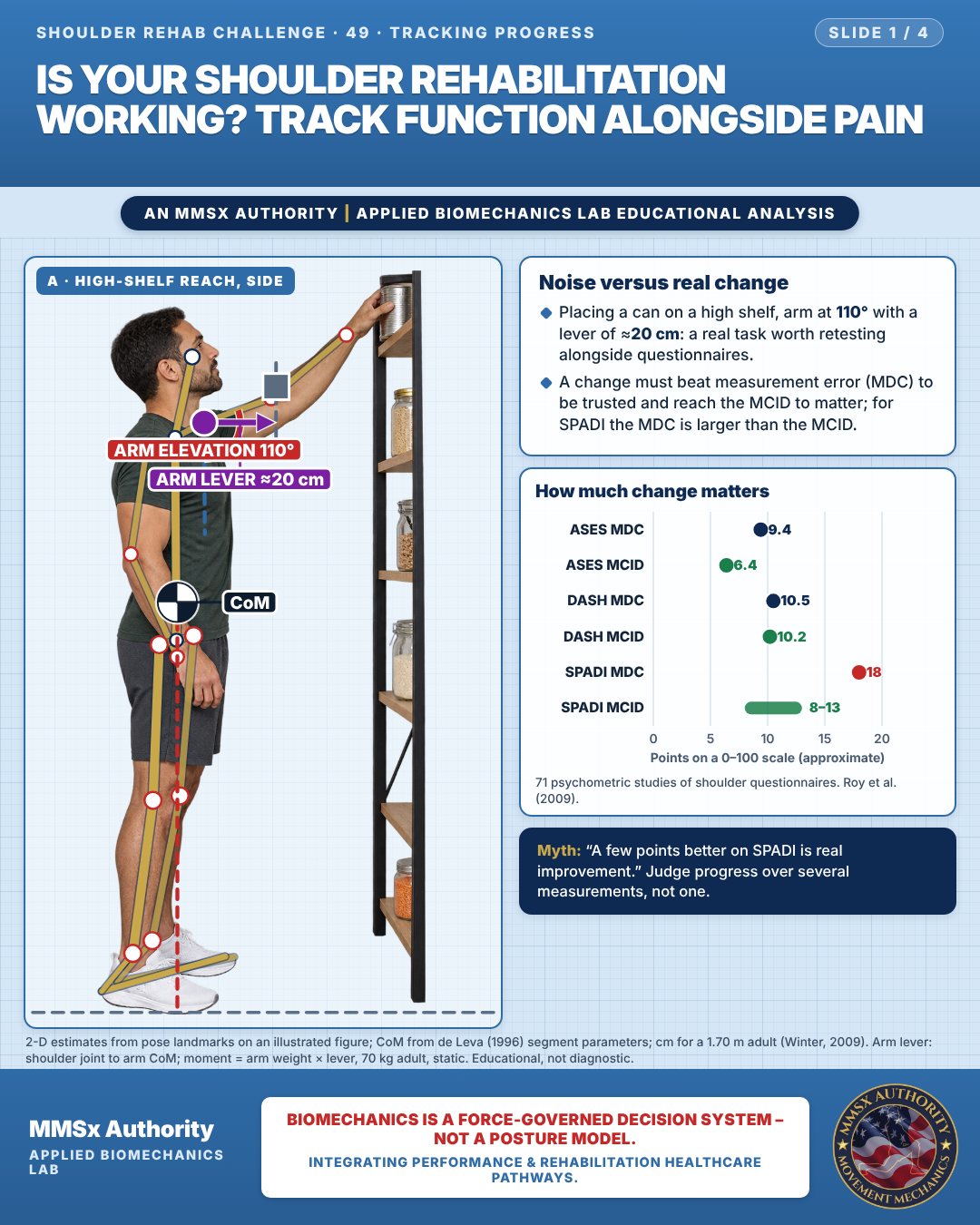
Noise versus real change
Placing a can on a high shelf, arm at 110° with a lever of ≈20 cm: a real task worth retesting alongside questionnaires.
A change must beat measurement error (MDC) to be trusted and reach the MCID to matter; for SPADI the MDC is larger than the MCID.
How much change matters
Movement B: Hand behind head (front view)
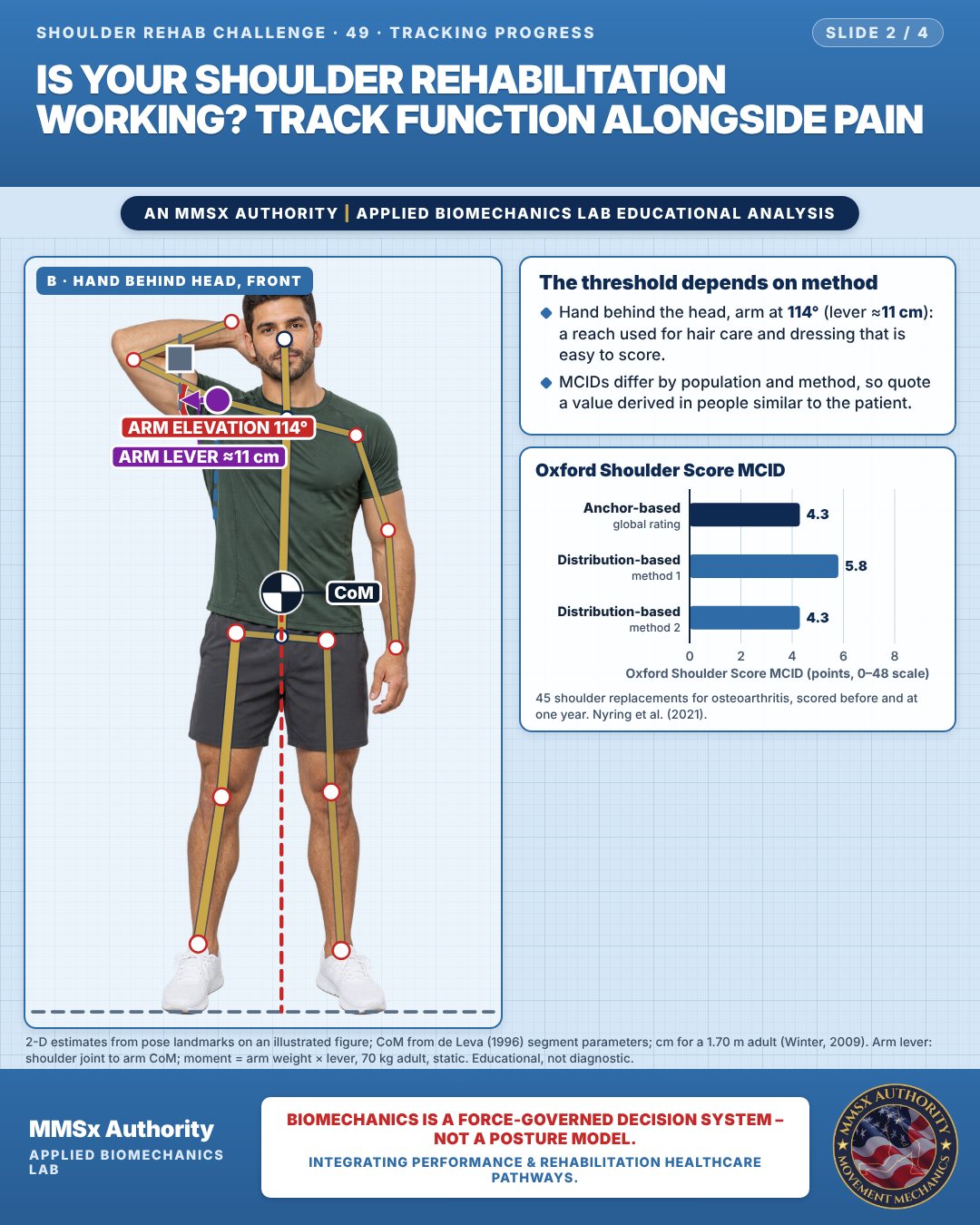
The threshold depends on method
Hand behind the head, arm at 114° (lever ≈11 cm): a reach used for hair care and dressing that is easy to score.
MCIDs differ by population and method, so quote a value derived in people similar to the patient.
Oxford Shoulder Score MCID
Movement C: 5 kg bag carry (front view)
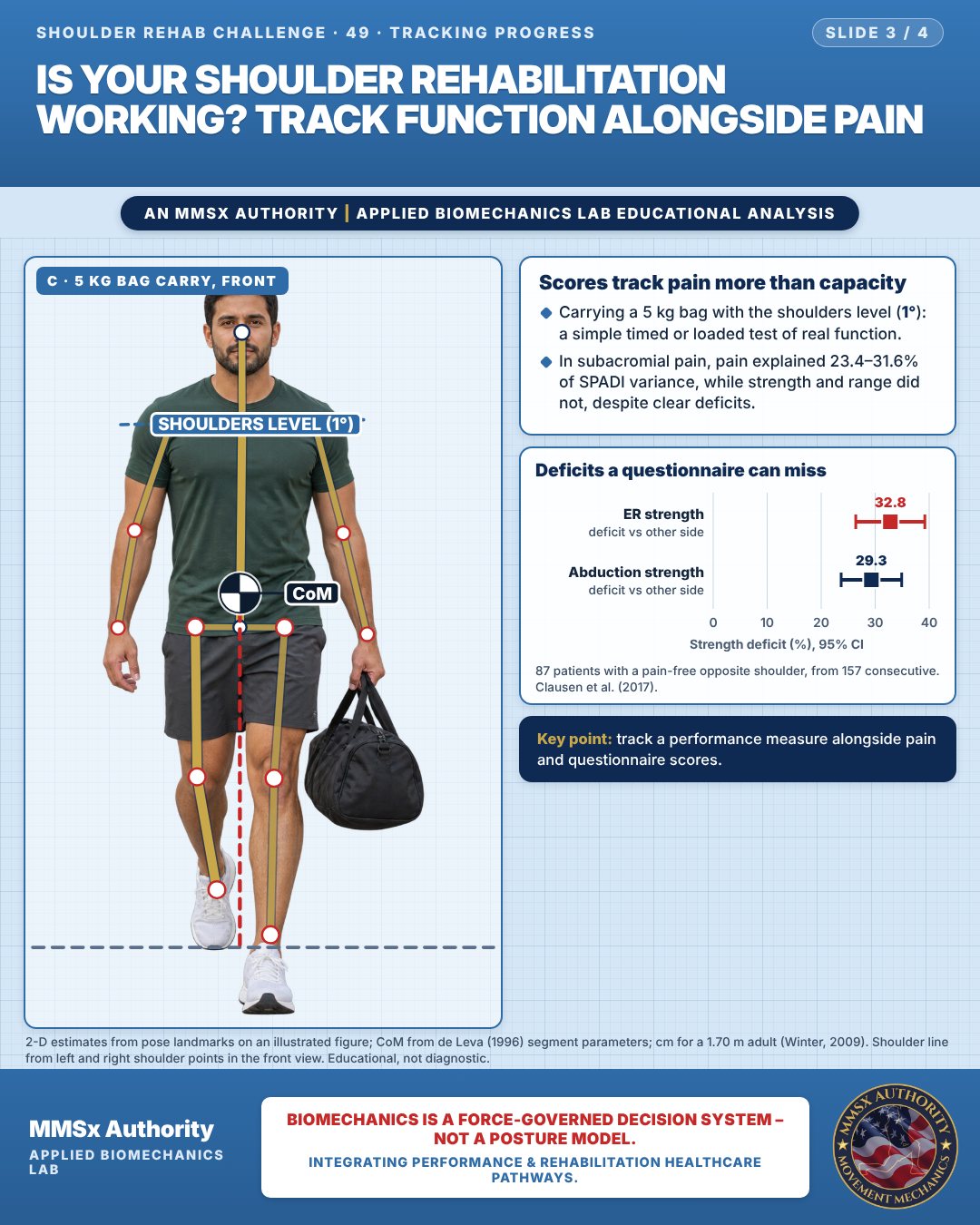
Scores track pain more than capacity
Carrying a 5 kg bag with the shoulders level (1°): a simple timed or loaded test of real function.
In subacromial pain, pain explained 23.4–31.6% of SPADI variance, while strength and range did not, despite clear deficits.
Deficits a questionnaire can miss
Decision pathway
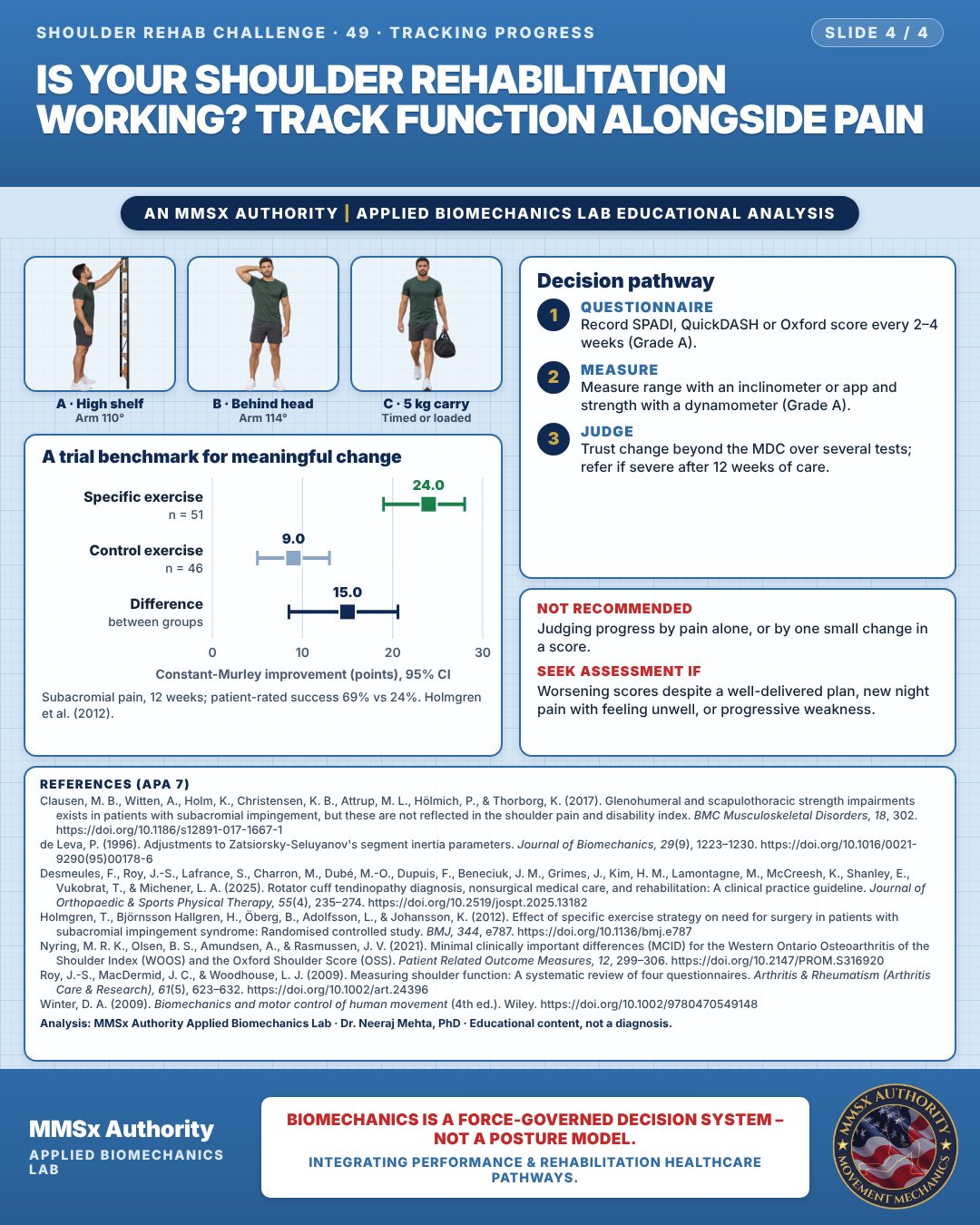
A trial benchmark for meaningful change
Questionnaire
Record SPADI, QuickDASH or Oxford score every 2–4 weeks (Grade A).
Measure
Measure range with an inclinometer or app and strength with a dynamometer (Grade A).
Judge
Trust change beyond the MDC over several tests; refer if severe after 12 weeks of care.
What the evidence supports
- Recommended: measure range with an inclinometer, goniometer or smartphone app rather than by eye (Grade A); measure isometric strength with a handheld dynamometer (Grade A); use validated patient-reported questionnaires (Grade A) (Desmeules et al., 2025, clinical practice guideline).
- Use reliable, valid, responsive patient-rated tools and functional measures when planning return to sport (Grade F) (Desmeules et al., 2025).
- Refer for specialist opinion if severe, persistent pain and/or disability continue despite up to 12 weeks of appropriate non-surgical care (Desmeules et al., 2025).
Myth and evidence
Myth“If the pain number is down, rehabilitation is finished.”
EvidenceQuestionnaires track pain more than strength (Clausen et al., 2017), and the guideline recommends objective range and strength measurement alongside PROMs (Desmeules et al., 2025).
Myth“A few points of change on SPADI means real improvement.”
EvidenceThe SPADI MDC is about 18 points; the MCID is 8–13 (Roy et al., 2009).
Cautions
Not recommended
Judging progress by pain alone, or by one small change in a score.
Seek assessment if
Worsening scores despite a well-delivered plan, new night pain with feeling unwell, or progressive weakness.
Methods note
2-D estimates from pose landmarks on an illustrated figure; CoM from de Leva (1996) segment parameters; cm for a 1.70 m adult (Winter, 2009). Arm lever: shoulder joint to arm CoM; moment = arm weight × lever, 70 kg adult, static. Shoulder line from left and right shoulder points in the front view. These are educational estimates, not a diagnosis.
References
- Clausen, M. B., Witten, A., Holm, K., Christensen, K. B., Attrup, M. L., Hölmich, P., & Thorborg, K. (2017). Glenohumeral and scapulothoracic strength impairments exists in patients with subacromial impingement, but these are not reflected in the shoulder pain and disability index. BMC Musculoskeletal Disorders, 18, 302. https://doi.org/10.1186/s12891-017-1667-1
- de Leva, P. (1996). Adjustments to Zatsiorsky-Seluyanov's segment inertia parameters. Journal of Biomechanics, 29(9), 1223–1230. https://doi.org/10.1016/0021-9290(95)00178-6
- Desmeules, F., Roy, J.-S., Lafrance, S., Charron, M., Dubé, M.-O., Dupuis, F., Beneciuk, J. M., Grimes, J., Kim, H. M., Lamontagne, M., McCreesh, K., Shanley, E., Vukobrat, T., & Michener, L. A. (2025). Rotator cuff tendinopathy diagnosis, nonsurgical medical care, and rehabilitation: A clinical practice guideline. Journal of Orthopaedic & Sports Physical Therapy, 55(4), 235–274. https://doi.org/10.2519/jospt.2025.13182
- Holmgren, T., Björnsson Hallgren, H., Öberg, B., Adolfsson, L., & Johansson, K. (2012). Effect of specific exercise strategy on need for surgery in patients with subacromial impingement syndrome: Randomised controlled study. BMJ, 344, e787. https://doi.org/10.1136/bmj.e787
- Nyring, M. R. K., Olsen, B. S., Amundsen, A., & Rasmussen, J. V. (2021). Minimal clinically important differences (MCID) for the Western Ontario Osteoarthritis of the Shoulder Index (WOOS) and the Oxford Shoulder Score (OSS). Patient Related Outcome Measures, 12, 299–306. https://doi.org/10.2147/PROM.S316920
- Roy, J.-S., MacDermid, J. C., & Woodhouse, L. J. (2009). Measuring shoulder function: A systematic review of four questionnaires. Arthritis & Rheumatism (Arthritis Care & Research), 61(5), 623–632. https://doi.org/10.1002/art.24396
- Winter, D. A. (2009). Biomechanics and motor control of human movement (4th ed.). Wiley. https://doi.org/10.1002/9780470549148
Cite this article
Mehta, N. (2026, October 24). Is your shoulder rehabilitation working? Track function alongside pain. MMSx Authority Applied Biomechanics Lab. https://mmsxauthority.org/edu/analysis/shoulder/49-is-your-shoulder-rehabilitation-working-track-function-alongside-pain/
Part of the collection
Mehta, N. (2026). Shoulder Rehabilitation: 50 Evidence-Based Biomechanics Analyses [Collection]. MMSx Authority Applied Biomechanics Lab. Zenodo. https://doi.org/10.5281/zenodo.23735725
All Shoulder Rehab Challenge articles · Rehabilitation Library