Shoulder Rehab Challenge · 50
Shoulder red flags: when shoulder pain needs urgent medical care
Red flags are signs or symptoms suggesting that shoulder pain may come from serious pathology or systemic disease rather than a musculoskeletal…
Key points
- Urgent. Chest symptoms, deformity after trauma, fever with a hot joint, sudden loss of function: same day.
- Prompt. Cancer history, unexplained weight loss, constant night pain or a non-mechanical pattern: within days.
- Routine. Severe, persistent pain after up to 12 weeks of good non-surgical care: specialist referral.
What it is
Red flags are signs or symptoms suggesting that shoulder pain may come from serious pathology or systemic disease rather than a musculoskeletal problem: for example, suspicious deformity after trauma (possible fracture or dislocation), fever and/or chills (possible infection), symptoms suggesting cardiovascular or visceral causes (such as referred cardiac pain), or a history or suspicion of cancer. They call for medical assessment before or instead of exercise-based care.
How we analysed the movement
Three movements relevant to this topic were analysed from illustrated reference figures. Joint centres were located with two-dimensional pose estimation; arm elevation and elbow angles, shoulder level, the whole-body centre of mass and, where relevant, the arm lever (the horizontal distance from the shoulder joint to the centre of mass of the arm, with any hand load) and the resulting shoulder moment were then calculated from standard segment parameters. The figures are educational estimates that show how position changes mechanical demand; they are not measurements of a patient. Every research value quoted below comes from the published source cited beside it.
Movement A: Chest and shoulder (front view)
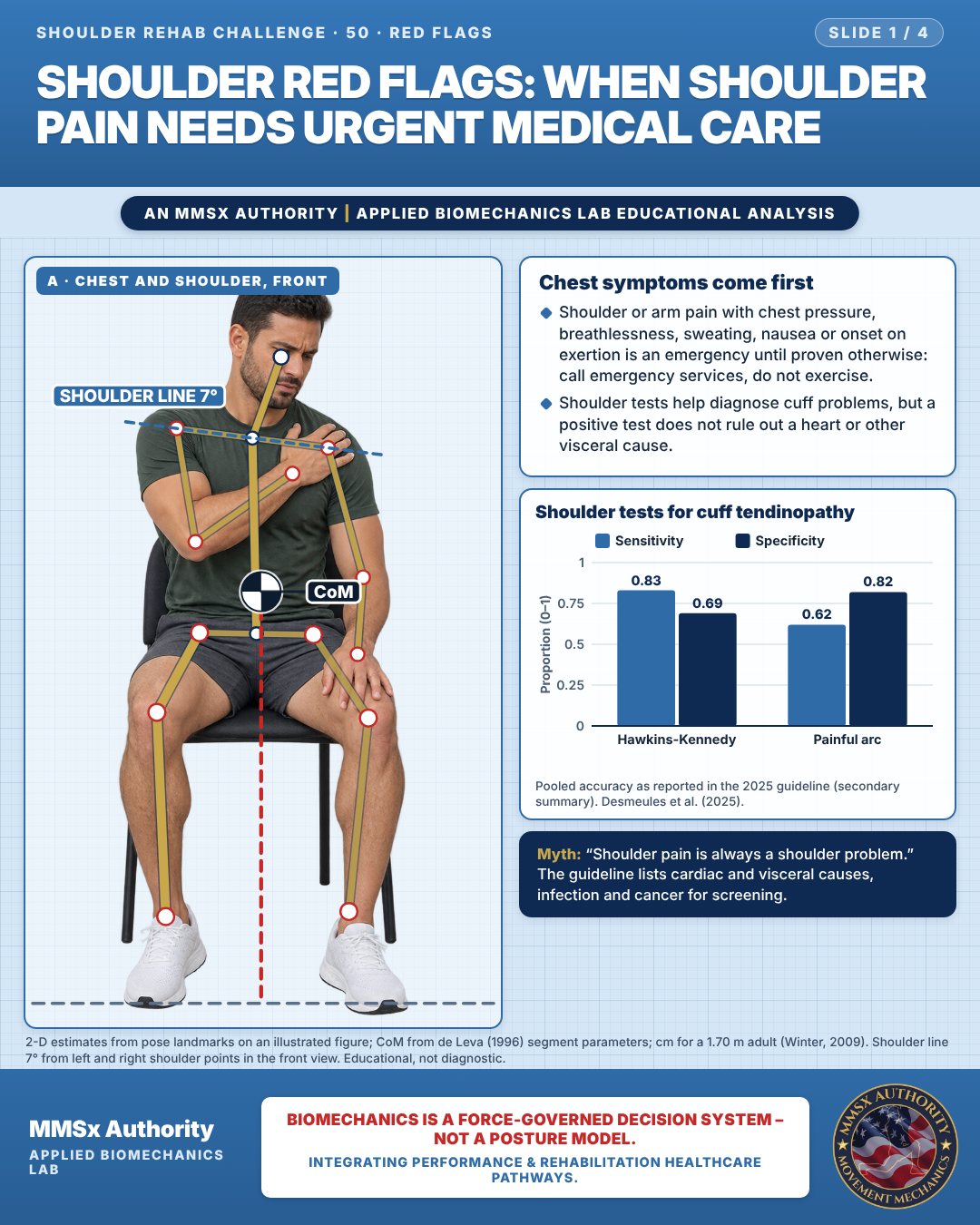
Chest symptoms come first
Shoulder or arm pain with chest pressure, breathlessness, sweating, nausea or onset on exertion is an emergency until proven otherwise: call emergency services, do not exercise.
Shoulder tests help diagnose cuff problems, but a positive test does not rule out a heart or other visceral cause.
Shoulder tests for cuff tendinopathy
Movement B: Arm after a fall (front view)
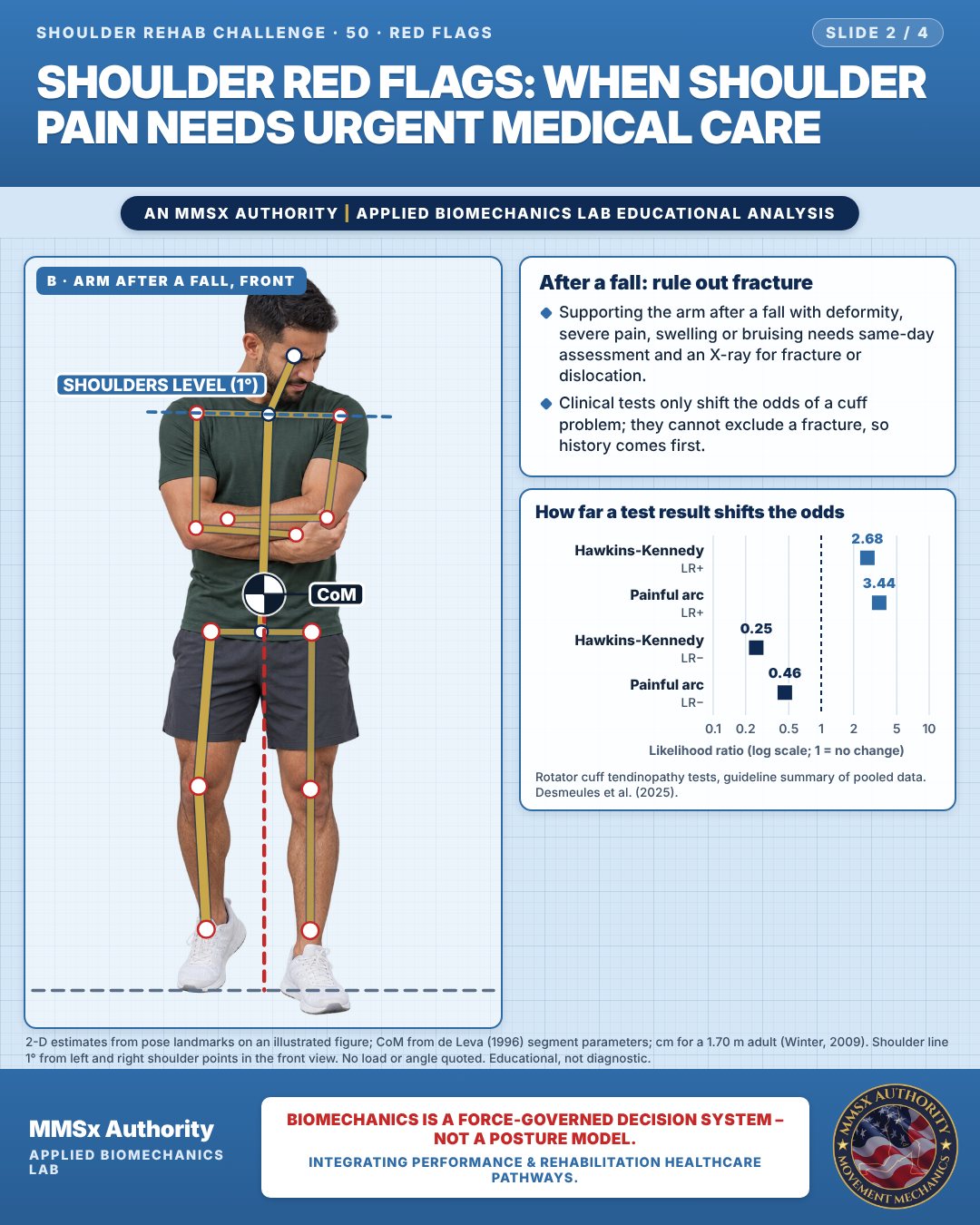
After a fall: rule out fracture
Supporting the arm after a fall with deformity, severe pain, swelling or bruising needs same-day assessment and an X-ray for fracture or dislocation.
Clinical tests only shift the odds of a cuff problem; they cannot exclude a fracture, so history comes first.
How far a test result shifts the odds
Movement C: Cannot lift arm (front view)
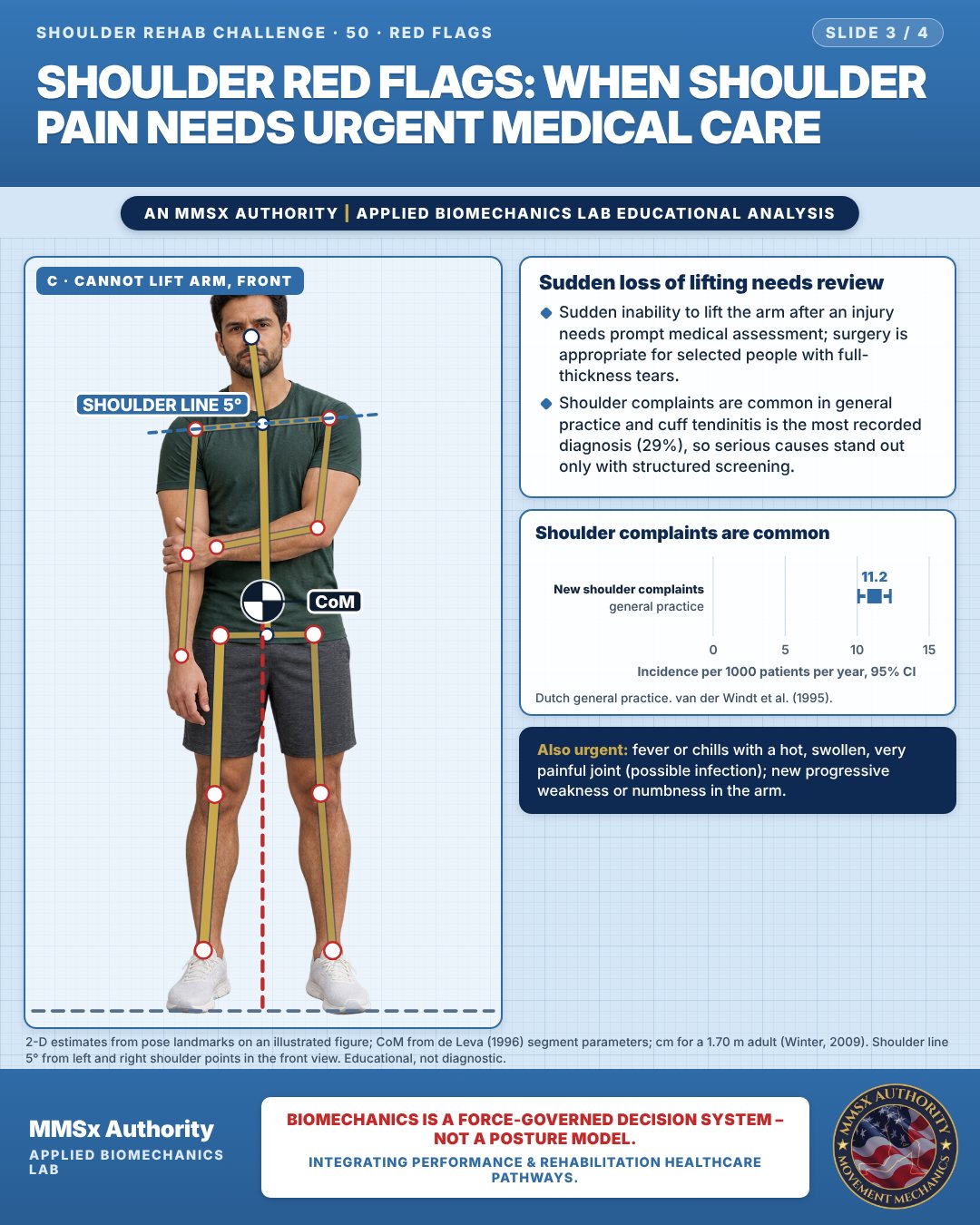
Sudden loss of lifting needs review
Sudden inability to lift the arm after an injury needs prompt medical assessment; surgery is appropriate for selected people with full-thickness tears.
Shoulder complaints are common in general practice and cuff tendinitis is the most recorded diagnosis (29%), so serious causes stand out only with structured screening.
Shoulder complaints are common
Decision pathway
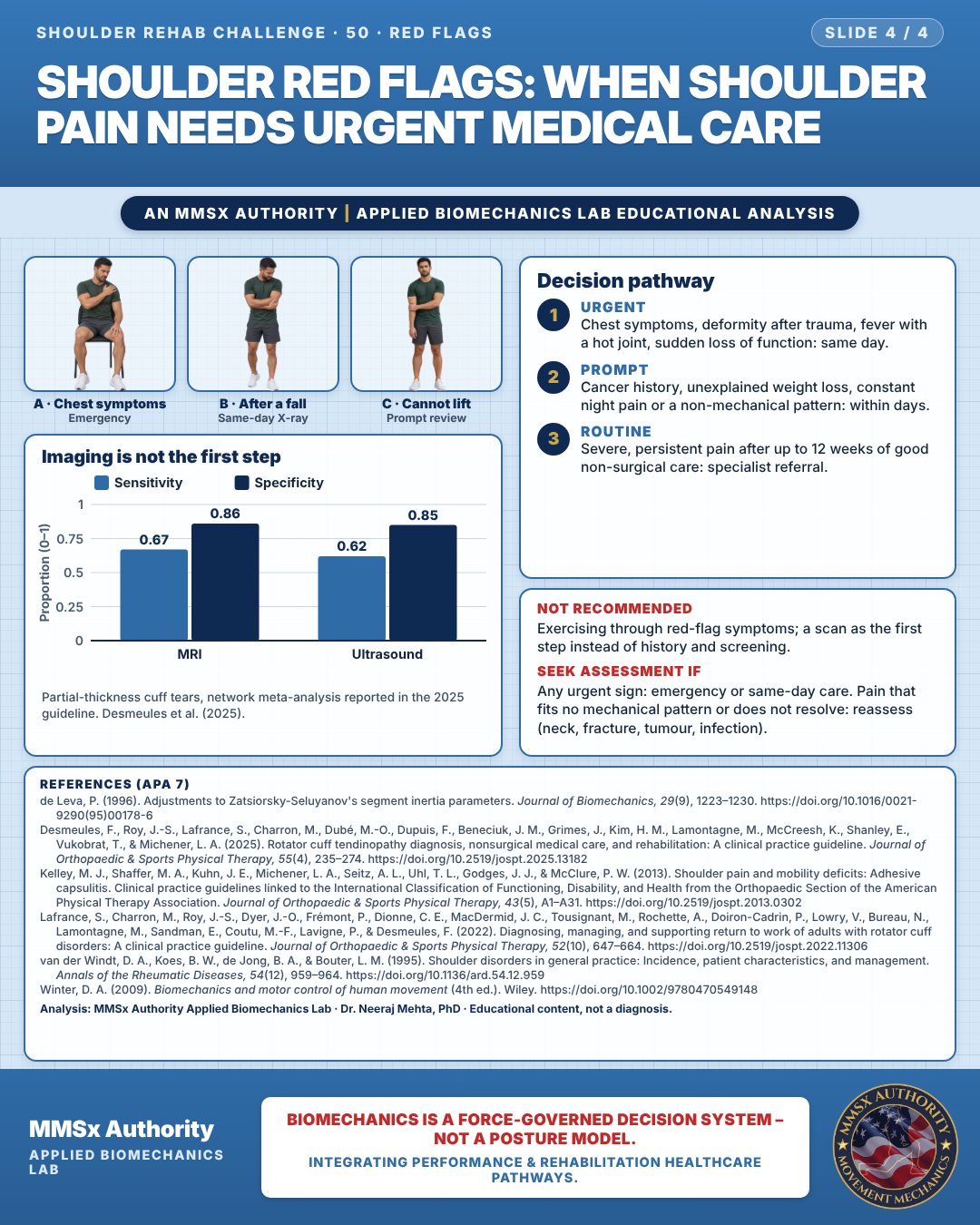
Imaging is not the first step
Urgent
Chest symptoms, deformity after trauma, fever with a hot joint, sudden loss of function: same day.
Prompt
Cancer history, unexplained weight loss, constant night pain or a non-mechanical pattern: within days.
Routine
Severe, persistent pain after up to 12 weeks of good non-surgical care: specialist referral.
What the evidence supports
- Screen every new shoulder presentation for red flags and systemic involvement (Desmeules et al., 2025, Grade F).
- Movement C (cannot lift the arm): sudden inability to lift the arm after an injury needs prompt medical assessment; surgery is appropriate for selected patients with full-thickness tears (Lafrance et al., 2022).
- Fever and/or chills with a hot, swollen, very painful joint: urgent assessment for infection (Desmeules et al., 2025; Kelley et al., 2013).
- History or suspicion of cancer, unexplained weight loss, or constant night pain unrelieved by rest or position: medical assessment (Desmeules et al., 2025).
Myth and evidence
Myth“Shoulder pain is always a shoulder problem.”
EvidenceThe guideline lists cardiovascular and visceral causes, infection and cancer as serious sources that must be screened for (Desmeules et al., 2025), and the frozen-shoulder guideline names cervical disorders, fractures and neoplasm in the differential (Kelley et al., 2013).
Cautions
Not recommended
Exercising through red-flag symptoms; a scan as the first step instead of history and screening.
Seek assessment if
Any urgent sign: emergency or same-day care. Pain that fits no mechanical pattern or does not resolve: reassess (neck, fracture, tumour, infection).
Methods note
2-D estimates from pose landmarks on an illustrated figure; CoM from de Leva (1996) segment parameters; cm for a 1.70 m adult (Winter, 2009). Shoulder line 7° from left and right shoulder points in the front view. Shoulder line 1° from left and right shoulder points in the front view. No load or angle quoted. Shoulder line 5° from left and right shoulder points in the front view. These are educational estimates, not a diagnosis.
References
- de Leva, P. (1996). Adjustments to Zatsiorsky-Seluyanov's segment inertia parameters. Journal of Biomechanics, 29(9), 1223–1230. https://doi.org/10.1016/0021-9290(95)00178-6
- Desmeules, F., Roy, J.-S., Lafrance, S., Charron, M., Dubé, M.-O., Dupuis, F., Beneciuk, J. M., Grimes, J., Kim, H. M., Lamontagne, M., McCreesh, K., Shanley, E., Vukobrat, T., & Michener, L. A. (2025). Rotator cuff tendinopathy diagnosis, nonsurgical medical care, and rehabilitation: A clinical practice guideline. Journal of Orthopaedic & Sports Physical Therapy, 55(4), 235–274. https://doi.org/10.2519/jospt.2025.13182
- Kelley, M. J., Shaffer, M. A., Kuhn, J. E., Michener, L. A., Seitz, A. L., Uhl, T. L., Godges, J. J., & McClure, P. W. (2013). Shoulder pain and mobility deficits: Adhesive capsulitis. Clinical practice guidelines linked to the International Classification of Functioning, Disability, and Health from the Orthopaedic Section of the American Physical Therapy Association. Journal of Orthopaedic & Sports Physical Therapy, 43(5), A1–A31. https://doi.org/10.2519/jospt.2013.0302
- Lafrance, S., Charron, M., Roy, J.-S., Dyer, J.-O., Frémont, P., Dionne, C. E., MacDermid, J. C., Tousignant, M., Rochette, A., Doiron-Cadrin, P., Lowry, V., Bureau, N., Lamontagne, M., Sandman, E., Coutu, M.-F., Lavigne, P., & Desmeules, F. (2022). Diagnosing, managing, and supporting return to work of adults with rotator cuff disorders: A clinical practice guideline. Journal of Orthopaedic & Sports Physical Therapy, 52(10), 647–664. https://doi.org/10.2519/jospt.2022.11306
- van der Windt, D. A., Koes, B. W., de Jong, B. A., & Bouter, L. M. (1995). Shoulder disorders in general practice: Incidence, patient characteristics, and management. Annals of the Rheumatic Diseases, 54(12), 959–964. https://doi.org/10.1136/ard.54.12.959
- Winter, D. A. (2009). Biomechanics and motor control of human movement (4th ed.). Wiley. https://doi.org/10.1002/9780470549148
Cite this article
Mehta, N. (2026, October 24). Shoulder red flags: when shoulder pain needs urgent medical care. MMSx Authority Applied Biomechanics Lab. https://mmsxauthority.org/edu/analysis/shoulder/50-shoulder-red-flags-when-shoulder-pain-needs-urgent-medical-care/
Part of the collection
Mehta, N. (2026). Shoulder Rehabilitation: 50 Evidence-Based Biomechanics Analyses [Collection]. MMSx Authority Applied Biomechanics Lab. Zenodo. https://doi.org/10.5281/zenodo.23735725
All Shoulder Rehab Challenge articles · Rehabilitation Library