Shoulder Rehab Challenge · 48
Fear of moving a painful shoulder: how avoidance changes movement
Kinesiophobia (fear of movement) and fear-avoidance beliefs are expectations that moving will cause pain or harm, leading people to guard the arm,…
Key points
- Explain. Pain during movement is not a reliable signal of damage; exercise can be done with acceptable pain.
- Grade. Progress from guarded, to part range, to full reach in small steps that succeed.
- Confidence. Build self-efficacy and realistic, positive expectations of recovery.
What it is
Kinesiophobia (fear of movement) and fear-avoidance beliefs are expectations that moving will cause pain or harm, leading people to guard the arm, restrict range and avoid tasks. In shoulder pain they are associated with higher pain and disability, but the strength of the link varies between studies and causation is not established.
How we analysed the movement
Three movements relevant to this topic were analysed from illustrated reference figures. Joint centres were located with two-dimensional pose estimation; arm elevation and elbow angles, shoulder level, the whole-body centre of mass and, where relevant, the arm lever (the horizontal distance from the shoulder joint to the centre of mass of the arm, with any hand load) and the resulting shoulder moment were then calculated from standard segment parameters. The figures are educational estimates that show how position changes mechanical demand; they are not measurements of a patient. Every research value quoted below comes from the published source cited beside it.
Movement A: Guarded arm (front view)
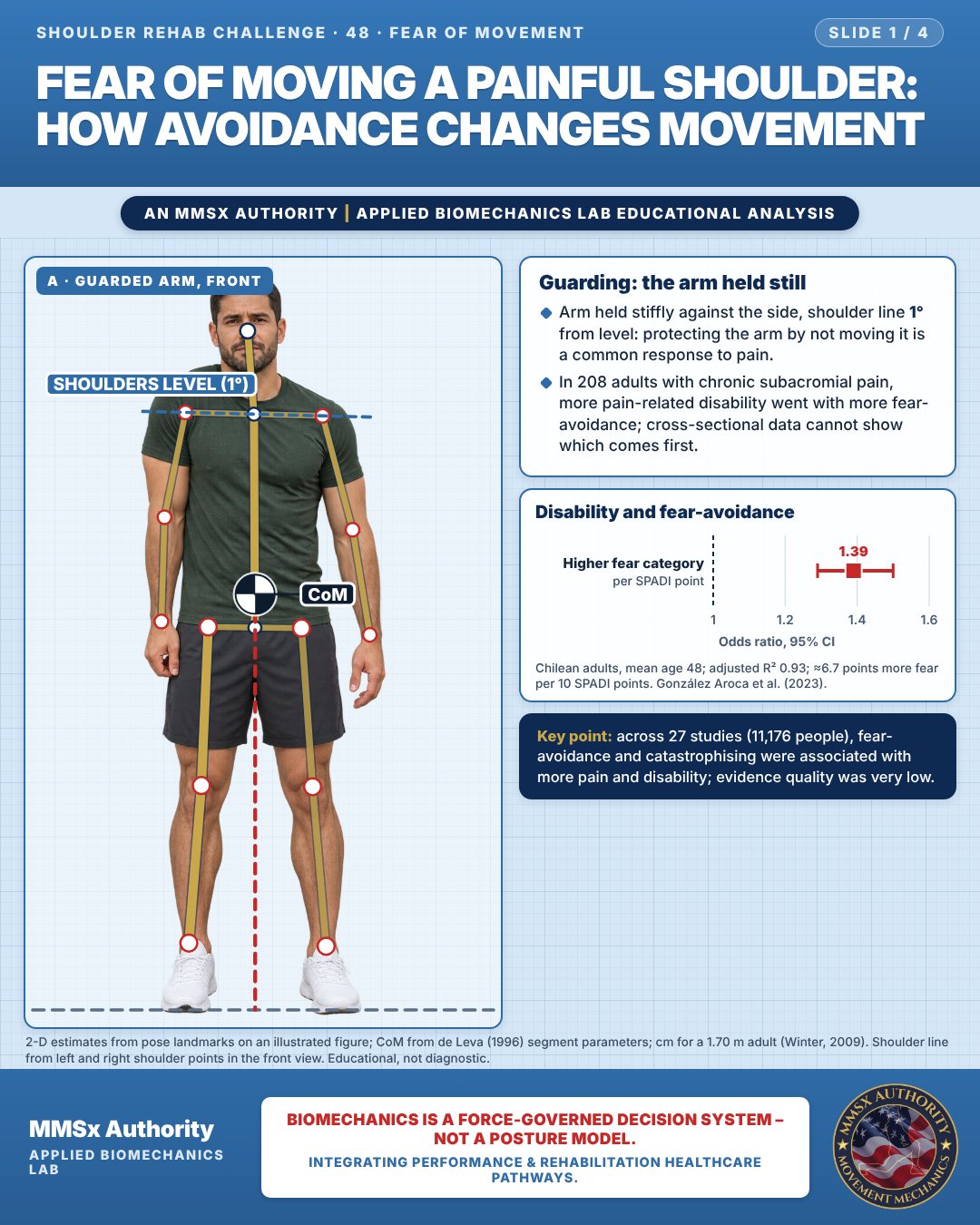
Guarding: the arm held still
Arm held stiffly against the side, shoulder line 1° from level: protecting the arm by not moving it is a common response to pain.
In 208 adults with chronic subacromial pain, more pain-related disability went with more fear-avoidance; cross-sectional data cannot show which comes first.
Disability and fear-avoidance
Movement B: Cautious raise (front view)
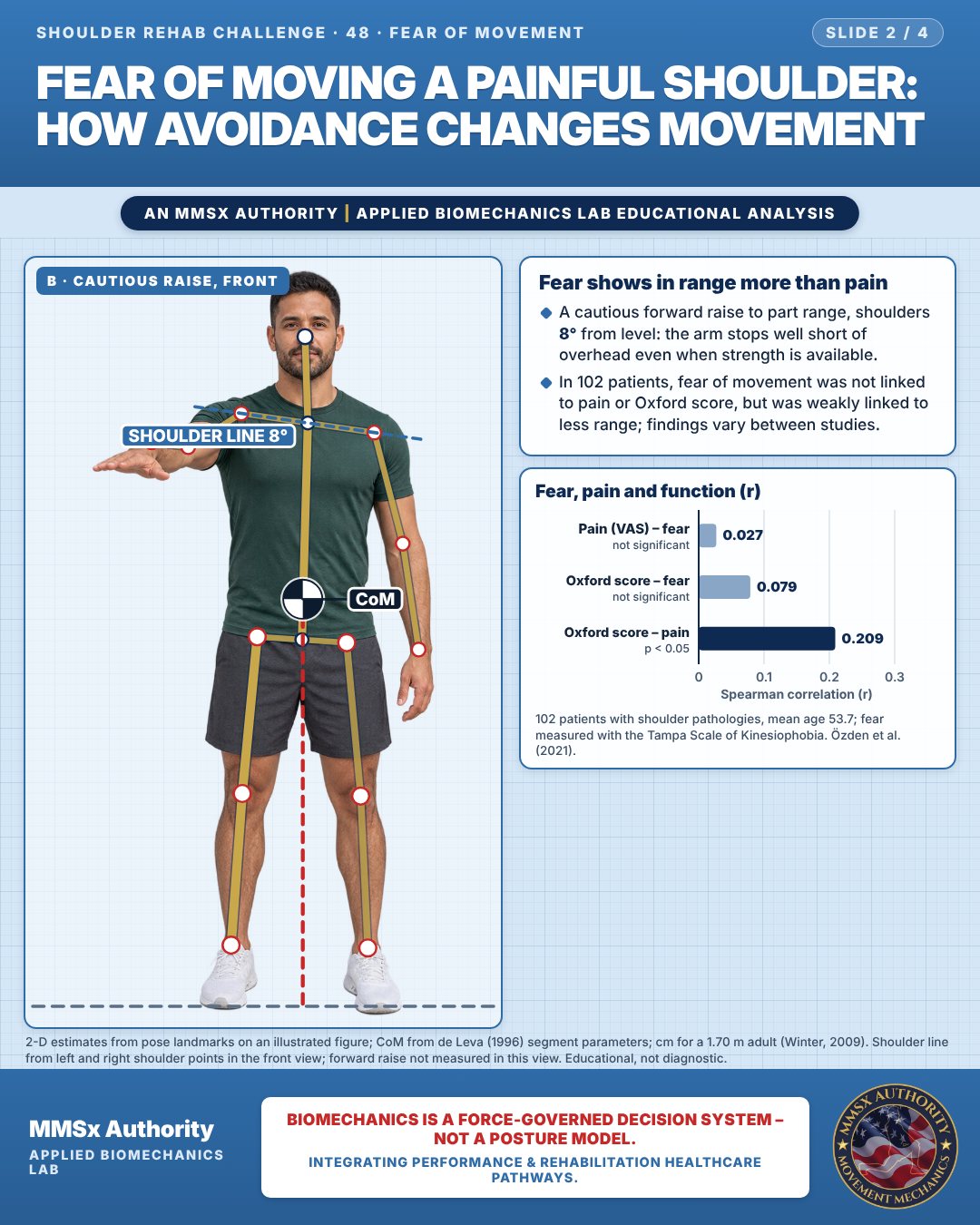
Fear shows in range more than pain
A cautious forward raise to part range, shoulders 8° from level: the arm stops well short of overhead even when strength is available.
In 102 patients, fear of movement was not linked to pain or Oxford score, but was weakly linked to less range; findings vary between studies.
Fear, pain and function (r)
Movement C: Confident reach (front view)
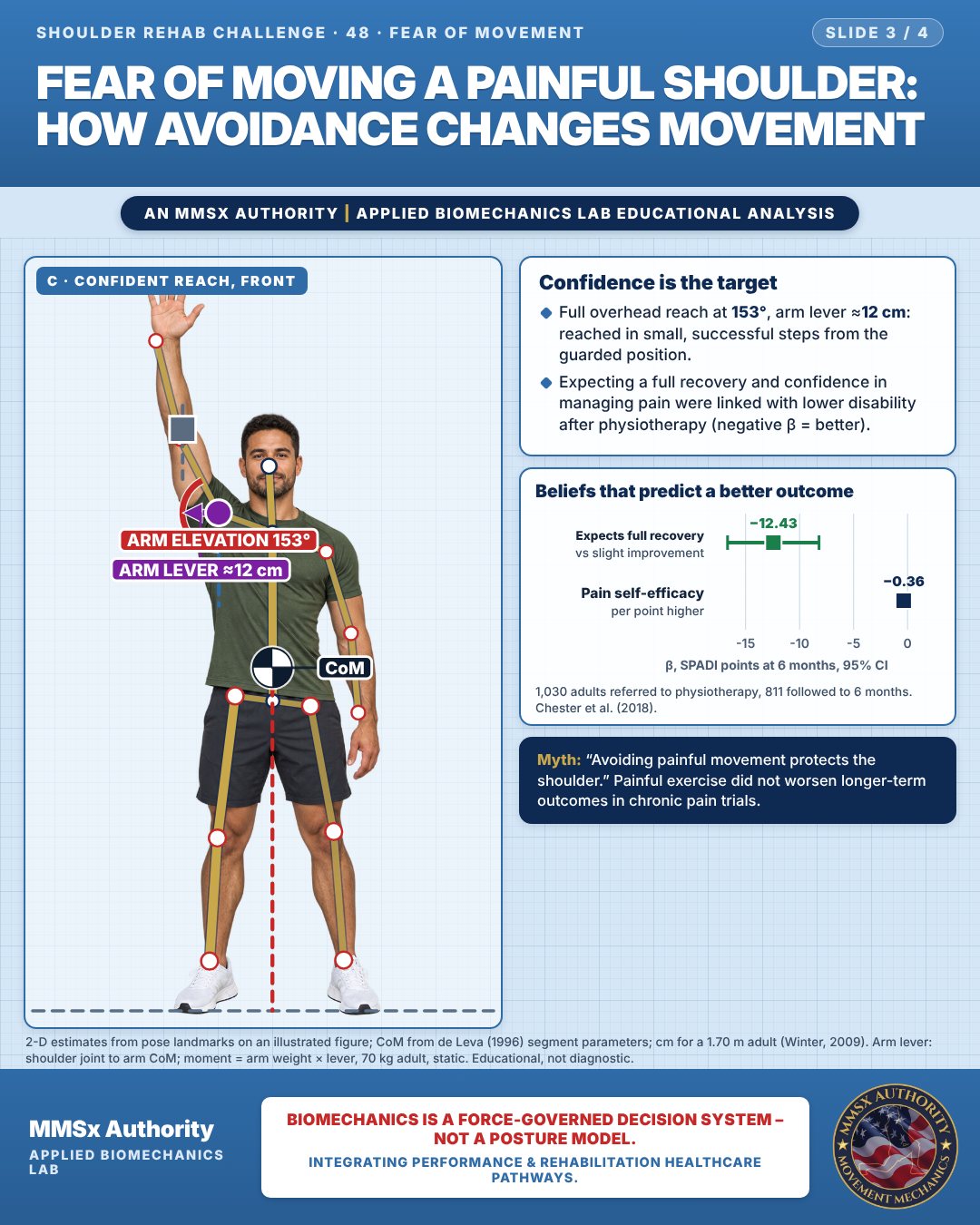
Confidence is the target
Full overhead reach at 153°, arm lever ≈12 cm: reached in small, successful steps from the guarded position.
Expecting a full recovery and confidence in managing pain were linked with lower disability after physiotherapy (negative β = better).
Beliefs that predict a better outcome
Decision pathway
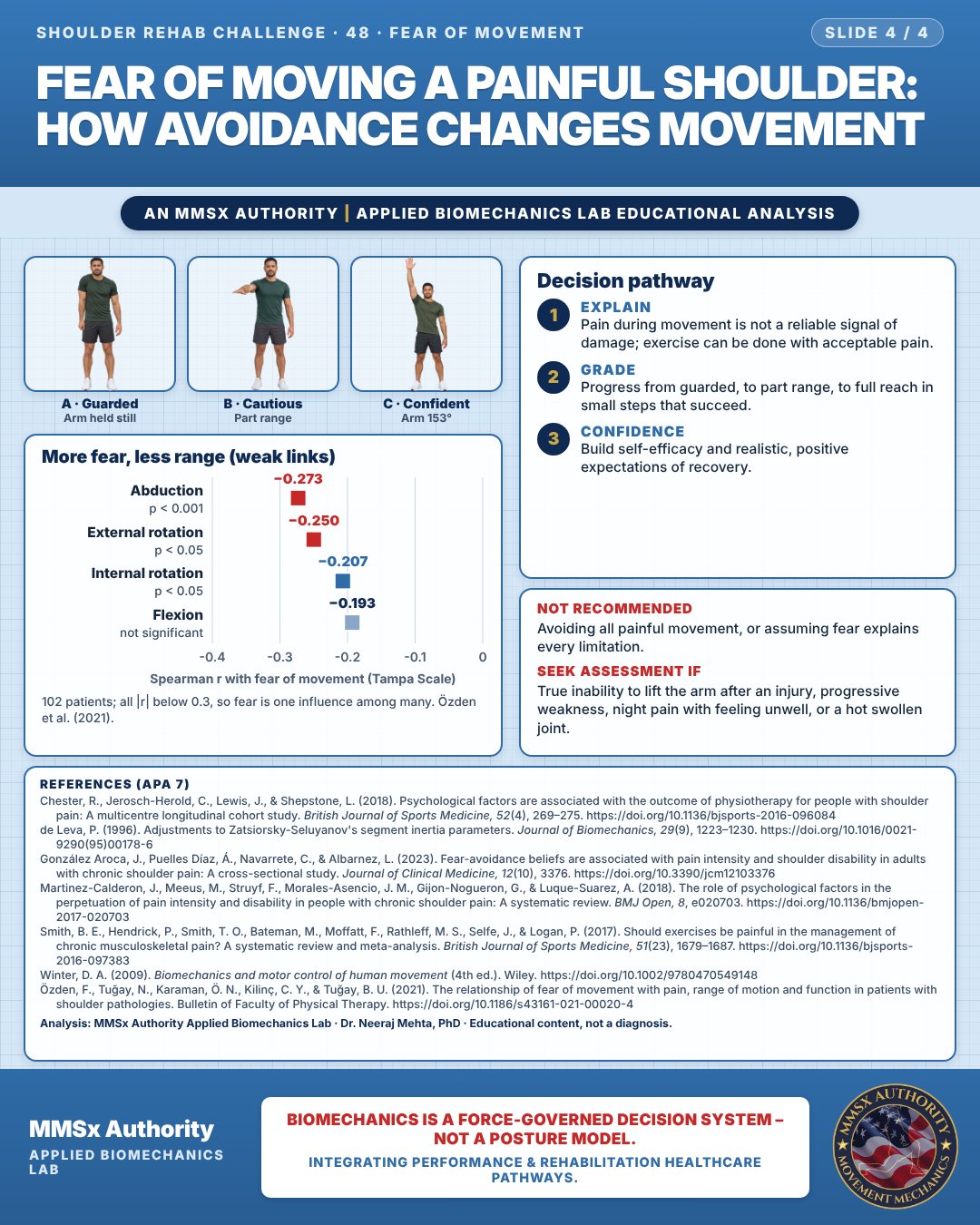
More fear, less range (weak links)
Explain
Pain during movement is not a reliable signal of damage; exercise can be done with acceptable pain.
Grade
Progress from guarded, to part range, to full reach in small steps that succeed.
Confidence
Build self-efficacy and realistic, positive expectations of recovery.
What the evidence supports
- Build self-efficacy and realistic positive expectations (Chester et al., 2018).
Myth and evidence
Myth“If moving hurts, avoiding it protects the shoulder.”
EvidenceFear-avoidance beliefs are associated with more pain and disability (Martinez-Calderon et al., 2018), higher fear goes with less range (Özden et al., 2021), and painful exercise did not worsen long-term outcomes (Smith et al., 2017).
Cautions
Not recommended
Avoiding all painful movement, or assuming fear explains every limitation.
Seek assessment if
True inability to lift the arm after an injury, progressive weakness, night pain with feeling unwell, or a hot swollen joint.
Methods note
2-D estimates from pose landmarks on an illustrated figure; CoM from de Leva (1996) segment parameters; cm for a 1.70 m adult (Winter, 2009). Shoulder line from left and right shoulder points in the front view. Shoulder line from left and right shoulder points in the front view; forward raise not measured in this view. Arm lever: shoulder joint to arm CoM; moment = arm weight × lever, 70 kg adult, static. These are educational estimates, not a diagnosis.
References
- Chester, R., Jerosch-Herold, C., Lewis, J., & Shepstone, L. (2018). Psychological factors are associated with the outcome of physiotherapy for people with shoulder pain: A multicentre longitudinal cohort study. British Journal of Sports Medicine, 52(4), 269–275. https://doi.org/10.1136/bjsports-2016-096084
- de Leva, P. (1996). Adjustments to Zatsiorsky-Seluyanov's segment inertia parameters. Journal of Biomechanics, 29(9), 1223–1230. https://doi.org/10.1016/0021-9290(95)00178-6
- González Aroca, J., Puelles Díaz, Á., Navarrete, C., & Albarnez, L. (2023). Fear-avoidance beliefs are associated with pain intensity and shoulder disability in adults with chronic shoulder pain: A cross-sectional study. Journal of Clinical Medicine, 12(10), 3376. https://doi.org/10.3390/jcm12103376
- Martinez-Calderon, J., Meeus, M., Struyf, F., Morales-Asencio, J. M., Gijon-Nogueron, G., & Luque-Suarez, A. (2018). The role of psychological factors in the perpetuation of pain intensity and disability in people with chronic shoulder pain: A systematic review. BMJ Open, 8, e020703. https://doi.org/10.1136/bmjopen-2017-020703
- Smith, B. E., Hendrick, P., Smith, T. O., Bateman, M., Moffatt, F., Rathleff, M. S., Selfe, J., & Logan, P. (2017). Should exercises be painful in the management of chronic musculoskeletal pain? A systematic review and meta-analysis. British Journal of Sports Medicine, 51(23), 1679–1687. https://doi.org/10.1136/bjsports-2016-097383
- Winter, D. A. (2009). Biomechanics and motor control of human movement (4th ed.). Wiley. https://doi.org/10.1002/9780470549148
- Özden, F., Tuğay, N., Karaman, Ö. N., Kilinç, C. Y., & Tuğay, B. U. (2021). The relationship of fear of movement with pain, range of motion and function in patients with shoulder pathologies. Bulletin of Faculty of Physical Therapy. https://doi.org/10.1186/s43161-021-00020-4
Cite this article
Mehta, N. (2026, October 24). Fear of moving a painful shoulder: how avoidance changes movement. MMSx Authority Applied Biomechanics Lab. https://mmsxauthority.org/edu/analysis/shoulder/48-fear-of-moving-a-painful-shoulder-how-avoidance-changes-movement/
Part of the collection
Mehta, N. (2026). Shoulder Rehabilitation: 50 Evidence-Based Biomechanics Analyses [Collection]. MMSx Authority Applied Biomechanics Lab. Zenodo. https://doi.org/10.5281/zenodo.23735725
All Shoulder Rehab Challenge articles · Rehabilitation Library