Shoulder Rehab Challenge · 47
A shoulder pain flare-up: how to adjust your training plan
A flare-up is a temporary increase in shoulder pain, sensitivity or stiffness above a person's usual level, often after a change in load, sleep or stress.
Key points
- Settle. Cut load, range, sets or frequency first and stay within the agreed ceiling, e.g. ≤5/10.
- Keep moving. Use gentle pendulum, isometric holds and supported rest; keep the rest of the body training.
- Rebuild. Return to the planned dose over days as pain settles; build confidence, not fear.
What it is
A flare-up is a temporary increase in shoulder pain, sensitivity or stiffness above a person's usual level, often after a change in load, sleep or stress. Shoulder pain commonly follows a fluctuating, episodic course, so a flare-up is usually a cue to adjust the dose of training rather than evidence of new damage.
How we analysed the movement
Three movements relevant to this topic were analysed from illustrated reference figures. Joint centres were located with two-dimensional pose estimation; arm elevation and elbow angles, shoulder level, the whole-body centre of mass and, where relevant, the arm lever (the horizontal distance from the shoulder joint to the centre of mass of the arm, with any hand load) and the resulting shoulder moment were then calculated from standard segment parameters. The figures are educational estimates that show how position changes mechanical demand; they are not measurements of a patient. Every research value quoted below comes from the published source cited beside it.
Movement A: Supported rest (side view)
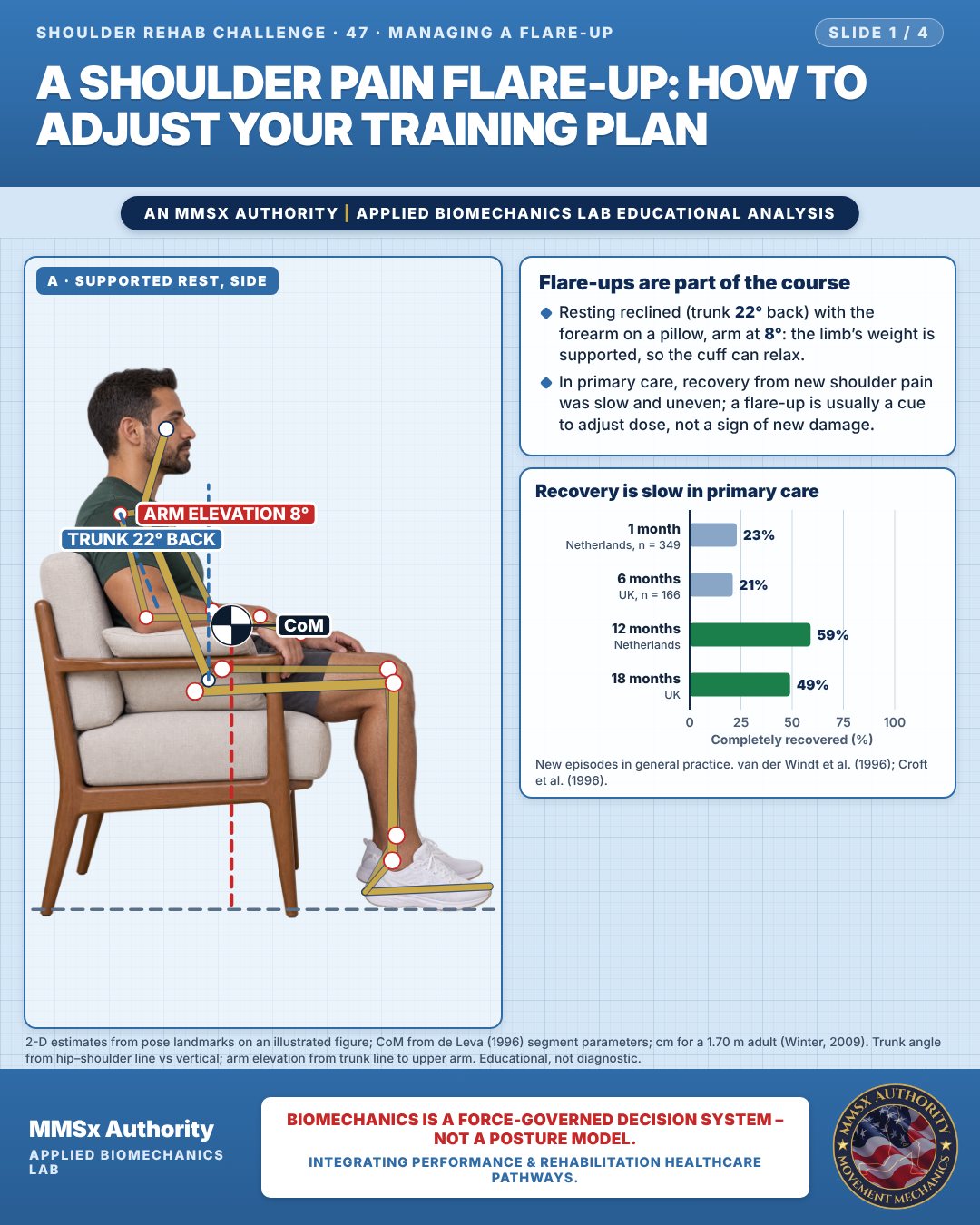
Flare-ups are part of the course
Resting reclined (trunk 22° back) with the forearm on a pillow, arm at 8°: the limb’s weight is supported, so the cuff can relax.
In primary care, recovery from new shoulder pain was slow and uneven; a flare-up is usually a cue to adjust dose, not a sign of new damage.
Recovery is slow in primary care
Movement B: Pendulum swing (side view)
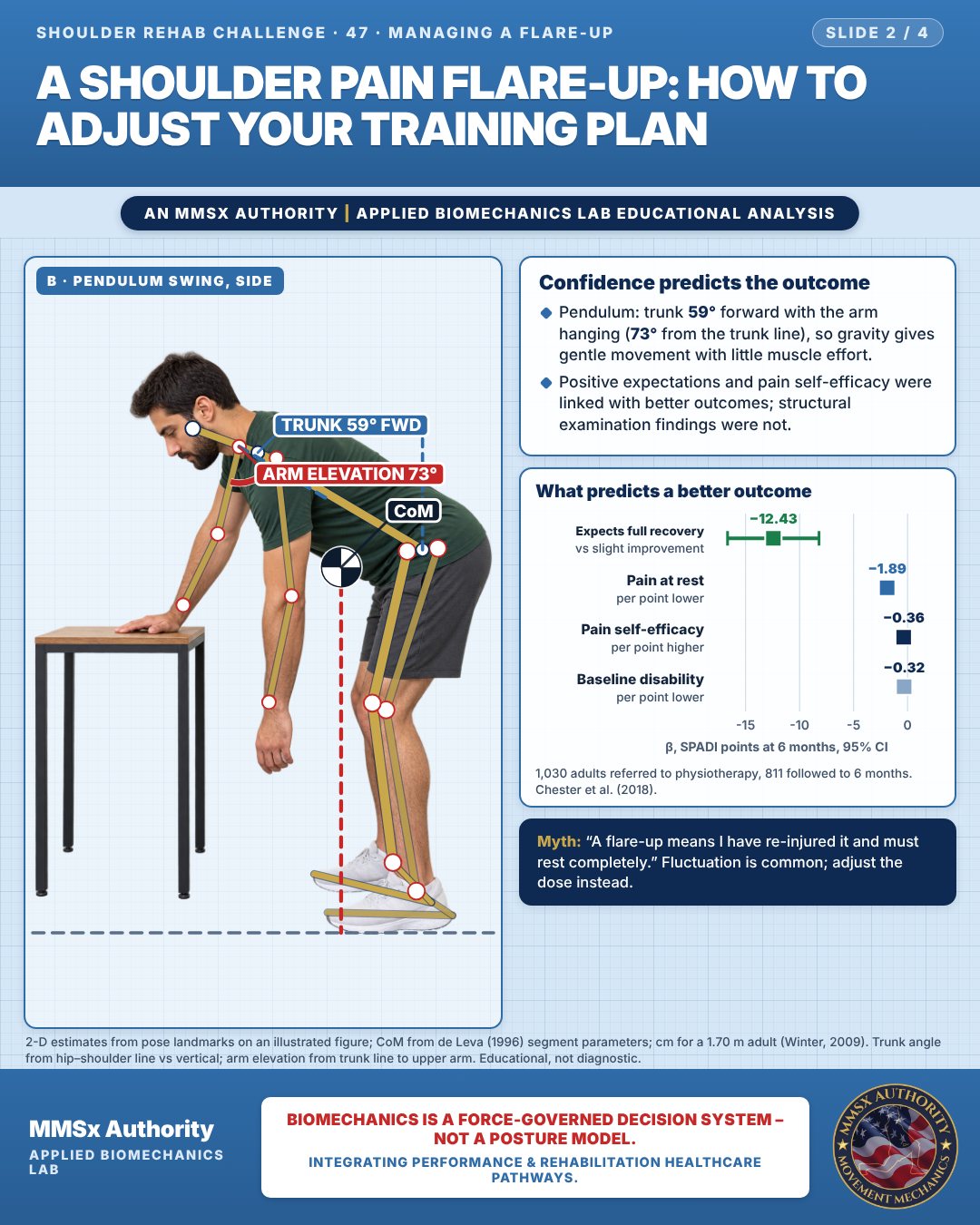
Confidence predicts the outcome
Pendulum: trunk 59° forward with the arm hanging (73° from the trunk line), so gravity gives gentle movement with little muscle effort.
Positive expectations and pain self-efficacy were linked with better outcomes; structural examination findings were not.
What predicts a better outcome
Movement C: Wall isometric (front view)
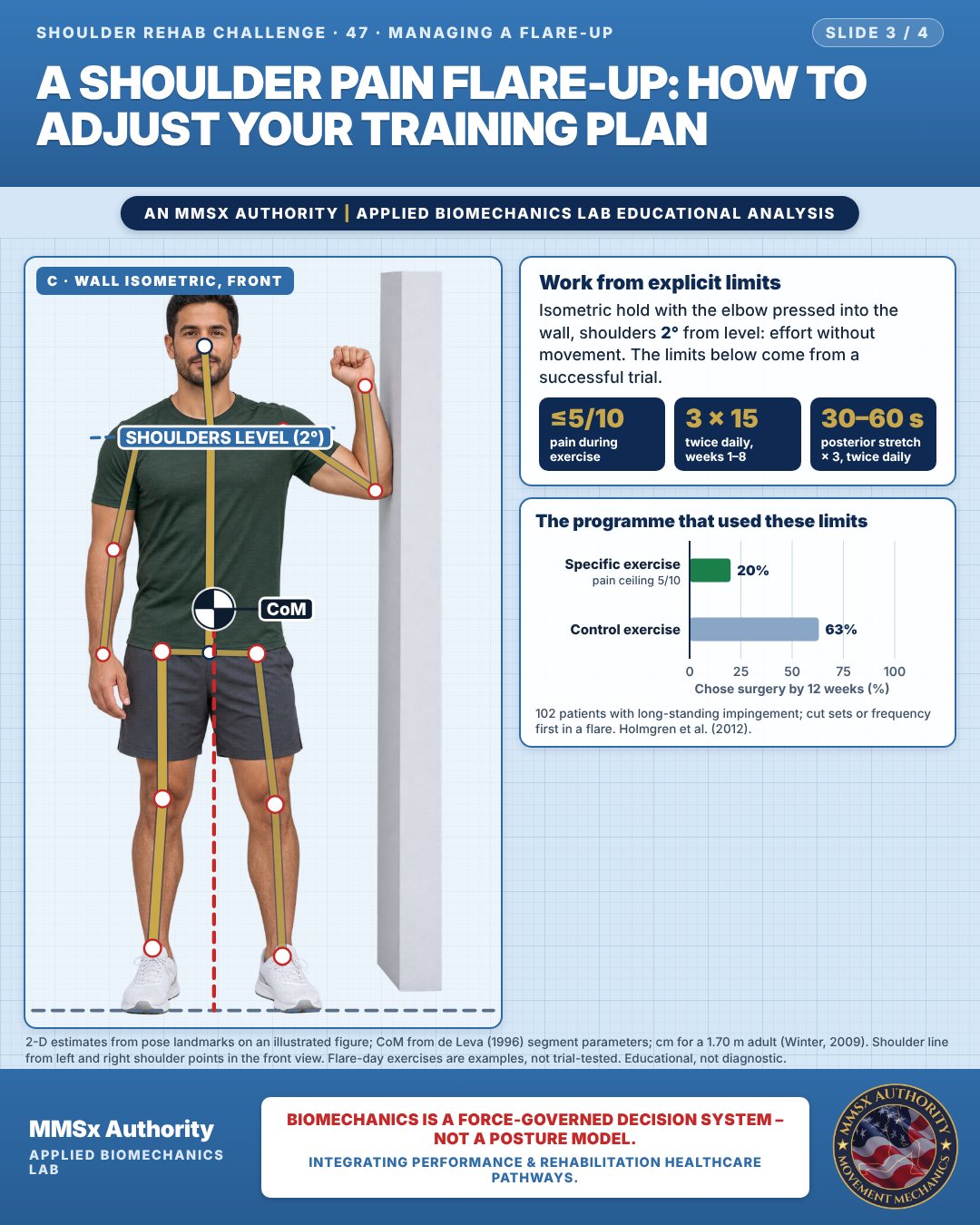
Work from explicit limits
Isometric hold with the elbow pressed into the wall, shoulders 2° from level: effort without movement. The limits below come from a successful trial.
The programme that used these limits
Decision pathway
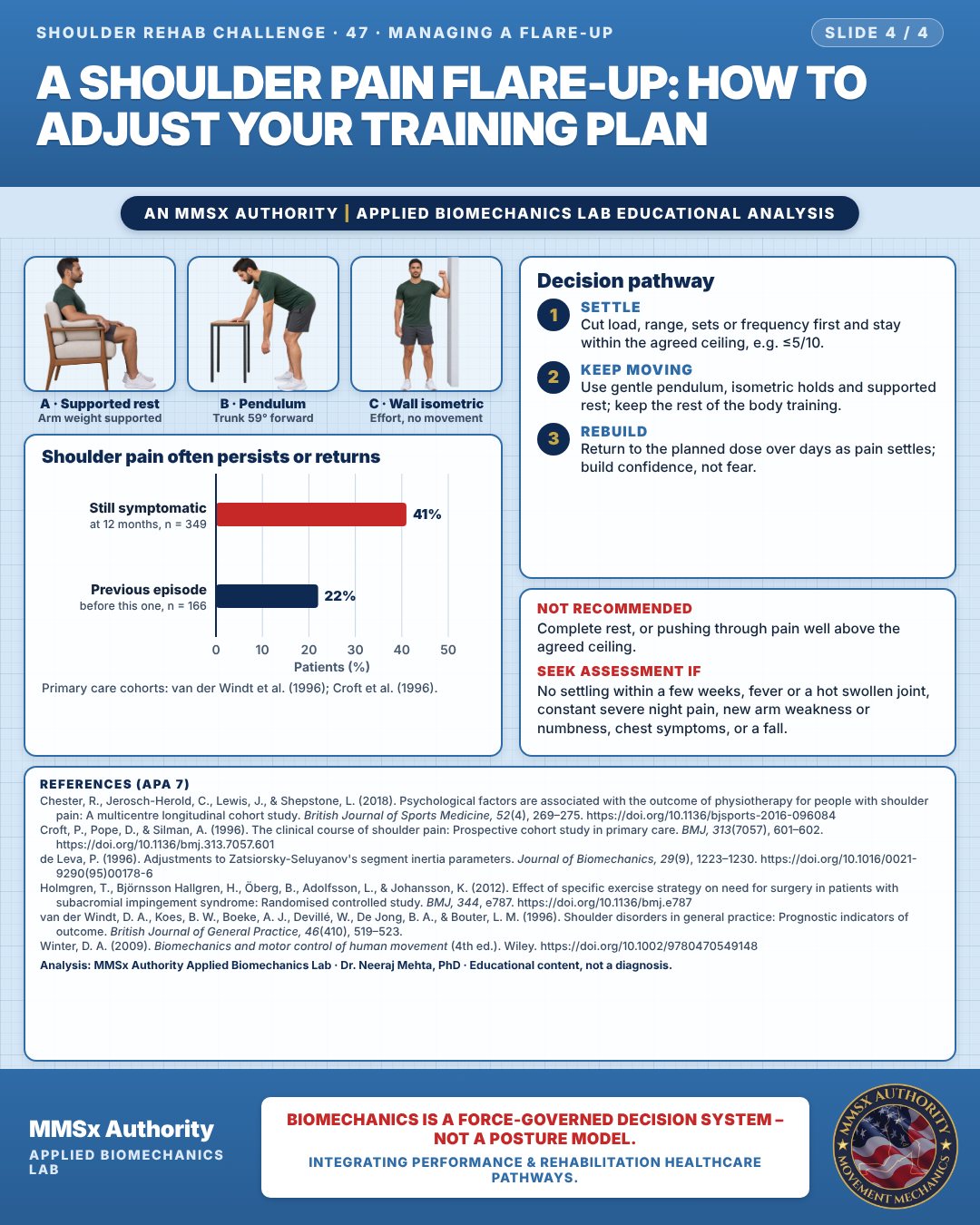
Shoulder pain often persists or returns
Settle
Cut load, range, sets or frequency first and stay within the agreed ceiling, e.g. ≤5/10.
Keep moving
Use gentle pendulum, isometric holds and supported rest; keep the rest of the body training.
Rebuild
Return to the planned dose over days as pain settles; build confidence, not fear.
What the evidence supports
- Adjust dose before stopping: reduce load, range, sets or frequency, stay within an agreed pain ceiling (e.g. ≤5/10; Holmgren et al., 2012), then rebuild over days.
- Build self-efficacy and realistic expectations, which are associated with better outcomes (Chester et al., 2018).
Myth and evidence
Myth“A flare-up means I have re-injured it and must rest completely.”
EvidenceShoulder pain often follows a fluctuating course: about four in ten still have symptoms at a year (van der Windt et al., 1996), and recurrences are common (Croft et al., 1996). Outcome is associated more with self-efficacy and expectation than with structural findings (Chester et al., 2018).
Cautions
Not recommended
Complete rest, or pushing through pain well above the agreed ceiling.
Seek assessment if
No settling within a few weeks, fever or a hot swollen joint, constant severe night pain, new arm weakness or numbness, chest symptoms, or a fall.
Methods note
2-D estimates from pose landmarks on an illustrated figure; CoM from de Leva (1996) segment parameters; cm for a 1.70 m adult (Winter, 2009). Trunk angle from hip–shoulder line vs vertical; arm elevation from trunk line to upper arm. Shoulder line from left and right shoulder points in the front view. Flare-day exercises are examples, not trial-tested. These are educational estimates, not a diagnosis.
References
- Chester, R., Jerosch-Herold, C., Lewis, J., & Shepstone, L. (2018). Psychological factors are associated with the outcome of physiotherapy for people with shoulder pain: A multicentre longitudinal cohort study. British Journal of Sports Medicine, 52(4), 269–275. https://doi.org/10.1136/bjsports-2016-096084
- Croft, P., Pope, D., & Silman, A. (1996). The clinical course of shoulder pain: Prospective cohort study in primary care. BMJ, 313(7057), 601–602. https://doi.org/10.1136/bmj.313.7057.601
- de Leva, P. (1996). Adjustments to Zatsiorsky-Seluyanov's segment inertia parameters. Journal of Biomechanics, 29(9), 1223–1230. https://doi.org/10.1016/0021-9290(95)00178-6
- Holmgren, T., Björnsson Hallgren, H., Öberg, B., Adolfsson, L., & Johansson, K. (2012). Effect of specific exercise strategy on need for surgery in patients with subacromial impingement syndrome: Randomised controlled study. BMJ, 344, e787. https://doi.org/10.1136/bmj.e787
- van der Windt, D. A., Koes, B. W., Boeke, A. J., Devillé, W., De Jong, B. A., & Bouter, L. M. (1996). Shoulder disorders in general practice: Prognostic indicators of outcome. British Journal of General Practice, 46(410), 519–523.
- Winter, D. A. (2009). Biomechanics and motor control of human movement (4th ed.). Wiley. https://doi.org/10.1002/9780470549148
Cite this article
Mehta, N. (2026, October 24). A shoulder pain flare-up: how to adjust your training plan. MMSx Authority Applied Biomechanics Lab. https://mmsxauthority.org/edu/analysis/shoulder/47-a-shoulder-pain-flare-up-how-to-adjust-your-training-plan/
Part of the collection
Mehta, N. (2026). Shoulder Rehabilitation: 50 Evidence-Based Biomechanics Analyses [Collection]. MMSx Authority Applied Biomechanics Lab. Zenodo. https://doi.org/10.5281/zenodo.23735725
All Shoulder Rehab Challenge articles · Rehabilitation Library