Shoulder Rehab Challenge · 46
Pain during shoulder rehabilitation: when to modify, pause or seek help
Pain monitoring is the practice of allowing a defined, acceptable level of pain during and after rehabilitation exercise (for example, not above 5 on…
Key points
- Ceiling. Agree an acceptable level, e.g. up to 5/10 during exercise, settling by the next day.
- Modify. Above the ceiling or worse next day: reduce load, range, speed or sets.
- Pause. Pause only the aggravating exercise; keep the rest of the programme going.
What it is
Pain monitoring is the practice of allowing a defined, acceptable level of pain during and after rehabilitation exercise (for example, not above 5 on a 0–10 scale), and adjusting load when pain exceeds that level or does not settle. Pain during exercise is not by itself a sign of tissue damage in persistent shoulder pain.
How we analysed the movement
Three movements relevant to this topic were analysed from illustrated reference figures. Joint centres were located with two-dimensional pose estimation; arm elevation and elbow angles, shoulder level, the whole-body centre of mass and, where relevant, the arm lever (the horizontal distance from the shoulder joint to the centre of mass of the arm, with any hand load) and the resulting shoulder moment were then calculated from standard segment parameters. The figures are educational estimates that show how position changes mechanical demand; they are not measurements of a patient. Every research value quoted below comes from the published source cited beside it.
Movement A: Lateral raise (front view)
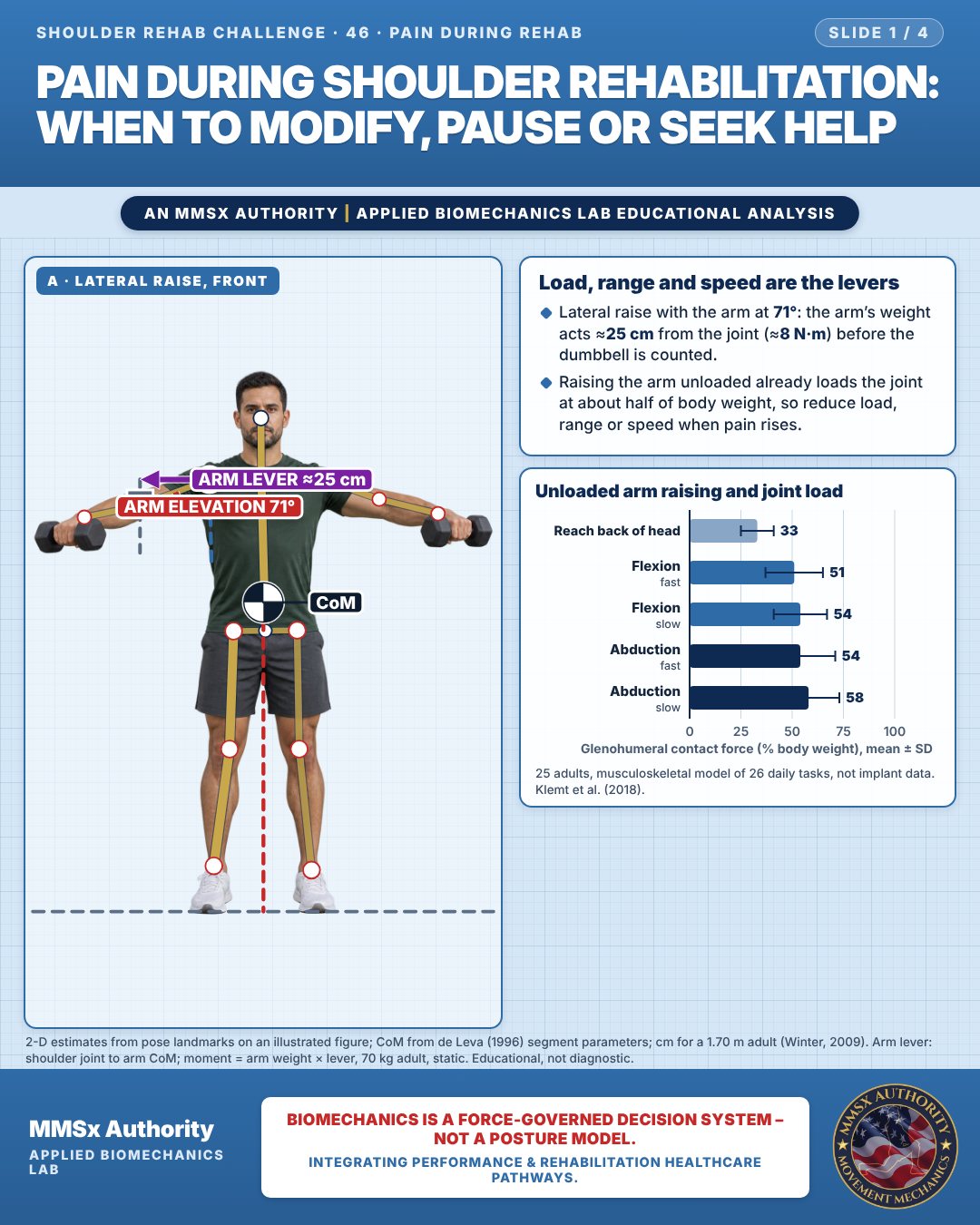
Load, range and speed are the levers
Lateral raise with the arm at 71°: the arm’s weight acts ≈25 cm from the joint (≈8 N·m) before the dumbbell is counted.
Raising the arm unloaded already loads the joint at about half of body weight, so reduce load, range or speed when pain rises.
Unloaded arm raising and joint load
Movement B: Band er at side (front view)
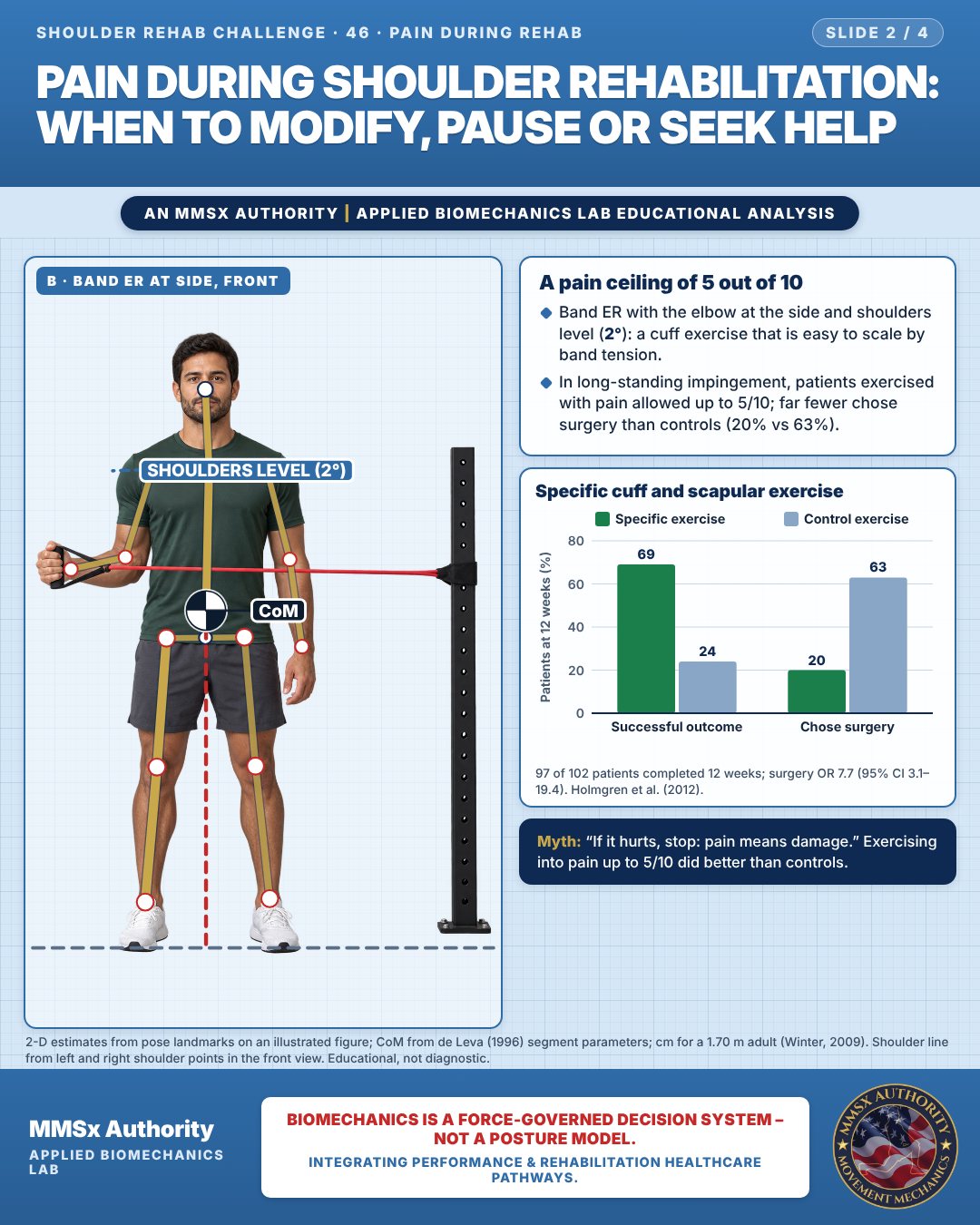
A pain ceiling of 5 out of 10
Band ER with the elbow at the side and shoulders level (2°): a cuff exercise that is easy to scale by band tension.
In long-standing impingement, patients exercised with pain allowed up to 5/10; far fewer chose surgery than controls (20% vs 63%).
Specific cuff and scapular exercise
Movement C: Overhead press (side view)
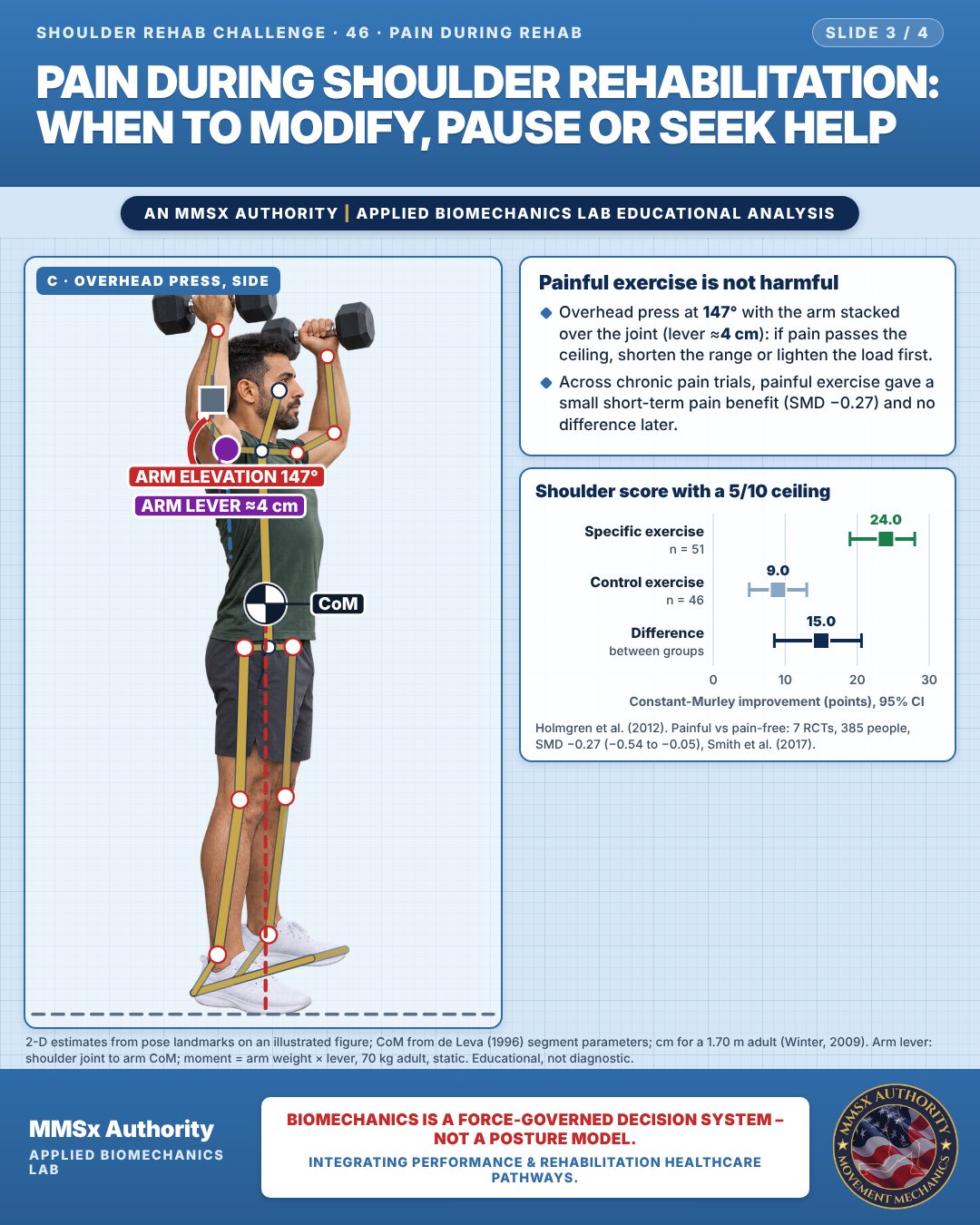
Painful exercise is not harmful
Overhead press at 147° with the arm stacked over the joint (lever ≈4 cm): if pain passes the ceiling, shorten the range or lighten the load first.
Across chronic pain trials, painful exercise gave a small short-term pain benefit (SMD −0.27) and no difference later.
Shoulder score with a 5/10 ceiling
Decision pathway
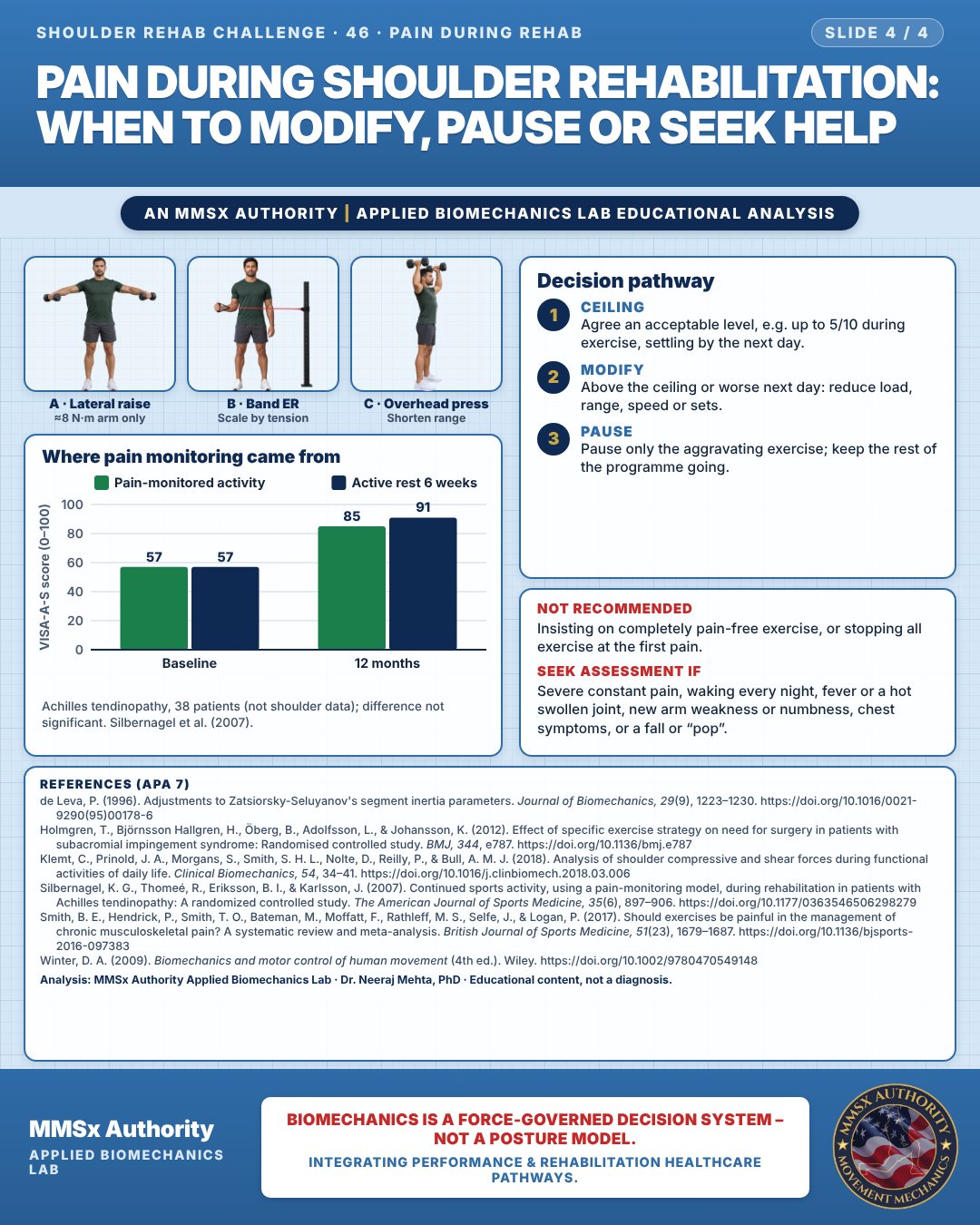
Where pain monitoring came from
Ceiling
Agree an acceptable level, e.g. up to 5/10 during exercise, settling by the next day.
Modify
Above the ceiling or worse next day: reduce load, range, speed or sets.
Pause
Pause only the aggravating exercise; keep the rest of the programme going.
What the evidence supports
- Do not insist on completely pain-free exercise; painful and pain-free approaches give similar longer-term results (Smith et al., 2017).
Myth and evidence
Myth“If it hurts, stop — pain means damage.”
EvidenceIn the Holmgren trial patients exercised into pain up to 5/10 and did better than controls (Holmgren et al., 2012); across chronic musculoskeletal pain, painful exercise was not harmful and gave a small short-term benefit (Smith et al., 2017).
Cautions
Not recommended
Insisting on completely pain-free exercise, or stopping all exercise at the first pain.
Seek assessment if
Severe constant pain, waking every night, fever or a hot swollen joint, new arm weakness or numbness, chest symptoms, or a fall or “pop”.
Methods note
2-D estimates from pose landmarks on an illustrated figure; CoM from de Leva (1996) segment parameters; cm for a 1.70 m adult (Winter, 2009). Arm lever: shoulder joint to arm CoM; moment = arm weight × lever, 70 kg adult, static. Shoulder line from left and right shoulder points in the front view. These are educational estimates, not a diagnosis.
References
- de Leva, P. (1996). Adjustments to Zatsiorsky-Seluyanov's segment inertia parameters. Journal of Biomechanics, 29(9), 1223–1230. https://doi.org/10.1016/0021-9290(95)00178-6
- Holmgren, T., Björnsson Hallgren, H., Öberg, B., Adolfsson, L., & Johansson, K. (2012). Effect of specific exercise strategy on need for surgery in patients with subacromial impingement syndrome: Randomised controlled study. BMJ, 344, e787. https://doi.org/10.1136/bmj.e787
- Klemt, C., Prinold, J. A., Morgans, S., Smith, S. H. L., Nolte, D., Reilly, P., & Bull, A. M. J. (2018). Analysis of shoulder compressive and shear forces during functional activities of daily life. Clinical Biomechanics, 54, 34–41. https://doi.org/10.1016/j.clinbiomech.2018.03.006
- Silbernagel, K. G., Thomeé, R., Eriksson, B. I., & Karlsson, J. (2007). Continued sports activity, using a pain-monitoring model, during rehabilitation in patients with Achilles tendinopathy: A randomized controlled study. The American Journal of Sports Medicine, 35(6), 897–906. https://doi.org/10.1177/0363546506298279
- Smith, B. E., Hendrick, P., Smith, T. O., Bateman, M., Moffatt, F., Rathleff, M. S., Selfe, J., & Logan, P. (2017). Should exercises be painful in the management of chronic musculoskeletal pain? A systematic review and meta-analysis. British Journal of Sports Medicine, 51(23), 1679–1687. https://doi.org/10.1136/bjsports-2016-097383
- Winter, D. A. (2009). Biomechanics and motor control of human movement (4th ed.). Wiley. https://doi.org/10.1002/9780470549148
Cite this article
Mehta, N. (2026, October 24). Pain during shoulder rehabilitation: when to modify, pause or seek help. MMSx Authority Applied Biomechanics Lab. https://mmsxauthority.org/edu/analysis/shoulder/46-pain-during-shoulder-rehabilitation-when-to-modify-pause-or-seek-help/
Part of the collection
Mehta, N. (2026). Shoulder Rehabilitation: 50 Evidence-Based Biomechanics Analyses [Collection]. MMSx Authority Applied Biomechanics Lab. Zenodo. https://doi.org/10.5281/zenodo.23735725
All Shoulder Rehab Challenge articles · Rehabilitation Library