Shoulder Rehab Challenge · 45
Scapular exercises: who benefits from shoulder blade training?
Scapular-focused exercise aims to improve strength, endurance and control of the muscles that position and rotate the shoulder blade (trapezius,…
Key points
- Assess. Look for a real scapular strength or control deficit, not just how the blade looks.
- Select. Lower-trapezius bias: prone Y, prone ER. Serratus bias: presses, protraction, wall slides.
- Integrate. Add scapular work to progressive cuff and shoulder exercise with education.
What it is
Scapular-focused exercise aims to improve strength, endurance and control of the muscles that position and rotate the shoulder blade (trapezius, serratus anterior, rhomboids), usually by choosing exercises that activate the middle/lower trapezius and serratus anterior more than the upper trapezius. Altered scapular movement (dyskinesis) is common and is a modest risk marker, not a diagnosis.
How we analysed the movement
Three movements relevant to this topic were analysed from illustrated reference figures. Joint centres were located with two-dimensional pose estimation; arm elevation and elbow angles, shoulder level, the whole-body centre of mass and, where relevant, the arm lever (the horizontal distance from the shoulder joint to the centre of mass of the arm, with any hand load) and the resulting shoulder moment were then calculated from standard segment parameters. The figures are educational estimates that show how position changes mechanical demand; they are not measurements of a patient. Every research value quoted below comes from the published source cited beside it.
Movement A: Standing band row (side view)
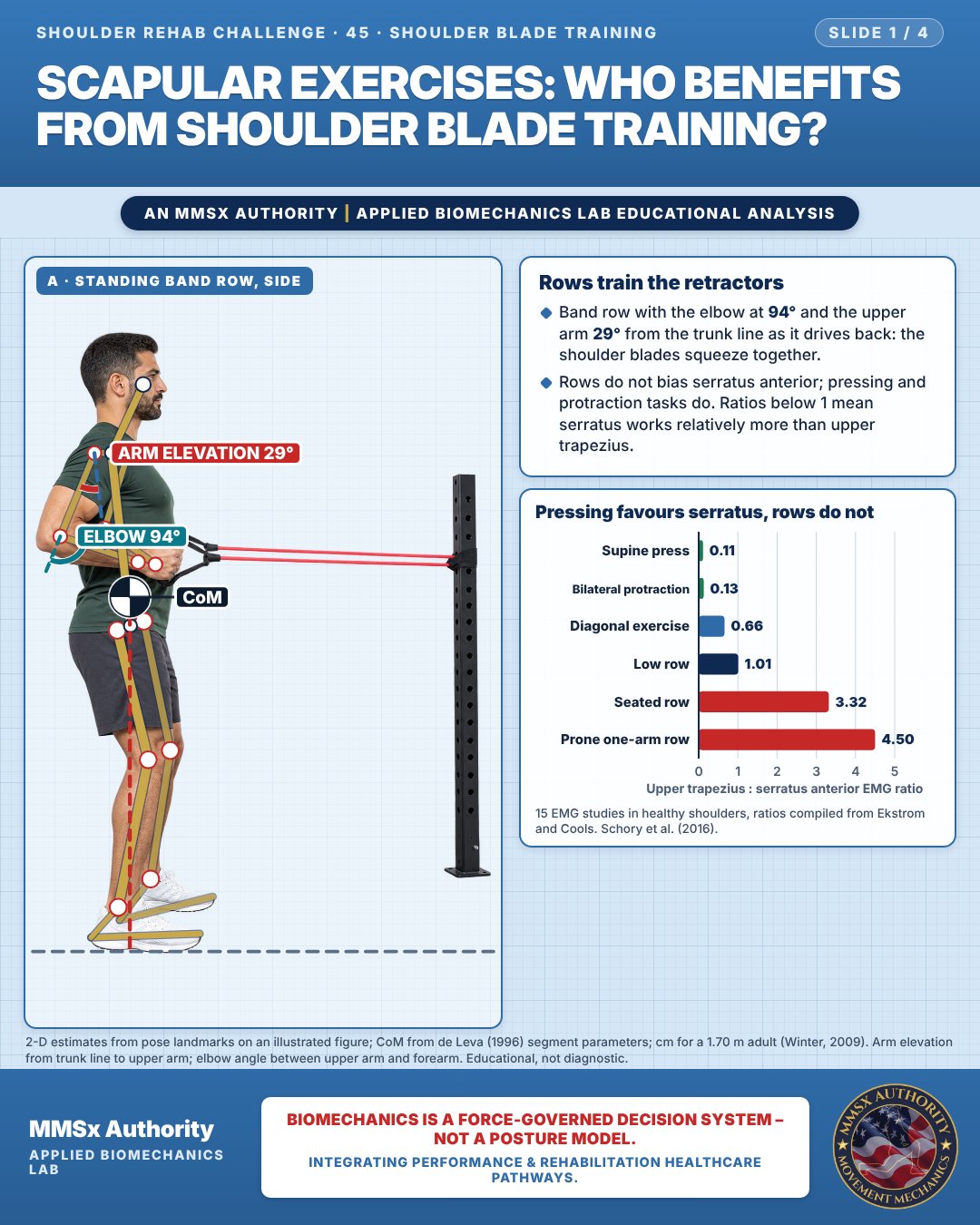
Rows train the retractors
Band row with the elbow at 94° and the upper arm 29° from the trunk line as it drives back: the shoulder blades squeeze together.
Rows do not bias serratus anterior; pressing and protraction tasks do. Ratios below 1 mean serratus works relatively more than upper trapezius.
Pressing favours serratus, rows do not
Movement B: Prone y raise (rear view)
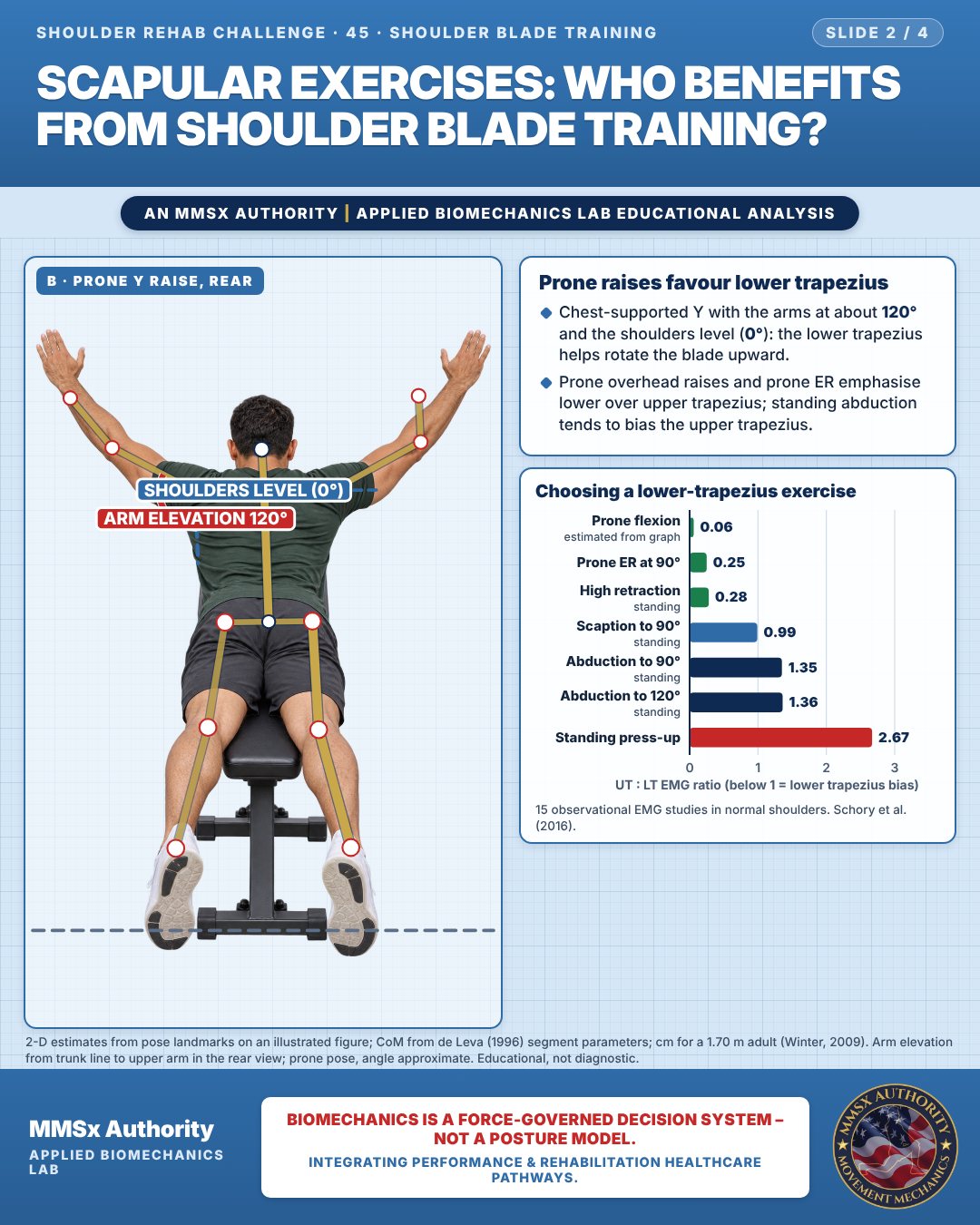
Prone raises favour lower trapezius
Chest-supported Y with the arms at about 120° and the shoulders level (0°): the lower trapezius helps rotate the blade upward.
Prone overhead raises and prone ER emphasise lower over upper trapezius; standing abduction tends to bias the upper trapezius.
Choosing a lower-trapezius exercise
Movement C: Wall roller slide (side view)
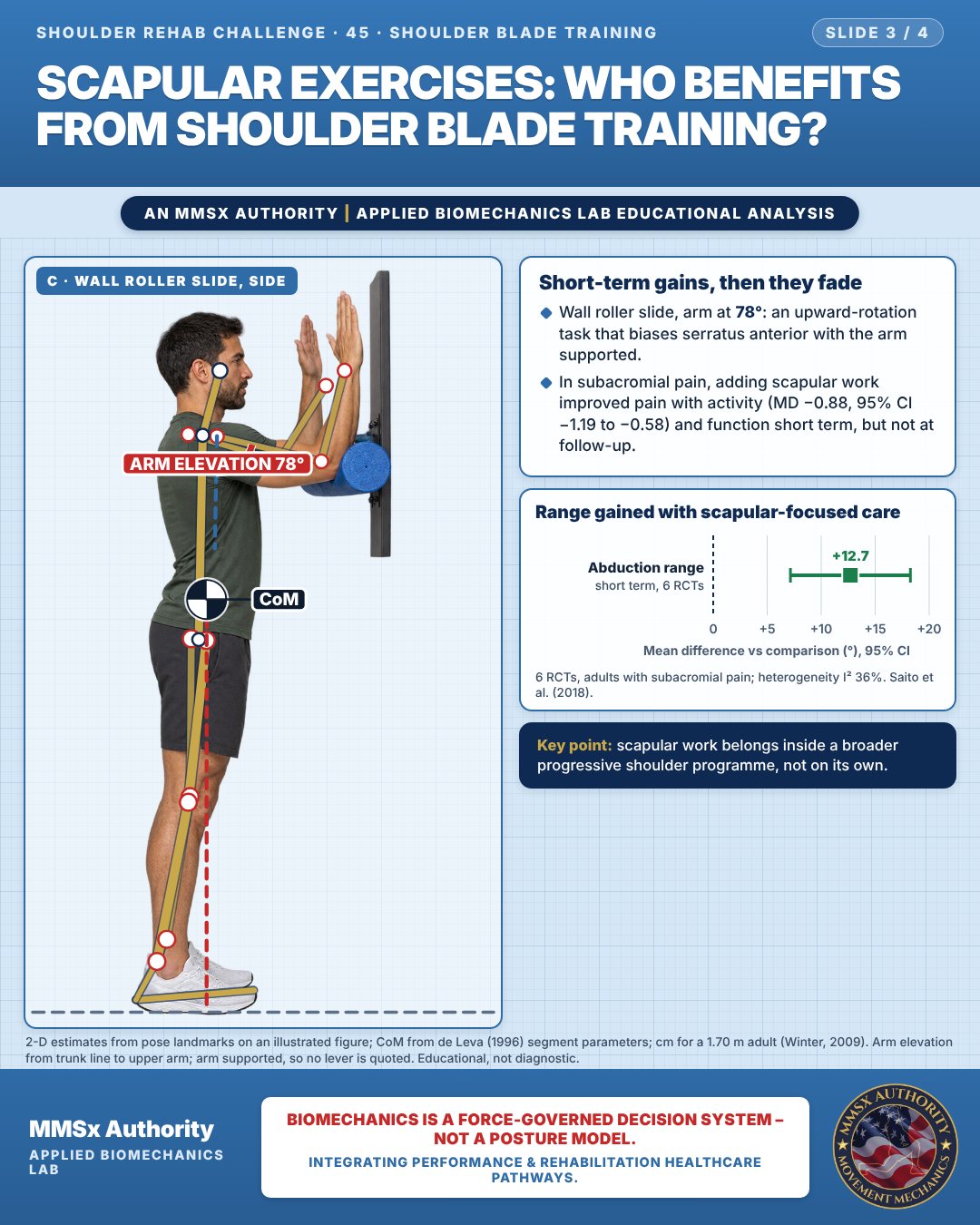
Short-term gains, then they fade
Wall roller slide, arm at 78°: an upward-rotation task that biases serratus anterior with the arm supported.
In subacromial pain, adding scapular work improved pain with activity (MD −0.88, 95% CI −1.19 to −0.58) and function short term, but not at follow-up.
Range gained with scapular-focused care
Decision pathway
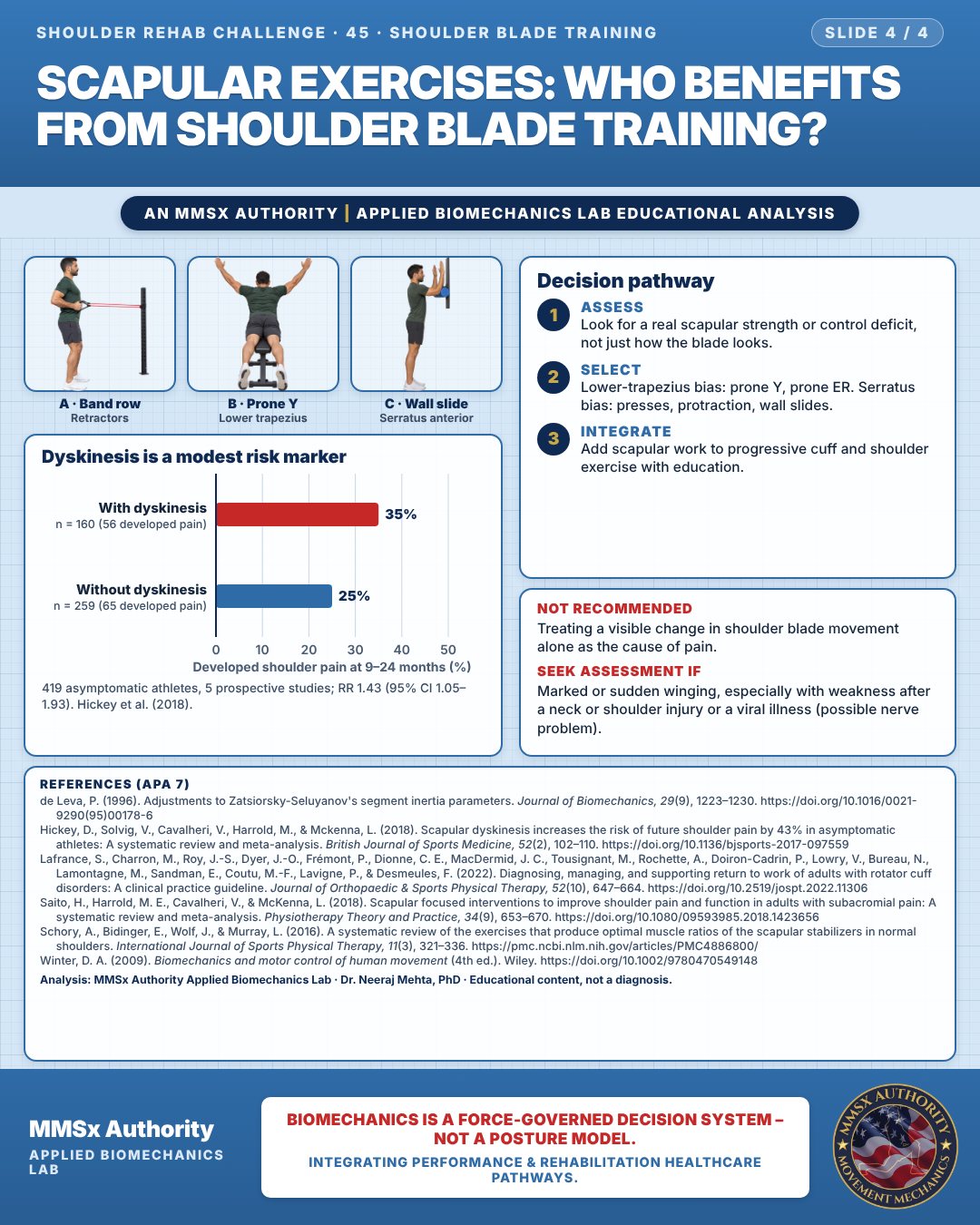
Dyskinesis is a modest risk marker
Assess
Look for a real scapular strength or control deficit, not just how the blade looks.
Select
Lower-trapezius bias: prone Y, prone ER. Serratus bias: presses, protraction, wall slides.
Integrate
Add scapular work to progressive cuff and shoulder exercise with education.
What the evidence supports
- Recommended: an active, task-oriented rehabilitation programme (exercise and education) for rotator cuff/subacromial disorders (Lafrance et al., 2022); scapular-focused exercises can be included where scapular control or strength deficits are found, with short-term benefit (Saito et al., 2018).
- Not supported: treating a visible dyskinesis alone as the cause of pain (Hickey et al., 2018 shows a modest risk association only).
Myth and evidence
Myth“If your shoulder blade moves differently, it is the cause of your pain and must be fixed.”
EvidenceIn asymptomatic athletes, 25% without dyskinesis also developed pain and 65% with dyskinesis did not (Hickey et al., 2018). Scapular training helps in the short term as part of a programme (Saito et al., 2018).
Cautions
Not recommended
Treating a visible change in shoulder blade movement alone as the cause of pain.
Seek assessment if
Marked or sudden winging, especially with weakness after a neck or shoulder injury or a viral illness (possible nerve problem).
Methods note
2-D estimates from pose landmarks on an illustrated figure; CoM from de Leva (1996) segment parameters; cm for a 1.70 m adult (Winter, 2009). Arm elevation from trunk line to upper arm; elbow angle between upper arm and forearm. Arm elevation from trunk line to upper arm in the rear view; prone pose, angle approximate. Arm elevation from trunk line to upper arm; arm supported, so no lever is quoted. These are educational estimates, not a diagnosis.
References
- de Leva, P. (1996). Adjustments to Zatsiorsky-Seluyanov's segment inertia parameters. Journal of Biomechanics, 29(9), 1223–1230. https://doi.org/10.1016/0021-9290(95)00178-6
- Hickey, D., Solvig, V., Cavalheri, V., Harrold, M., & Mckenna, L. (2018). Scapular dyskinesis increases the risk of future shoulder pain by 43% in asymptomatic athletes: A systematic review and meta-analysis. British Journal of Sports Medicine, 52(2), 102–110. https://doi.org/10.1136/bjsports-2017-097559
- Lafrance, S., Charron, M., Roy, J.-S., Dyer, J.-O., Frémont, P., Dionne, C. E., MacDermid, J. C., Tousignant, M., Rochette, A., Doiron-Cadrin, P., Lowry, V., Bureau, N., Lamontagne, M., Sandman, E., Coutu, M.-F., Lavigne, P., & Desmeules, F. (2022). Diagnosing, managing, and supporting return to work of adults with rotator cuff disorders: A clinical practice guideline. Journal of Orthopaedic & Sports Physical Therapy, 52(10), 647–664. https://doi.org/10.2519/jospt.2022.11306
- Saito, H., Harrold, M. E., Cavalheri, V., & McKenna, L. (2018). Scapular focused interventions to improve shoulder pain and function in adults with subacromial pain: A systematic review and meta-analysis. Physiotherapy Theory and Practice, 34(9), 653–670. https://doi.org/10.1080/09593985.2018.1423656
- Schory, A., Bidinger, E., Wolf, J., & Murray, L. (2016). A systematic review of the exercises that produce optimal muscle ratios of the scapular stabilizers in normal shoulders. International Journal of Sports Physical Therapy, 11(3), 321–336. https://pmc.ncbi.nlm.nih.gov/articles/PMC4886800/
- Winter, D. A. (2009). Biomechanics and motor control of human movement (4th ed.). Wiley. https://doi.org/10.1002/9780470549148
Cite this article
Mehta, N. (2026, October 24). Scapular exercises: who benefits from shoulder blade training? MMSx Authority Applied Biomechanics Lab. https://mmsxauthority.org/edu/analysis/shoulder/45-scapular-exercises-who-benefits-from-shoulder-blade-training/
Part of the collection
Mehta, N. (2026). Shoulder Rehabilitation: 50 Evidence-Based Biomechanics Analyses [Collection]. MMSx Authority Applied Biomechanics Lab. Zenodo. https://doi.org/10.5281/zenodo.23735725
All Shoulder Rehab Challenge articles · Rehabilitation Library