Shoulder Rehab Challenge · 44
External rotation strength: why the cuff's weakest direction matters
External rotation (ER) strength is the torque the posterior rotator cuff (chiefly infraspinatus and teres minor, with posterior deltoid assistance)…
Key points
- Measure. Test ER strength directly, e.g. a handheld dynamometer against the other side.
- Load. Start side-lying or at the side, then progress towards 90° as part of active rehabilitation.
- Recheck. Retest strength; an improving questionnaire score does not prove strength has returned.
What it is
External rotation (ER) strength is the torque the posterior rotator cuff (chiefly infraspinatus and teres minor, with posterior deltoid assistance) can produce to turn the humerus outward. In healthy adults it is consistently lower than internal rotation strength, and it is often the most reduced direction in people with subacromial shoulder pain.
How we analysed the movement
Three movements relevant to this topic were analysed from illustrated reference figures. Joint centres were located with two-dimensional pose estimation; arm elevation and elbow angles, shoulder level, the whole-body centre of mass and, where relevant, the arm lever (the horizontal distance from the shoulder joint to the centre of mass of the arm, with any hand load) and the resulting shoulder moment were then calculated from standard segment parameters. The figures are educational estimates that show how position changes mechanical demand; they are not measurements of a patient. Every research value quoted below comes from the published source cited beside it.
Movement A: Side-lying er (front view)
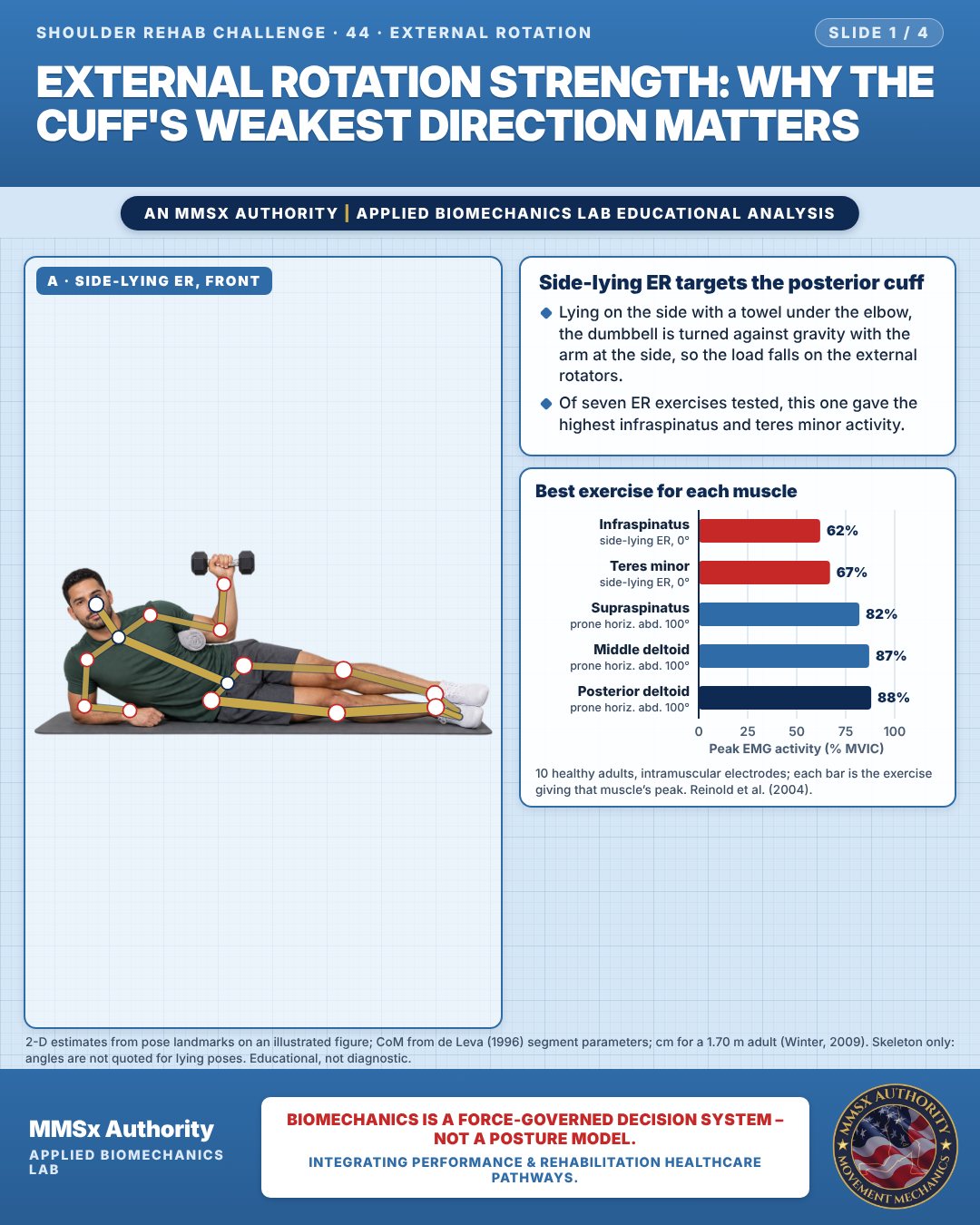
Side-lying ER targets the posterior cuff
Lying on the side with a towel under the elbow, the dumbbell is turned against gravity with the arm at the side, so the load falls on the external rotators.
Of seven ER exercises tested, this one gave the highest infraspinatus and teres minor activity.
Best exercise for each muscle
Movement B: Band er at side (front view)
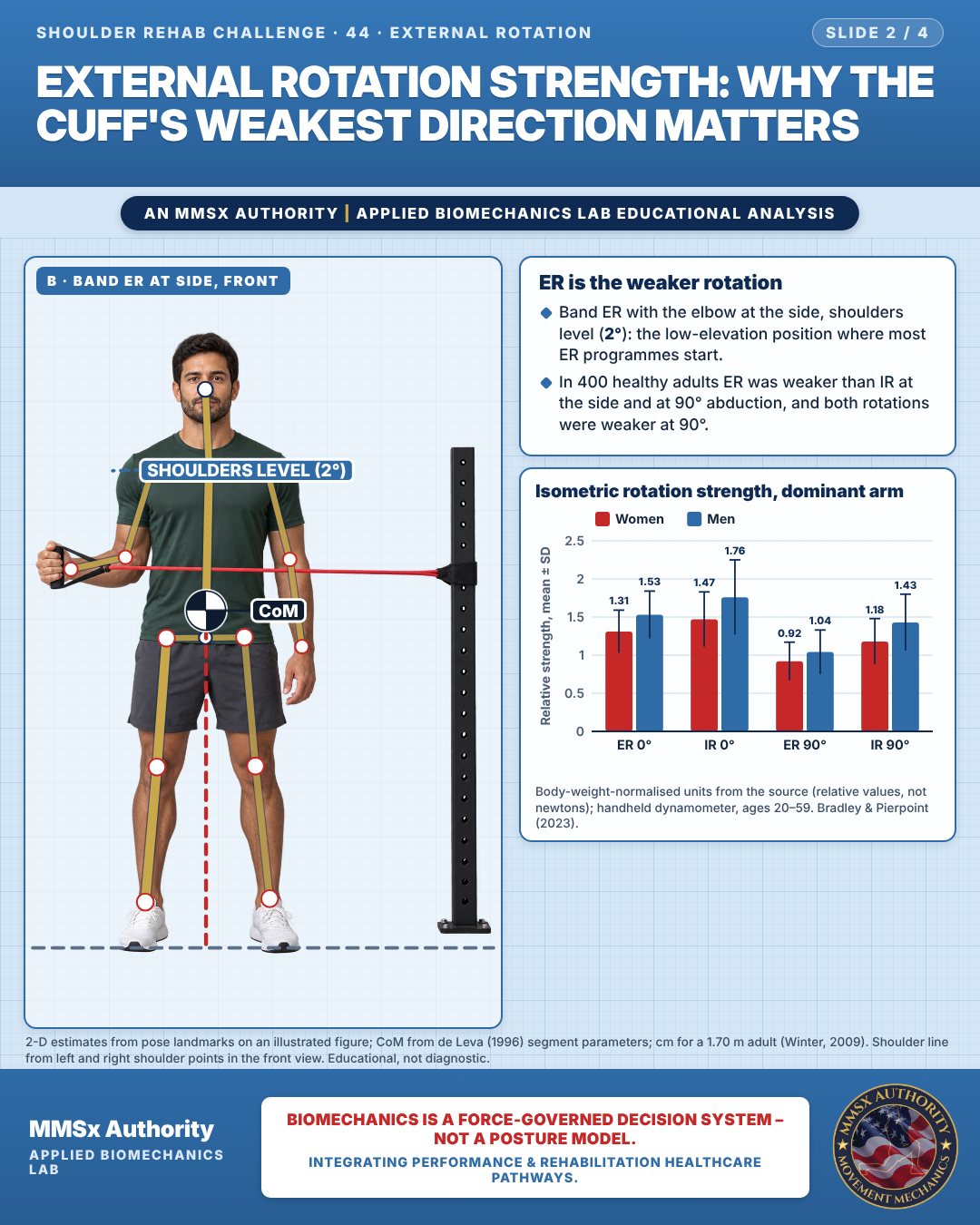
ER is the weaker rotation
Band ER with the elbow at the side, shoulders level (2°): the low-elevation position where most ER programmes start.
In 400 healthy adults ER was weaker than IR at the side and at 90° abduction, and both rotations were weaker at 90°.
Isometric rotation strength, dominant arm
Movement C: Band er at 90° (front view)
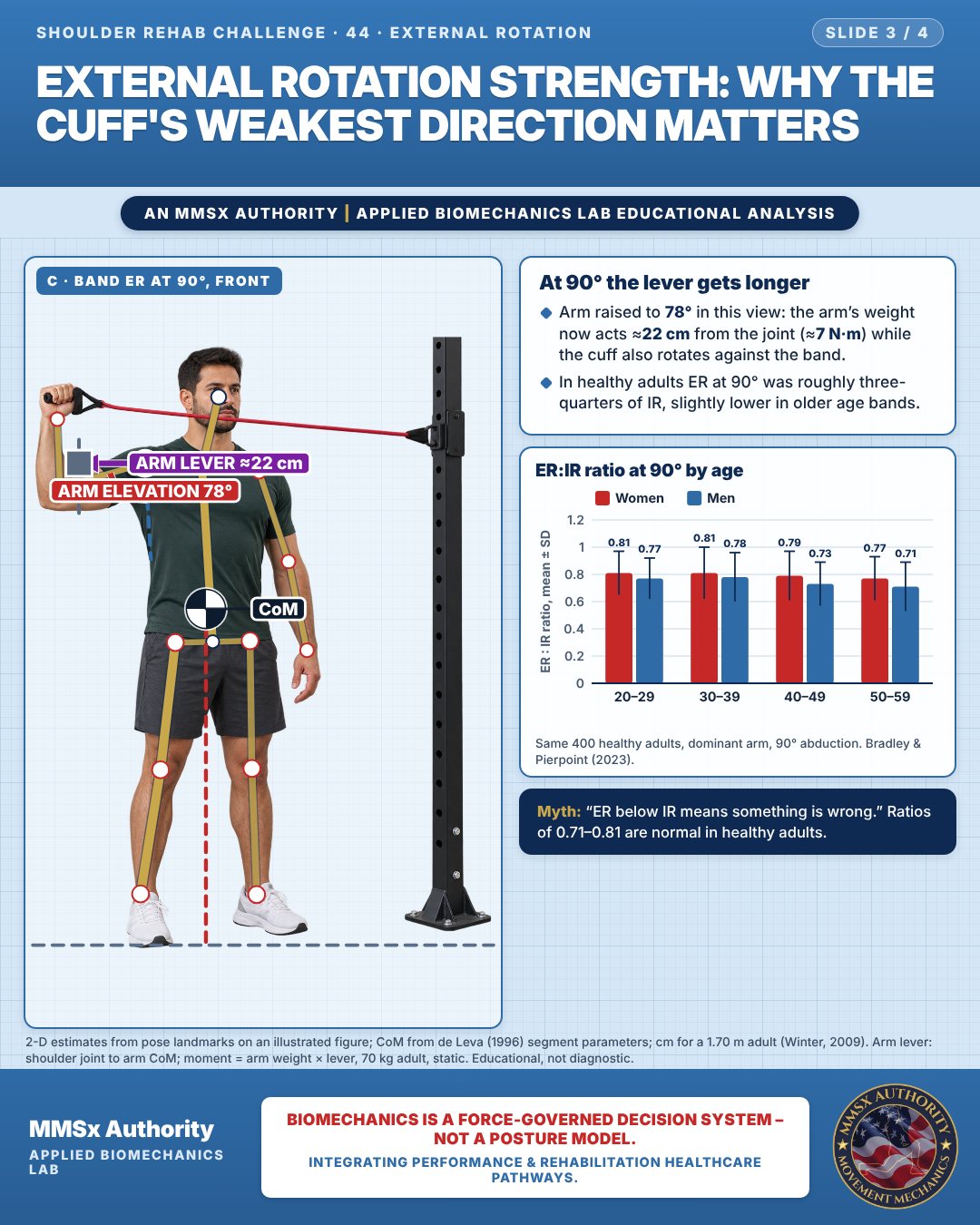
At 90° the lever gets longer
Arm raised to 78° in this view: the arm’s weight now acts ≈22 cm from the joint (≈7 N·m) while the cuff also rotates against the band.
In healthy adults ER at 90° was roughly three-quarters of IR, slightly lower in older age bands.
ER:IR ratio at 90° by age
Decision pathway
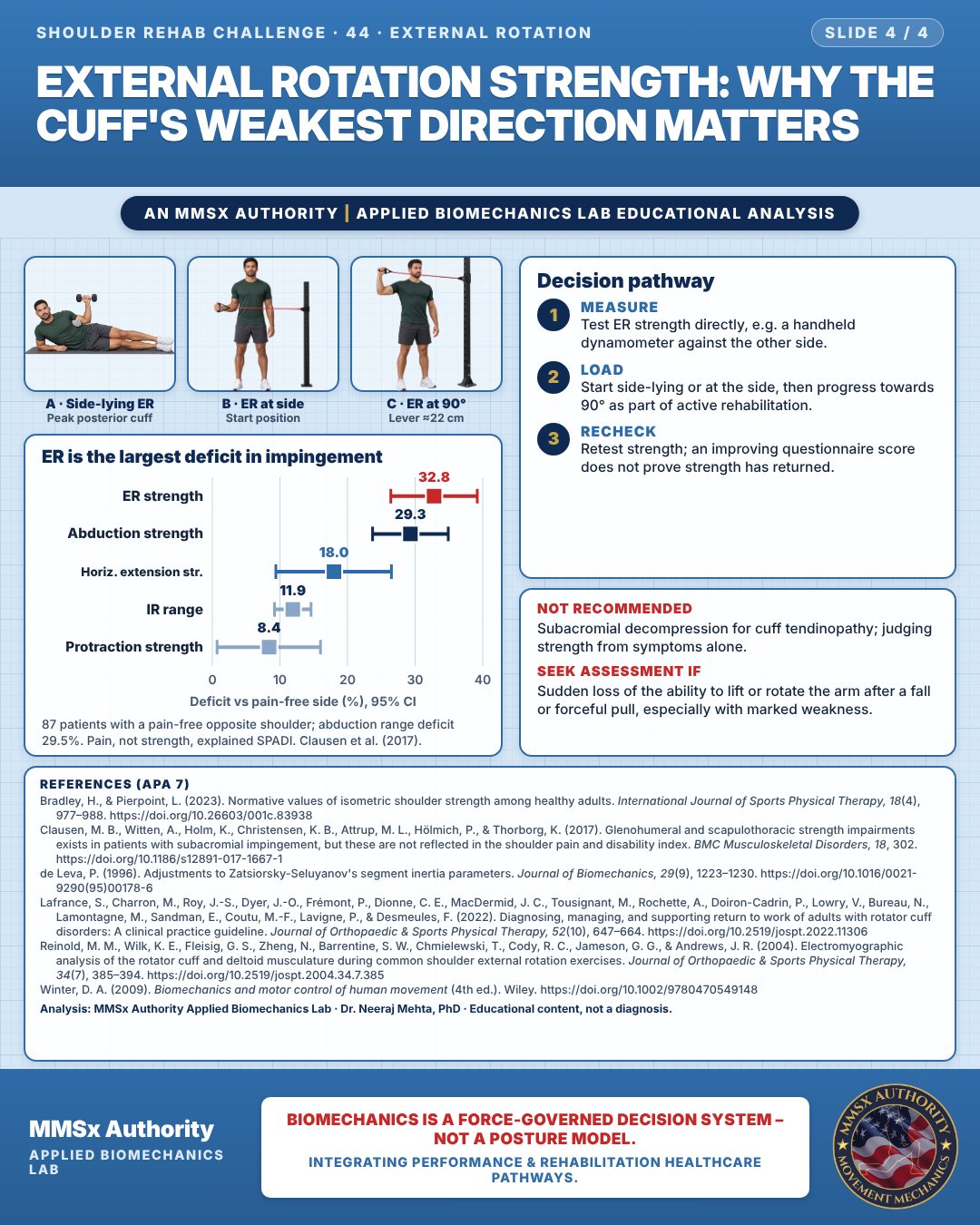
ER is the largest deficit in impingement
Measure
Test ER strength directly, e.g. a handheld dynamometer against the other side.
Load
Start side-lying or at the side, then progress towards 90° as part of active rehabilitation.
Recheck
Retest strength; an improving questionnaire score does not prove strength has returned.
What the evidence supports
- Short-term pain relief: paracetamol (acetaminophen), NSAIDs and injection therapies "may be useful" in the short term (Lafrance et al., 2022).
- Not recommended: subacromial decompression for rotator cuff tendinopathy (Lafrance et al., 2022).
- Imaging only in select circumstances (Lafrance et al., 2022).
- Measure ER strength directly (e.g. handheld dynamometer, compared with the other side), because questionnaires track pain more than strength (Clausen et al., 2017).
Myth and evidence
Myth“If my questionnaire score is improving, my strength must be back.”
EvidenceIn subacromial pain, SPADI was explained by pain (R² 23.4–31.6%) but not by strength or range, despite a 32.8% ER deficit (Clausen et al., 2017). Strength needs its own test.
Myth“ER below IR means something is wrong.”
EvidenceHealthy adults have ER:IR ratios of about 0.71–0.81 at 90° abduction (Bradley & Pierpoint, 2023).
Cautions
Not recommended
Subacromial decompression for cuff tendinopathy; judging strength from symptoms alone.
Seek assessment if
Sudden loss of the ability to lift or rotate the arm after a fall or forceful pull, especially with marked weakness.
Methods note
2-D estimates from pose landmarks on an illustrated figure; CoM from de Leva (1996) segment parameters; cm for a 1.70 m adult (Winter, 2009). Skeleton only: angles are not quoted for lying poses. Shoulder line from left and right shoulder points in the front view. Arm lever: shoulder joint to arm CoM; moment = arm weight × lever, 70 kg adult, static. These are educational estimates, not a diagnosis.
References
- Bradley, H., & Pierpoint, L. (2023). Normative values of isometric shoulder strength among healthy adults. International Journal of Sports Physical Therapy, 18(4), 977–988. https://doi.org/10.26603/001c.83938
- Clausen, M. B., Witten, A., Holm, K., Christensen, K. B., Attrup, M. L., Hölmich, P., & Thorborg, K. (2017). Glenohumeral and scapulothoracic strength impairments exists in patients with subacromial impingement, but these are not reflected in the shoulder pain and disability index. BMC Musculoskeletal Disorders, 18, 302. https://doi.org/10.1186/s12891-017-1667-1
- de Leva, P. (1996). Adjustments to Zatsiorsky-Seluyanov's segment inertia parameters. Journal of Biomechanics, 29(9), 1223–1230. https://doi.org/10.1016/0021-9290(95)00178-6
- Lafrance, S., Charron, M., Roy, J.-S., Dyer, J.-O., Frémont, P., Dionne, C. E., MacDermid, J. C., Tousignant, M., Rochette, A., Doiron-Cadrin, P., Lowry, V., Bureau, N., Lamontagne, M., Sandman, E., Coutu, M.-F., Lavigne, P., & Desmeules, F. (2022). Diagnosing, managing, and supporting return to work of adults with rotator cuff disorders: A clinical practice guideline. Journal of Orthopaedic & Sports Physical Therapy, 52(10), 647–664. https://doi.org/10.2519/jospt.2022.11306
- Reinold, M. M., Wilk, K. E., Fleisig, G. S., Zheng, N., Barrentine, S. W., Chmielewski, T., Cody, R. C., Jameson, G. G., & Andrews, J. R. (2004). Electromyographic analysis of the rotator cuff and deltoid musculature during common shoulder external rotation exercises. Journal of Orthopaedic & Sports Physical Therapy, 34(7), 385–394. https://doi.org/10.2519/jospt.2004.34.7.385
- Winter, D. A. (2009). Biomechanics and motor control of human movement (4th ed.). Wiley. https://doi.org/10.1002/9780470549148
Cite this article
Mehta, N. (2026, October 24). External rotation strength: why the cuff's weakest direction matters. MMSx Authority Applied Biomechanics Lab. https://mmsxauthority.org/edu/analysis/shoulder/44-external-rotation-strength-why-the-cuffs-weakest-direction-matters/
Part of the collection
Mehta, N. (2026). Shoulder Rehabilitation: 50 Evidence-Based Biomechanics Analyses [Collection]. MMSx Authority Applied Biomechanics Lab. Zenodo. https://doi.org/10.5281/zenodo.23735725
All Shoulder Rehab Challenge articles · Rehabilitation Library