Shoulder Rehab Challenge · 43
Shoulder pain in menopause: frozen shoulder risk and staying active
Frozen shoulder (adhesive capsulitis) is a painful, progressive loss of both active and passive glenohumeral movement, especially external rotation,…
Key points
- Explain. Describe the natural course of 1–2 years (Grade B) and check for diabetes and thyroid disease.
- Stretch. Stretch within tolerable pain, matched to irritability (Grade B); keep the rest of the body strong.
- Relieve. A corticosteroid injection eases pain and function for 4–6 weeks (Grade A); mobilisation may help (Grade C).
What it is
Frozen shoulder (adhesive capsulitis) is a painful, progressive loss of both active and passive glenohumeral movement, especially external rotation, caused by thickening and contracture of the joint capsule. It occurs most often between 40 and 65 years of age, an age band that overlaps the menopausal transition. A link with falling oestrogen has been proposed but is not yet established.
How we analysed the movement
Three movements relevant to this topic were analysed from illustrated reference figures. Joint centres were located with two-dimensional pose estimation; arm elevation and elbow angles, shoulder level, the whole-body centre of mass and, where relevant, the arm lever (the horizontal distance from the shoulder joint to the centre of mass of the arm, with any hand load) and the resulting shoulder moment were then calculated from standard segment parameters. The figures are educational estimates that show how position changes mechanical demand; they are not measurements of a patient. Every research value quoted below comes from the published source cited beside it.
Movement A: Overhead reach (front view)
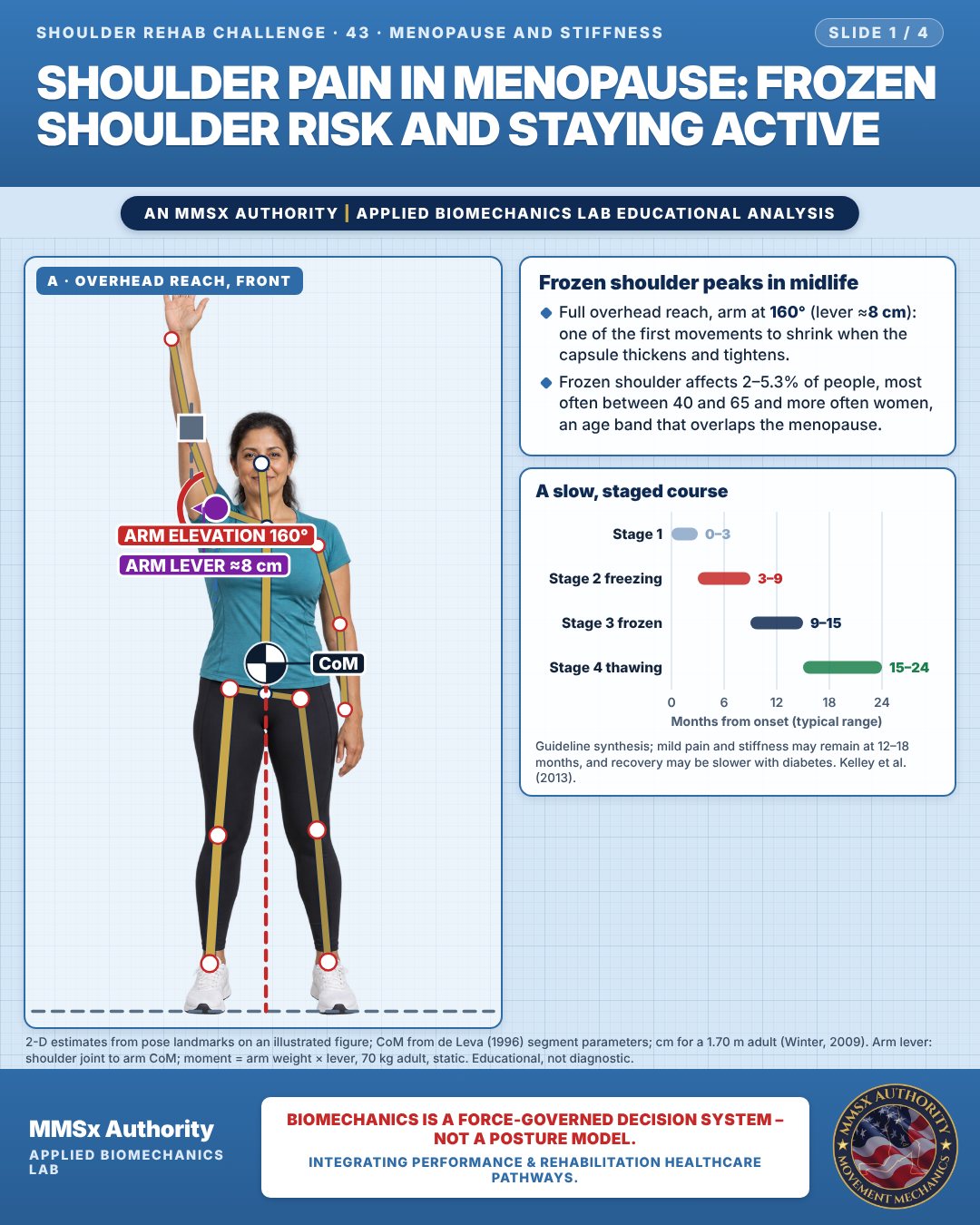
Frozen shoulder peaks in midlife
Full overhead reach, arm at 160° (lever ≈8 cm): one of the first movements to shrink when the capsule thickens and tightens.
Frozen shoulder affects 2–5.3% of people, most often between 40 and 65 and more often women, an age band that overlaps the menopause.
A slow, staged course
Movement B: Hand behind back (rear view)
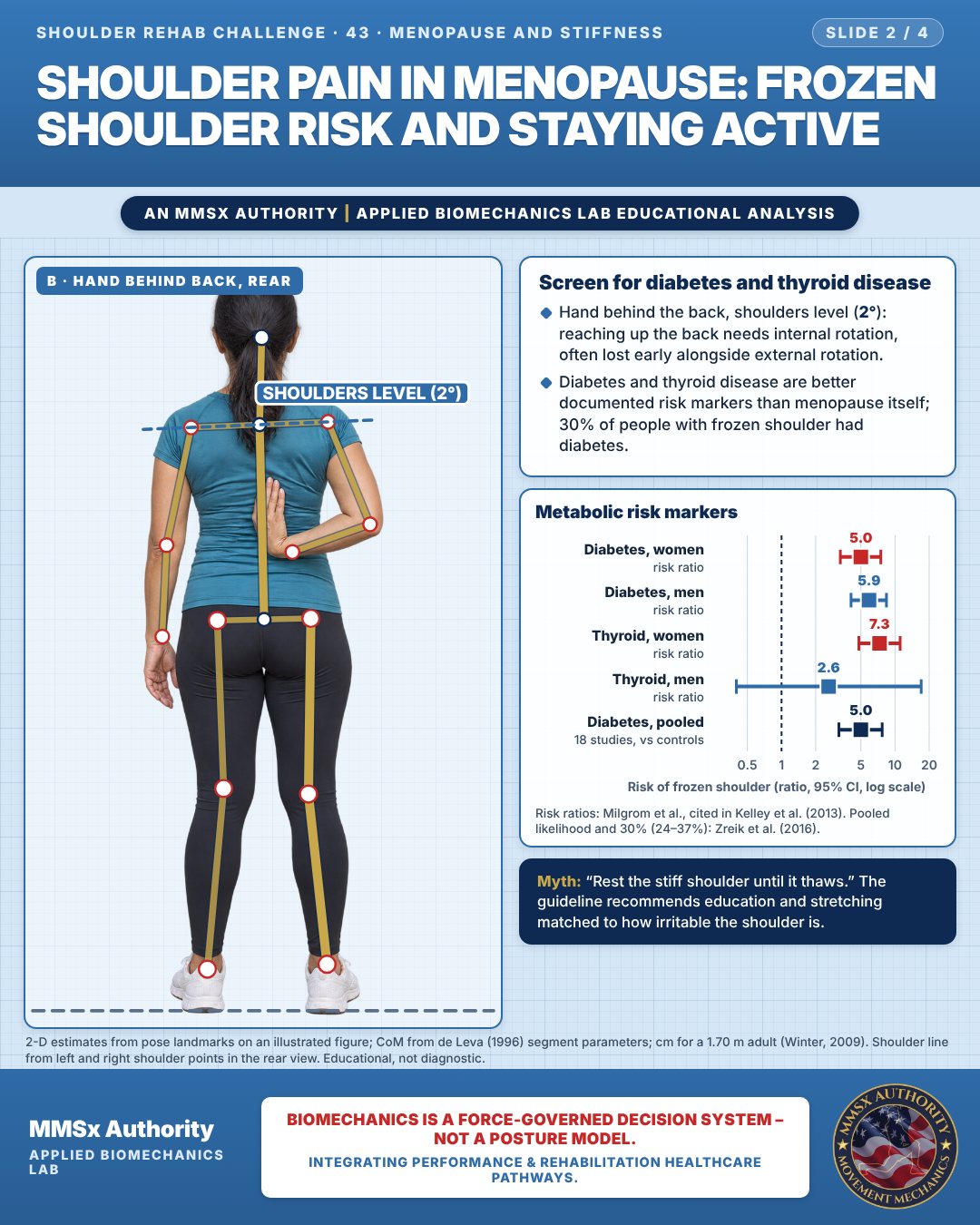
Screen for diabetes and thyroid disease
Hand behind the back, shoulders level (2°): reaching up the back needs internal rotation, often lost early alongside external rotation.
Diabetes and thyroid disease are better documented risk markers than menopause itself; 30% of people with frozen shoulder had diabetes.
Metabolic risk markers
Movement C: One-arm row (side view)
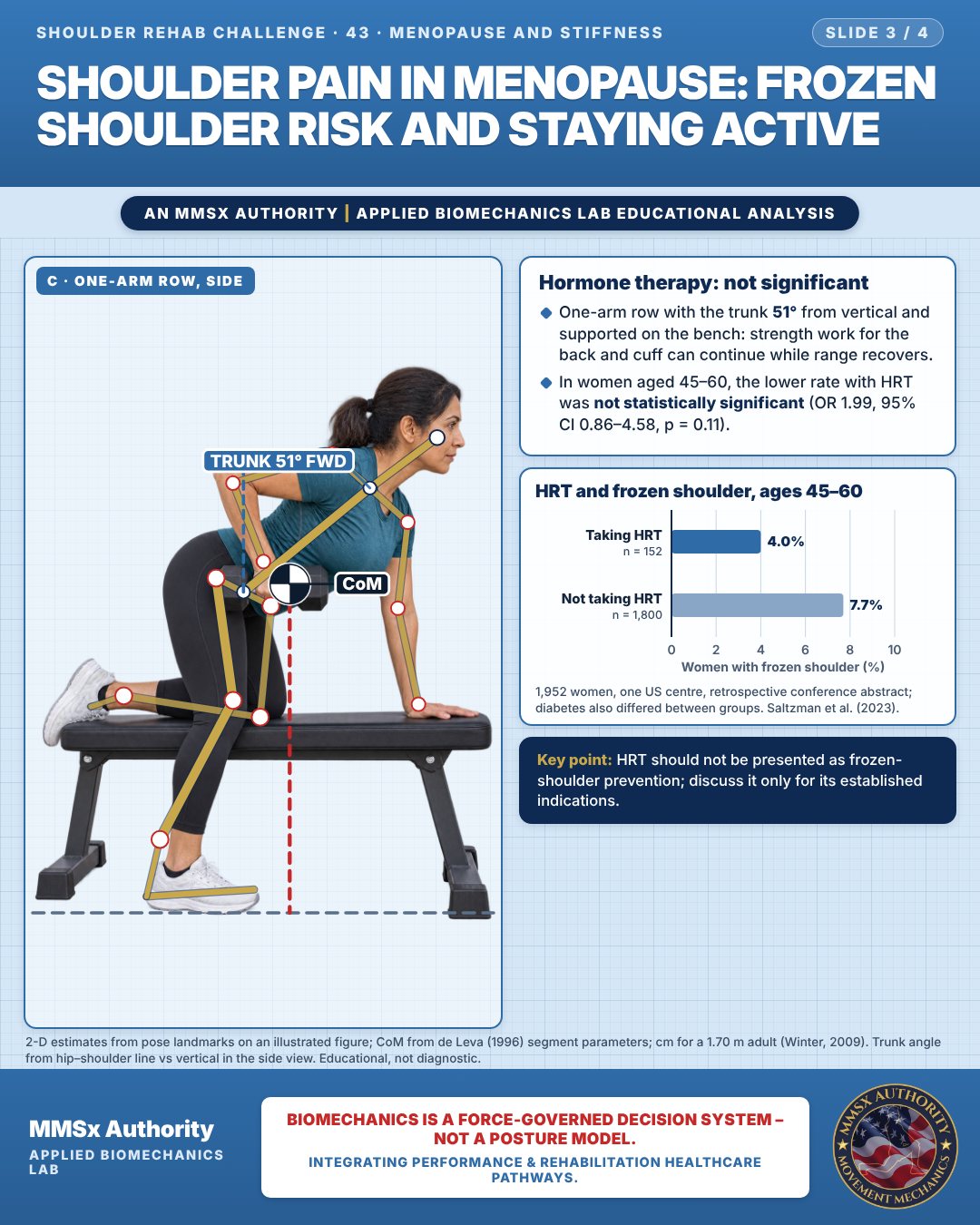
Hormone therapy: not significant
One-arm row with the trunk 51° from vertical and supported on the bench: strength work for the back and cuff can continue while range recovers.
In women aged 45–60, the lower rate with HRT was not statistically significant (OR 1.99, 95% CI 0.86–4.58, p = 0.11).
HRT and frozen shoulder, ages 45–60
Decision pathway
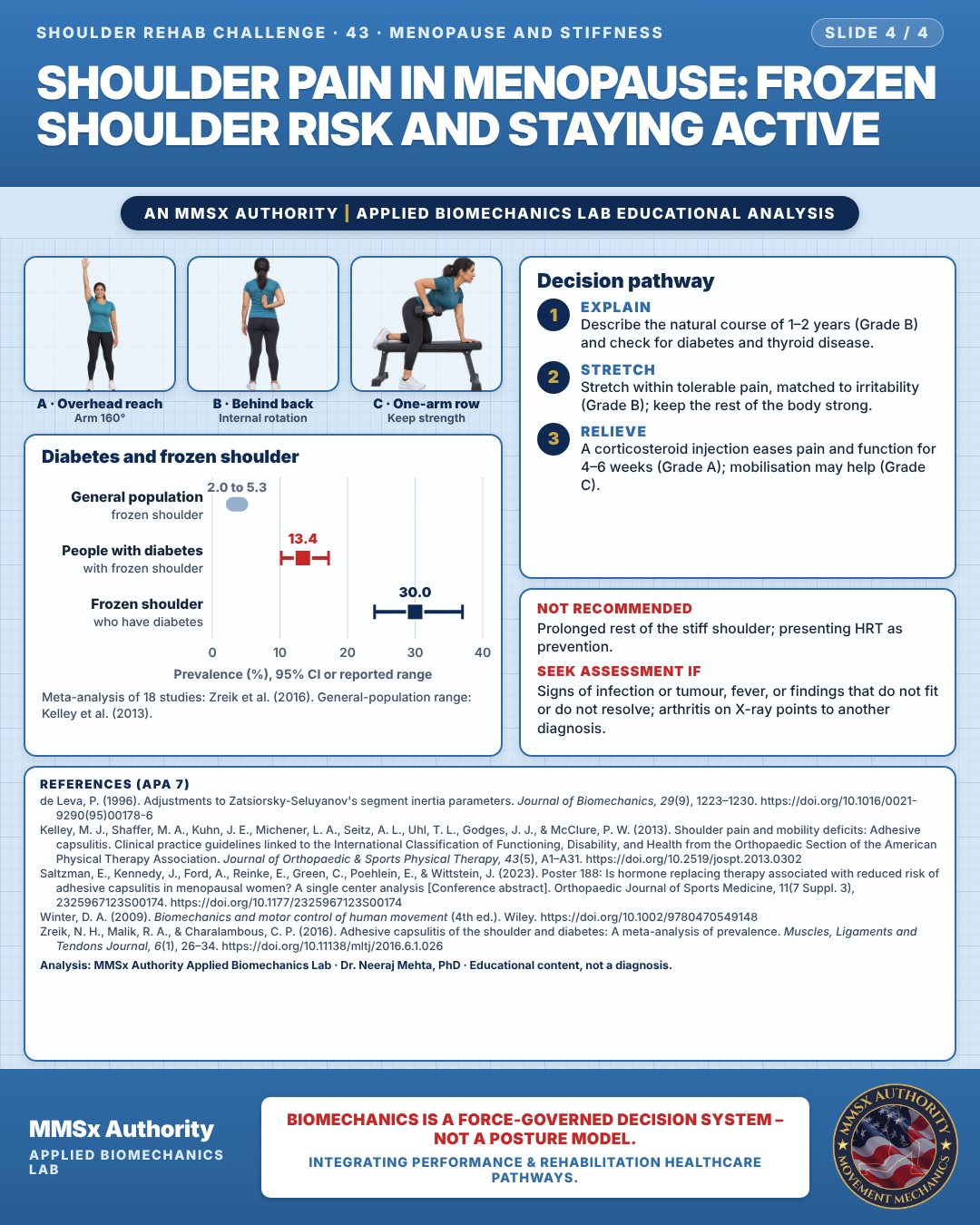
Diabetes and frozen shoulder
Explain
Describe the natural course of 1–2 years (Grade B) and check for diabetes and thyroid disease.
Stretch
Stretch within tolerable pain, matched to irritability (Grade B); keep the rest of the body strong.
Relieve
A corticosteroid injection eases pain and function for 4–6 weeks (Grade A); mobilisation may help (Grade C).
What the evidence supports
- Recommended (Kelley et al., 2013): explain the natural course (Grade B); stretching exercises, with intensity matched to how irritable the shoulder is (Grade B); corticosteroid injection for short-term pain relief and function (Grade A); joint mobilisation may be used (Grade C).
- Menopause-specific: check for diabetes and thyroid disease, which are documented risk factors; discuss HRT only within its established indications — current shoulder evidence is exploratory (Saltzman et al., 2023).
Myth and evidence
Myth“Menopause causes frozen shoulder, and HRT prevents it.”
EvidenceThe age and sex overlap is real, but the best available shoulder data show only a non-significant difference (OR 1.99, CI 0.86–4.58) (Saltzman et al., 2023). Diabetes (about 5 times the likelihood) and thyroid disease are better-supported risk factors (Zreik et al., 2016; Kelley et al., 2013).
Myth“Rest the stiff shoulder until it thaws.”
EvidenceThe guideline recommends education and stretching exercises (Kelley et al., 2013).
Cautions
Not recommended
Prolonged rest of the stiff shoulder; presenting HRT as prevention.
Seek assessment if
Signs of infection or tumour, fever, or findings that do not fit or do not resolve; arthritis on X-ray points to another diagnosis.
Methods note
2-D estimates from pose landmarks on an illustrated figure; CoM from de Leva (1996) segment parameters; cm for a 1.70 m adult (Winter, 2009). Arm lever: shoulder joint to arm CoM; moment = arm weight × lever, 70 kg adult, static. Shoulder line from left and right shoulder points in the rear view. Trunk angle from hip–shoulder line vs vertical in the side view. These are educational estimates, not a diagnosis.
References
- de Leva, P. (1996). Adjustments to Zatsiorsky-Seluyanov's segment inertia parameters. Journal of Biomechanics, 29(9), 1223–1230. https://doi.org/10.1016/0021-9290(95)00178-6
- Kelley, M. J., Shaffer, M. A., Kuhn, J. E., Michener, L. A., Seitz, A. L., Uhl, T. L., Godges, J. J., & McClure, P. W. (2013). Shoulder pain and mobility deficits: Adhesive capsulitis. Clinical practice guidelines linked to the International Classification of Functioning, Disability, and Health from the Orthopaedic Section of the American Physical Therapy Association. Journal of Orthopaedic & Sports Physical Therapy, 43(5), A1–A31. https://doi.org/10.2519/jospt.2013.0302
- Saltzman, E., Kennedy, J., Ford, A., Reinke, E., Green, C., Poehlein, E., & Wittstein, J. (2023). Poster 188: Is hormone replacing therapy associated with reduced risk of adhesive capsulitis in menopausal women? A single center analysis [Conference abstract]. Orthopaedic Journal of Sports Medicine, 11(7 Suppl. 3), 2325967123S00174. https://doi.org/10.1177/2325967123S00174
- Winter, D. A. (2009). Biomechanics and motor control of human movement (4th ed.). Wiley. https://doi.org/10.1002/9780470549148
- Zreik, N. H., Malik, R. A., & Charalambous, C. P. (2016). Adhesive capsulitis of the shoulder and diabetes: A meta-analysis of prevalence. Muscles, Ligaments and Tendons Journal, 6(1), 26–34. https://doi.org/10.11138/mltj/2016.6.1.026
Cite this article
Mehta, N. (2026, October 24). Shoulder pain in menopause: frozen shoulder risk and staying active. MMSx Authority Applied Biomechanics Lab. https://mmsxauthority.org/edu/analysis/shoulder/43-shoulder-pain-in-menopause-frozen-shoulder-risk-and-staying-active/
Part of the collection
Mehta, N. (2026). Shoulder Rehabilitation: 50 Evidence-Based Biomechanics Analyses [Collection]. MMSx Authority Applied Biomechanics Lab. Zenodo. https://doi.org/10.5281/zenodo.23735725
All Shoulder Rehab Challenge articles · Rehabilitation Library