Shoulder Rehab Challenge · 42
Shoulder pain after 60: strength, cuff health and independence
After about 50 years of age, full-thickness rotator cuff tears become increasingly common, and many cause no symptoms.
Key points
- Screen. Ask about falls, sudden weakness and general health before starting exercise.
- Strengthen. Progress cuff and shoulder-blade exercise by load and range, including overhead work.
- Function. Practise real tasks such as reaching shelves, hanging washing and rising from a chair.
What it is
After about 50 years of age, full-thickness rotator cuff tears become increasingly common, and many cause no symptoms. In older adults with shoulder pain, the goal is to keep strength and overhead function for independent daily life; a tear seen on a scan is not by itself a reason for surgery.
How we analysed the movement
Three movements relevant to this topic were analysed from illustrated reference figures. Joint centres were located with two-dimensional pose estimation; arm elevation and elbow angles, shoulder level, the whole-body centre of mass and, where relevant, the arm lever (the horizontal distance from the shoulder joint to the centre of mass of the arm, with any hand load) and the resulting shoulder moment were then calculated from standard segment parameters. The figures are educational estimates that show how position changes mechanical demand; they are not measurements of a patient. Every research value quoted below comes from the published source cited beside it.
Movement A: Seated press (side view)
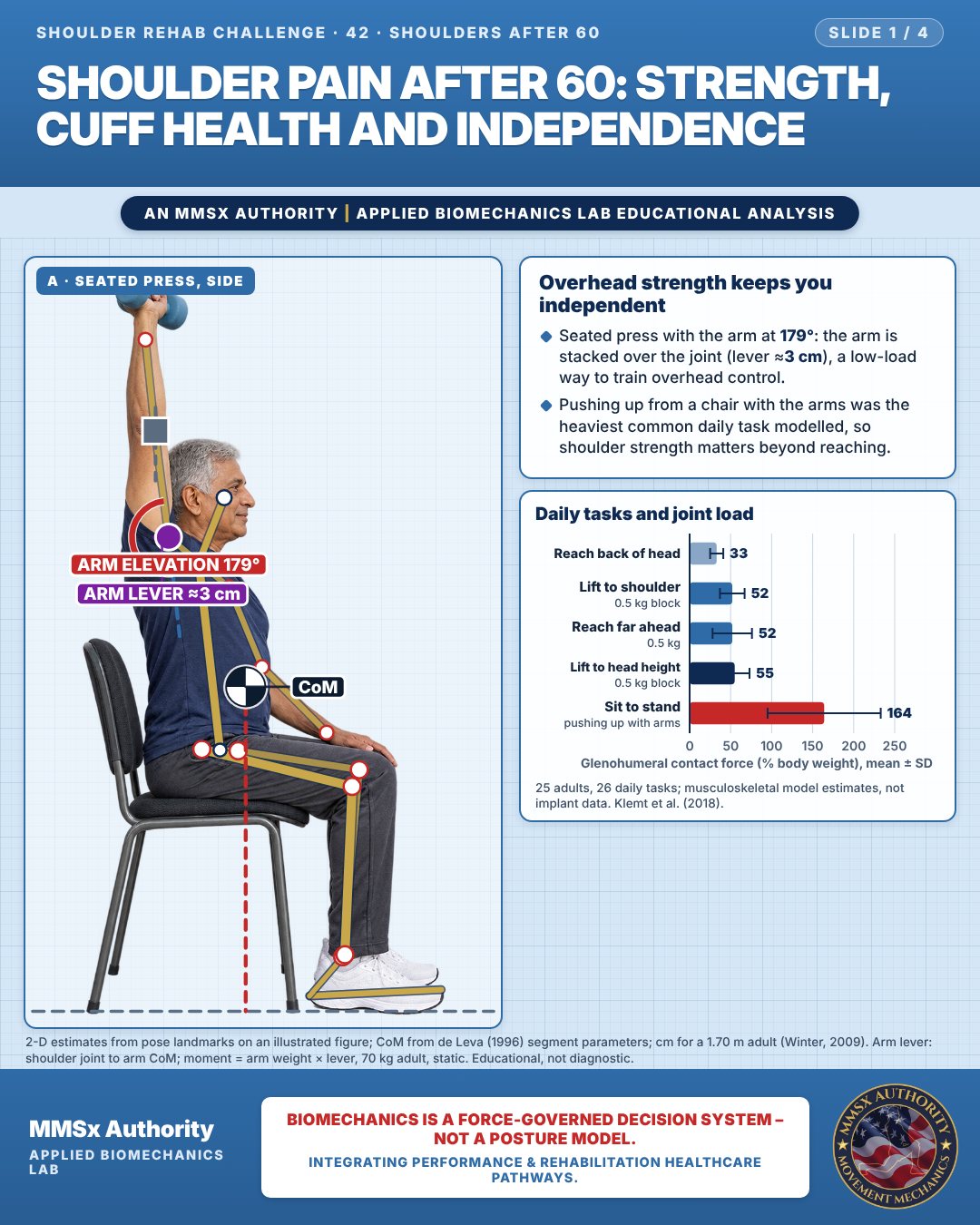
Overhead strength keeps you independent
Seated press with the arm at 179°: the arm is stacked over the joint (lever ≈3 cm), a low-load way to train overhead control.
Pushing up from a chair with the arms was the heaviest common daily task modelled, so shoulder strength matters beyond reaching.
Daily tasks and joint load
Movement B: Hanging washing (side view)
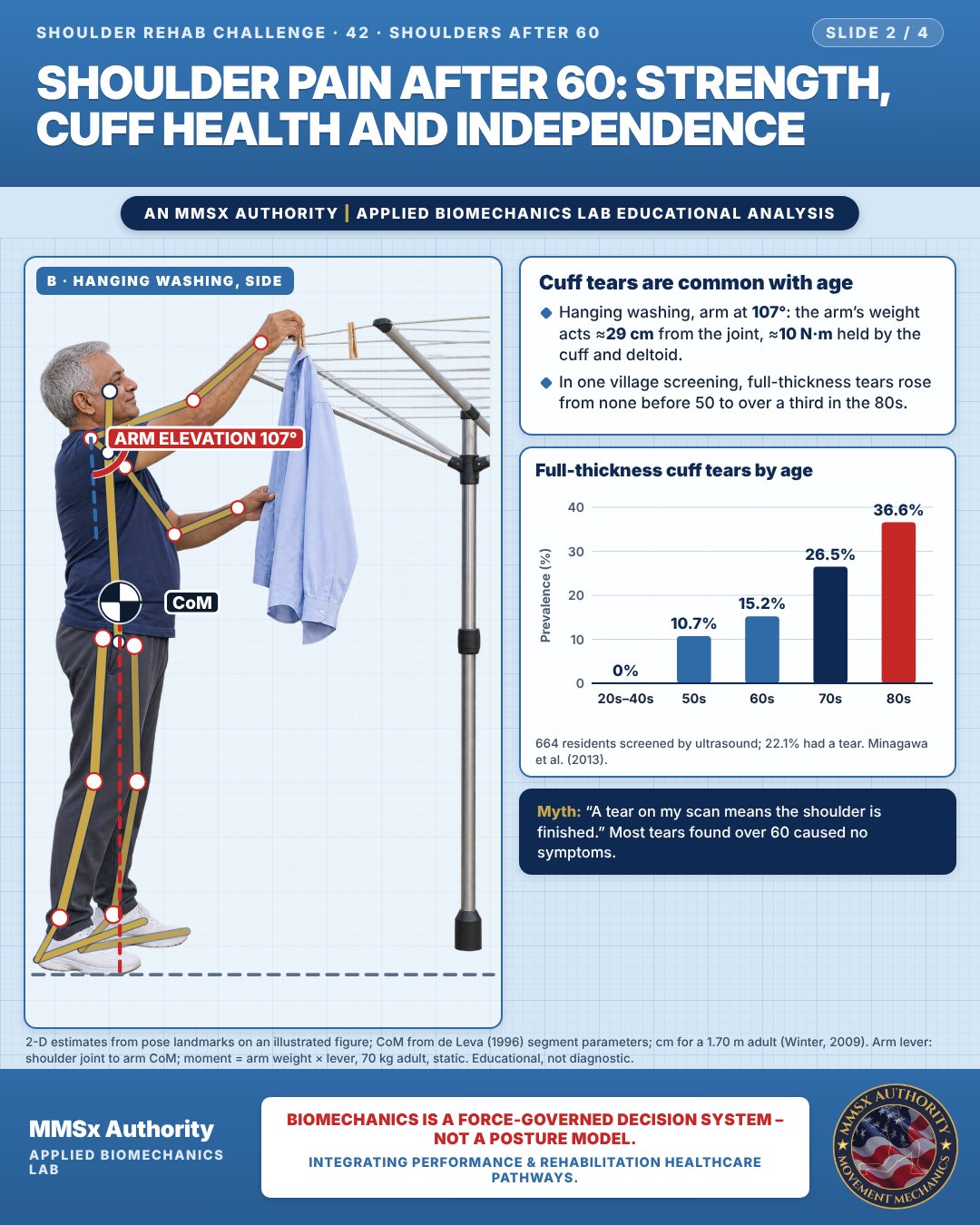
Cuff tears are common with age
Hanging washing, arm at 107°: the arm’s weight acts ≈29 cm from the joint, ≈10 N·m held by the cuff and deltoid.
In one village screening, full-thickness tears rose from none before 50 to over a third in the 80s.
Full-thickness cuff tears by age
Movement C: Band pull-apart (front view)
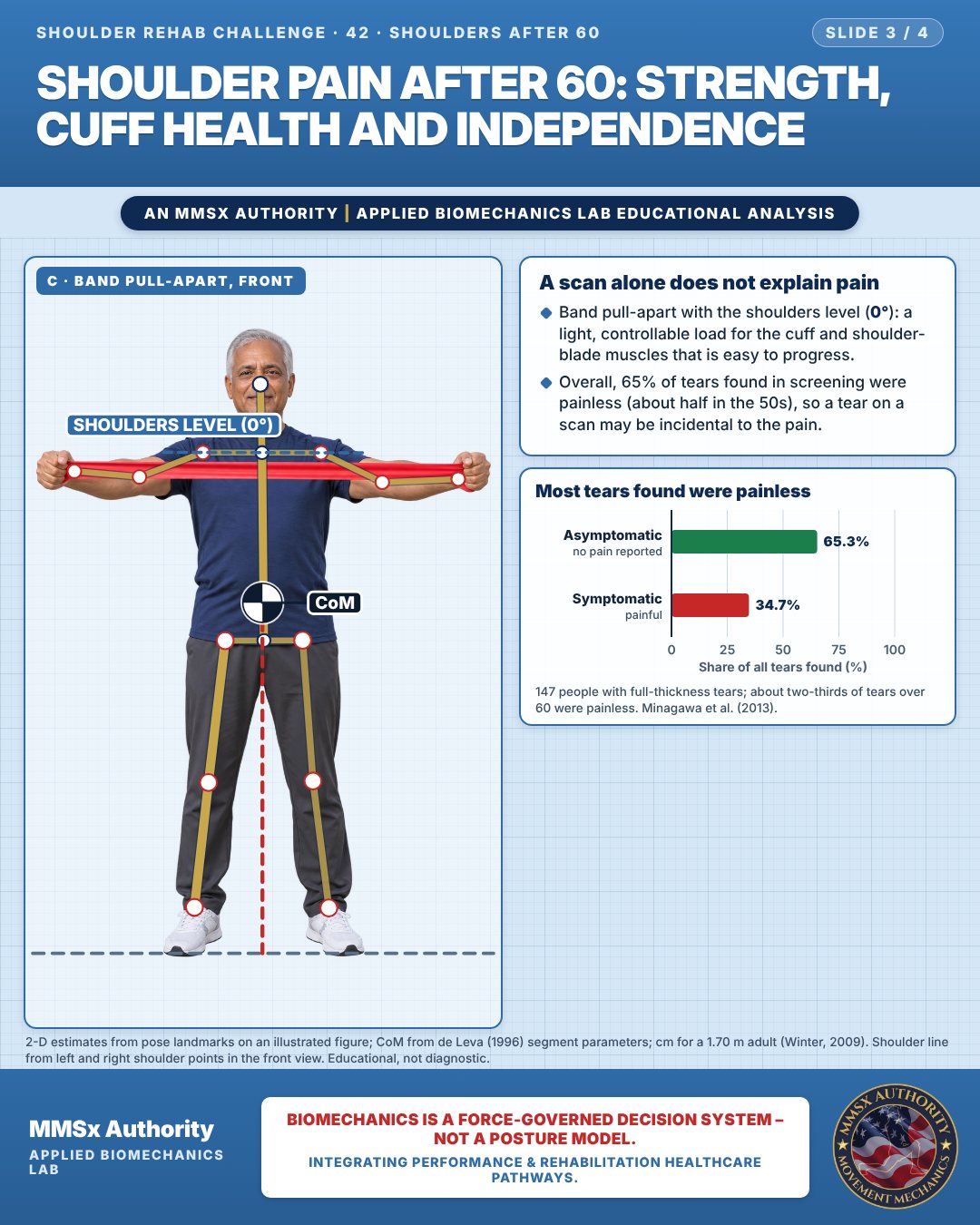
A scan alone does not explain pain
Band pull-apart with the shoulders level (0°): a light, controllable load for the cuff and shoulder-blade muscles that is easy to progress.
Overall, 65% of tears found in screening were painless (about half in the 50s), so a tear on a scan may be incidental to the pain.
Most tears found were painless
Decision pathway
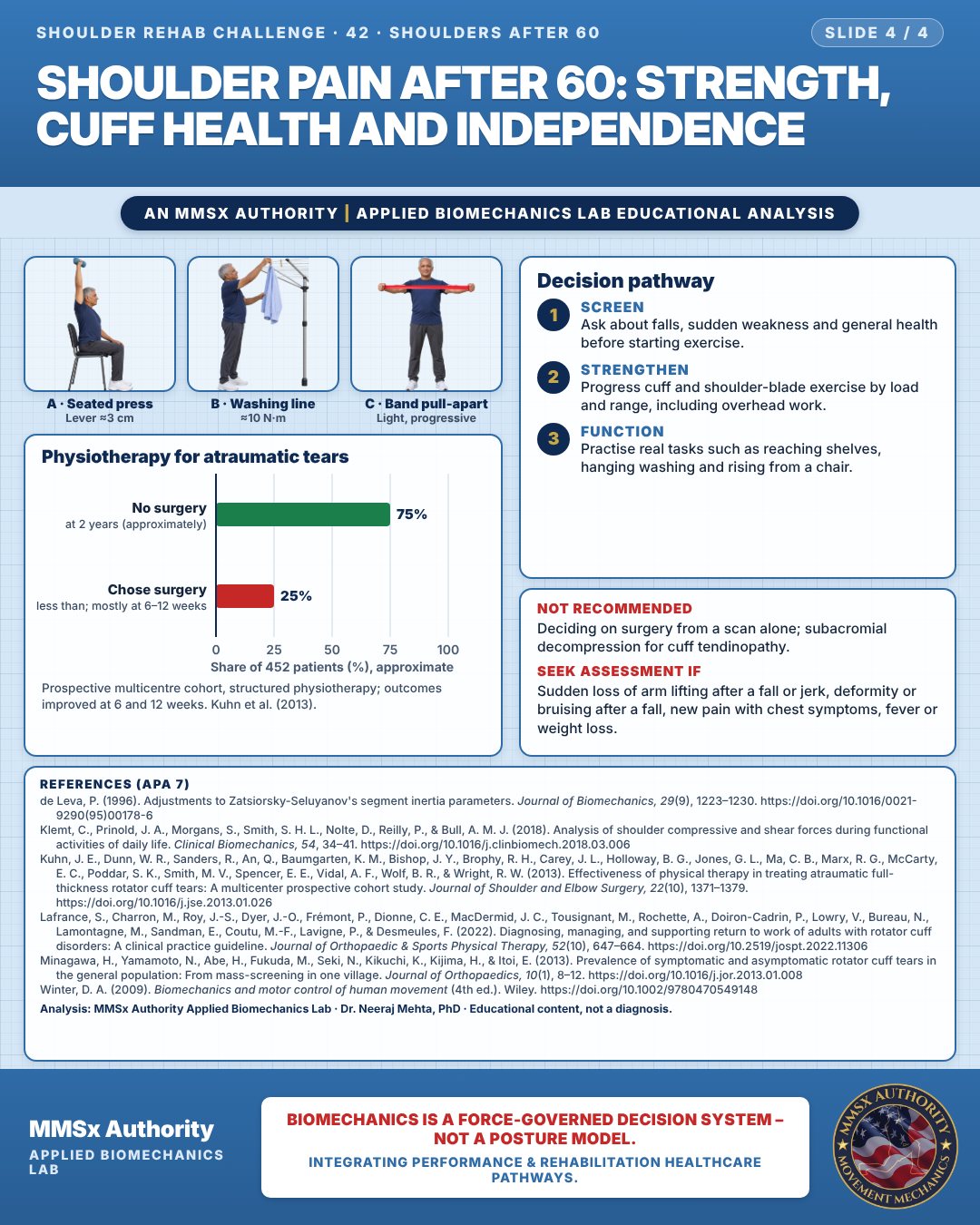
Physiotherapy for atraumatic tears
Screen
Ask about falls, sudden weakness and general health before starting exercise.
Strengthen
Progress cuff and shoulder-blade exercise by load and range, including overhead work.
Function
Practise real tasks such as reaching shelves, hanging washing and rising from a chair.
What the evidence supports
- Recommended: active, task-oriented rehabilitation (exercise and education) for rotator cuff disorders; imaging only in select circumstances; surgery is appropriate for selected patients with full-thickness tears (Lafrance et al., 2022).
- A structured physiotherapy programme was effective for about 75% of atraumatic full-thickness tears at 2 years (Kuhn et al., 2013). Movement A (seated press) and C (band pull-apart) are suitable low-load starting points, progressed by load and range.
- Not recommended: subacromial decompression for rotator cuff tendinopathy (Lafrance et al., 2022).
Myth and evidence
Myth“At my age a cuff tear on the scan means the shoulder is finished, or must be repaired.”
EvidenceTears are found in about a quarter of people in their 70s, and two-thirds of tears over 60 are painless (Minagawa et al., 2013); most people with atraumatic tears did well with physiotherapy for 2 years (Kuhn et al., 2013).
Cautions
Not recommended
Deciding on surgery from a scan alone; subacromial decompression for cuff tendinopathy.
Seek assessment if
Sudden loss of arm lifting after a fall or jerk, deformity or bruising after a fall, new pain with chest symptoms, fever or weight loss.
Methods note
2-D estimates from pose landmarks on an illustrated figure; CoM from de Leva (1996) segment parameters; cm for a 1.70 m adult (Winter, 2009). Arm lever: shoulder joint to arm CoM; moment = arm weight × lever, 70 kg adult, static. Shoulder line from left and right shoulder points in the front view. These are educational estimates, not a diagnosis.
References
- de Leva, P. (1996). Adjustments to Zatsiorsky-Seluyanov's segment inertia parameters. Journal of Biomechanics, 29(9), 1223–1230. https://doi.org/10.1016/0021-9290(95)00178-6
- Klemt, C., Prinold, J. A., Morgans, S., Smith, S. H. L., Nolte, D., Reilly, P., & Bull, A. M. J. (2018). Analysis of shoulder compressive and shear forces during functional activities of daily life. Clinical Biomechanics, 54, 34–41. https://doi.org/10.1016/j.clinbiomech.2018.03.006
- Kuhn, J. E., Dunn, W. R., Sanders, R., An, Q., Baumgarten, K. M., Bishop, J. Y., Brophy, R. H., Carey, J. L., Holloway, B. G., Jones, G. L., Ma, C. B., Marx, R. G., McCarty, E. C., Poddar, S. K., Smith, M. V., Spencer, E. E., Vidal, A. F., Wolf, B. R., & Wright, R. W. (2013). Effectiveness of physical therapy in treating atraumatic full-thickness rotator cuff tears: A multicenter prospective cohort study. Journal of Shoulder and Elbow Surgery, 22(10), 1371–1379. https://doi.org/10.1016/j.jse.2013.01.026
- Lafrance, S., Charron, M., Roy, J.-S., Dyer, J.-O., Frémont, P., Dionne, C. E., MacDermid, J. C., Tousignant, M., Rochette, A., Doiron-Cadrin, P., Lowry, V., Bureau, N., Lamontagne, M., Sandman, E., Coutu, M.-F., Lavigne, P., & Desmeules, F. (2022). Diagnosing, managing, and supporting return to work of adults with rotator cuff disorders: A clinical practice guideline. Journal of Orthopaedic & Sports Physical Therapy, 52(10), 647–664. https://doi.org/10.2519/jospt.2022.11306
- Minagawa, H., Yamamoto, N., Abe, H., Fukuda, M., Seki, N., Kikuchi, K., Kijima, H., & Itoi, E. (2013). Prevalence of symptomatic and asymptomatic rotator cuff tears in the general population: From mass-screening in one village. Journal of Orthopaedics, 10(1), 8–12. https://doi.org/10.1016/j.jor.2013.01.008
- Winter, D. A. (2009). Biomechanics and motor control of human movement (4th ed.). Wiley. https://doi.org/10.1002/9780470549148
Cite this article
Mehta, N. (2026, October 24). Shoulder pain after 60: strength, cuff health and independence. MMSx Authority Applied Biomechanics Lab. https://mmsxauthority.org/edu/analysis/shoulder/42-shoulder-pain-after-60-strength-cuff-health-and-independence/
Part of the collection
Mehta, N. (2026). Shoulder Rehabilitation: 50 Evidence-Based Biomechanics Analyses [Collection]. MMSx Authority Applied Biomechanics Lab. Zenodo. https://doi.org/10.5281/zenodo.23735725
All Shoulder Rehab Challenge articles · Rehabilitation Library