Shoulder Rehab Challenge · 41
Carrying bags and children: everyday shoulder loads that add up
Everyday carrying and lifting load the glenohumeral joint through compressive and shear contact forces.
Key points
- Split. Share loads between both hands and switch the hip that carries a child.
- Close. Keep loads near the trunk and lift from the floor with the legs, not at arm’s length.
- Dose. Grade how heavy, how often and how long you carry; practise the real tasks in rehabilitation.
What it is
Everyday carrying and lifting load the glenohumeral joint through compressive and shear contact forces. Each task alone is usually well within tissue tolerance, but how often, how heavy and how long loads are handled (cumulative dose) is associated with shoulder complaints.
How we analysed the movement
Three movements relevant to this topic were analysed from illustrated reference figures. Joint centres were located with two-dimensional pose estimation; arm elevation and elbow angles, shoulder level, the whole-body centre of mass and, where relevant, the arm lever (the horizontal distance from the shoulder joint to the centre of mass of the arm, with any hand load) and the resulting shoulder moment were then calculated from standard segment parameters. The figures are educational estimates that show how position changes mechanical demand; they are not measurements of a patient. Every research value quoted below comes from the published source cited beside it.
Movement A: Two shopping bags (front view)
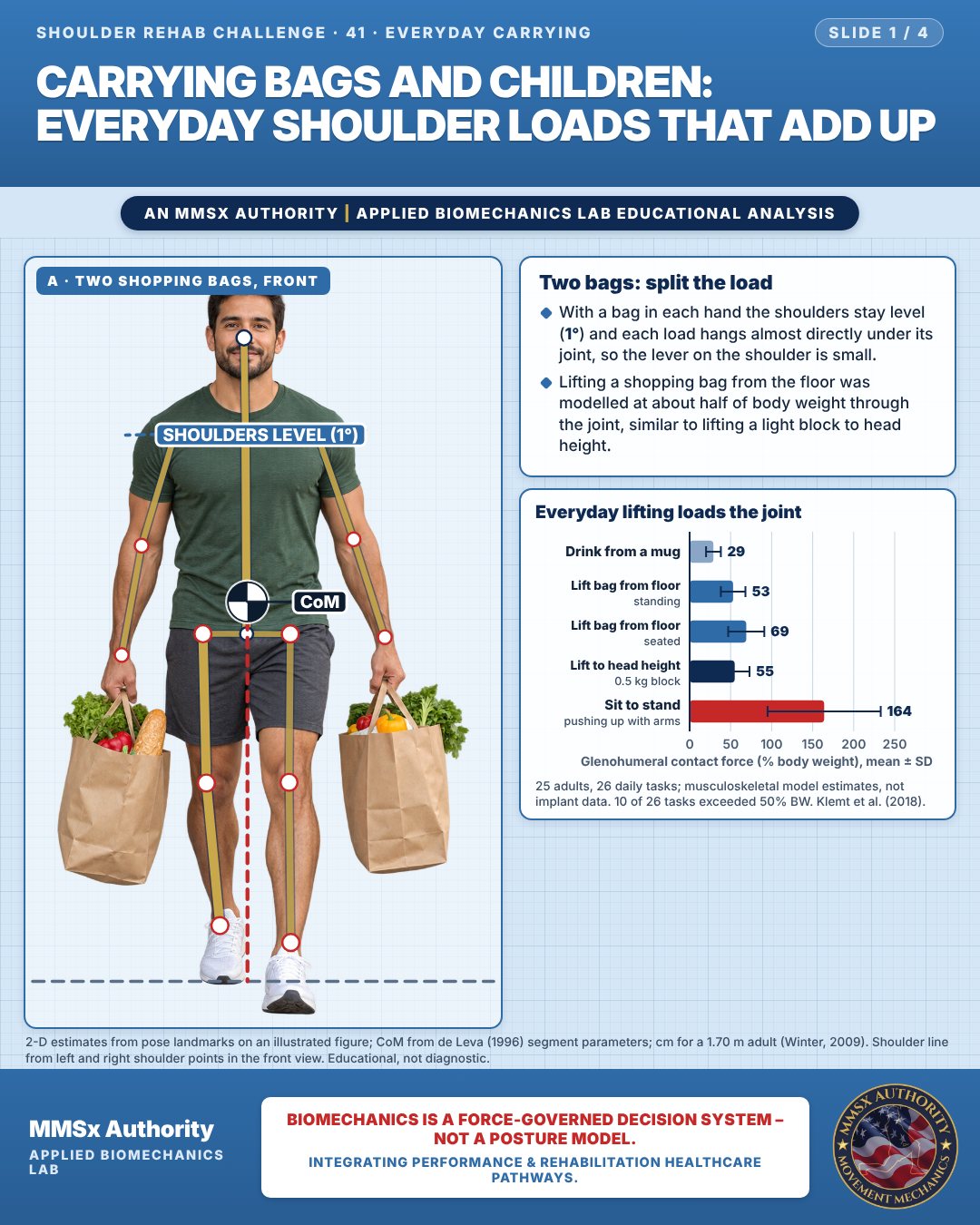
Two bags: split the load
With a bag in each hand the shoulders stay level (1°) and each load hangs almost directly under its joint, so the lever on the shoulder is small.
Lifting a shopping bag from the floor was modelled at about half of body weight through the joint, similar to lifting a light block to head height.
Everyday lifting loads the joint
Movement B: Child on the hip (front view)
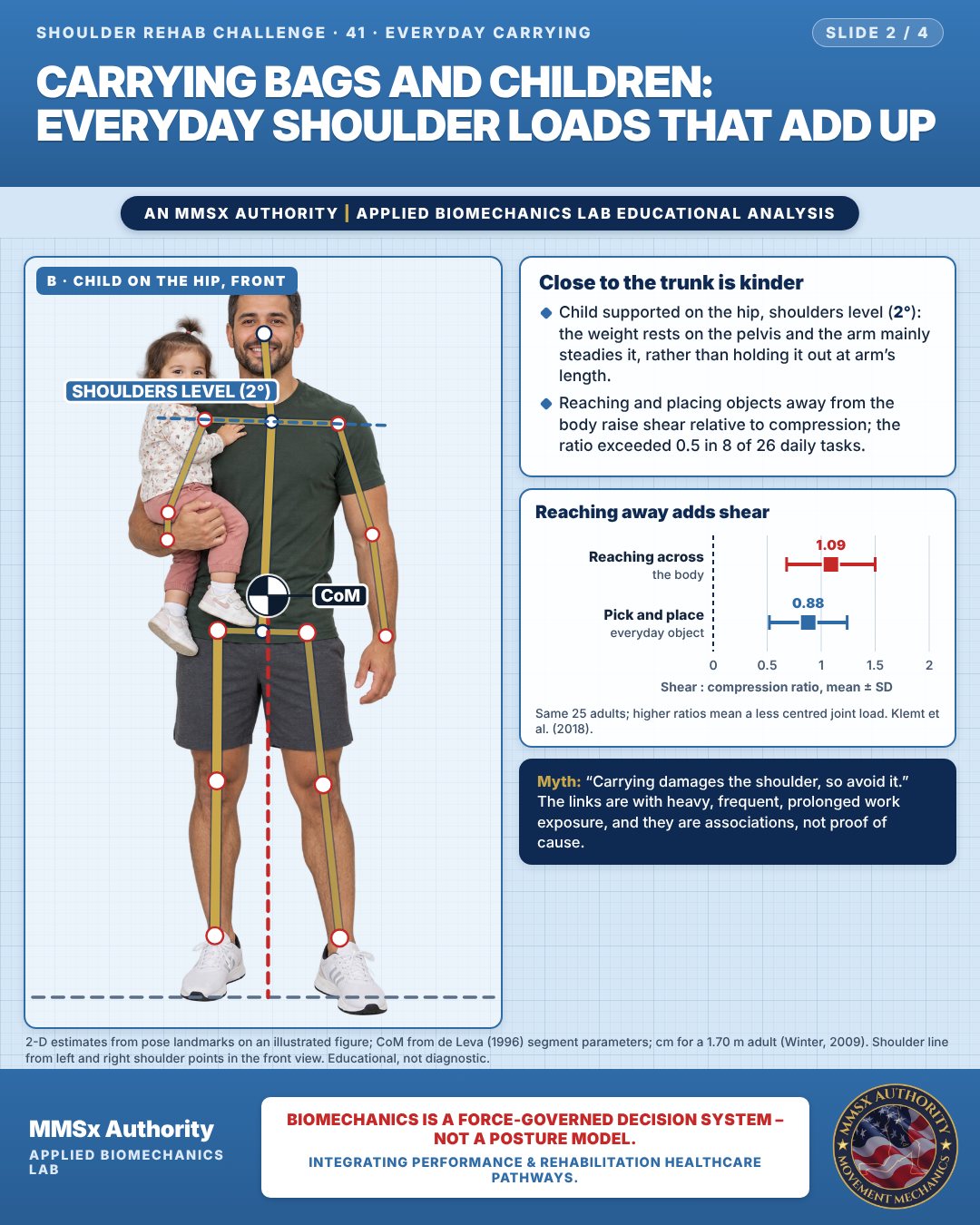
Close to the trunk is kinder
Child supported on the hip, shoulders level (2°): the weight rests on the pelvis and the arm mainly steadies it, rather than holding it out at arm’s length.
Reaching and placing objects away from the body raise shear relative to compression; the ratio exceeded 0.5 in 8 of 26 daily tasks.
Reaching away adds shear
Movement C: Lifting a basket (side view)
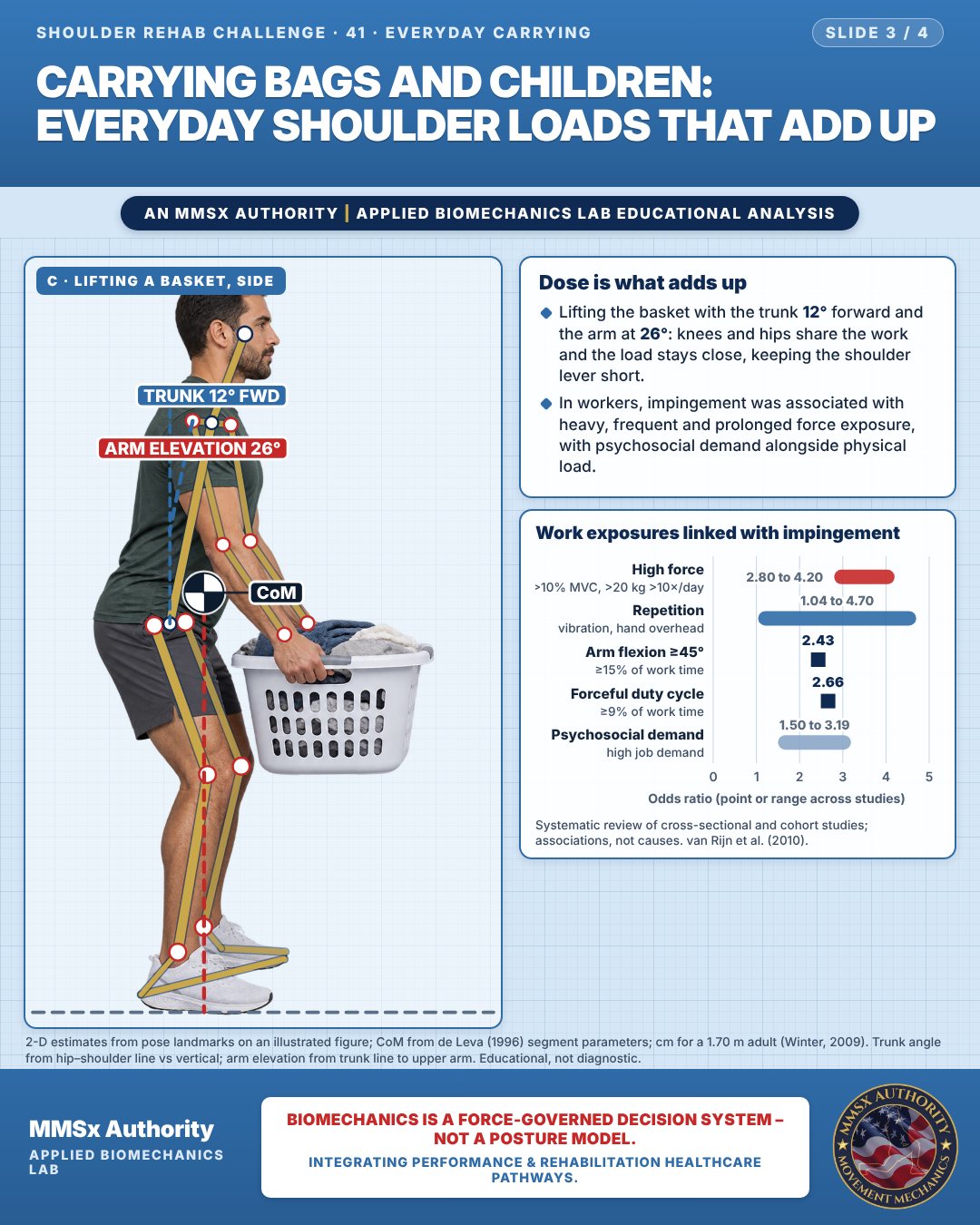
Dose is what adds up
Lifting the basket with the trunk 12° forward and the arm at 26°: knees and hips share the work and the load stays close, keeping the shoulder lever short.
In workers, impingement was associated with heavy, frequent and prolonged force exposure, with psychosocial demand alongside physical load.
Work exposures linked with impingement
Decision pathway
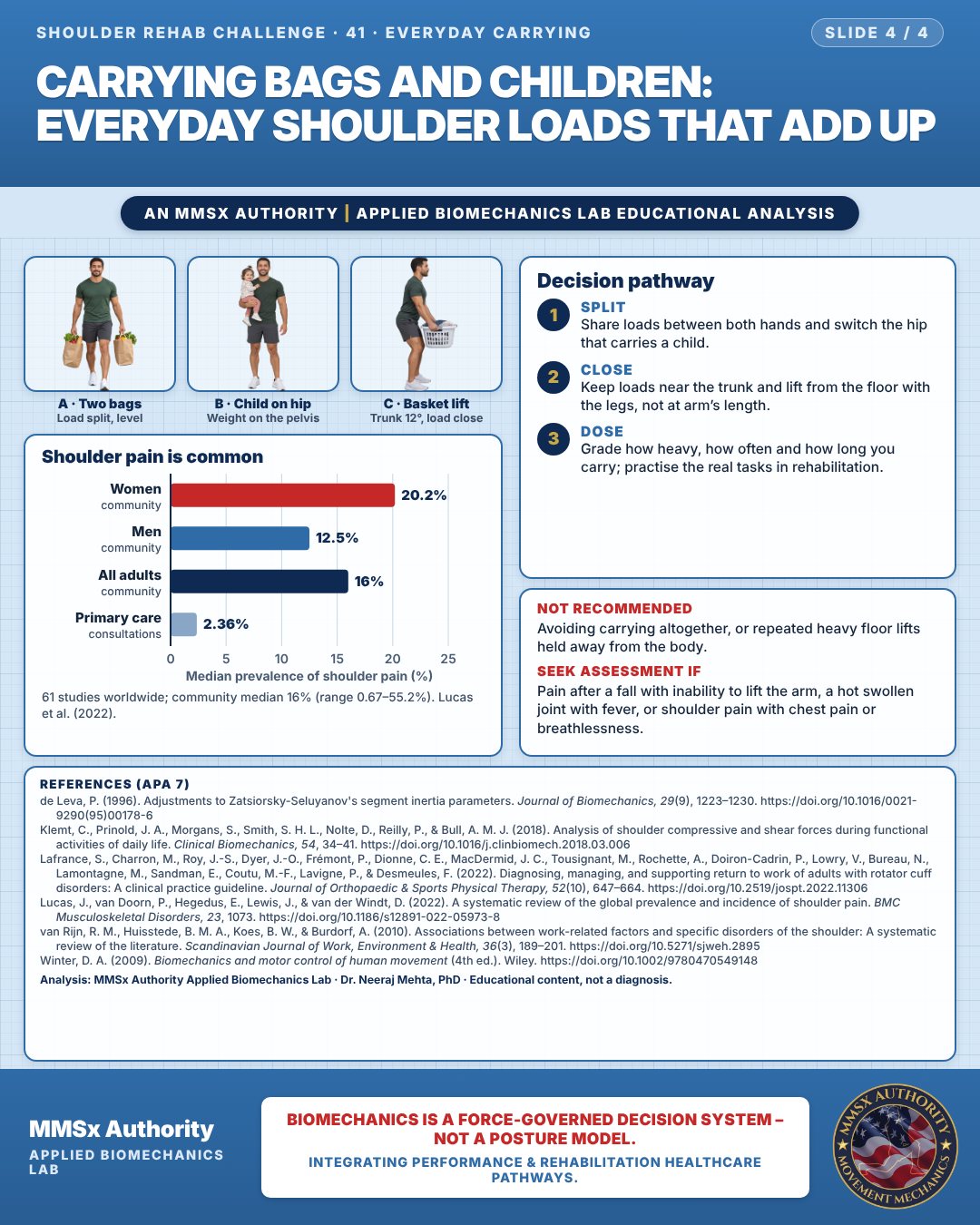
Shoulder pain is common
Split
Share loads between both hands and switch the hip that carries a child.
Close
Keep loads near the trunk and lift from the floor with the legs, not at arm’s length.
Dose
Grade how heavy, how often and how long you carry; practise the real tasks in rehabilitation.
What the evidence supports
- Exercise and education first: clinicians should prescribe an active, task-oriented rehabilitation programme (Lafrance et al., 2022). For carrying, this means graded practice of the real tasks (bags, child on hip, basket) rather than avoidance.
Myth and evidence
Myth“Carrying heavy things damages the shoulder, so avoid carrying.”
EvidenceThe evidence links shoulder disorders with heavy, frequent and prolonged exposure in some jobs (e.g. lifting >20 kg more than 10 times a day), and these are associations, not proof of cause (van Rijn et al., 2010). Lifting a bag from the floor loads the joint at around half of body weight, less than pushing up from a chair (Klemt et al., 2018). The aim is to build capacity and manage dose, not to stop carrying.
Cautions
Not recommended
Avoiding carrying altogether, or repeated heavy floor lifts held away from the body.
Seek assessment if
Pain after a fall with inability to lift the arm, a hot swollen joint with fever, or shoulder pain with chest pain or breathlessness.
Methods note
2-D estimates from pose landmarks on an illustrated figure; CoM from de Leva (1996) segment parameters; cm for a 1.70 m adult (Winter, 2009). Shoulder line from left and right shoulder points in the front view. Trunk angle from hip–shoulder line vs vertical; arm elevation from trunk line to upper arm. These are educational estimates, not a diagnosis.
References
- de Leva, P. (1996). Adjustments to Zatsiorsky-Seluyanov's segment inertia parameters. Journal of Biomechanics, 29(9), 1223–1230. https://doi.org/10.1016/0021-9290(95)00178-6
- Klemt, C., Prinold, J. A., Morgans, S., Smith, S. H. L., Nolte, D., Reilly, P., & Bull, A. M. J. (2018). Analysis of shoulder compressive and shear forces during functional activities of daily life. Clinical Biomechanics, 54, 34–41. https://doi.org/10.1016/j.clinbiomech.2018.03.006
- Lafrance, S., Charron, M., Roy, J.-S., Dyer, J.-O., Frémont, P., Dionne, C. E., MacDermid, J. C., Tousignant, M., Rochette, A., Doiron-Cadrin, P., Lowry, V., Bureau, N., Lamontagne, M., Sandman, E., Coutu, M.-F., Lavigne, P., & Desmeules, F. (2022). Diagnosing, managing, and supporting return to work of adults with rotator cuff disorders: A clinical practice guideline. Journal of Orthopaedic & Sports Physical Therapy, 52(10), 647–664. https://doi.org/10.2519/jospt.2022.11306
- Lucas, J., van Doorn, P., Hegedus, E., Lewis, J., & van der Windt, D. (2022). A systematic review of the global prevalence and incidence of shoulder pain. BMC Musculoskeletal Disorders, 23, 1073. https://doi.org/10.1186/s12891-022-05973-8
- van Rijn, R. M., Huisstede, B. M. A., Koes, B. W., & Burdorf, A. (2010). Associations between work-related factors and specific disorders of the shoulder: A systematic review of the literature. Scandinavian Journal of Work, Environment & Health, 36(3), 189–201. https://doi.org/10.5271/sjweh.2895
- Winter, D. A. (2009). Biomechanics and motor control of human movement (4th ed.). Wiley. https://doi.org/10.1002/9780470549148
Cite this article
Mehta, N. (2026, October 24). Carrying bags and children: everyday shoulder loads that add up. MMSx Authority Applied Biomechanics Lab. https://mmsxauthority.org/edu/analysis/shoulder/41-carrying-bags-and-children-everyday-shoulder-loads-that-add-up/
Part of the collection
Mehta, N. (2026). Shoulder Rehabilitation: 50 Evidence-Based Biomechanics Analyses [Collection]. MMSx Authority Applied Biomechanics Lab. Zenodo. https://doi.org/10.5281/zenodo.23735725
All Shoulder Rehab Challenge articles · Rehabilitation Library