Shoulder Rehab Challenge · 40
Desk work and shoulder pain: reach, mouse position and movement breaks
Desk-related neck–shoulder pain is aching or tension in the upper trapezius and shoulder region in people who work at a computer for long periods.
Key points
- Support. Give the forearms support with armrests or a forearm board.
- Mouse. Keep the mouse close and central, e.g. with a keyboard without a number pad.
- Move. Add specific neck–shoulder strength work; refer shoulder pain not better by 12 weeks.
What it is
Desk-related neck–shoulder pain is aching or tension in the upper trapezius and shoulder region in people who work at a computer for long periods. It is often labelled trapezius myalgia or tension neck syndrome. It is associated with prolonged low-level static muscle load, unsupported forearms and reaching to the mouse. The evidence links it more consistently to the neck–shoulder muscles than to shoulder tendon disease.
How we analysed the movement
Three movements relevant to this topic were analysed from illustrated reference figures. Joint centres were located with two-dimensional pose estimation; arm elevation and elbow angles, shoulder level, the whole-body centre of mass and, where relevant, the arm lever (the horizontal distance from the shoulder joint to the centre of mass of the arm, with any hand load) and the resulting shoulder moment were then calculated from standard segment parameters. The figures are educational estimates that show how position changes mechanical demand; they are not measurements of a patient. Every research value quoted below comes from the published source cited beside it.
Movement A: Long mouse reach (side view)
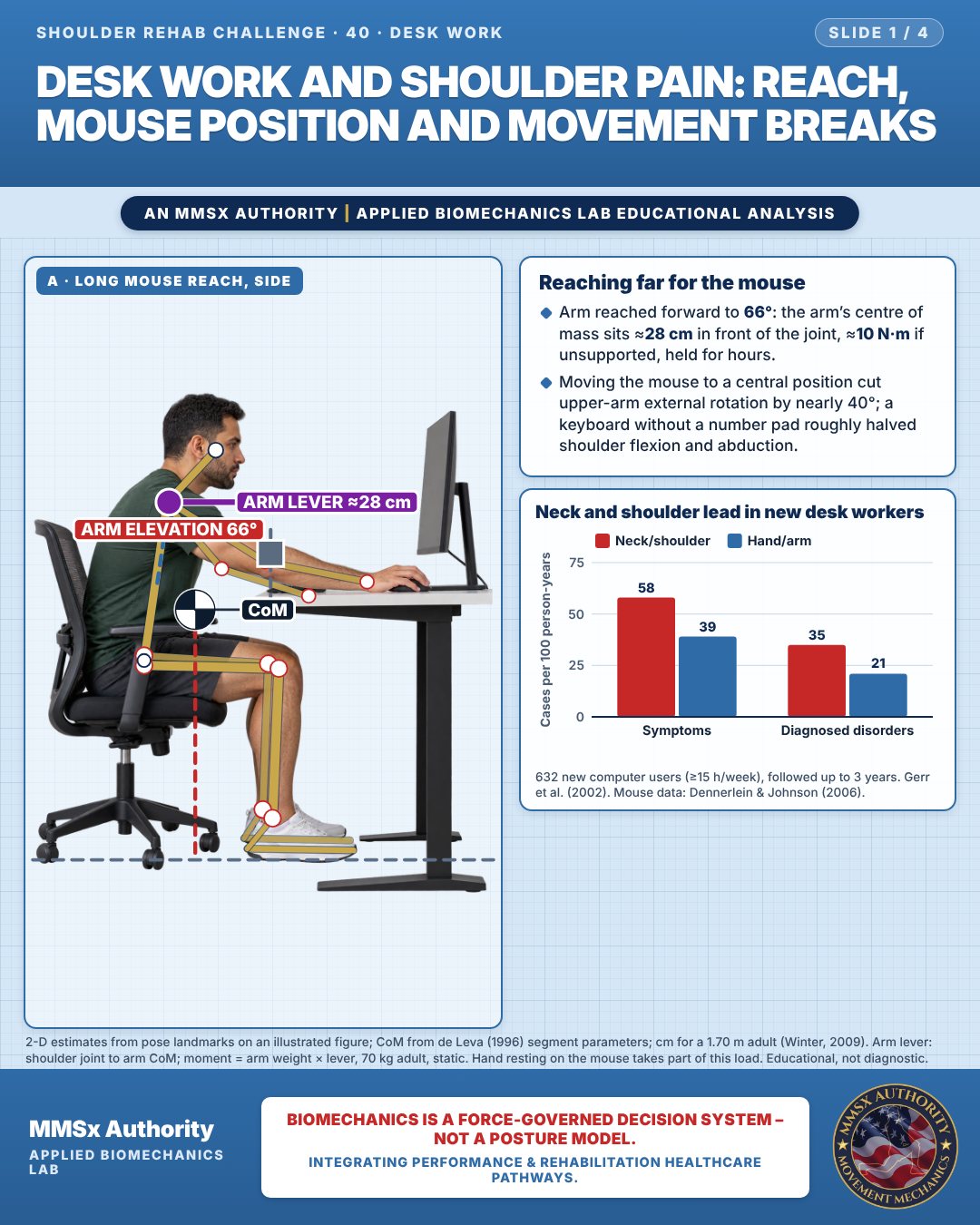
Reaching far for the mouse
Arm reached forward to 66°: the arm’s centre of mass sits ≈28 cm in front of the joint, ≈10 N·m if unsupported, held for hours.
Moving the mouse to a central position cut upper-arm external rotation by nearly 40°; a keyboard without a number pad roughly halved shoulder flexion and abduction.
Neck and shoulder lead in new desk workers
Movement B: Mouse close (side view)
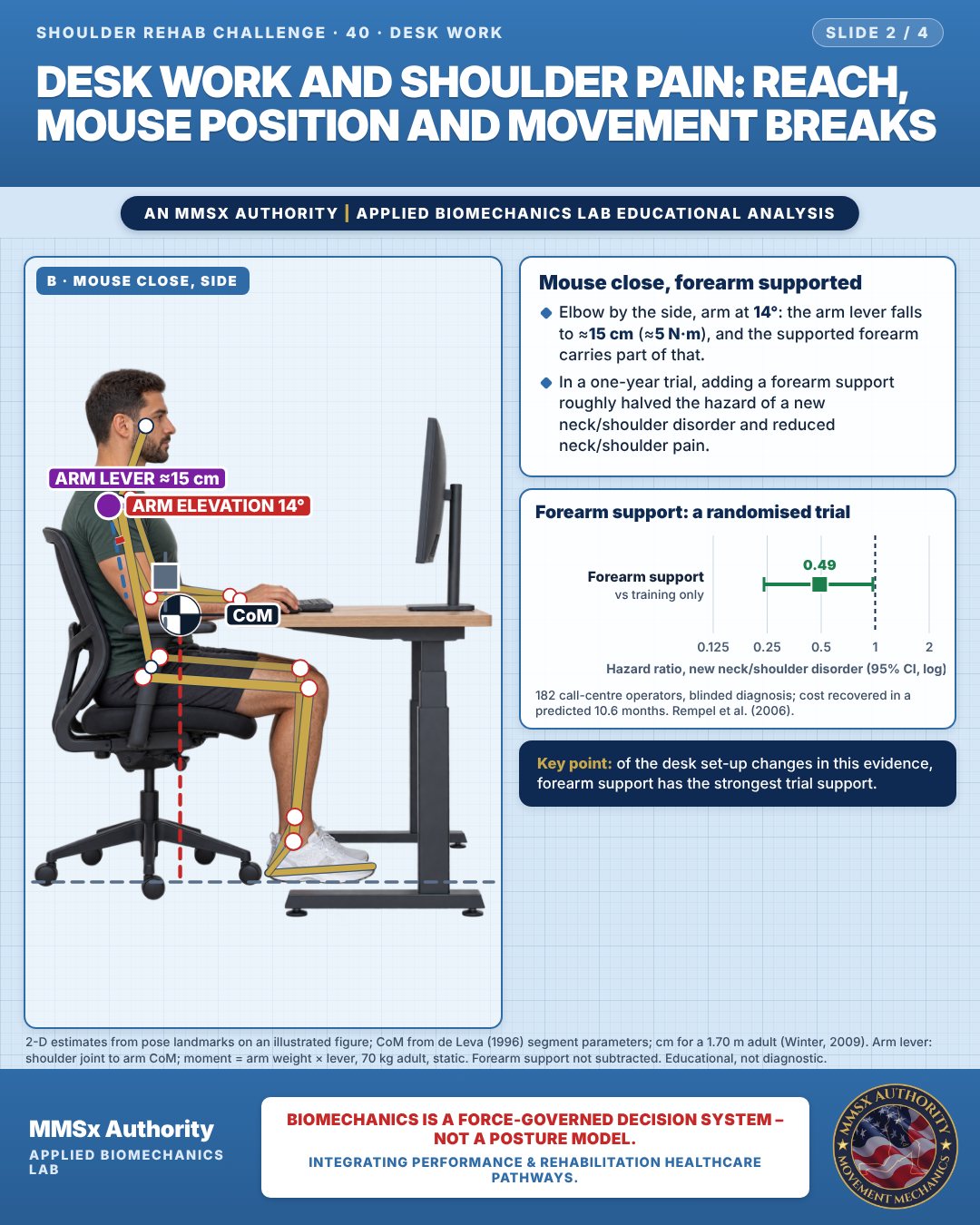
Mouse close, forearm supported
Elbow by the side, arm at 14°: the arm lever falls to ≈15 cm (≈5 N·m), and the supported forearm carries part of that.
In a one-year trial, adding a forearm support roughly halved the hazard of a new neck/shoulder disorder and reduced neck/shoulder pain.
Forearm support: a randomised trial
Movement C: Overhead stretch (front view)
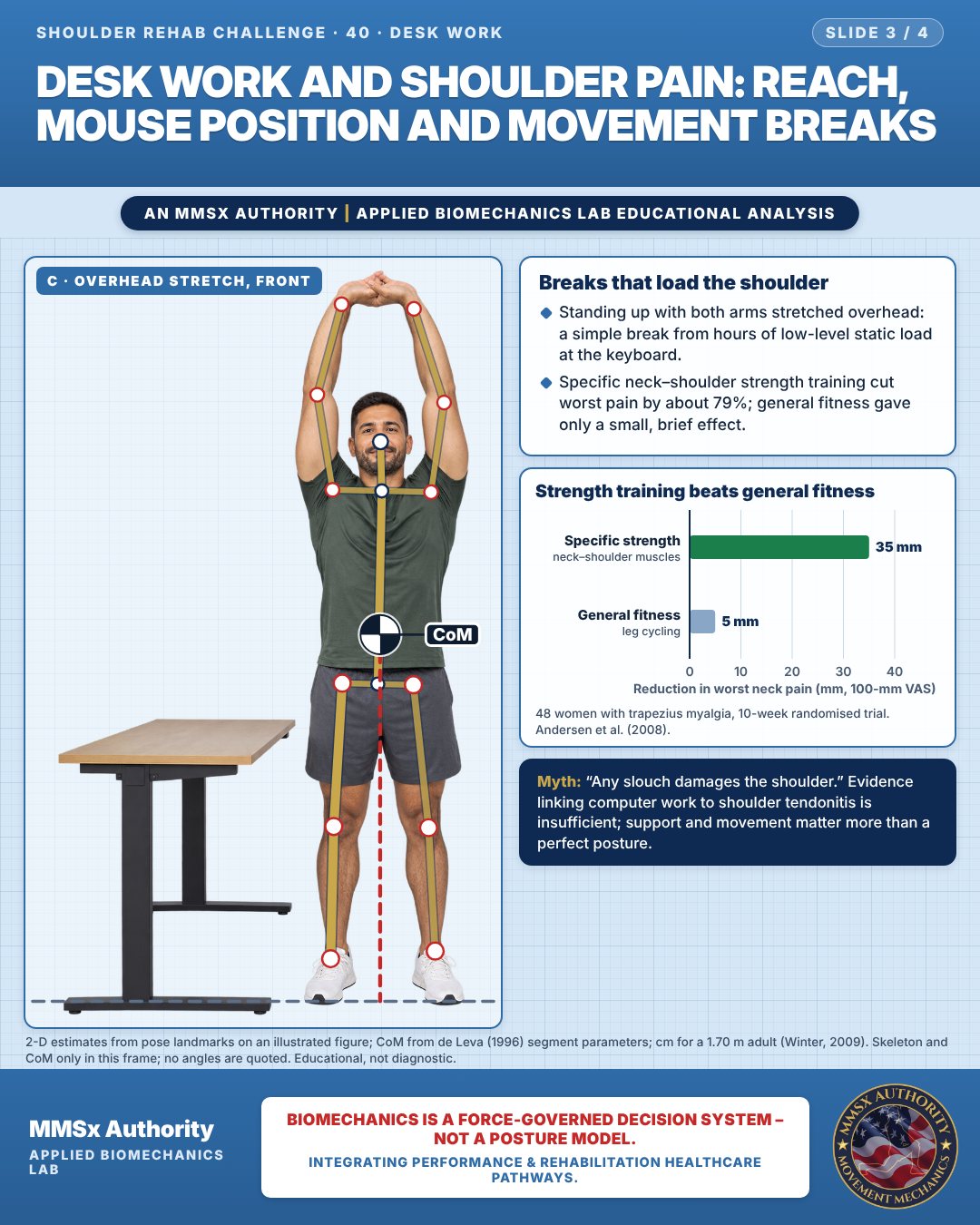
Breaks that load the shoulder
Standing up with both arms stretched overhead: a simple break from hours of low-level static load at the keyboard.
Specific neck–shoulder strength training cut worst pain by about 79%; general fitness gave only a small, brief effect.
Strength training beats general fitness
Decision pathway
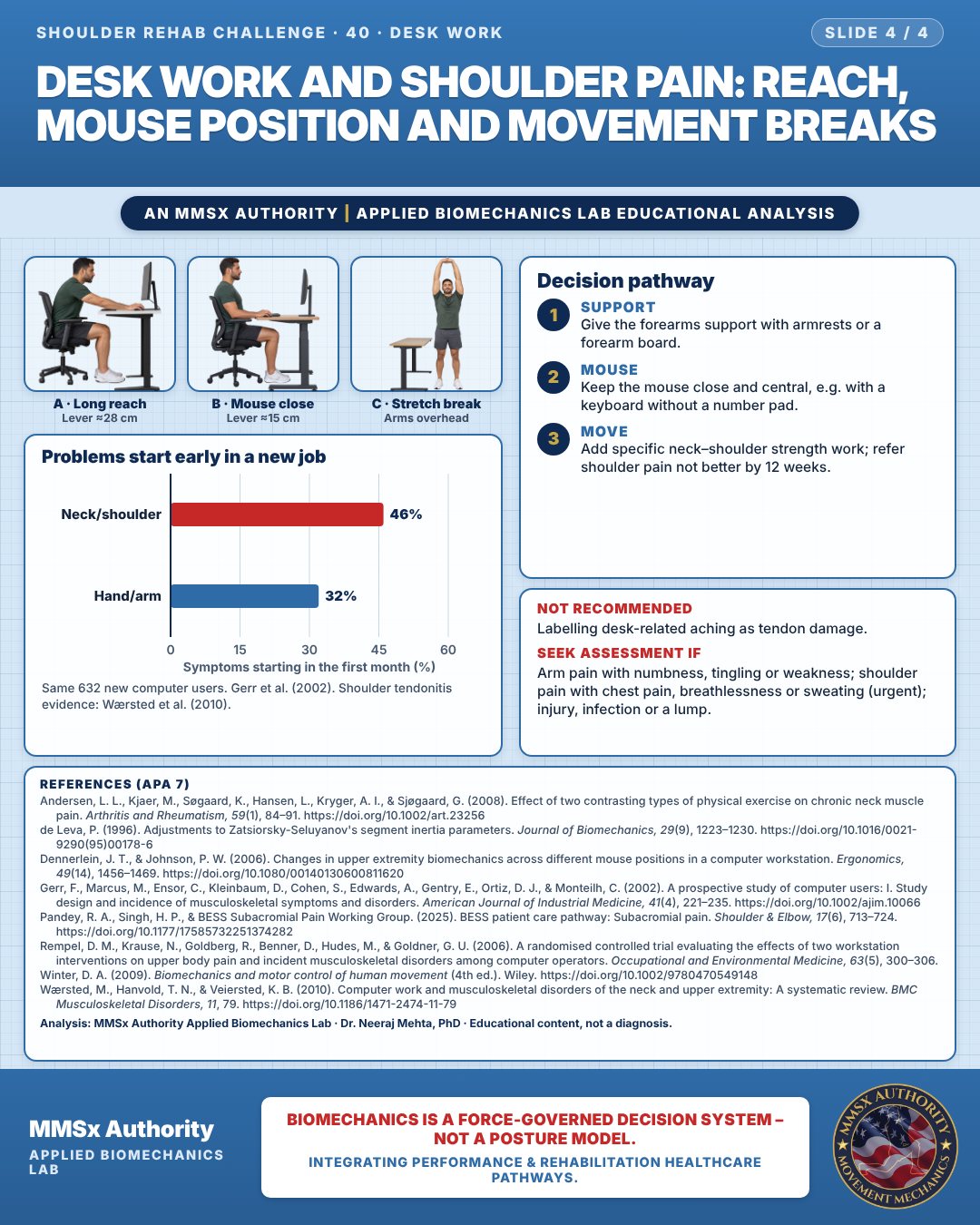
Problems start early in a new job
Support
Give the forearms support with armrests or a forearm board.
Mouse
Keep the mouse close and central, e.g. with a keyboard without a number pad.
Move
Add specific neck–shoulder strength work; refer shoulder pain not better by 12 weeks.
What the evidence supports
- Recommended (evidence-informed): forearm support or armrests (HR 0.49 for new neck/shoulder disorders; Rempel et al., 2006; Gerr et al. cohort II). Keep the mouse close and central, for example with a keyboard without a number pad (Dennerlein & Johnson, 2006). Elbows at or above keyboard height (cohort II). Specific neck–shoulder strength training, not just general fitness (Andersen et al., 2008).
- For established shoulder (subacromial) pain: exercise-led rehabilitation; refer if there is no improvement by 12 weeks (Pandey & Singh, 2025).
Cautions
Not recommended
Labelling desk-related aching as tendon damage.
Seek assessment if
Arm pain with numbness, tingling or weakness; shoulder pain with chest pain, breathlessness or sweating (urgent); injury, infection or a lump.
Methods note
2-D estimates from pose landmarks on an illustrated figure; CoM from de Leva (1996) segment parameters; cm for a 1.70 m adult (Winter, 2009). Arm lever: shoulder joint to arm CoM; moment = arm weight × lever, 70 kg adult, static. Hand resting on the mouse takes part of this load. Forearm support not subtracted. Skeleton and CoM only in this frame; no angles are quoted. These are educational estimates, not a diagnosis.
References
- Andersen, L. L., Kjaer, M., Søgaard, K., Hansen, L., Kryger, A. I., & Sjøgaard, G. (2008). Effect of two contrasting types of physical exercise on chronic neck muscle pain. Arthritis and Rheumatism, 59(1), 84–91. https://doi.org/10.1002/art.23256
- de Leva, P. (1996). Adjustments to Zatsiorsky-Seluyanov's segment inertia parameters. Journal of Biomechanics, 29(9), 1223–1230. https://doi.org/10.1016/0021-9290(95)00178-6
- Dennerlein, J. T., & Johnson, P. W. (2006). Changes in upper extremity biomechanics across different mouse positions in a computer workstation. Ergonomics, 49(14), 1456–1469. https://doi.org/10.1080/00140130600811620
- Gerr, F., Marcus, M., Ensor, C., Kleinbaum, D., Cohen, S., Edwards, A., Gentry, E., Ortiz, D. J., & Monteilh, C. (2002). A prospective study of computer users: I. Study design and incidence of musculoskeletal symptoms and disorders. American Journal of Industrial Medicine, 41(4), 221–235. https://doi.org/10.1002/ajim.10066
- Pandey, R. A., Singh, H. P., & BESS Subacromial Pain Working Group. (2025). BESS patient care pathway: Subacromial pain. Shoulder & Elbow, 17(6), 713–724. https://doi.org/10.1177/17585732251374282
- Rempel, D. M., Krause, N., Goldberg, R., Benner, D., Hudes, M., & Goldner, G. U. (2006). A randomised controlled trial evaluating the effects of two workstation interventions on upper body pain and incident musculoskeletal disorders among computer operators. Occupational and Environmental Medicine, 63(5), 300–306.
- Winter, D. A. (2009). Biomechanics and motor control of human movement (4th ed.). Wiley. https://doi.org/10.1002/9780470549148
- Wærsted, M., Hanvold, T. N., & Veiersted, K. B. (2010). Computer work and musculoskeletal disorders of the neck and upper extremity: A systematic review. BMC Musculoskeletal Disorders, 11, 79. https://doi.org/10.1186/1471-2474-11-79
Cite this article
Mehta, N. (2026, October 24). Desk work and shoulder pain: reach, mouse position and movement breaks. MMSx Authority Applied Biomechanics Lab. https://mmsxauthority.org/edu/analysis/shoulder/40-desk-work-and-shoulder-pain-reach-mouse-position-and-movement-breaks/
Part of the collection
Mehta, N. (2026). Shoulder Rehabilitation: 50 Evidence-Based Biomechanics Analyses [Collection]. MMSx Authority Applied Biomechanics Lab. Zenodo. https://doi.org/10.5281/zenodo.23735725
All Shoulder Rehab Challenge articles · Rehabilitation Library