Shoulder Rehab Challenge · 39
Golf and shoulder pain: the lead shoulder and swing load
Golfer's shoulder pain most often affects the lead shoulder (the left in a right-handed golfer).
Key points
- Warm up. Warm up for at least 10 minutes and use a trolley rather than carrying the bag.
- Grade. Build up by club length and swing size: putting, chipping, irons, then woods and a full round.
- Rehab. Treat persisting cuff or AC pain with exercise first; refer if no better by 12 weeks.
What it is
Golfer's shoulder pain most often affects the lead shoulder (the left in a right-handed golfer). At the top of the backswing that arm is held in maximal cross-body adduction, and through impact and follow-through it moves rapidly. The common diagnoses are acromioclavicular (AC) joint pain, rotator cuff tendinopathy or subacromial pain, and, less often, posterior instability, nearly always from overuse rather than a single injury.
How we analysed the movement
Three movements relevant to this topic were analysed from illustrated reference figures. Joint centres were located with two-dimensional pose estimation; arm elevation and elbow angles, shoulder level, the whole-body centre of mass and, where relevant, the arm lever (the horizontal distance from the shoulder joint to the centre of mass of the arm, with any hand load) and the resulting shoulder moment were then calculated from standard segment parameters. The figures are educational estimates that show how position changes mechanical demand; they are not measurements of a patient. Every research value quoted below comes from the published source cited beside it.
Movement A: Top of backswing (front view)
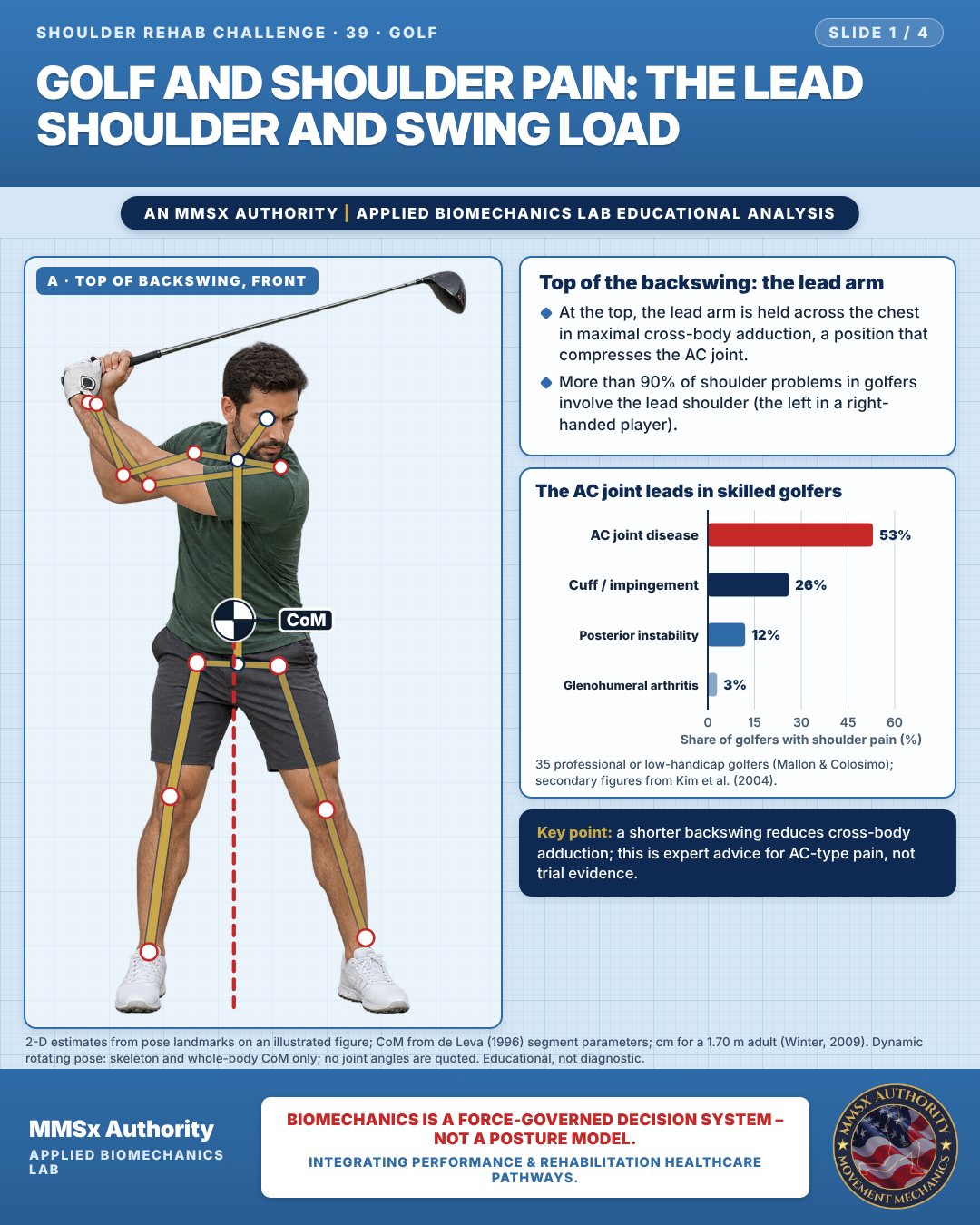
Top of the backswing: the lead arm
At the top, the lead arm is held across the chest in maximal cross-body adduction, a position that compresses the AC joint.
More than 90% of shoulder problems in golfers involve the lead shoulder (the left in a right-handed player).
The AC joint leads in skilled golfers
Movement B: Impact (front view)
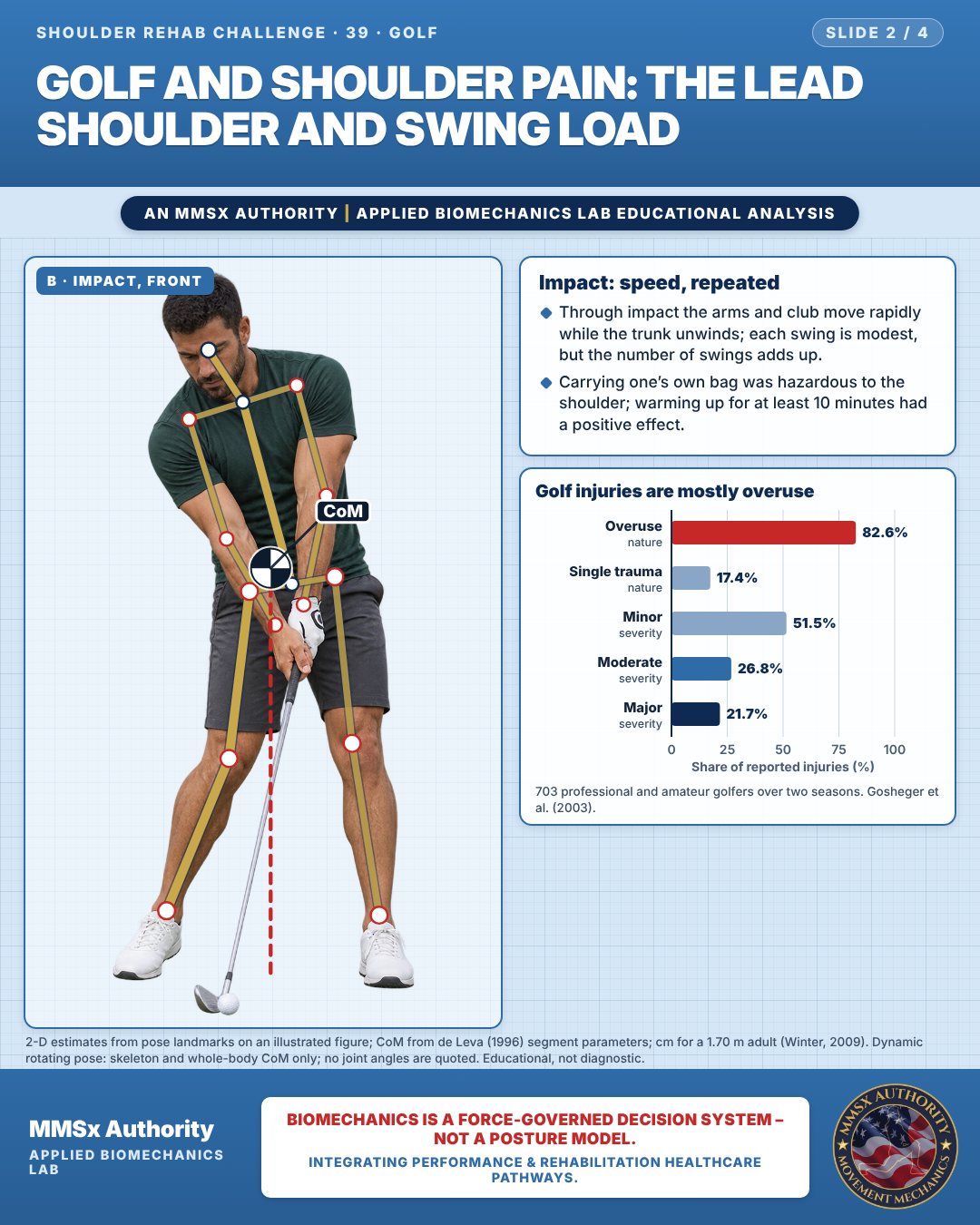
Impact: speed, repeated
Through impact the arms and club move rapidly while the trunk unwinds; each swing is modest, but the number of swings adds up.
Carrying one’s own bag was hazardous to the shoulder; warming up for at least 10 minutes had a positive effect.
Golf injuries are mostly overuse
Movement C: Finish (front view)
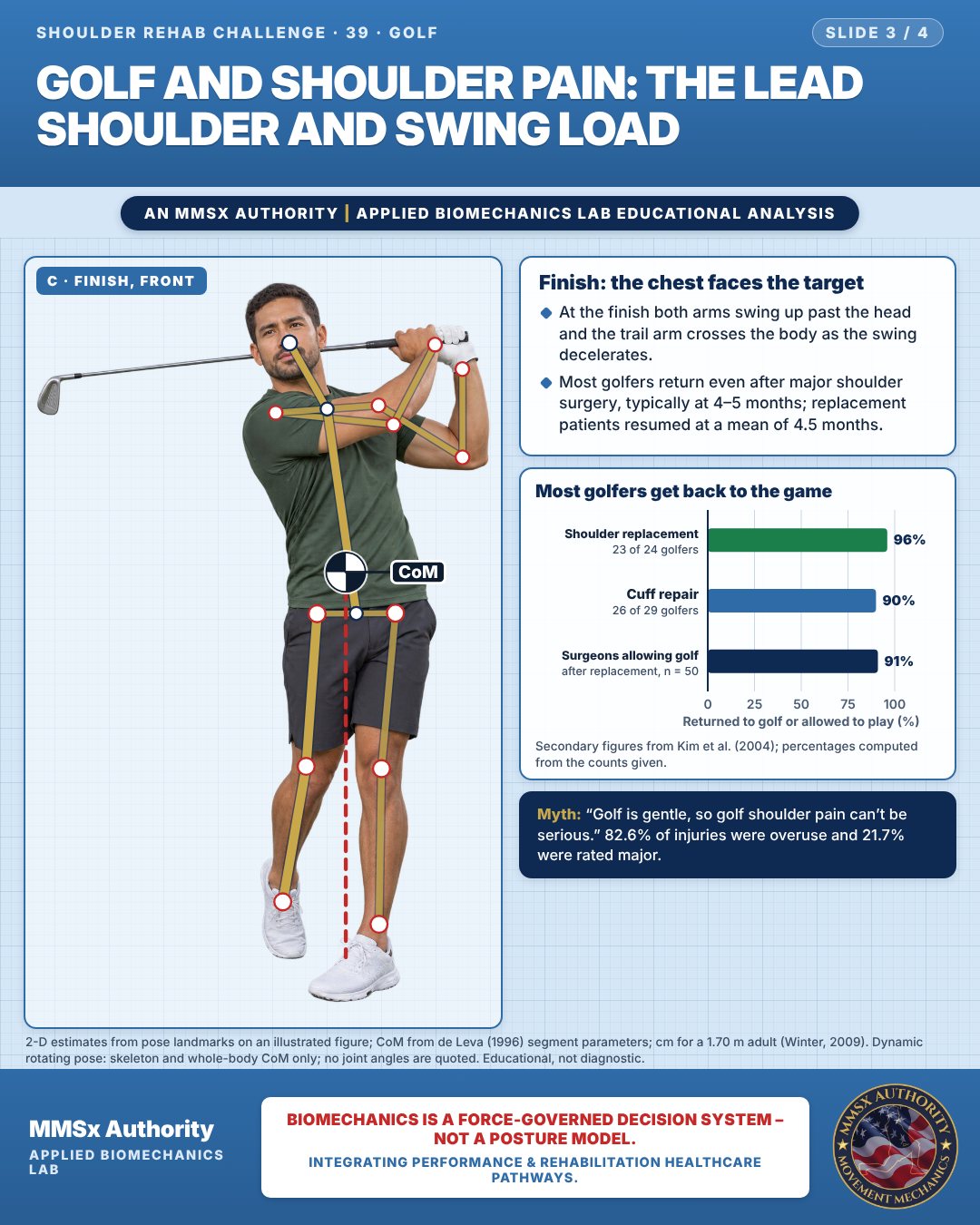
Finish: the chest faces the target
At the finish both arms swing up past the head and the trail arm crosses the body as the swing decelerates.
Most golfers return even after major shoulder surgery, typically at 4–5 months; replacement patients resumed at a mean of 4.5 months.
Most golfers get back to the game
Decision pathway
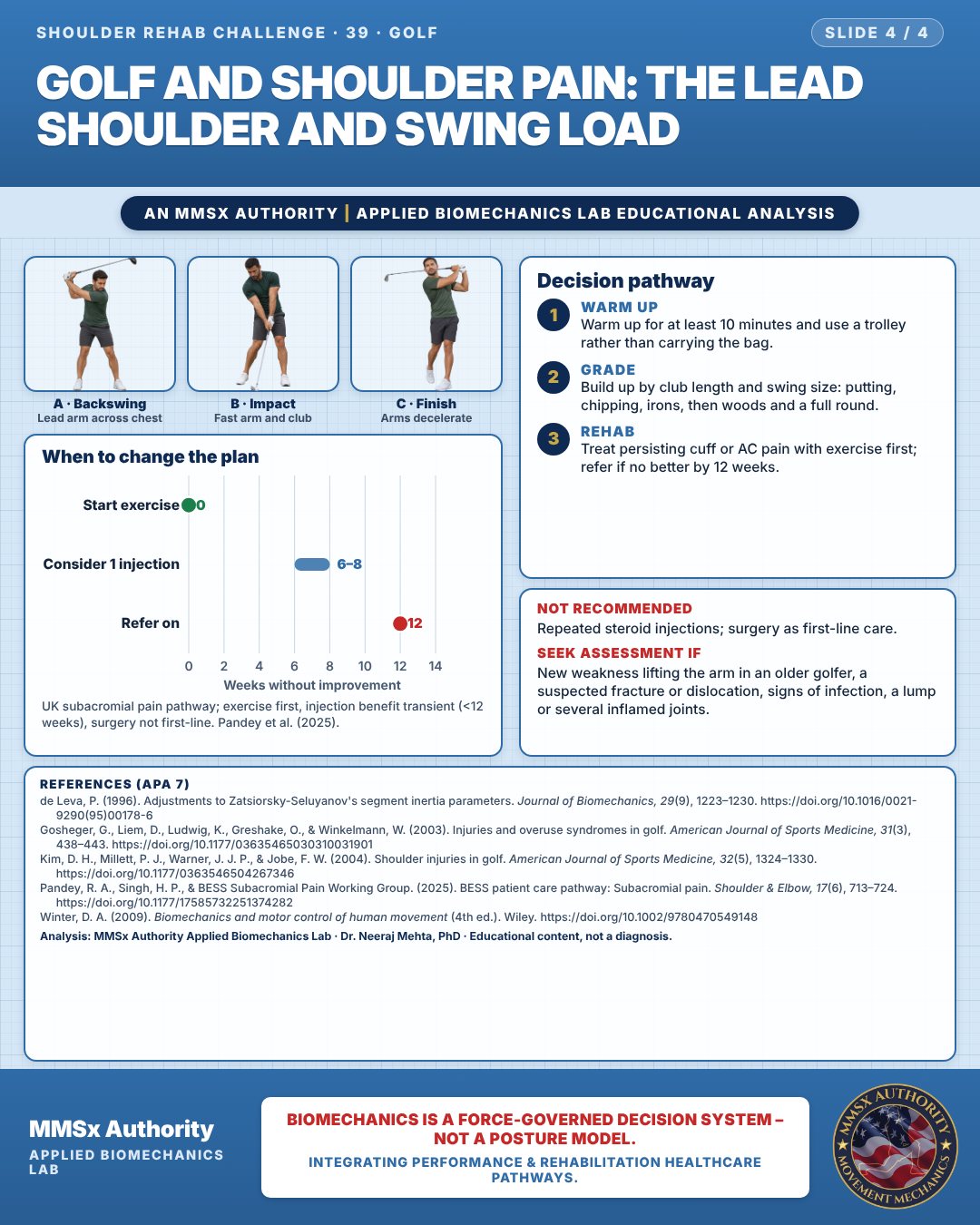
When to change the plan
Warm up
Warm up for at least 10 minutes and use a trolley rather than carrying the bag.
Grade
Build up by club length and swing size: putting, chipping, irons, then woods and a full round.
Rehab
Treat persisting cuff or AC pain with exercise first; refer if no better by 12 weeks.
What the evidence supports
- Recommended (evidence-informed): warm up for at least 10 minutes before play, and consider a trolley rather than carrying the bag when the shoulder is painful (Gosheger et al., 2003). Grade swing load by club length and swing amplitude (39-D; expert protocol, Kim et al., 2004). For AC-dominant pain, temporarily limit the lead arm's cross-body adduction, for example with a shorter backswing (inferred from 39-B; expert opinion).
- For persisting cuff or subacromial pain: exercise-led rehabilitation; at most one injection if there is no improvement by 6–8 weeks; refer if there is no improvement by 12 weeks; surgery is not first-line (Pandey & Singh, 2025).
Cautions
Not recommended
Repeated steroid injections; surgery as first-line care.
Seek assessment if
New weakness lifting the arm in an older golfer, a suspected fracture or dislocation, signs of infection, a lump or several inflamed joints.
Methods note
2-D estimates from pose landmarks on an illustrated figure; CoM from de Leva (1996) segment parameters; cm for a 1.70 m adult (Winter, 2009). Dynamic rotating pose: skeleton and whole-body CoM only; no joint angles are quoted. These are educational estimates, not a diagnosis.
References
- de Leva, P. (1996). Adjustments to Zatsiorsky-Seluyanov's segment inertia parameters. Journal of Biomechanics, 29(9), 1223–1230. https://doi.org/10.1016/0021-9290(95)00178-6
- Gosheger, G., Liem, D., Ludwig, K., Greshake, O., & Winkelmann, W. (2003). Injuries and overuse syndromes in golf. American Journal of Sports Medicine, 31(3), 438–443. https://doi.org/10.1177/03635465030310031901
- Kim, D. H., Millett, P. J., Warner, J. J. P., & Jobe, F. W. (2004). Shoulder injuries in golf. American Journal of Sports Medicine, 32(5), 1324–1330. https://doi.org/10.1177/0363546504267346
- Pandey, R. A., Singh, H. P., & BESS Subacromial Pain Working Group. (2025). BESS patient care pathway: Subacromial pain. Shoulder & Elbow, 17(6), 713–724. https://doi.org/10.1177/17585732251374282
- Winter, D. A. (2009). Biomechanics and motor control of human movement (4th ed.). Wiley. https://doi.org/10.1002/9780470549148
Cite this article
Mehta, N. (2026, October 24). Golf and shoulder pain: the lead shoulder and swing load. MMSx Authority Applied Biomechanics Lab. https://mmsxauthority.org/edu/analysis/shoulder/39-golf-and-shoulder-pain-the-lead-shoulder-and-swing-load/
Part of the collection
Mehta, N. (2026). Shoulder Rehabilitation: 50 Evidence-Based Biomechanics Analyses [Collection]. MMSx Authority Applied Biomechanics Lab. Zenodo. https://doi.org/10.5281/zenodo.23735725
All Shoulder Rehab Challenge articles · Rehabilitation Library