Shoulder Rehab Challenge · 38
Volleyball and overhead-sport shoulder pain: spiking, blocking and recovery
Volleyball shoulder pain is mostly overuse pain in the hitting shoulder, usually rotator cuff tendinopathy.
Key points
- Skill. Swap spikes for roll shots and jump serves for float serves while symptoms settle.
- Strength. Build external-rotator strength to restore the external-to-internal rotation balance.
- Return. Finish rehabilitation before full spiking volume; refer if no better by 12 weeks.
What it is
Volleyball shoulder pain is mostly overuse pain in the hitting shoulder, usually rotator cuff tendinopathy. It builds from repeated spiking and jump serving, with the arm at about 130° of abduction at ball contact. Rotator-cuff strength imbalance and limited internal rotation range are associated features. Pain occurs less often with blocking, which loads the arms overhead with lower velocity.
How we analysed the movement
Three movements relevant to this topic were analysed from illustrated reference figures. Joint centres were located with two-dimensional pose estimation; arm elevation and elbow angles, shoulder level, the whole-body centre of mass and, where relevant, the arm lever (the horizontal distance from the shoulder joint to the centre of mass of the arm, with any hand load) and the resulting shoulder moment were then calculated from standard segment parameters. The figures are educational estimates that show how position changes mechanical demand; they are not measurements of a patient. Every research value quoted below comes from the published source cited beside it.
Movement A: Spike cocking (side view)
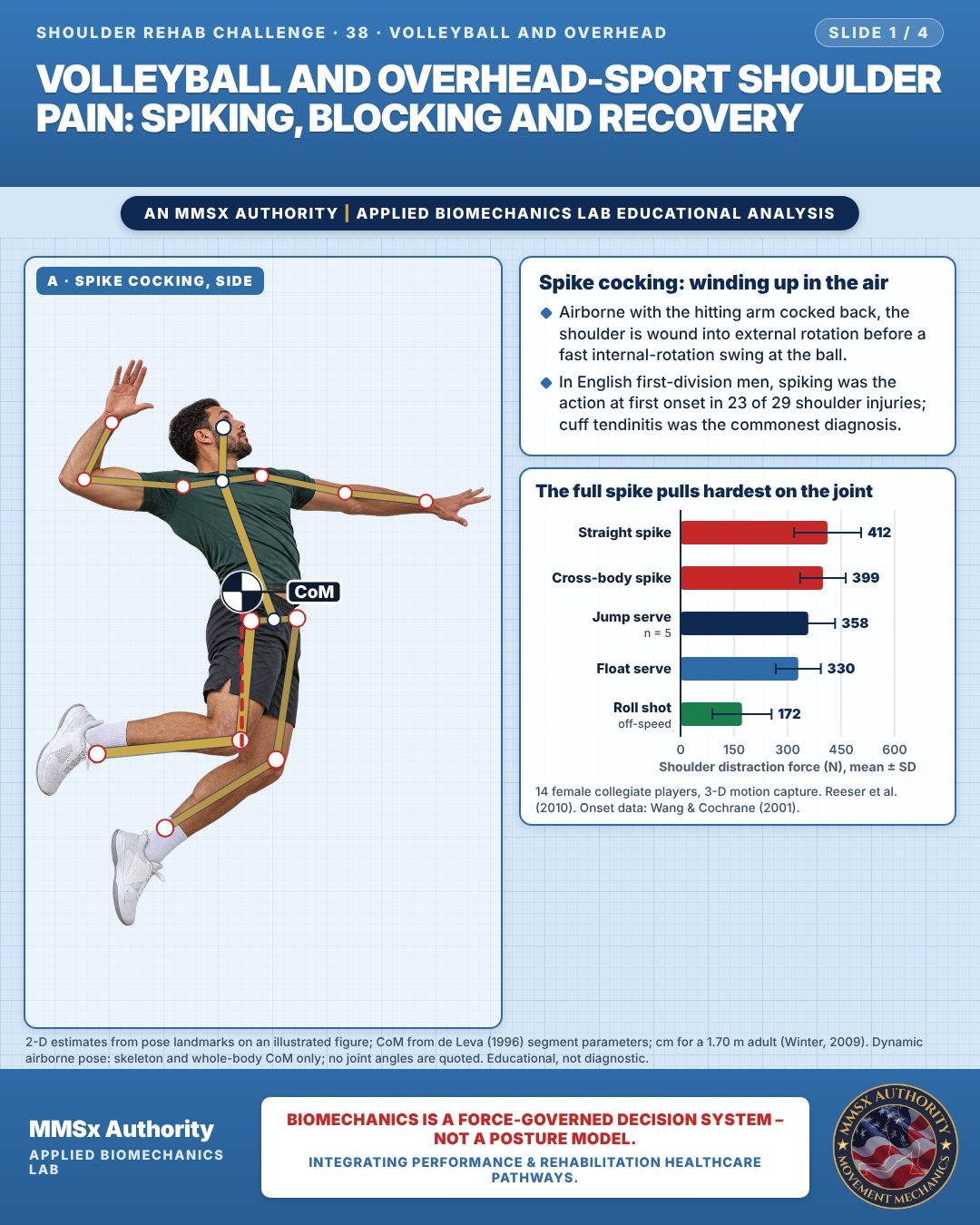
Spike cocking: winding up in the air
Airborne with the hitting arm cocked back, the shoulder is wound into external rotation before a fast internal-rotation swing at the ball.
In English first-division men, spiking was the action at first onset in 23 of 29 shoulder injuries; cuff tendinitis was the commonest diagnosis.
The full spike pulls hardest on the joint
Movement B: Spike contact (front view)
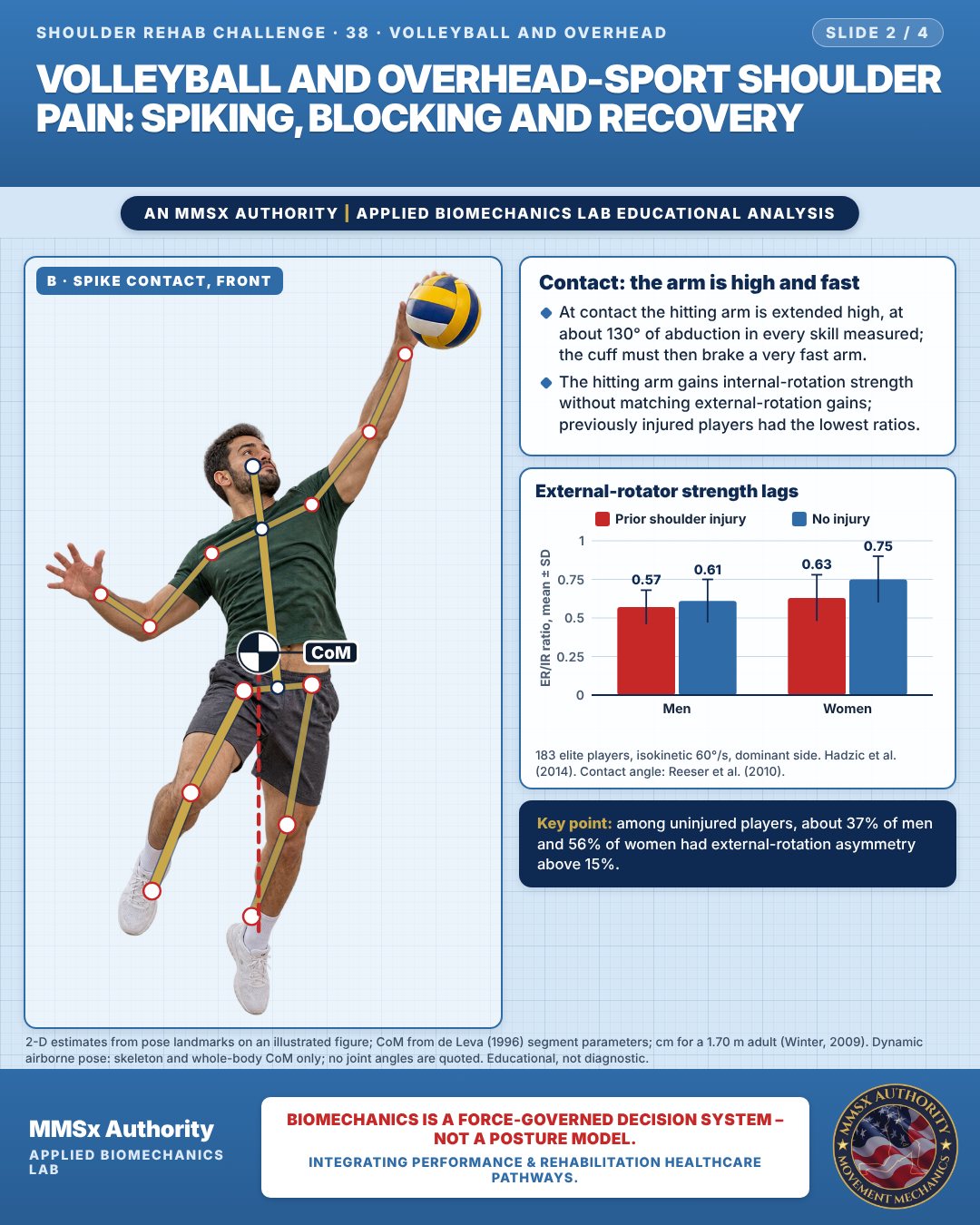
Contact: the arm is high and fast
At contact the hitting arm is extended high, at about 130° of abduction in every skill measured; the cuff must then brake a very fast arm.
The hitting arm gains internal-rotation strength without matching external-rotation gains; previously injured players had the lowest ratios.
External-rotator strength lags
Movement C: Block at the net (front view)
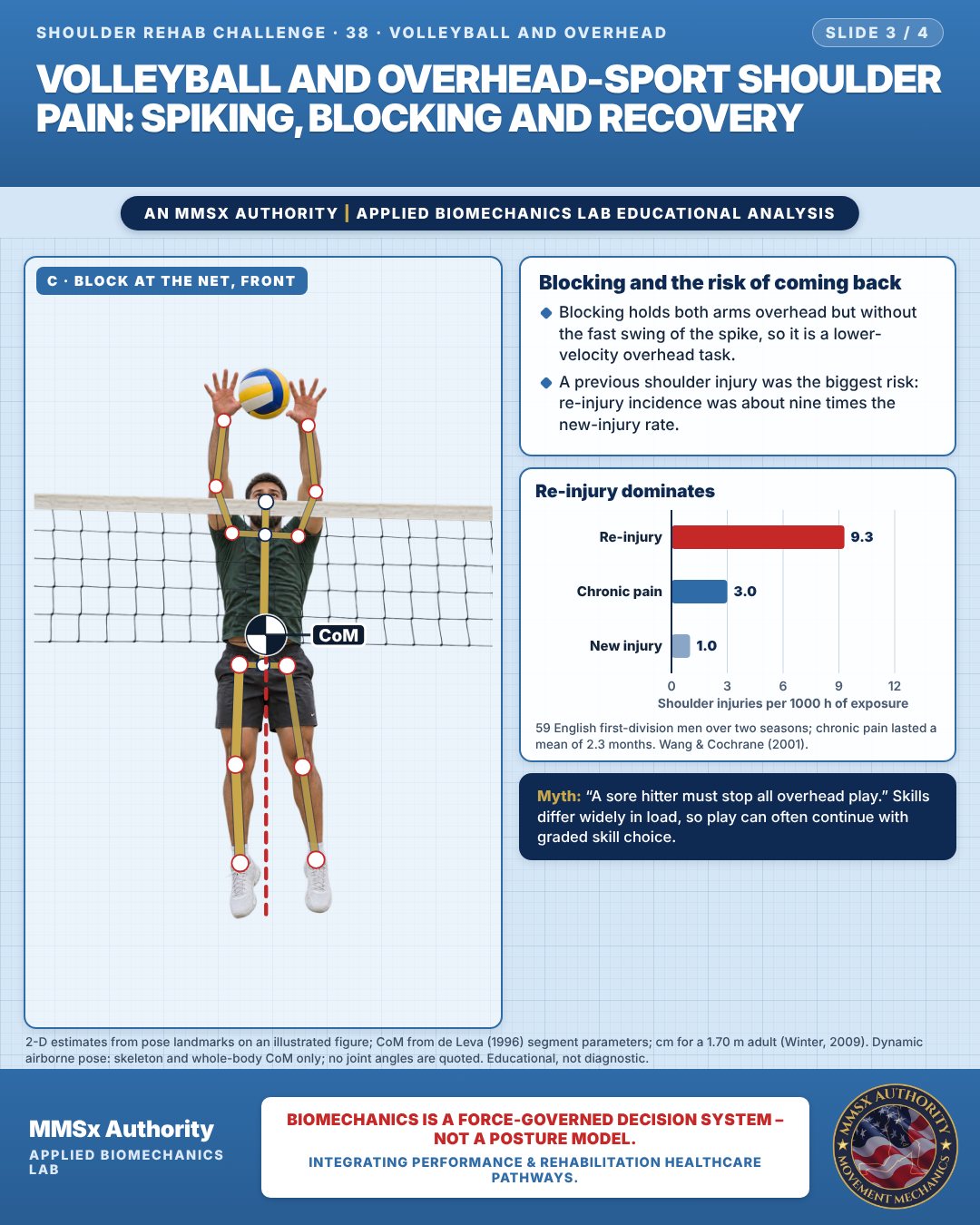
Blocking and the risk of coming back
Blocking holds both arms overhead but without the fast swing of the spike, so it is a lower-velocity overhead task.
A previous shoulder injury was the biggest risk: re-injury incidence was about nine times the new-injury rate.
Re-injury dominates
Decision pathway
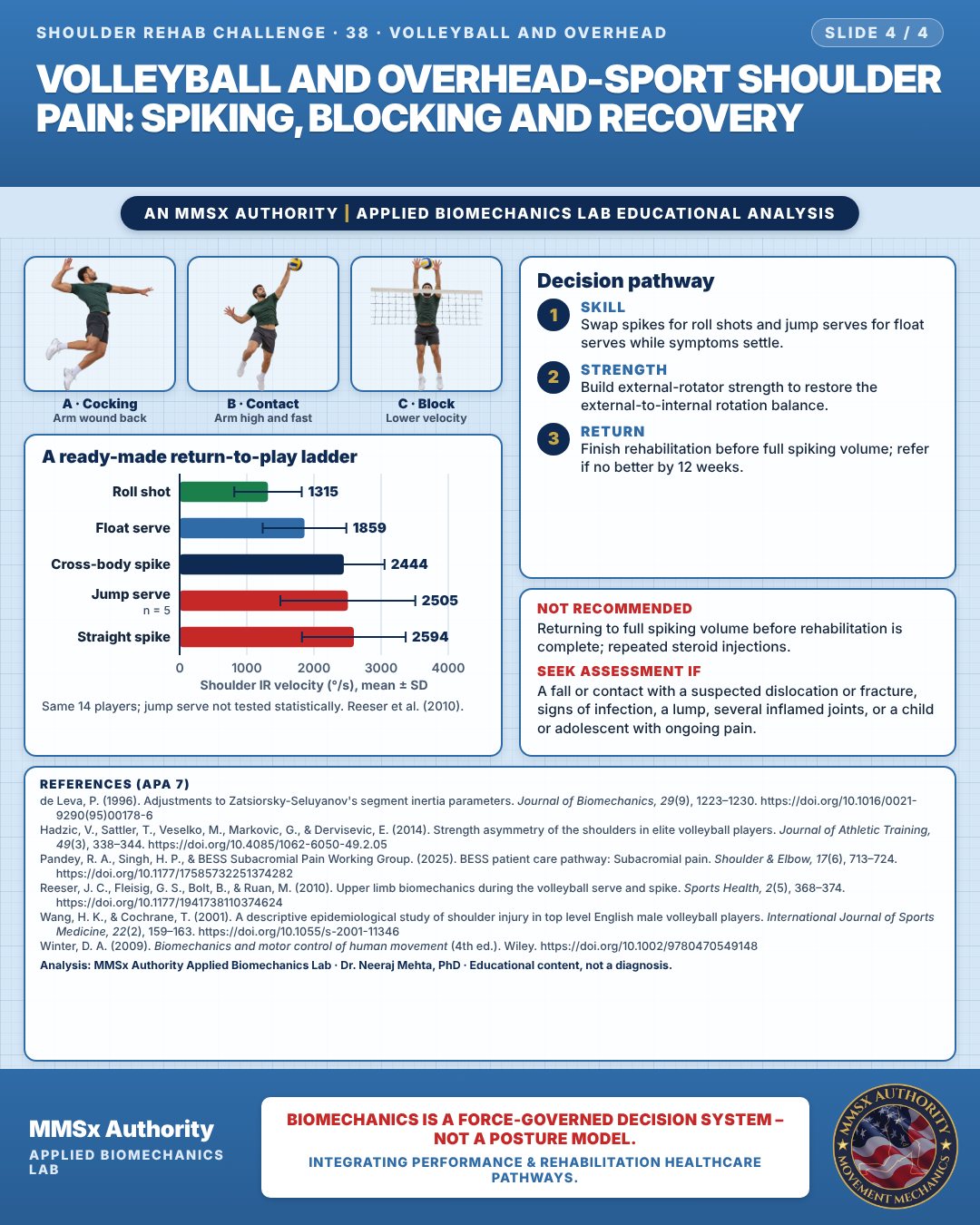
A ready-made return-to-play ladder
Skill
Swap spikes for roll shots and jump serves for float serves while symptoms settle.
Strength
Build external-rotator strength to restore the external-to-internal rotation balance.
Return
Finish rehabilitation before full spiking volume; refer if no better by 12 weeks.
What the evidence supports
- Recommended (evidence-informed): players with overuse symptoms may benefit from fewer spike repetitions, and limiting jump serves may reduce risk (Reeser et al., 2010). Strengthen the external rotators to restore the ER/IR ratio (Hadzic et al., 2014; Wang & Cochrane, 2001b). Finish rehabilitation before returning to full volume, given the high re-injury incidence (Wang & Cochrane, 2001a).
- For persisting cuff or subacromial pain: exercise-led rehabilitation; at most one injection if there is no improvement by 6–8 weeks; refer if there is no improvement by 12 weeks; surgery is not first-line (Pandey & Singh, 2025).
Myth and evidence
EvidenceEvidence: skills differ greatly in load. A roll shot gives about half the internal-rotation velocity and less than half the distraction force of a full spike, and a float serve is lighter than a jump serve (Reeser et al., 2010). Graded skill selection allows continued play while symptoms settle.
Cautions
Not recommended
Returning to full spiking volume before rehabilitation is complete; repeated steroid injections.
Seek assessment if
A fall or contact with a suspected dislocation or fracture, signs of infection, a lump, several inflamed joints, or a child or adolescent with ongoing pain.
Methods note
2-D estimates from pose landmarks on an illustrated figure; CoM from de Leva (1996) segment parameters; cm for a 1.70 m adult (Winter, 2009). Dynamic airborne pose: skeleton and whole-body CoM only; no joint angles are quoted. These are educational estimates, not a diagnosis.
References
- de Leva, P. (1996). Adjustments to Zatsiorsky-Seluyanov's segment inertia parameters. Journal of Biomechanics, 29(9), 1223–1230. https://doi.org/10.1016/0021-9290(95)00178-6
- Hadzic, V., Sattler, T., Veselko, M., Markovic, G., & Dervisevic, E. (2014). Strength asymmetry of the shoulders in elite volleyball players. Journal of Athletic Training, 49(3), 338–344. https://doi.org/10.4085/1062-6050-49.2.05
- Pandey, R. A., Singh, H. P., & BESS Subacromial Pain Working Group. (2025). BESS patient care pathway: Subacromial pain. Shoulder & Elbow, 17(6), 713–724. https://doi.org/10.1177/17585732251374282
- Reeser, J. C., Fleisig, G. S., Bolt, B., & Ruan, M. (2010). Upper limb biomechanics during the volleyball serve and spike. Sports Health, 2(5), 368–374. https://doi.org/10.1177/1941738110374624
- Wang, H. K., & Cochrane, T. (2001). A descriptive epidemiological study of shoulder injury in top level English male volleyball players. International Journal of Sports Medicine, 22(2), 159–163. https://doi.org/10.1055/s-2001-11346
- Winter, D. A. (2009). Biomechanics and motor control of human movement (4th ed.). Wiley. https://doi.org/10.1002/9780470549148
Cite this article
Mehta, N. (2026, October 24). Volleyball and overhead-sport shoulder pain: spiking, blocking and recovery. MMSx Authority Applied Biomechanics Lab. https://mmsxauthority.org/edu/analysis/shoulder/38-volleyball-and-overhead-sport-shoulder-pain-spiking-blocking-and/
Part of the collection
Mehta, N. (2026). Shoulder Rehabilitation: 50 Evidence-Based Biomechanics Analyses [Collection]. MMSx Authority Applied Biomechanics Lab. Zenodo. https://doi.org/10.5281/zenodo.23735725
All Shoulder Rehab Challenge articles · Rehabilitation Library