Shoulder Rehab Challenge · 37
Tennis and padel shoulder pain: serve mechanics and load management
Tennis and padel shoulder pain is overuse pain in the racket-arm shoulder. Movement analysis, verified research data and a decision pathway.
Key points
- Monitor. Measure racket-side total rotation against the other side through the season.
- Load. Plan weekly hitting and match density; matches carry the higher injury rate in padel.
- Rehab. Treat persisting cuff pain with exercise first; refer if no better by 12 weeks.
What it is
Tennis and padel shoulder pain is overuse pain in the racket-arm shoulder. It is usually rotator cuff or subacromial in type, sometimes with posterior-superior (internal) impingement. It is linked to the repeated overhead serve and smash, to the large external-rotation "cocking" and rapid internal-rotation acceleration of the arm, and to deceleration after ball contact. How efficiently the legs and trunk contribute changes how much load the shoulder must supply.
How we analysed the movement
Three movements relevant to this topic were analysed from illustrated reference figures. Joint centres were located with two-dimensional pose estimation; arm elevation and elbow angles, shoulder level, the whole-body centre of mass and, where relevant, the arm lever (the horizontal distance from the shoulder joint to the centre of mass of the arm, with any hand load) and the resulting shoulder moment were then calculated from standard segment parameters. The figures are educational estimates that show how position changes mechanical demand; they are not measurements of a patient. Every research value quoted below comes from the published source cited beside it.
Movement A: Serve trophy (side view)
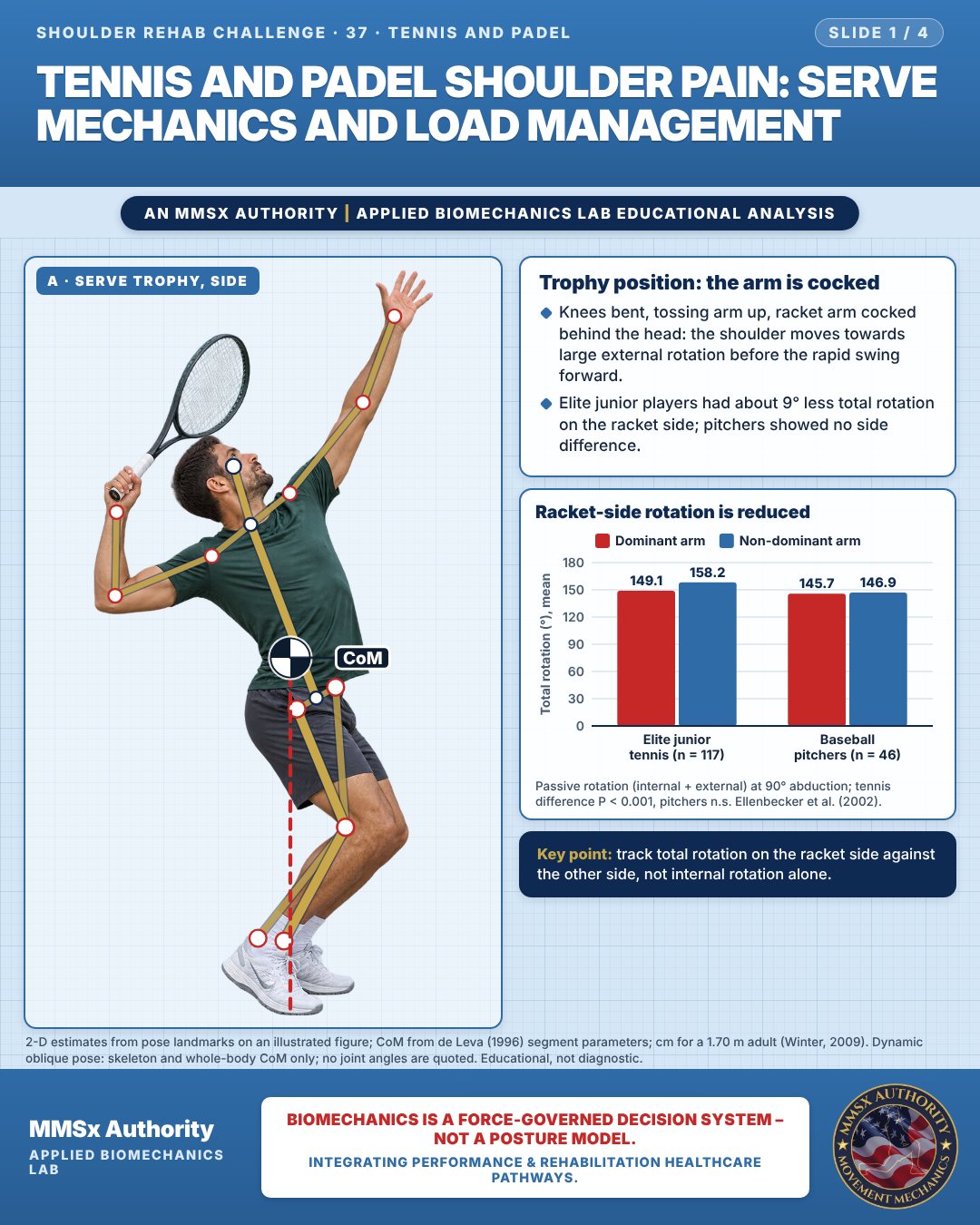
Trophy position: the arm is cocked
Knees bent, tossing arm up, racket arm cocked behind the head: the shoulder moves towards large external rotation before the rapid swing forward.
Elite junior players had about 9° less total rotation on the racket side; pitchers showed no side difference.
Racket-side rotation is reduced
Movement B: Serve contact (side view)
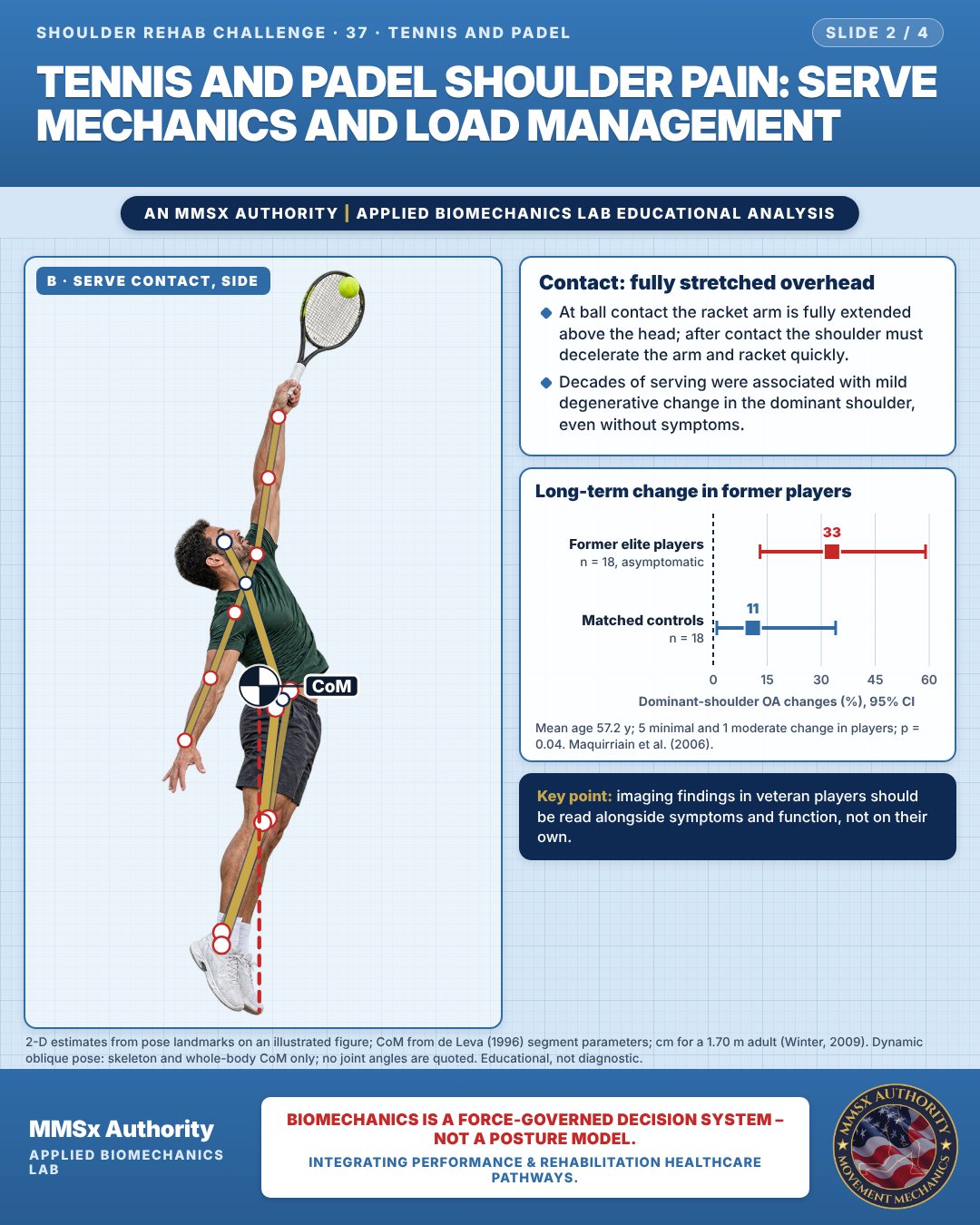
Contact: fully stretched overhead
At ball contact the racket arm is fully extended above the head; after contact the shoulder must decelerate the arm and racket quickly.
Decades of serving were associated with mild degenerative change in the dominant shoulder, even without symptoms.
Long-term change in former players
Movement C: Forehand finish (front view)
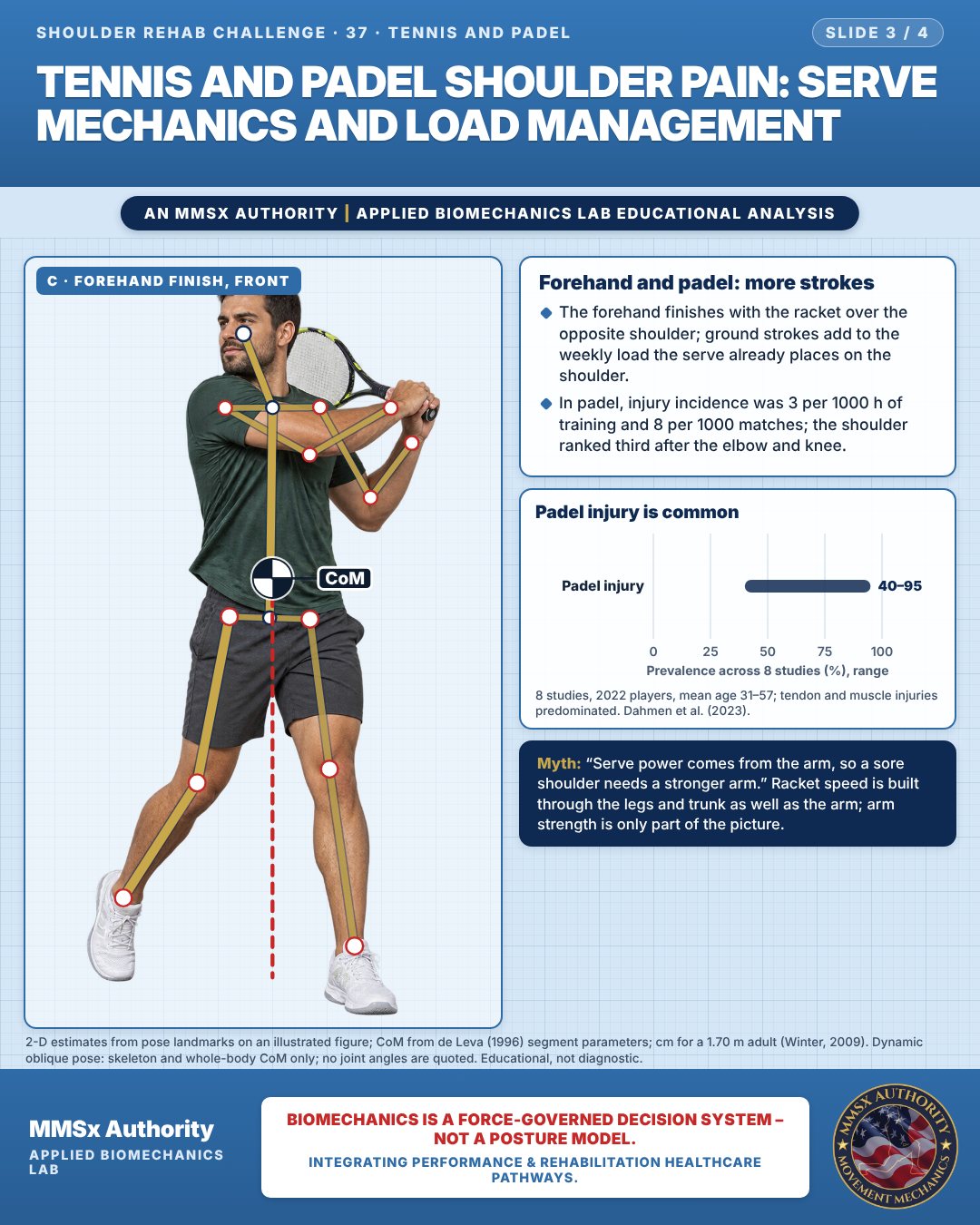
Forehand and padel: more strokes
The forehand finishes with the racket over the opposite shoulder; ground strokes add to the weekly load the serve already places on the shoulder.
In padel, injury incidence was 3 per 1000 h of training and 8 per 1000 matches; the shoulder ranked third after the elbow and knee.
Padel injury is common
Decision pathway
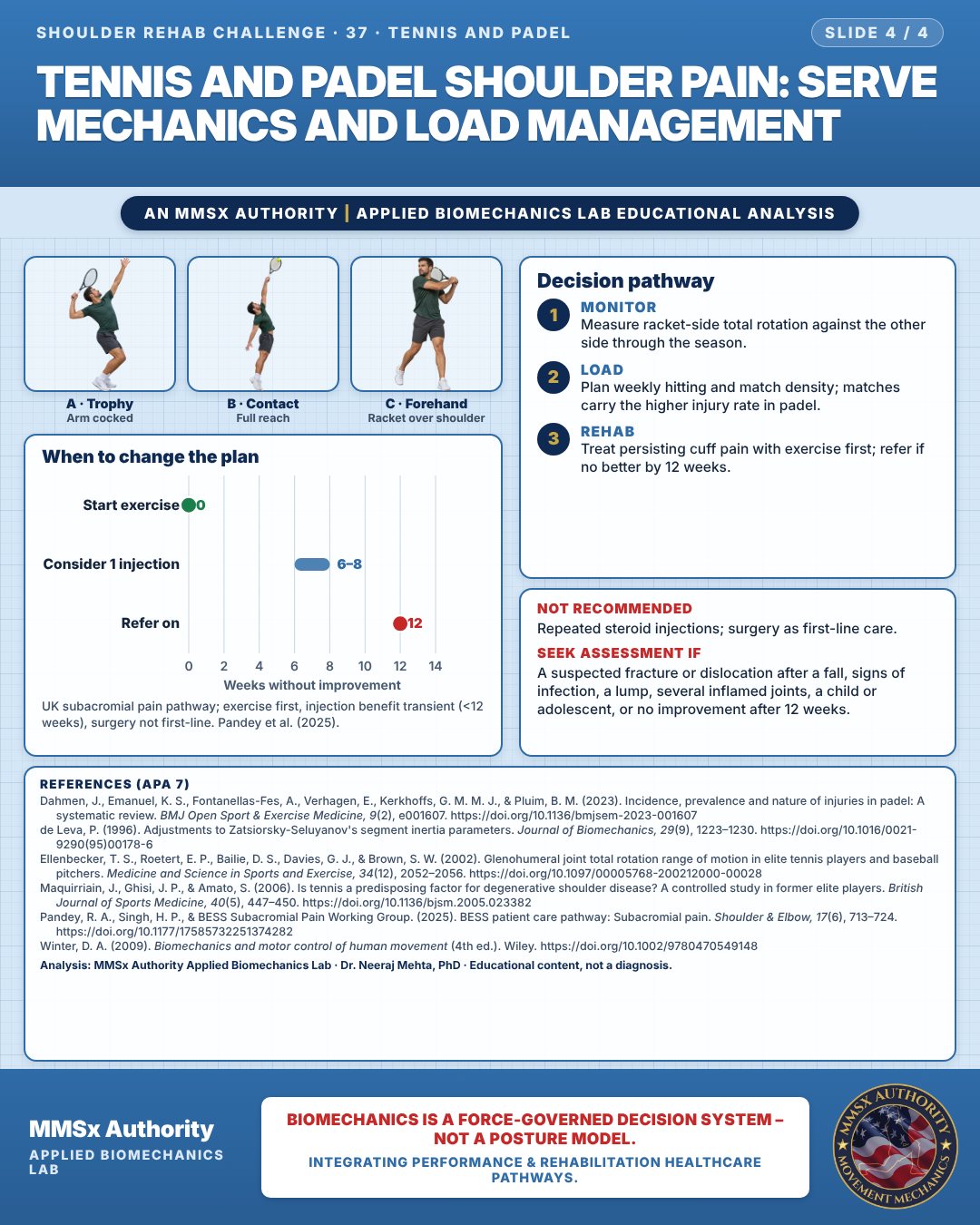
When to change the plan
Monitor
Measure racket-side total rotation against the other side through the season.
Load
Plan weekly hitting and match density; matches carry the higher injury rate in padel.
Rehab
Treat persisting cuff pain with exercise first; refer if no better by 12 weeks.
What the evidence supports
- For persisting cuff or subacromial pain: exercise-led rehabilitation; at most one injection if there is no improvement by 6–8 weeks; refer if there is no improvement by 12 weeks; surgery is not first-line (Pandey & Singh, 2025).
Cautions
Not recommended
Repeated steroid injections; surgery as first-line care.
Seek assessment if
A suspected fracture or dislocation after a fall, signs of infection, a lump, several inflamed joints, a child or adolescent, or no improvement after 12 weeks.
Methods note
2-D estimates from pose landmarks on an illustrated figure; CoM from de Leva (1996) segment parameters; cm for a 1.70 m adult (Winter, 2009). Dynamic oblique pose: skeleton and whole-body CoM only; no joint angles are quoted. These are educational estimates, not a diagnosis.
References
- Dahmen, J., Emanuel, K. S., Fontanellas-Fes, A., Verhagen, E., Kerkhoffs, G. M. M. J., & Pluim, B. M. (2023). Incidence, prevalence and nature of injuries in padel: A systematic review. BMJ Open Sport & Exercise Medicine, 9(2), e001607. https://doi.org/10.1136/bmjsem-2023-001607
- de Leva, P. (1996). Adjustments to Zatsiorsky-Seluyanov's segment inertia parameters. Journal of Biomechanics, 29(9), 1223–1230. https://doi.org/10.1016/0021-9290(95)00178-6
- Ellenbecker, T. S., Roetert, E. P., Bailie, D. S., Davies, G. J., & Brown, S. W. (2002). Glenohumeral joint total rotation range of motion in elite tennis players and baseball pitchers. Medicine and Science in Sports and Exercise, 34(12), 2052–2056. https://doi.org/10.1097/00005768-200212000-00028
- Maquirriain, J., Ghisi, J. P., & Amato, S. (2006). Is tennis a predisposing factor for degenerative shoulder disease? A controlled study in former elite players. British Journal of Sports Medicine, 40(5), 447–450. https://doi.org/10.1136/bjsm.2005.023382
- Pandey, R. A., Singh, H. P., & BESS Subacromial Pain Working Group. (2025). BESS patient care pathway: Subacromial pain. Shoulder & Elbow, 17(6), 713–724. https://doi.org/10.1177/17585732251374282
- Winter, D. A. (2009). Biomechanics and motor control of human movement (4th ed.). Wiley. https://doi.org/10.1002/9780470549148
Cite this article
Mehta, N. (2026, October 24). Tennis and padel shoulder pain: serve mechanics and load management. MMSx Authority Applied Biomechanics Lab. https://mmsxauthority.org/edu/analysis/shoulder/37-tennis-and-padel-shoulder-pain-serve-mechanics-and-load-management/
Part of the collection
Mehta, N. (2026). Shoulder Rehabilitation: 50 Evidence-Based Biomechanics Analyses [Collection]. MMSx Authority Applied Biomechanics Lab. Zenodo. https://doi.org/10.5281/zenodo.23735725
All Shoulder Rehab Challenge articles · Rehabilitation Library