Shoulder Rehab Challenge · 36
Throwing shoulder: why the whole kinetic chain matters
The throwing shoulder is a term for pain or injury in overhead throwers. Movement analysis, verified research data and a decision pathway.
Key points
- Workload. Limit pitches per game; avoid pitching with arm fatigue or for several teams at once.
- Range. Screen throwing-side external rotation and total motion, not internal rotation alone.
- Chain. Train pelvis and trunk sequencing; for persisting pain, exercise first and refer at 12 weeks.
What it is
The throwing shoulder is a term for pain or injury in overhead throwers. It covers rotator cuff (often undersurface) tendinopathy, superior labral injury, internal impingement and, at the elbow, medial ligament overload. It arises from very high and very fast joint loads in late cocking and after ball release. Those loads are shaped by how well the legs, pelvis and trunk generate and pass on energy (the kinetic chain) and by throwing workload.
How we analysed the movement
Three movements relevant to this topic were analysed from illustrated reference figures. Joint centres were located with two-dimensional pose estimation; arm elevation and elbow angles, shoulder level, the whole-body centre of mass and, where relevant, the arm lever (the horizontal distance from the shoulder joint to the centre of mass of the arm, with any hand load) and the resulting shoulder moment were then calculated from standard segment parameters. The figures are educational estimates that show how position changes mechanical demand; they are not measurements of a patient. Every research value quoted below comes from the published source cited beside it.
Movement A: Late cocking (side view)
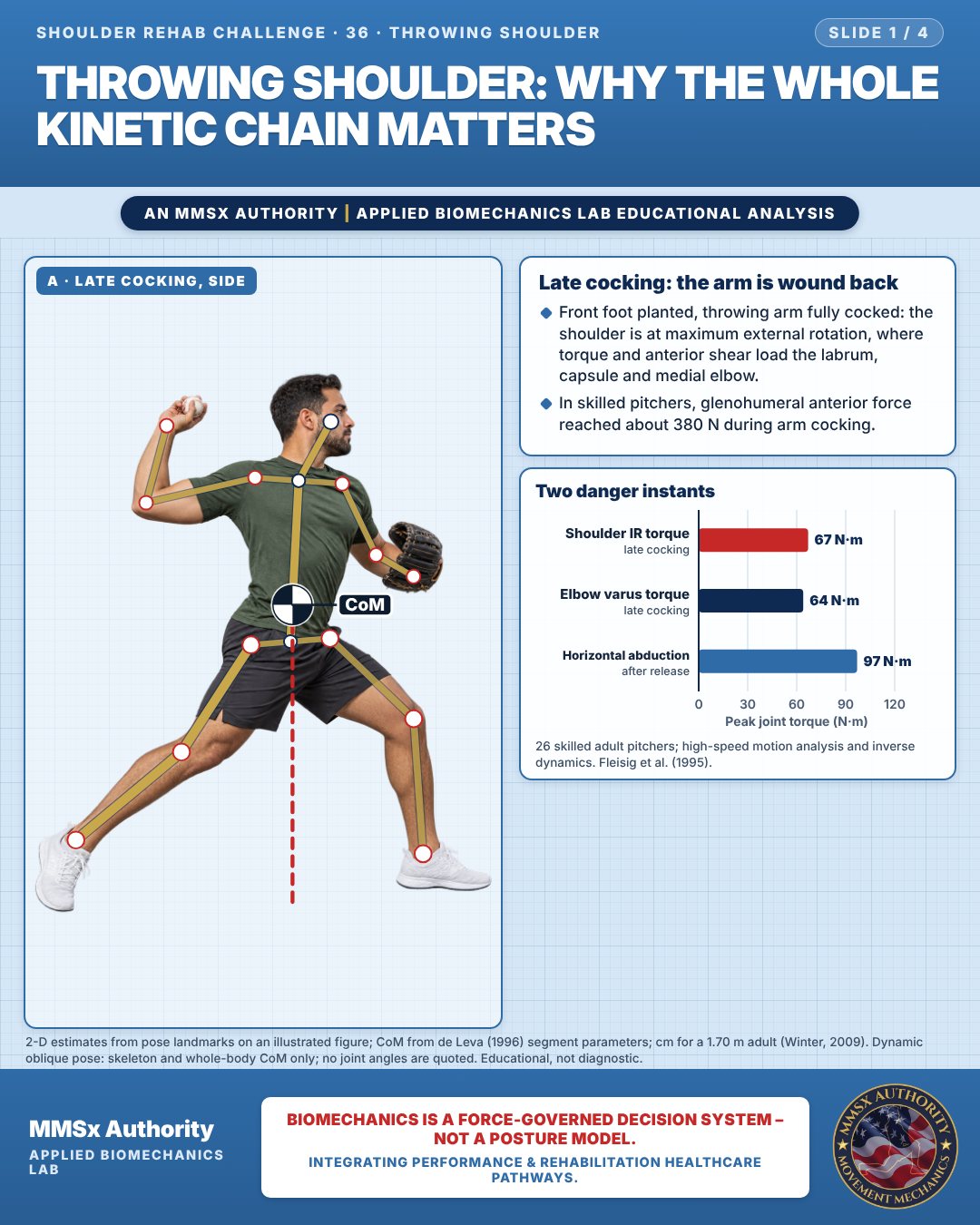
Late cocking: the arm is wound back
Front foot planted, throwing arm fully cocked: the shoulder is at maximum external rotation, where torque and anterior shear load the labrum, capsule and medial elbow.
In skilled pitchers, glenohumeral anterior force reached about 380 N during arm cocking.
Two danger instants
Movement B: Ball release (side view)
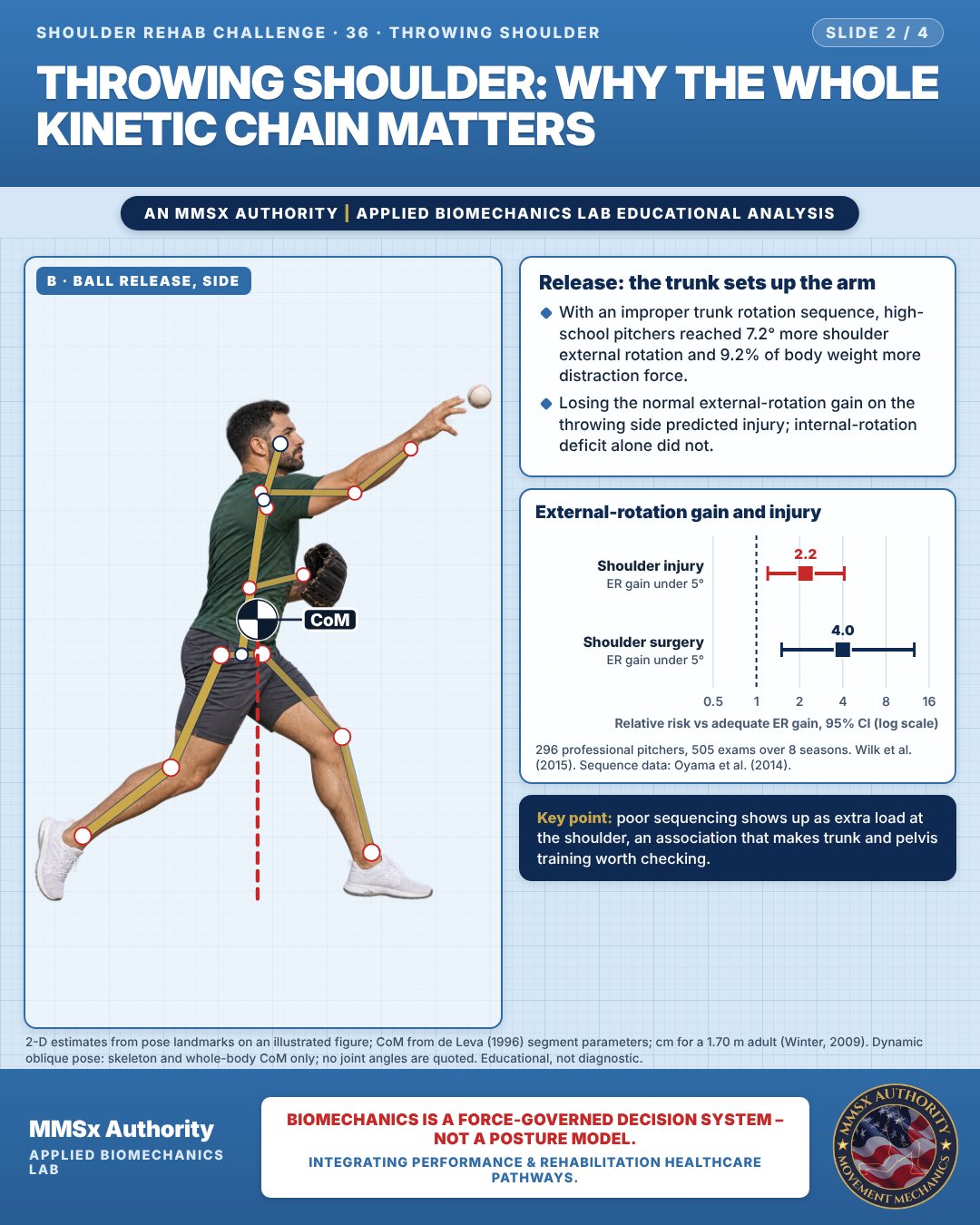
Release: the trunk sets up the arm
With an improper trunk rotation sequence, high-school pitchers reached 7.2° more shoulder external rotation and 9.2% of body weight more distraction force.
Losing the normal external-rotation gain on the throwing side predicted injury; internal-rotation deficit alone did not.
External-rotation gain and injury
Movement C: Follow-through (front view)
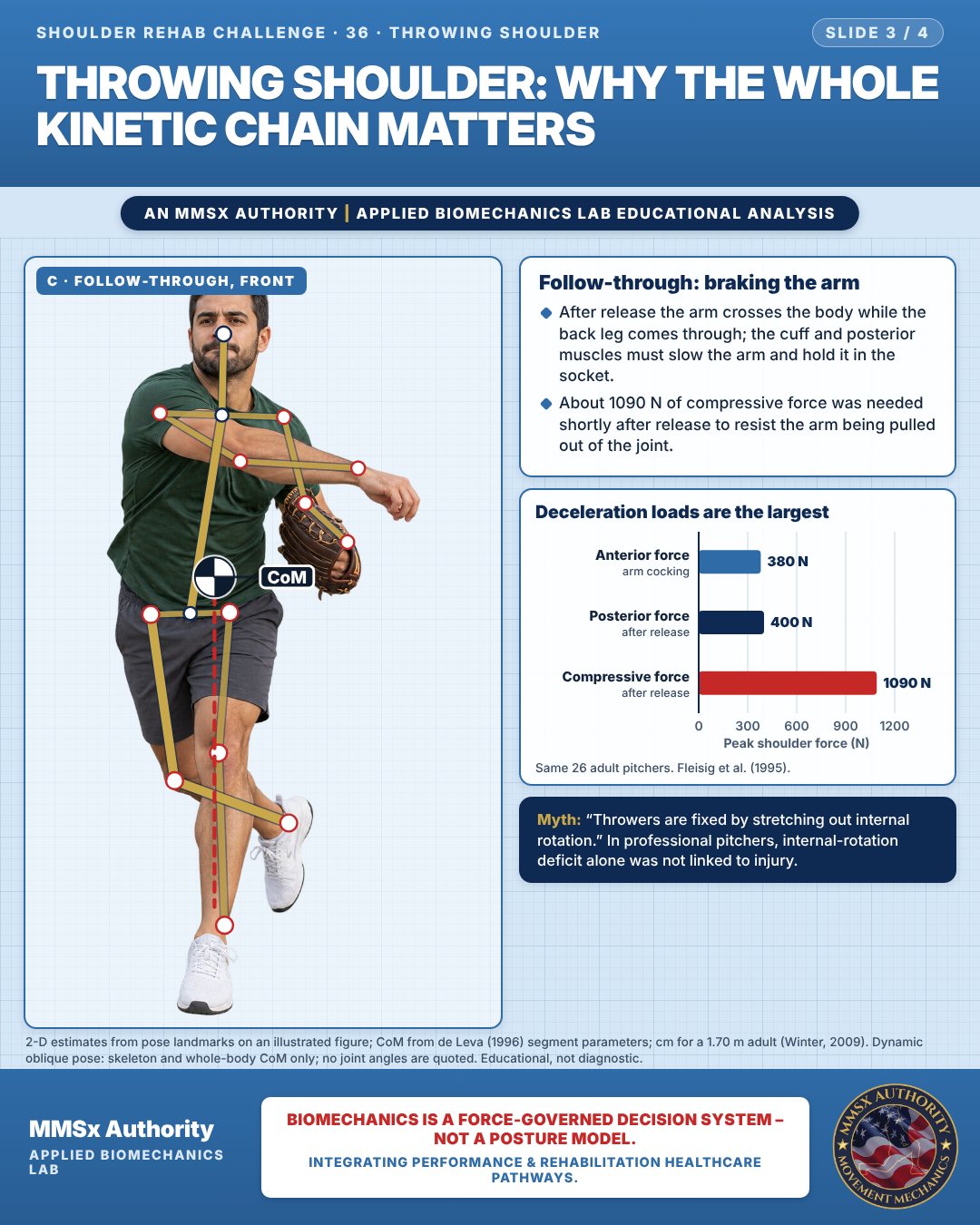
Follow-through: braking the arm
After release the arm crosses the body while the back leg comes through; the cuff and posterior muscles must slow the arm and hold it in the socket.
About 1090 N of compressive force was needed shortly after release to resist the arm being pulled out of the joint.
Deceleration loads are the largest
Decision pathway
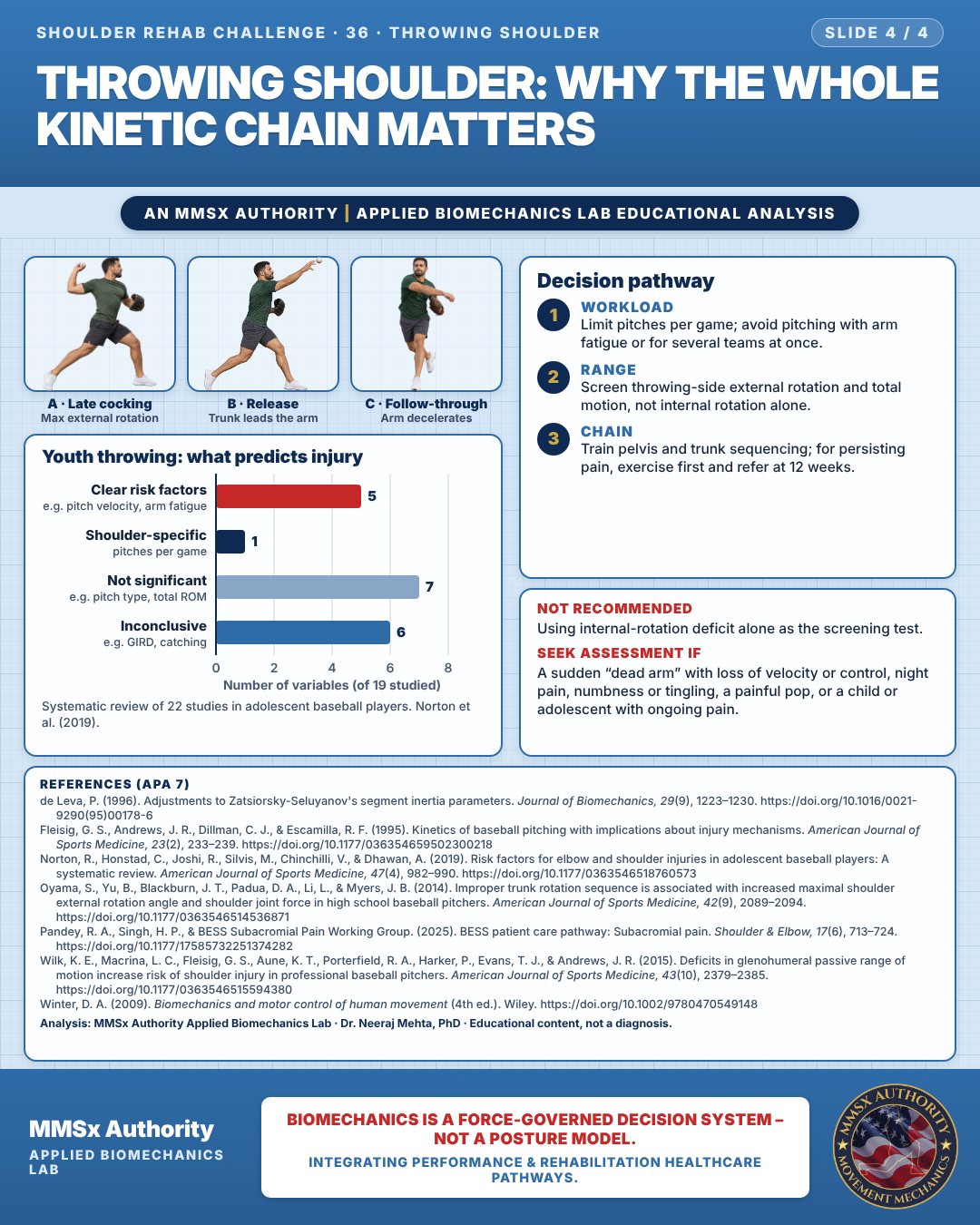
Youth throwing: what predicts injury
Workload
Limit pitches per game; avoid pitching with arm fatigue or for several teams at once.
Range
Screen throwing-side external rotation and total motion, not internal rotation alone.
Chain
Train pelvis and trunk sequencing; for persisting pain, exercise first and refer at 12 weeks.
What the evidence supports
- Recommended (evidence-informed): manage workload (pitches per game) and avoid pitching with arm fatigue or for multiple teams at once (Norton et al., 2019). Screen and restore throwing-side external rotation and total motion (Wilk et al., 2015). Train trunk and pelvis sequencing to reduce shoulder external rotation and distraction load (Oyama et al., 2014).
- For established subacromial or cuff pain: exercise-based rehabilitation first; refer if there is no improvement by 12 weeks (Pandey & Singh, 2025).
- Not supported as a single screening test: GIRD alone, which was not associated with injury in professional pitchers (Wilk et al., 2015) and was inconclusive in adolescents (Norton et al., 2019).
Myth and evidence
EvidenceEvidence: in 296 professional pitchers, GIRD was not significantly related to injury. Insufficient external-rotation gain was (2.2× injury, 4.0× surgery) (Wilk et al., 2015). Improper trunk sequencing raised shoulder distraction force by 9.2% of body weight (Oyama et al., 2014), and workload and fatigue are the clearest risk factors (Norton et al., 2019).
Cautions
Not recommended
Using internal-rotation deficit alone as the screening test.
Seek assessment if
A sudden “dead arm” with loss of velocity or control, night pain, numbness or tingling, a painful pop, or a child or adolescent with ongoing pain.
Methods note
2-D estimates from pose landmarks on an illustrated figure; CoM from de Leva (1996) segment parameters; cm for a 1.70 m adult (Winter, 2009). Dynamic oblique pose: skeleton and whole-body CoM only; no joint angles are quoted. These are educational estimates, not a diagnosis.
References
- de Leva, P. (1996). Adjustments to Zatsiorsky-Seluyanov's segment inertia parameters. Journal of Biomechanics, 29(9), 1223–1230. https://doi.org/10.1016/0021-9290(95)00178-6
- Fleisig, G. S., Andrews, J. R., Dillman, C. J., & Escamilla, R. F. (1995). Kinetics of baseball pitching with implications about injury mechanisms. American Journal of Sports Medicine, 23(2), 233–239. https://doi.org/10.1177/036354659502300218
- Norton, R., Honstad, C., Joshi, R., Silvis, M., Chinchilli, V., & Dhawan, A. (2019). Risk factors for elbow and shoulder injuries in adolescent baseball players: A systematic review. American Journal of Sports Medicine, 47(4), 982–990. https://doi.org/10.1177/0363546518760573
- Oyama, S., Yu, B., Blackburn, J. T., Padua, D. A., Li, L., & Myers, J. B. (2014). Improper trunk rotation sequence is associated with increased maximal shoulder external rotation angle and shoulder joint force in high school baseball pitchers. American Journal of Sports Medicine, 42(9), 2089–2094. https://doi.org/10.1177/0363546514536871
- Pandey, R. A., Singh, H. P., & BESS Subacromial Pain Working Group. (2025). BESS patient care pathway: Subacromial pain. Shoulder & Elbow, 17(6), 713–724. https://doi.org/10.1177/17585732251374282
- Wilk, K. E., Macrina, L. C., Fleisig, G. S., Aune, K. T., Porterfield, R. A., Harker, P., Evans, T. J., & Andrews, J. R. (2015). Deficits in glenohumeral passive range of motion increase risk of shoulder injury in professional baseball pitchers. American Journal of Sports Medicine, 43(10), 2379–2385. https://doi.org/10.1177/0363546515594380
- Winter, D. A. (2009). Biomechanics and motor control of human movement (4th ed.). Wiley. https://doi.org/10.1002/9780470549148
Cite this article
Mehta, N. (2026, October 24). Throwing shoulder: why the whole kinetic chain matters. MMSx Authority Applied Biomechanics Lab. https://mmsxauthority.org/edu/analysis/shoulder/36-throwing-shoulder-why-the-whole-kinetic-chain-matters/
Part of the collection
Mehta, N. (2026). Shoulder Rehabilitation: 50 Evidence-Based Biomechanics Analyses [Collection]. MMSx Authority Applied Biomechanics Lab. Zenodo. https://doi.org/10.5281/zenodo.23735725
All Shoulder Rehab Challenge articles · Rehabilitation Library