Shoulder Rehab Challenge · 35
Swimmer's shoulder: stroke volume, technique and fatigue
"Swimmer's shoulder" is a descriptive term, not a single diagnosis. Movement analysis, verified research data and a decision pathway.
Key points
- Volume. Track swim volume all year and avoid sudden large increases.
- Build. Strengthen the middle trapezius and internal rotators, train core endurance and keep another sport.
- Rehab. Treat persisting pain with exercise first; refer if no better by 12 weeks.
What it is
"Swimmer's shoulder" is a descriptive term, not a single diagnosis. It means anterior or lateral shoulder pain in swimmers, most often consistent with supraspinatus (rotator cuff) tendinopathy that builds with swim-training volume. Laxity and instability play a smaller and less consistent role.
How we analysed the movement
Three movements relevant to this topic were analysed from illustrated reference figures. Joint centres were located with two-dimensional pose estimation; arm elevation and elbow angles, shoulder level, the whole-body centre of mass and, where relevant, the arm lever (the horizontal distance from the shoulder joint to the centre of mass of the arm, with any hand load) and the resulting shoulder moment were then calculated from standard segment parameters. The figures are educational estimates that show how position changes mechanical demand; they are not measurements of a patient. Every research value quoted below comes from the published source cited beside it.
Movement A: Band freestyle pull (side view)
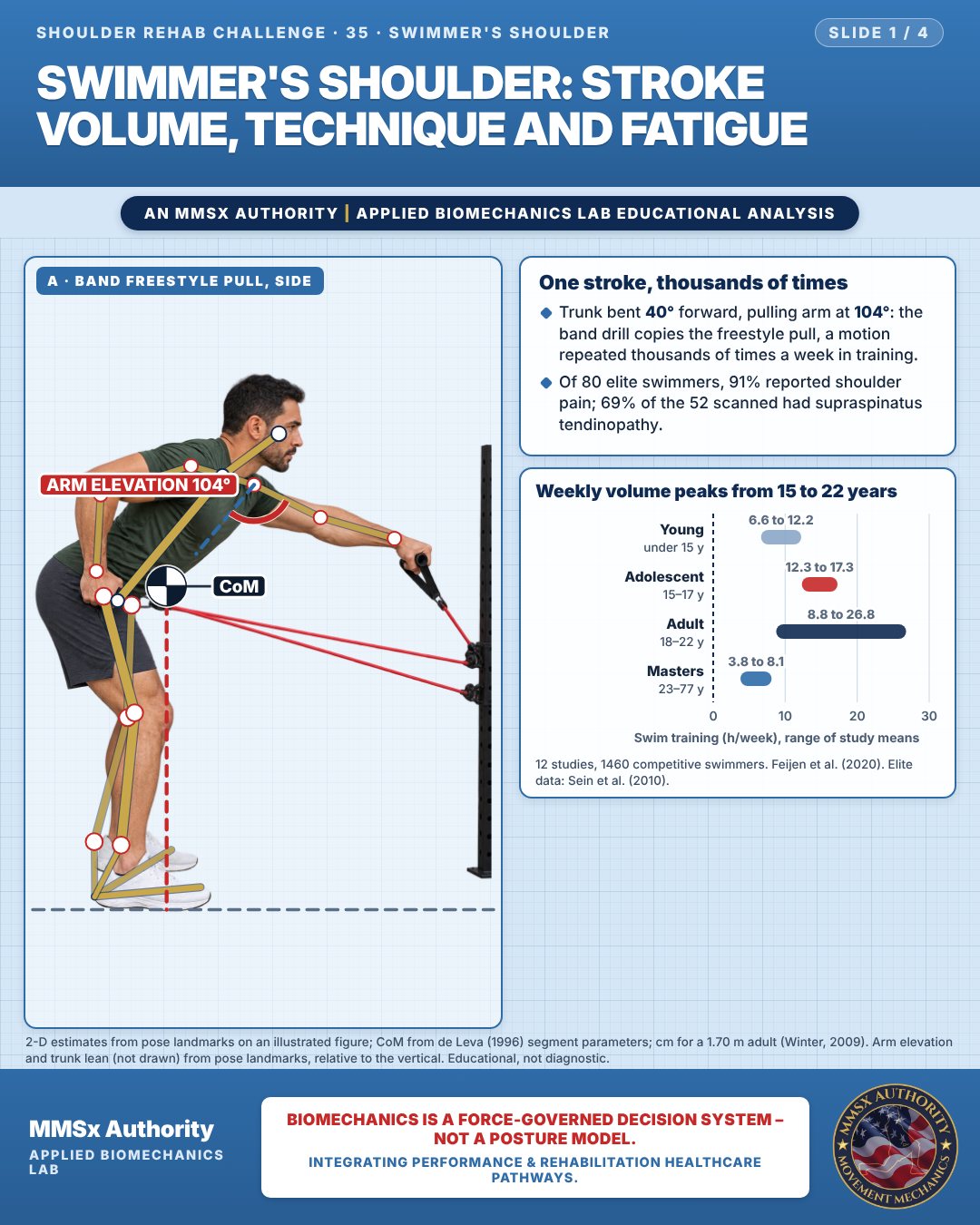
One stroke, thousands of times
Trunk bent 40° forward, pulling arm at 104°: the band drill copies the freestyle pull, a motion repeated thousands of times a week in training.
Of 80 elite swimmers, 91% reported shoulder pain; 69% of the 52 scanned had supraspinatus tendinopathy.
Weekly volume peaks from 15 to 22 years
Movement B: Streamline (side view)
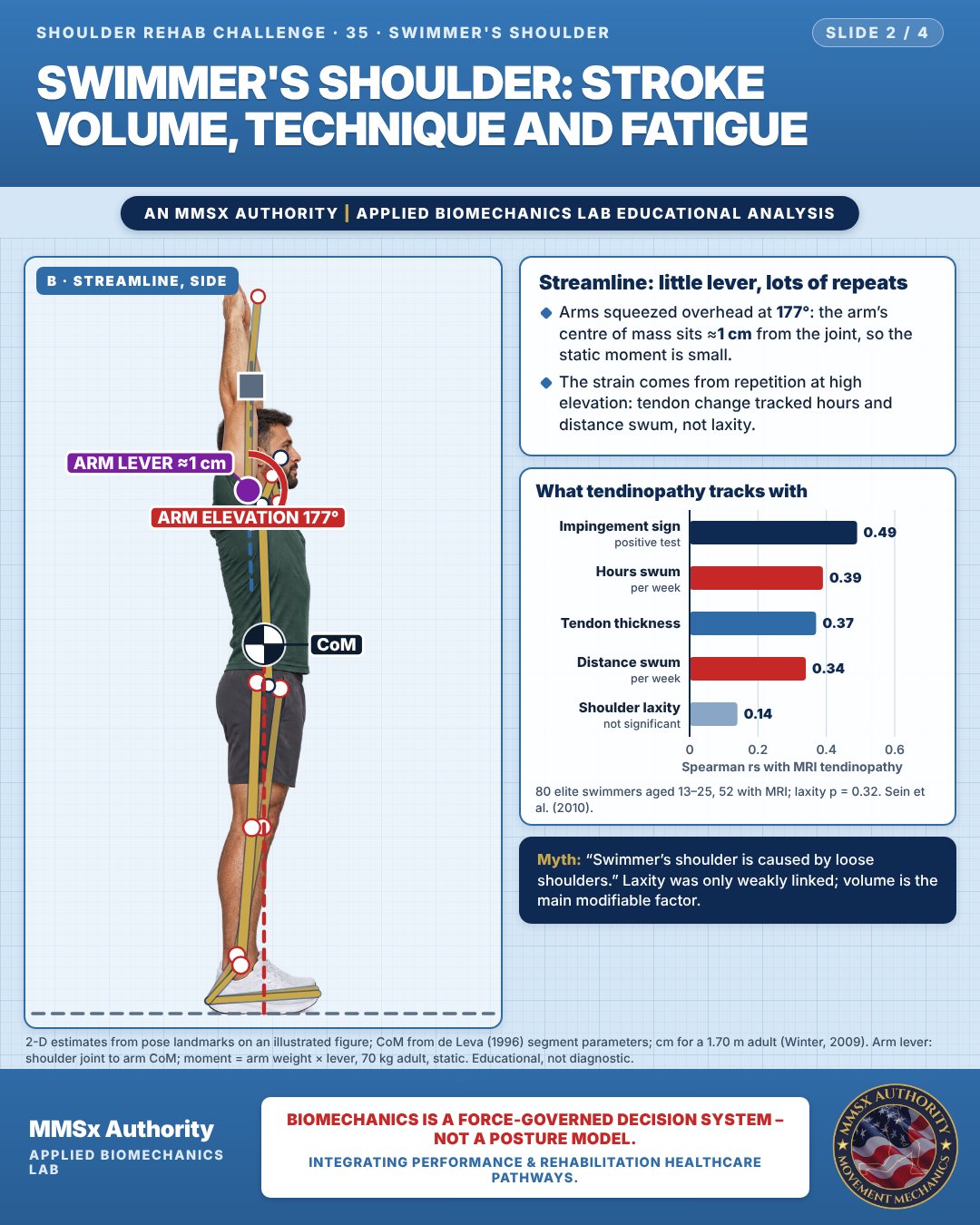
Streamline: little lever, lots of repeats
Arms squeezed overhead at 177°: the arm’s centre of mass sits ≈1 cm from the joint, so the static moment is small.
The strain comes from repetition at high elevation: tendon change tracked hours and distance swum, not laxity.
What tendinopathy tracks with
Movement C: Prone y raise (rear view)
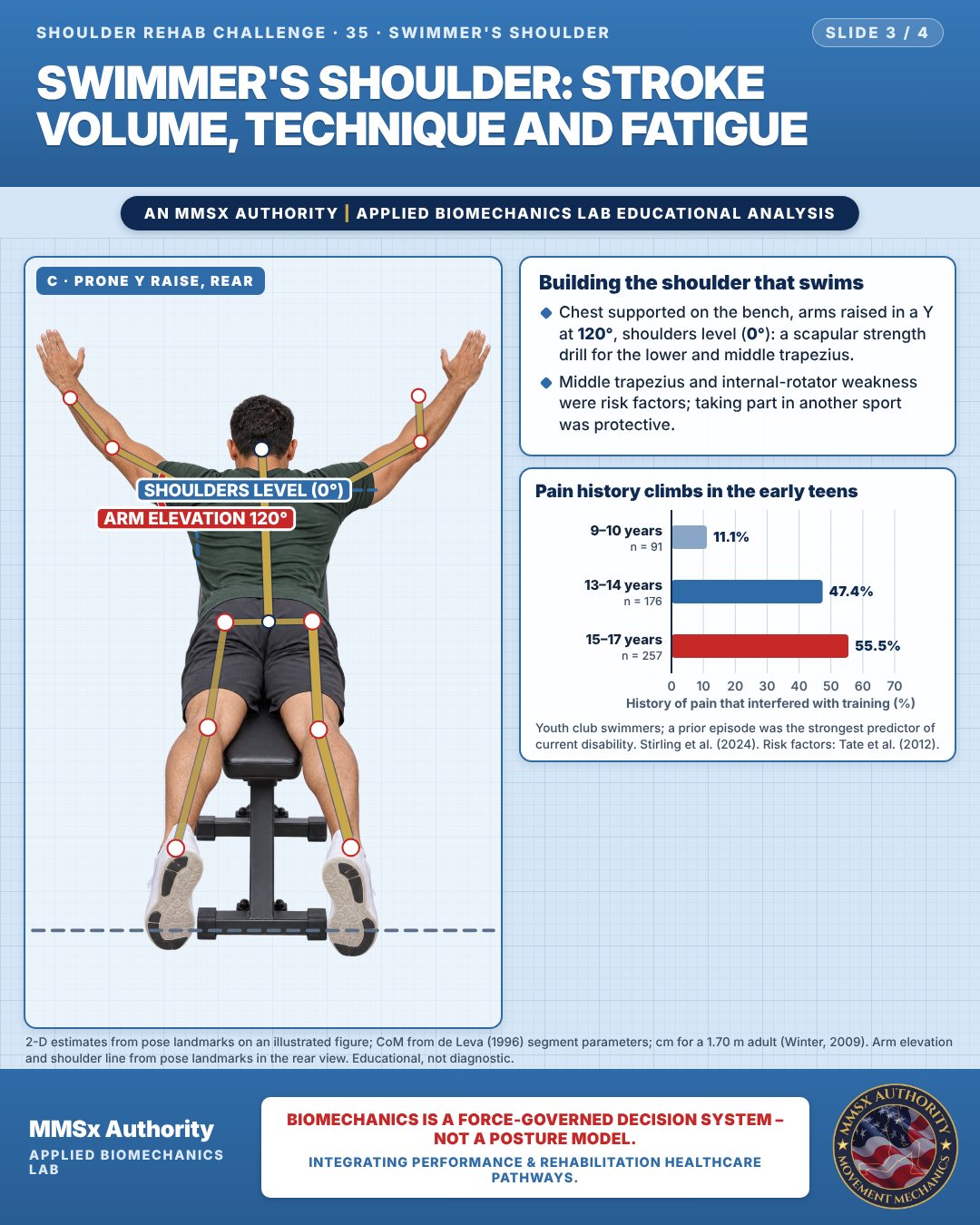
Building the shoulder that swims
Chest supported on the bench, arms raised in a Y at 120°, shoulders level (0°): a scapular strength drill for the lower and middle trapezius.
Middle trapezius and internal-rotator weakness were risk factors; taking part in another sport was protective.
Pain history climbs in the early teens
Decision pathway
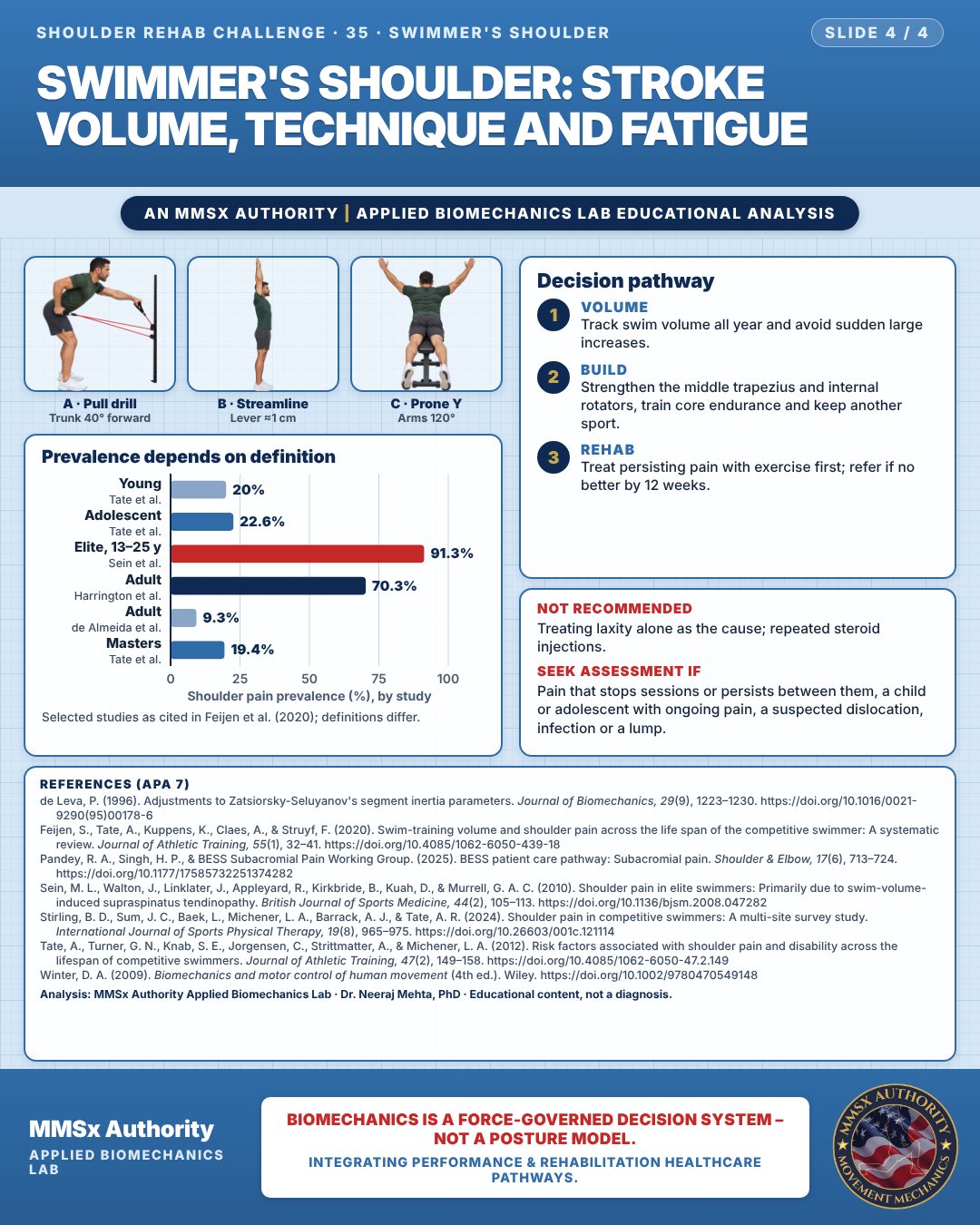
Prevalence depends on definition
Volume
Track swim volume all year and avoid sudden large increases.
Build
Strengthen the middle trapezius and internal rotators, train core endurance and keep another sport.
Rehab
Treat persisting pain with exercise first; refer if no better by 12 weeks.
What the evidence supports
- Recommended: monitor swim-training volume year-round and avoid sudden large increases in volume (Feijen et al., 2020). The suggested prevention elements are exposure reduction, cross-training (participation in another sport was protective), stretching, strengthening (middle trapezius and internal-rotator weakness were risk factors) and core endurance (Tate et al., 2012).
- For persisting subacromial or cuff-type pain: exercise-led rehabilitation first; at most one injection if there is no improvement by 6–8 weeks; refer if there is no improvement at 12 weeks (Pandey & Singh, 2025).
- Not recommended: treating laxity alone as the cause; laxity was only weakly associated with pain and not with tendinopathy (Sein et al., 2010).
Myth and evidence
EvidenceEvidence: in elite swimmers, MRI tendinopathy correlated with hours (rs = 0.39) and distance (rs = 0.34) swum, but not with laxity (rs = 0.14, p = 0.32) (Sein et al., 2010). Volume management is the key lever (Feijen et al., 2020).
Cautions
Not recommended
Treating laxity alone as the cause; repeated steroid injections.
Seek assessment if
Pain that stops sessions or persists between them, a child or adolescent with ongoing pain, a suspected dislocation, infection or a lump.
Methods note
2-D estimates from pose landmarks on an illustrated figure; CoM from de Leva (1996) segment parameters; cm for a 1.70 m adult (Winter, 2009). Arm elevation and trunk lean (not drawn) from pose landmarks, relative to the vertical. Arm lever: shoulder joint to arm CoM; moment = arm weight × lever, 70 kg adult, static. Arm elevation and shoulder line from pose landmarks in the rear view. These are educational estimates, not a diagnosis.
References
- de Leva, P. (1996). Adjustments to Zatsiorsky-Seluyanov's segment inertia parameters. Journal of Biomechanics, 29(9), 1223–1230. https://doi.org/10.1016/0021-9290(95)00178-6
- Feijen, S., Tate, A., Kuppens, K., Claes, A., & Struyf, F. (2020). Swim-training volume and shoulder pain across the life span of the competitive swimmer: A systematic review. Journal of Athletic Training, 55(1), 32–41. https://doi.org/10.4085/1062-6050-439-18
- Pandey, R. A., Singh, H. P., & BESS Subacromial Pain Working Group. (2025). BESS patient care pathway: Subacromial pain. Shoulder & Elbow, 17(6), 713–724. https://doi.org/10.1177/17585732251374282
- Sein, M. L., Walton, J., Linklater, J., Appleyard, R., Kirkbride, B., Kuah, D., & Murrell, G. A. C. (2010). Shoulder pain in elite swimmers: Primarily due to swim-volume-induced supraspinatus tendinopathy. British Journal of Sports Medicine, 44(2), 105–113. https://doi.org/10.1136/bjsm.2008.047282
- Stirling, B. D., Sum, J. C., Baek, L., Michener, L. A., Barrack, A. J., & Tate, A. R. (2024). Shoulder pain in competitive swimmers: A multi-site survey study. International Journal of Sports Physical Therapy, 19(8), 965–975. https://doi.org/10.26603/001c.121114
- Tate, A., Turner, G. N., Knab, S. E., Jorgensen, C., Strittmatter, A., & Michener, L. A. (2012). Risk factors associated with shoulder pain and disability across the lifespan of competitive swimmers. Journal of Athletic Training, 47(2), 149–158. https://doi.org/10.4085/1062-6050-47.2.149
- Winter, D. A. (2009). Biomechanics and motor control of human movement (4th ed.). Wiley. https://doi.org/10.1002/9780470549148
Cite this article
Mehta, N. (2026, October 24). Swimmer's shoulder: stroke volume, technique and fatigue. MMSx Authority Applied Biomechanics Lab. https://mmsxauthority.org/edu/analysis/shoulder/35-swimmers-shoulder-stroke-volume-technique-and-fatigue/
Part of the collection
Mehta, N. (2026). Shoulder Rehabilitation: 50 Evidence-Based Biomechanics Analyses [Collection]. MMSx Authority Applied Biomechanics Lab. Zenodo. https://doi.org/10.5281/zenodo.23735725
All Shoulder Rehab Challenge articles · Rehabilitation Library