Shoulder Rehab Challenge · 34
Pull-ups and hanging with shoulder pain: building tolerance safely
Pull-up- or hang-related shoulder pain is pain during hanging, pulling or the lowering phase.
Key points
- Control. Start with scapular drills such as external rotation with a scapular squeeze.
- Hang. Add active hangs with the shoulder blades drawn down, then assisted or slow-lowering pull-ups.
- Grip. Use a neutral or reverse grip if overhand hurts; build range and volume over weeks.
What it is
Pull-up- or hang-related shoulder pain is pain during hanging, pulling or the lowering phase. It usually arises when the rotator cuff and subacromial tissues are loaded at high arm elevation. The lowering (eccentric) phase loads the supraspinatus, deltoid and triceps in positions considered vulnerable. Scapular control (depression and retraction) and grip choice change how load is shared.
How we analysed the movement
Three movements relevant to this topic were analysed from illustrated reference figures. Joint centres were located with two-dimensional pose estimation; arm elevation and elbow angles, shoulder level, the whole-body centre of mass and, where relevant, the arm lever (the horizontal distance from the shoulder joint to the centre of mass of the arm, with any hand load) and the resulting shoulder moment were then calculated from standard segment parameters. The figures are educational estimates that show how position changes mechanical demand; they are not measurements of a patient. Every research value quoted below comes from the published source cited beside it.
Movement A: Straight-arm hang (front view)
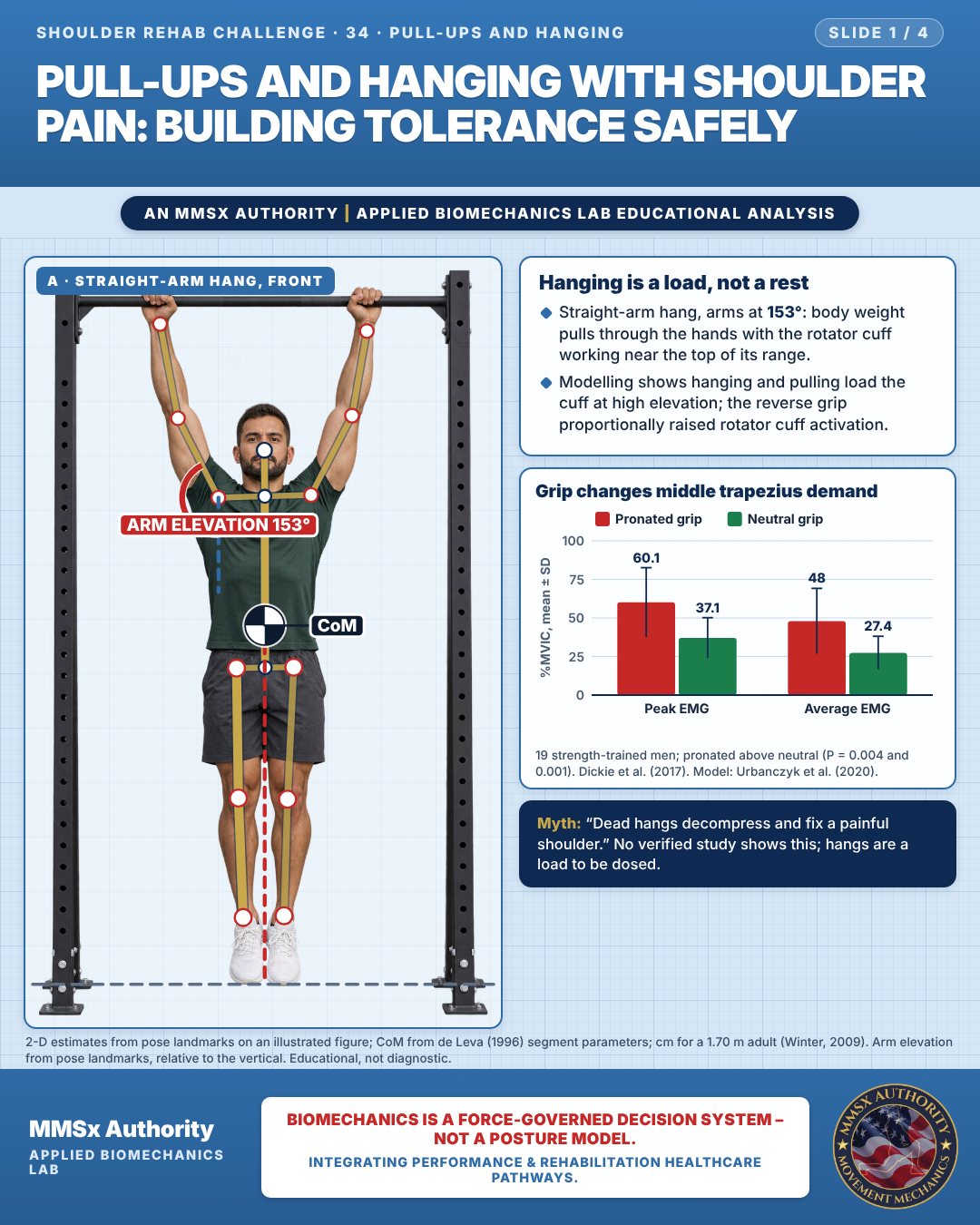
Hanging is a load, not a rest
Straight-arm hang, arms at 153°: body weight pulls through the hands with the rotator cuff working near the top of its range.
Modelling shows hanging and pulling load the cuff at high elevation; the reverse grip proportionally raised rotator cuff activation.
Grip changes middle trapezius demand
Movement B: Top of pull-up (side view)
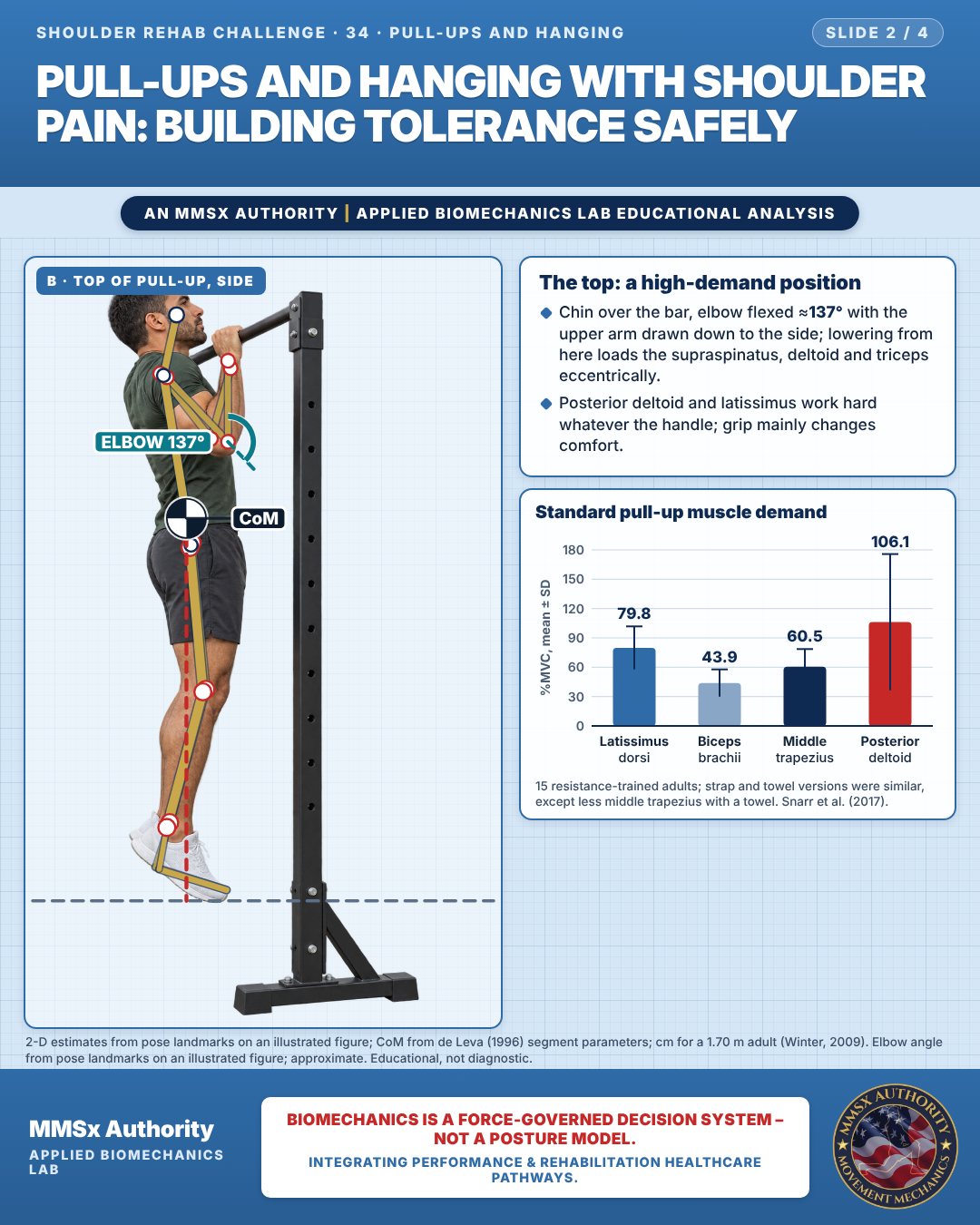
The top: a high-demand position
Chin over the bar, elbow flexed ≈137° with the upper arm drawn down to the side; lowering from here loads the supraspinatus, deltoid and triceps eccentrically.
Posterior deltoid and latissimus work hard whatever the handle; grip mainly changes comfort.
Standard pull-up muscle demand
Movement C: Scapular hang (rear view)
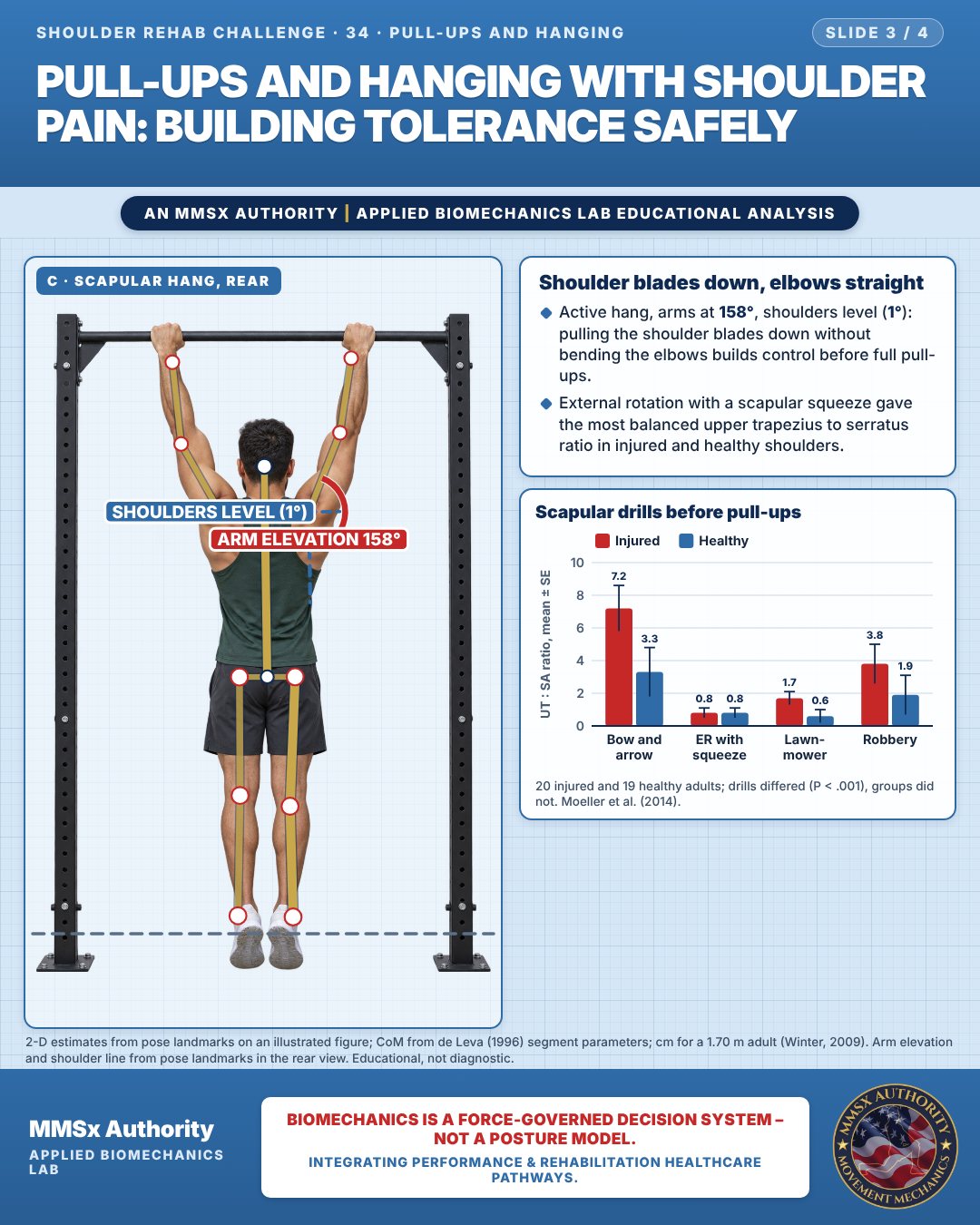
Shoulder blades down, elbows straight
Active hang, arms at 158°, shoulders level (1°): pulling the shoulder blades down without bending the elbows builds control before full pull-ups.
External rotation with a scapular squeeze gave the most balanced upper trapezius to serratus ratio in injured and healthy shoulders.
Scapular drills before pull-ups
Decision pathway
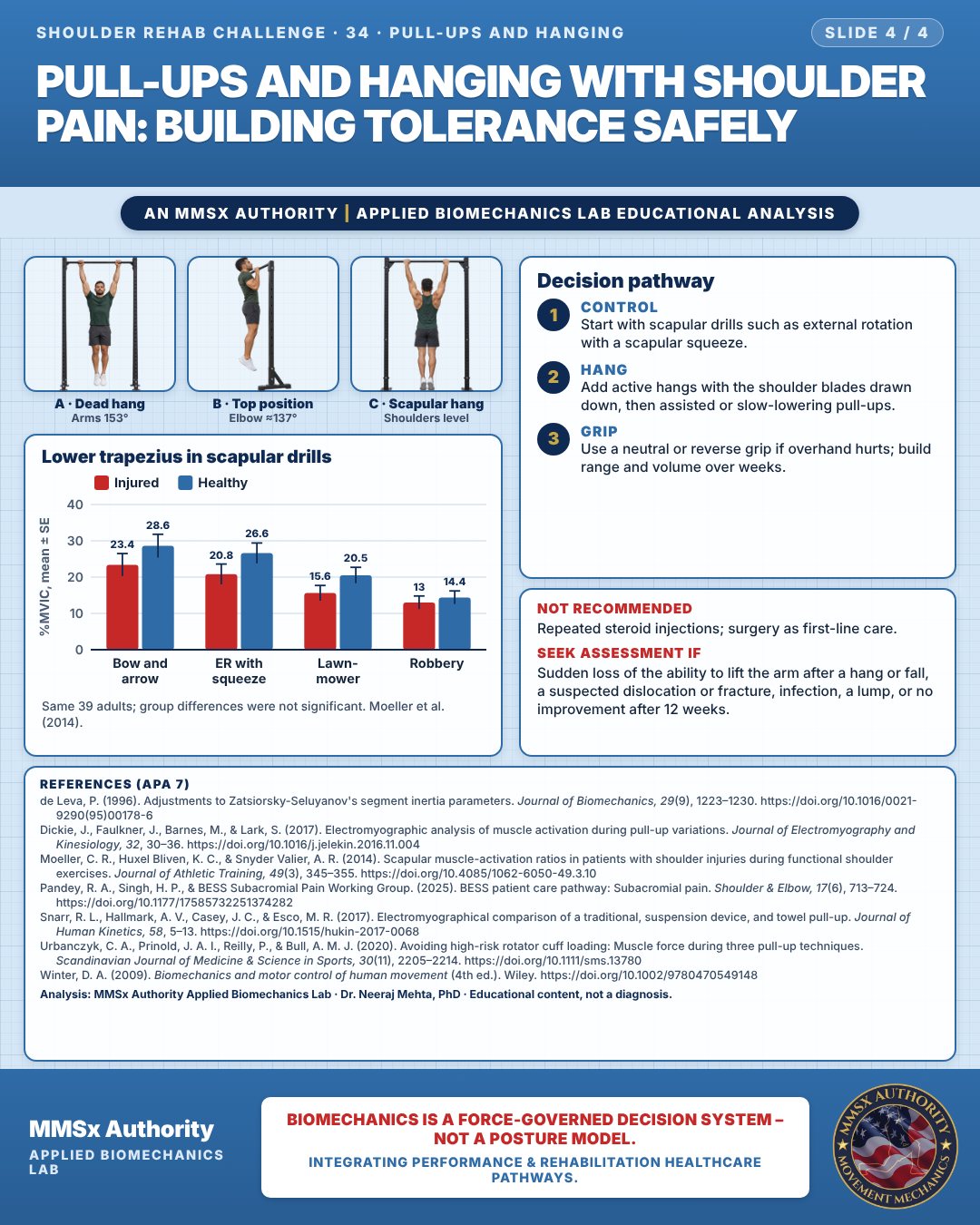
Lower trapezius in scapular drills
Control
Start with scapular drills such as external rotation with a scapular squeeze.
Hang
Add active hangs with the shoulder blades drawn down, then assisted or slow-lowering pull-ups.
Grip
Use a neutral or reverse grip if overhand hurts; build range and volume over weeks.
What the evidence supports
- Build tolerance in stages: scapular-control drills (34-C), then active hangs with scapular depression, then assisted or eccentric-limited pull-ups. Use a neutral or supinated grip if overhand provokes pain (34-B), and progress range and volume over weeks. No pull-up-specific guideline exists; these progressions are inferred from the EMG and modelling data above, and they fit the exercise-first approach of the BESS pathway (Pandey & Singh, 2025).
- Full range of motion and systematic use of all three grip variants are recommended for broad torso and upper-limb strengthening once the shoulder tolerates them (Urbanczyk et al., 2020).
- Not recommended: repeated steroid injections, or surgery as first-line care (Pandey & Singh, 2025).
Cautions
Not recommended
Repeated steroid injections; surgery as first-line care.
Seek assessment if
Sudden loss of the ability to lift the arm after a hang or fall, a suspected dislocation or fracture, infection, a lump, or no improvement after 12 weeks.
Methods note
2-D estimates from pose landmarks on an illustrated figure; CoM from de Leva (1996) segment parameters; cm for a 1.70 m adult (Winter, 2009). Arm elevation from pose landmarks, relative to the vertical. Elbow angle from pose landmarks on an illustrated figure; approximate. Arm elevation and shoulder line from pose landmarks in the rear view. These are educational estimates, not a diagnosis.
References
- de Leva, P. (1996). Adjustments to Zatsiorsky-Seluyanov's segment inertia parameters. Journal of Biomechanics, 29(9), 1223–1230. https://doi.org/10.1016/0021-9290(95)00178-6
- Dickie, J., Faulkner, J., Barnes, M., & Lark, S. (2017). Electromyographic analysis of muscle activation during pull-up variations. Journal of Electromyography and Kinesiology, 32, 30–36. https://doi.org/10.1016/j.jelekin.2016.11.004
- Moeller, C. R., Huxel Bliven, K. C., & Snyder Valier, A. R. (2014). Scapular muscle-activation ratios in patients with shoulder injuries during functional shoulder exercises. Journal of Athletic Training, 49(3), 345–355. https://doi.org/10.4085/1062-6050-49.3.10
- Pandey, R. A., Singh, H. P., & BESS Subacromial Pain Working Group. (2025). BESS patient care pathway: Subacromial pain. Shoulder & Elbow, 17(6), 713–724. https://doi.org/10.1177/17585732251374282
- Snarr, R. L., Hallmark, A. V., Casey, J. C., & Esco, M. R. (2017). Electromyographical comparison of a traditional, suspension device, and towel pull-up. Journal of Human Kinetics, 58, 5–13. https://doi.org/10.1515/hukin-2017-0068
- Urbanczyk, C. A., Prinold, J. A. I., Reilly, P., & Bull, A. M. J. (2020). Avoiding high-risk rotator cuff loading: Muscle force during three pull-up techniques. Scandinavian Journal of Medicine & Science in Sports, 30(11), 2205–2214. https://doi.org/10.1111/sms.13780
- Winter, D. A. (2009). Biomechanics and motor control of human movement (4th ed.). Wiley. https://doi.org/10.1002/9780470549148
Cite this article
Mehta, N. (2026, October 24). Pull-ups and hanging with shoulder pain: building tolerance safely. MMSx Authority Applied Biomechanics Lab. https://mmsxauthority.org/edu/analysis/shoulder/34-pull-ups-and-hanging-with-shoulder-pain-building-tolerance-safely/
Part of the collection
Mehta, N. (2026). Shoulder Rehabilitation: 50 Evidence-Based Biomechanics Analyses [Collection]. MMSx Authority Applied Biomechanics Lab. Zenodo. https://doi.org/10.5281/zenodo.23735725
All Shoulder Rehab Challenge articles · Rehabilitation Library