Shoulder Rehab Challenge · 33
Shoulder pain during push-ups: hand position and scapular control
Push-up-related shoulder pain is pain at the front or top of the shoulder during the lowering or pressing phase of a push-up.
Key points
- Angle. Start at an incline the shoulder tolerates, then progress to knees, floor and feet raised.
- Elbows. Tuck the elbows towards the body to keep the upper arm lower.
- Plus. Add the plus phase at the top to train serratus anterior control of the shoulder blade.
What it is
Push-up-related shoulder pain is pain at the front or top of the shoulder during the lowering or pressing phase of a push-up. Load depends on body angle (how much body mass the hands carry), on how far the arm is elevated from the trunk (elbows tucked or flared), and on how well the serratus anterior controls the scapula against the chest wall.
How we analysed the movement
Three movements relevant to this topic were analysed from illustrated reference figures. Joint centres were located with two-dimensional pose estimation; arm elevation and elbow angles, shoulder level, the whole-body centre of mass and, where relevant, the arm lever (the horizontal distance from the shoulder joint to the centre of mass of the arm, with any hand load) and the resulting shoulder moment were then calculated from standard segment parameters. The figures are educational estimates that show how position changes mechanical demand; they are not measurements of a patient. Every research value quoted below comes from the published source cited beside it.
Movement A: Push-up bottom (side view)
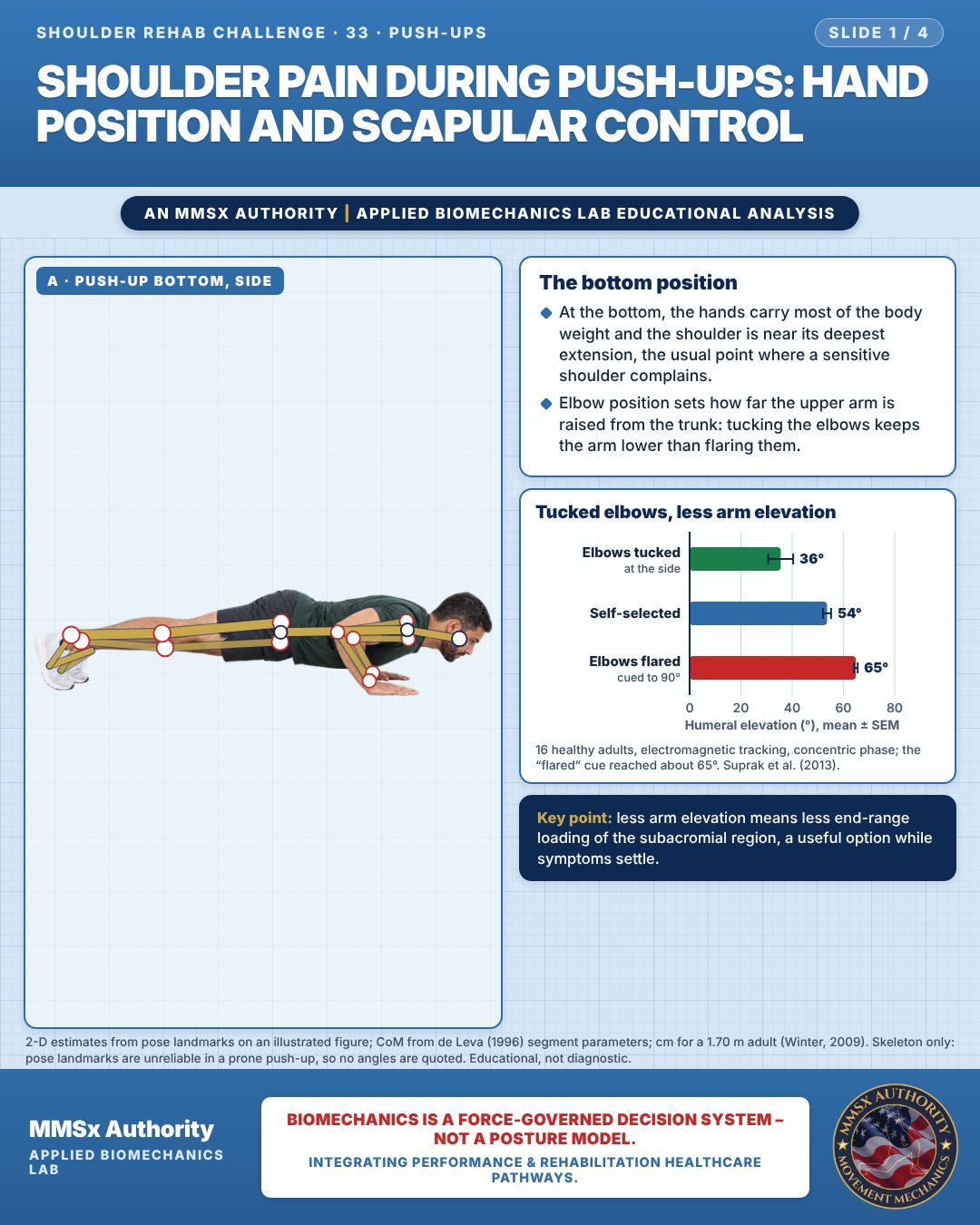
The bottom position
At the bottom, the hands carry most of the body weight and the shoulder is near its deepest extension, the usual point where a sensitive shoulder complains.
Elbow position sets how far the upper arm is raised from the trunk: tucking the elbows keeps the arm lower than flaring them.
Tucked elbows, less arm elevation
Movement B: Incline push-up (side view)
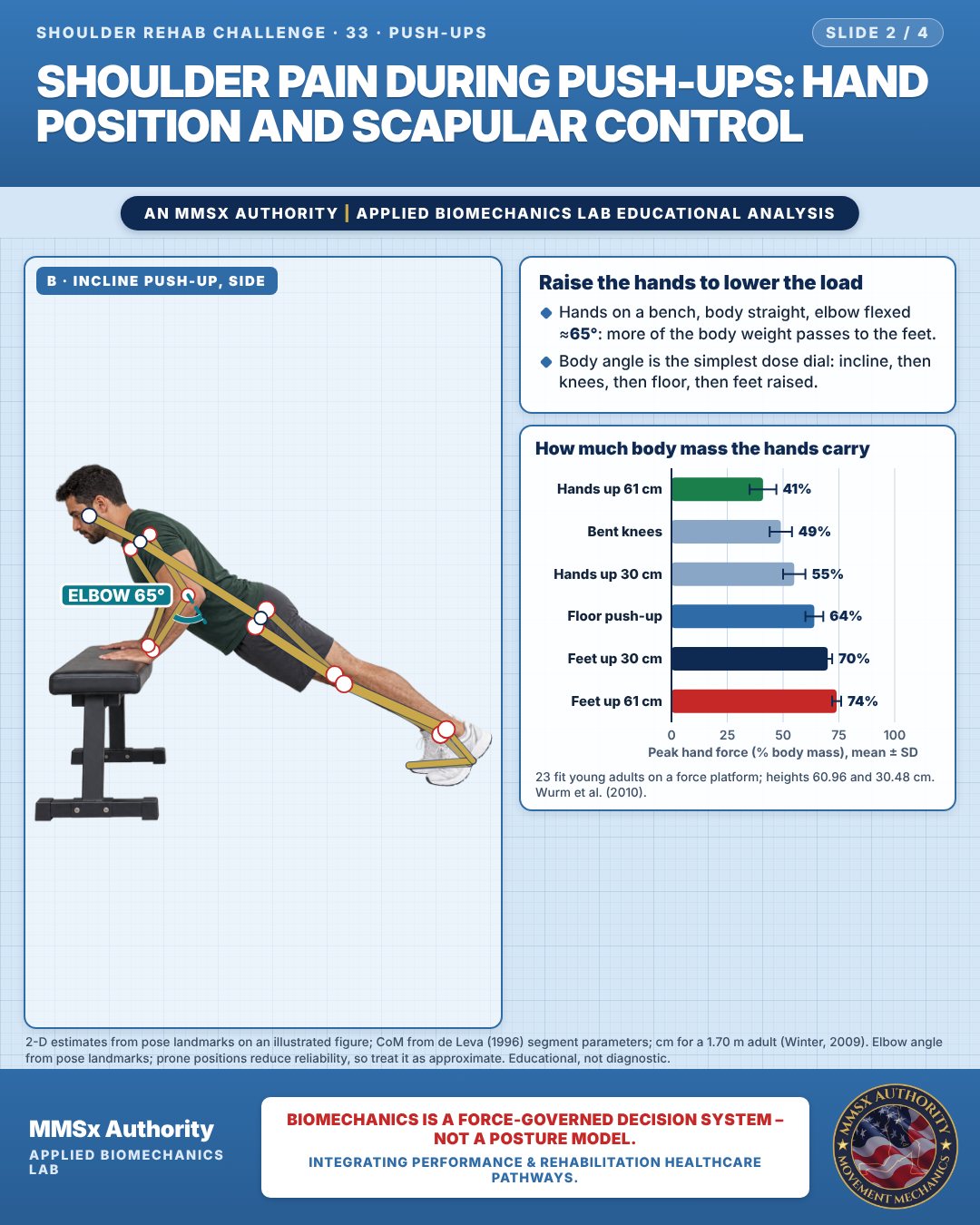
Raise the hands to lower the load
Hands on a bench, body straight, elbow flexed ≈65°: more of the body weight passes to the feet.
Body angle is the simplest dose dial: incline, then knees, then floor, then feet raised.
How much body mass the hands carry
Movement C: Wide-hand push-up (front view)
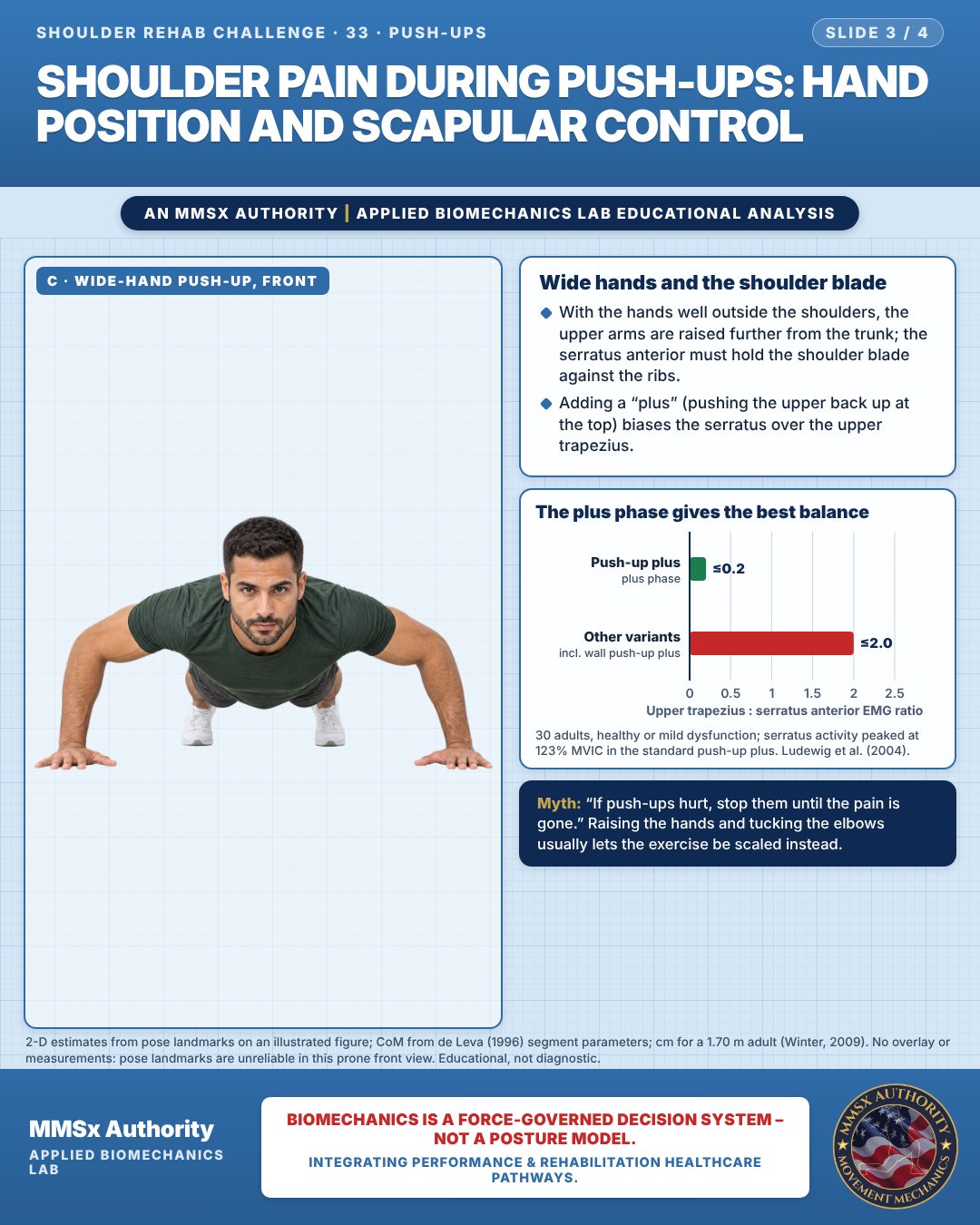
Wide hands and the shoulder blade
With the hands well outside the shoulders, the upper arms are raised further from the trunk; the serratus anterior must hold the shoulder blade against the ribs.
Adding a “plus” (pushing the upper back up at the top) biases the serratus over the upper trapezius.
The plus phase gives the best balance
Decision pathway
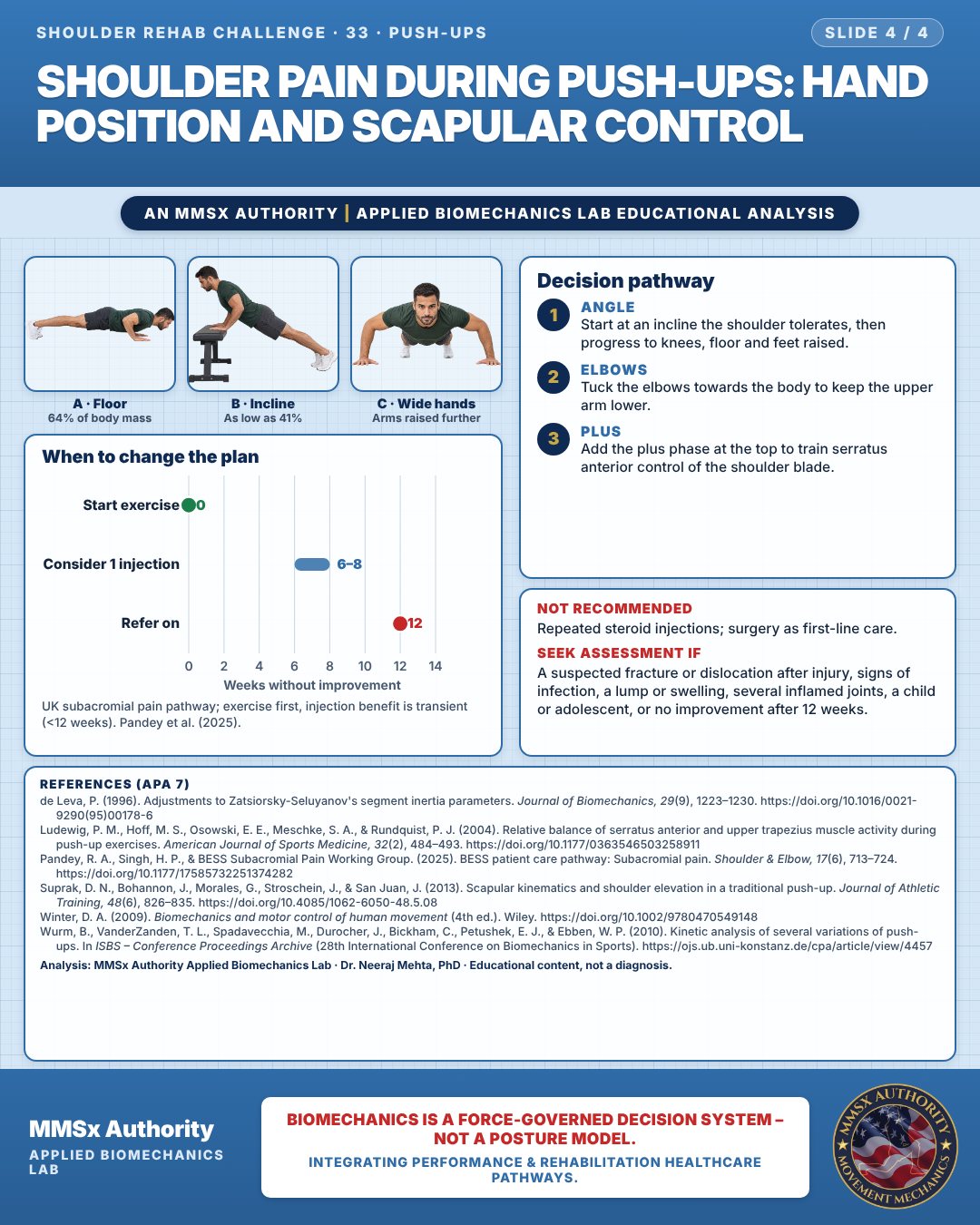
When to change the plan
Angle
Start at an incline the shoulder tolerates, then progress to knees, floor and feet raised.
Elbows
Tuck the elbows towards the body to keep the upper arm lower.
Plus
Add the plus phase at the top to train serratus anterior control of the shoulder blade.
What the evidence supports
- For subacromial-type pain: exercise first. Consider one injection only if there is no improvement by 6–8 weeks. Refer if there is no improvement after 12 weeks. Repeated injections and first-line surgery are not recommended (Pandey & Singh, 2025).
Myth and evidence
EvidenceEvidence: hand load can be cut from 64% to 41% of body mass by raising the hands about 61 cm (Wurm et al., 2010), and tucking the elbows lowers arm elevation from about 65° to about 36° (Suprak et al., 2013). The push-up can usually be scaled rather than dropped.
Cautions
Not recommended
Repeated steroid injections; surgery as first-line care.
Seek assessment if
A suspected fracture or dislocation after injury, signs of infection, a lump or swelling, several inflamed joints, a child or adolescent, or no improvement after 12 weeks.
Methods note
2-D estimates from pose landmarks on an illustrated figure; CoM from de Leva (1996) segment parameters; cm for a 1.70 m adult (Winter, 2009). Skeleton only: pose landmarks are unreliable in a prone push-up, so no angles are quoted. Elbow angle from pose landmarks; prone positions reduce reliability, so treat it as approximate. No overlay or measurements: pose landmarks are unreliable in this prone front view. These are educational estimates, not a diagnosis.
References
- de Leva, P. (1996). Adjustments to Zatsiorsky-Seluyanov's segment inertia parameters. Journal of Biomechanics, 29(9), 1223–1230. https://doi.org/10.1016/0021-9290(95)00178-6
- Ludewig, P. M., Hoff, M. S., Osowski, E. E., Meschke, S. A., & Rundquist, P. J. (2004). Relative balance of serratus anterior and upper trapezius muscle activity during push-up exercises. American Journal of Sports Medicine, 32(2), 484–493. https://doi.org/10.1177/0363546503258911
- Pandey, R. A., Singh, H. P., & BESS Subacromial Pain Working Group. (2025). BESS patient care pathway: Subacromial pain. Shoulder & Elbow, 17(6), 713–724. https://doi.org/10.1177/17585732251374282
- Suprak, D. N., Bohannon, J., Morales, G., Stroschein, J., & San Juan, J. (2013). Scapular kinematics and shoulder elevation in a traditional push-up. Journal of Athletic Training, 48(6), 826–835. https://doi.org/10.4085/1062-6050-48.5.08
- Winter, D. A. (2009). Biomechanics and motor control of human movement (4th ed.). Wiley. https://doi.org/10.1002/9780470549148
- Wurm, B., VanderZanden, T. L., Spadavecchia, M., Durocher, J., Bickham, C., Petushek, E. J., & Ebben, W. P. (2010). Kinetic analysis of several variations of push-ups. In ISBS – Conference Proceedings Archive (28th International Conference on Biomechanics in Sports). https://ojs.ub.uni-konstanz.de/cpa/article/view/4457
Cite this article
Mehta, N. (2026, October 24). Shoulder pain during push-ups: hand position and scapular control. MMSx Authority Applied Biomechanics Lab. https://mmsxauthority.org/edu/analysis/shoulder/33-shoulder-pain-during-push-ups-hand-position-and-scapular-control/
Part of the collection
Mehta, N. (2026). Shoulder Rehabilitation: 50 Evidence-Based Biomechanics Analyses [Collection]. MMSx Authority Applied Biomechanics Lab. Zenodo. https://doi.org/10.5281/zenodo.23735725
All Shoulder Rehab Challenge articles · Rehabilitation Library