Shoulder Rehab Challenge · 32
Shoulder pain during overhead press: range, bar path and trunk position
Overhead-press-related shoulder pain is pain felt during or after pressing a load above the head.
Key points
- Set-up. Use seated or barbell pressing to lower deltoid demand while symptoms settle.
- Range. Limit lateral raises and upright rows above 90°; strengthen the external rotators.
- Progress. Return range and load step by step; seek review if no better by 12 weeks.
What it is
Overhead-press-related shoulder pain is pain felt during or after pressing a load above the head. It is most often a subacromial or rotator cuff tendon presentation, and less often acromioclavicular or instability-related. It typically appears in the upper part of the lift, where the arm passes 90° of elevation, and when the trunk leans back to make up for limited overhead range.
How we analysed the movement
Three movements relevant to this topic were analysed from illustrated reference figures. Joint centres were located with two-dimensional pose estimation; arm elevation and elbow angles, shoulder level, the whole-body centre of mass and, where relevant, the arm lever (the horizontal distance from the shoulder joint to the centre of mass of the arm, with any hand load) and the resulting shoulder moment were then calculated from standard segment parameters. The figures are educational estimates that show how position changes mechanical demand; they are not measurements of a patient. Every research value quoted below comes from the published source cited beside it.
Movement A: Bar at collarbone (side view)
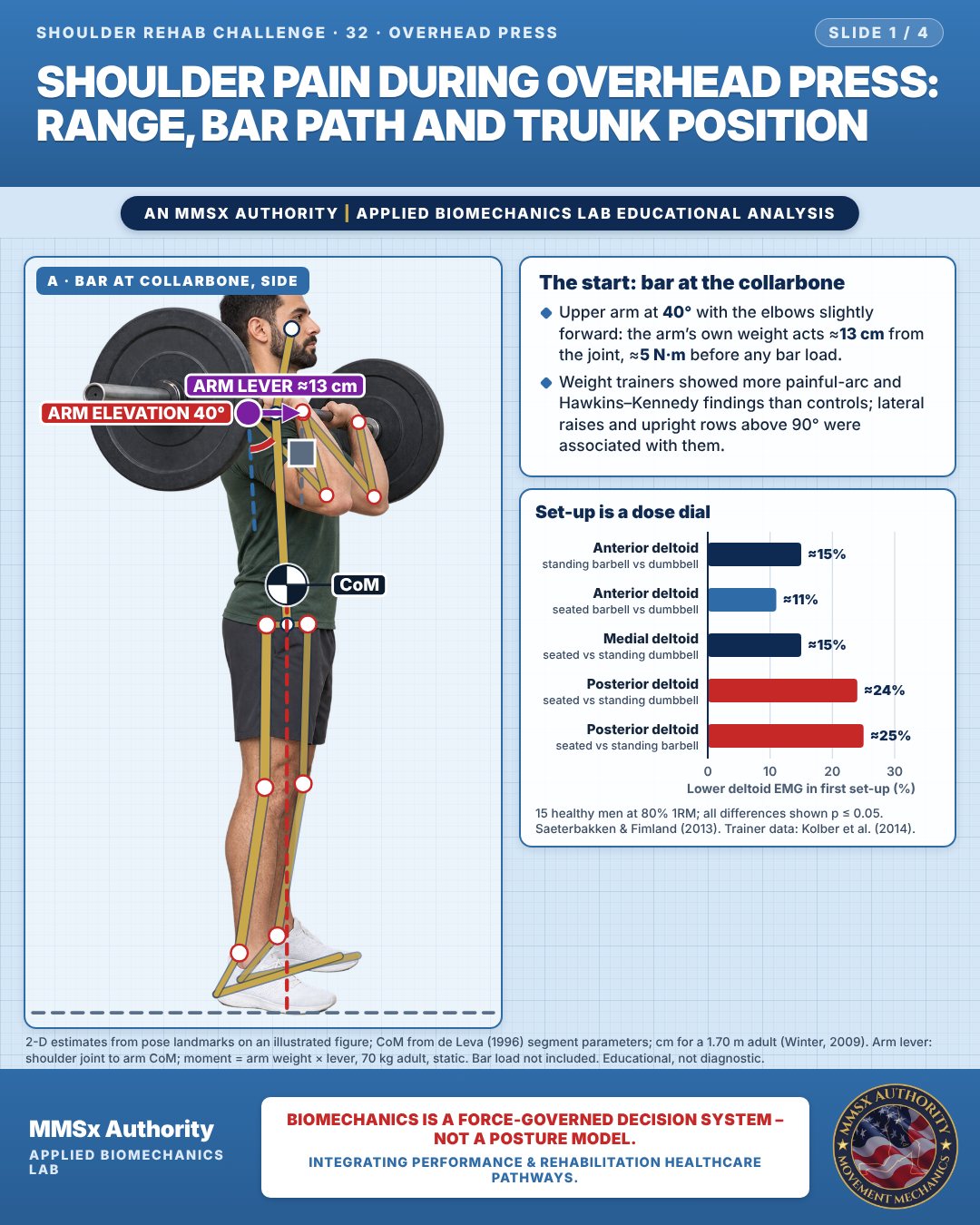
The start: bar at the collarbone
Upper arm at 40° with the elbows slightly forward: the arm’s own weight acts ≈13 cm from the joint, ≈5 N·m before any bar load.
Weight trainers showed more painful-arc and Hawkins–Kennedy findings than controls; lateral raises and upright rows above 90° were associated with them.
Set-up is a dose dial
Movement B: Overhead lockout (side view)
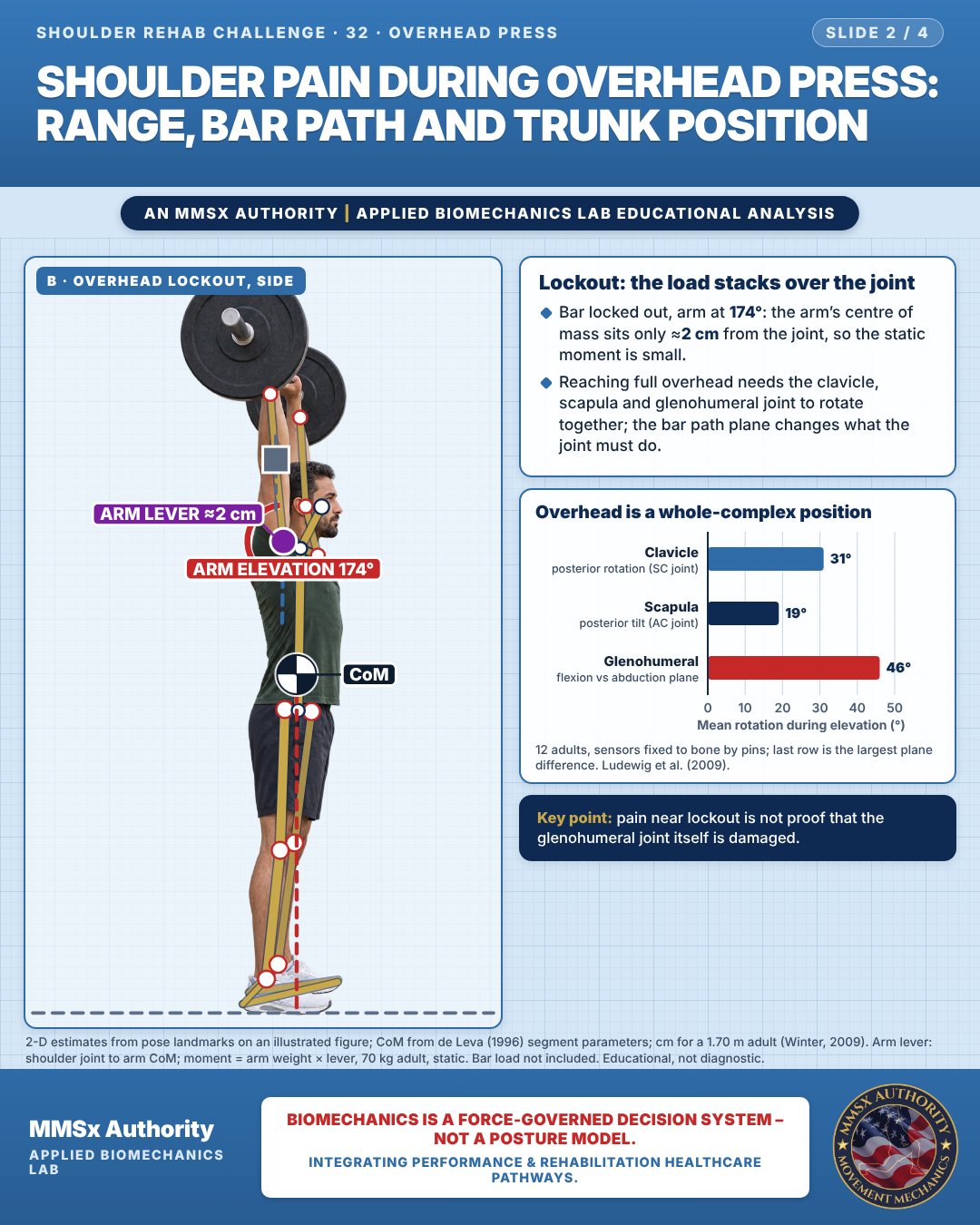
Lockout: the load stacks over the joint
Bar locked out, arm at 174°: the arm’s centre of mass sits only ≈2 cm from the joint, so the static moment is small.
Reaching full overhead needs the clavicle, scapula and glenohumeral joint to rotate together; the bar path plane changes what the joint must do.
Overhead is a whole-complex position
Movement C: Seated db press (front view)
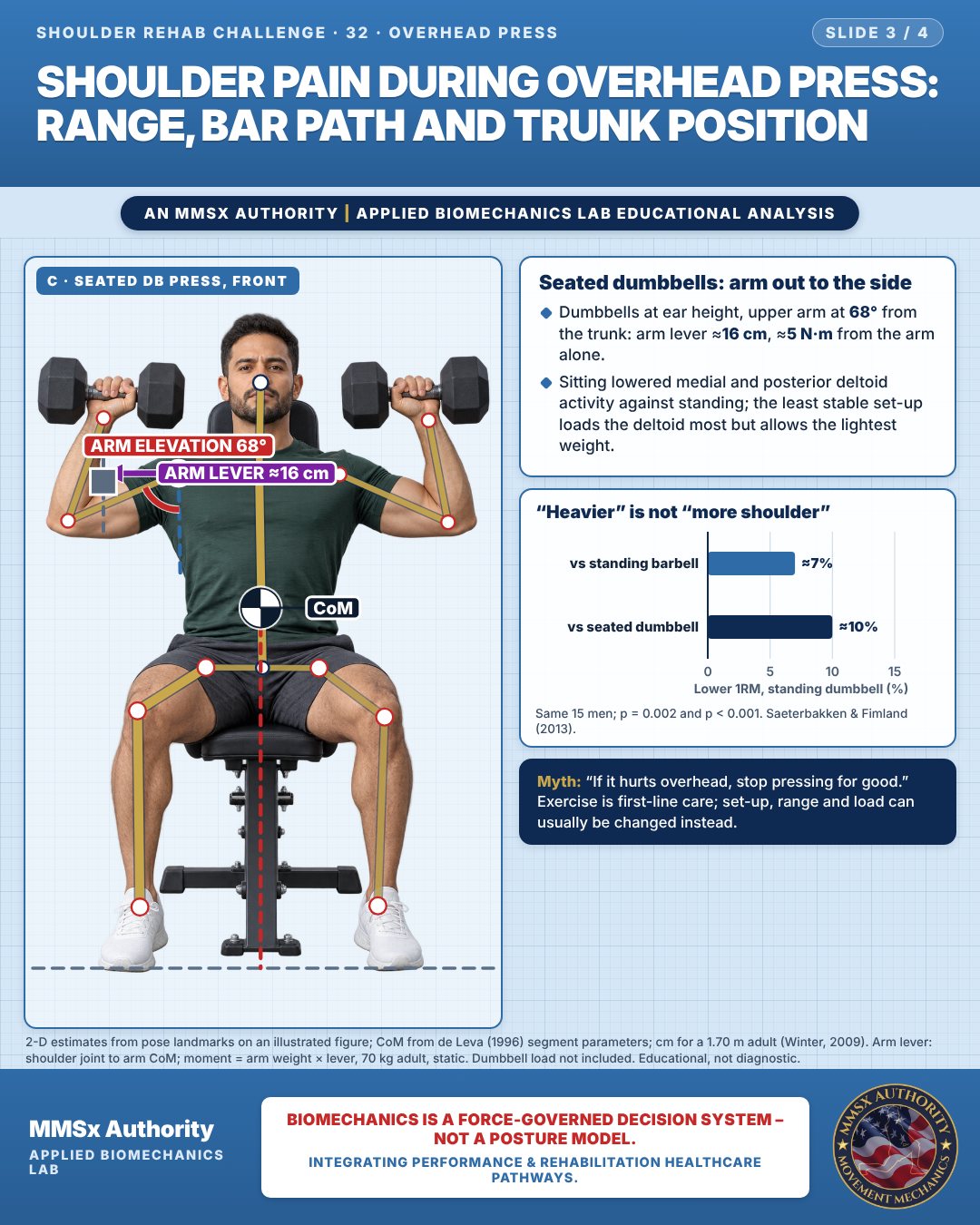
Seated dumbbells: arm out to the side
Dumbbells at ear height, upper arm at 68° from the trunk: arm lever ≈16 cm, ≈5 N·m from the arm alone.
Sitting lowered medial and posterior deltoid activity against standing; the least stable set-up loads the deltoid most but allows the lightest weight.
“Heavier” is not “more shoulder”
Decision pathway
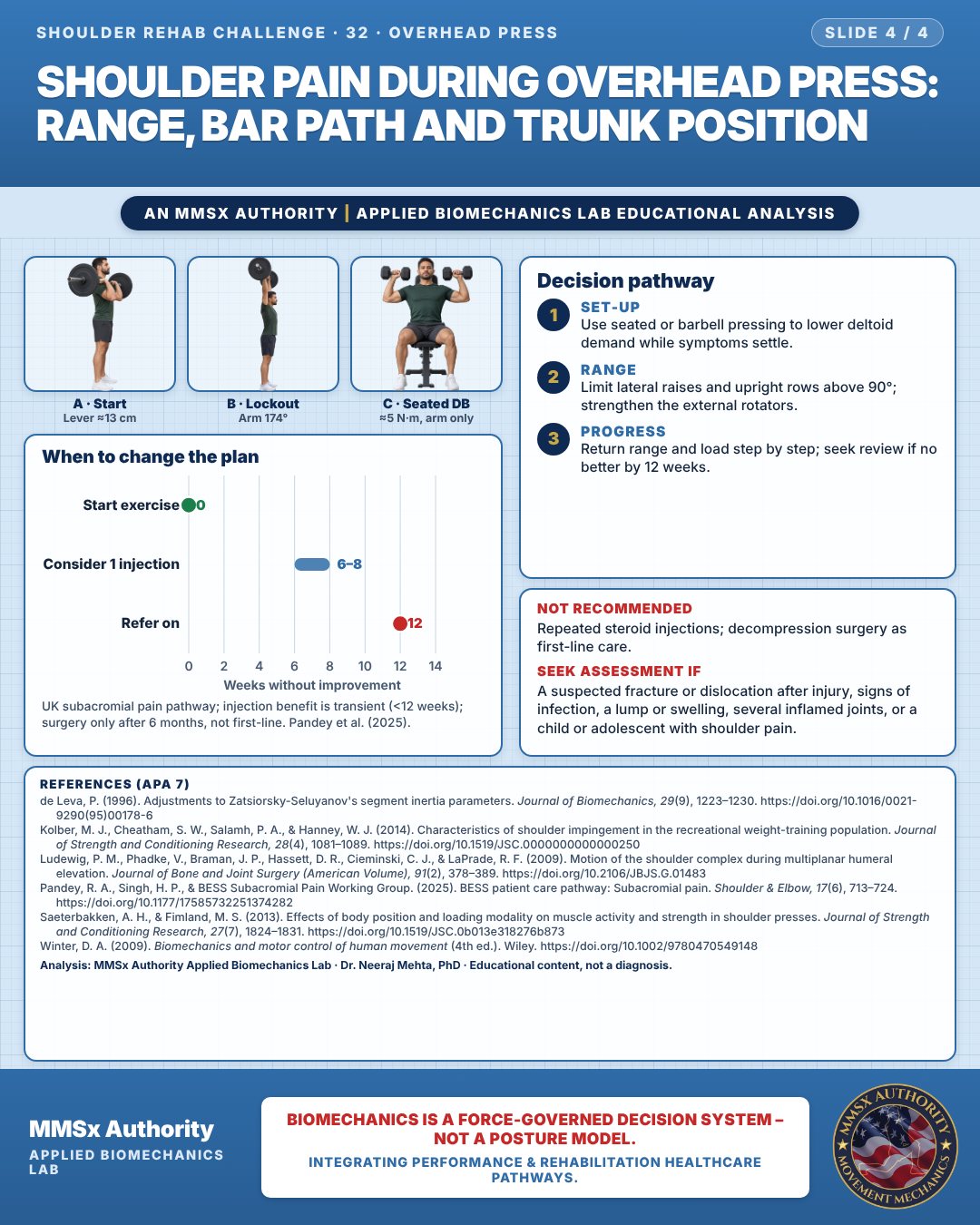
When to change the plan
Set-up
Use seated or barbell pressing to lower deltoid demand while symptoms settle.
Range
Limit lateral raises and upright rows above 90°; strengthen the external rotators.
Progress
Return range and load step by step; seek review if no better by 12 weeks.
What the evidence supports
- Recommended: exercise-based rehabilitation as first-line care (Pandey & Singh, 2025). Strengthen the external rotators, which are inversely associated with subacromial characteristics in weight trainers. Temporarily limit lateral raises and upright rows above 90° while symptomatic (Kolber et al., 2014). Use set-up as a dose control: seated and/or barbell lowers deltoid demand compared with standing dumbbell (Saeterbakken & Fimland, 2013).
- Not recommended: repeated steroid injections, which add no benefit over a single injection; decompression surgery as first-line care (Pandey & Singh, 2025).
Myth and evidence
EvidenceEvidence: overhead reach depends on substantial rotation at the sternoclavicular, acromioclavicular and glenohumeral joints (Ludewig et al., 2009). Exercise is the first-line treatment, not rest or surgery (Pandey & Singh, 2025). Pressing can usually be kept by changing the set-up (seated or barbell), the range and the load (Saeterbakken & Fimland, 2013).
Cautions
Not recommended
Repeated steroid injections; decompression surgery as first-line care.
Seek assessment if
A suspected fracture or dislocation after injury, signs of infection, a lump or swelling, several inflamed joints, or a child or adolescent with shoulder pain.
Methods note
2-D estimates from pose landmarks on an illustrated figure; CoM from de Leva (1996) segment parameters; cm for a 1.70 m adult (Winter, 2009). Arm lever: shoulder joint to arm CoM; moment = arm weight × lever, 70 kg adult, static. Bar load not included. Dumbbell load not included. These are educational estimates, not a diagnosis.
References
- de Leva, P. (1996). Adjustments to Zatsiorsky-Seluyanov's segment inertia parameters. Journal of Biomechanics, 29(9), 1223–1230. https://doi.org/10.1016/0021-9290(95)00178-6
- Kolber, M. J., Cheatham, S. W., Salamh, P. A., & Hanney, W. J. (2014). Characteristics of shoulder impingement in the recreational weight-training population. Journal of Strength and Conditioning Research, 28(4), 1081–1089. https://doi.org/10.1519/JSC.0000000000000250
- Ludewig, P. M., Phadke, V., Braman, J. P., Hassett, D. R., Cieminski, C. J., & LaPrade, R. F. (2009). Motion of the shoulder complex during multiplanar humeral elevation. Journal of Bone and Joint Surgery (American Volume), 91(2), 378–389. https://doi.org/10.2106/JBJS.G.01483
- Pandey, R. A., Singh, H. P., & BESS Subacromial Pain Working Group. (2025). BESS patient care pathway: Subacromial pain. Shoulder & Elbow, 17(6), 713–724. https://doi.org/10.1177/17585732251374282
- Saeterbakken, A. H., & Fimland, M. S. (2013). Effects of body position and loading modality on muscle activity and strength in shoulder presses. Journal of Strength and Conditioning Research, 27(7), 1824–1831. https://doi.org/10.1519/JSC.0b013e318276b873
- Winter, D. A. (2009). Biomechanics and motor control of human movement (4th ed.). Wiley. https://doi.org/10.1002/9780470549148
Cite this article
Mehta, N. (2026, October 24). Shoulder pain during overhead press: range, bar path and trunk position. MMSx Authority Applied Biomechanics Lab. https://mmsxauthority.org/edu/analysis/shoulder/32-shoulder-pain-during-overhead-press-range-bar-path-and-trunk-position/
Part of the collection
Mehta, N. (2026). Shoulder Rehabilitation: 50 Evidence-Based Biomechanics Analyses [Collection]. MMSx Authority Applied Biomechanics Lab. Zenodo. https://doi.org/10.5281/zenodo.23735725
All Shoulder Rehab Challenge articles · Rehabilitation Library