Shoulder Rehab Challenge · 31
Shoulder pain during bench press: grip width, depth and load
Bench-press-related shoulder pain is pain at the front, top or deep in the shoulder that is brought on or made worse by horizontal pressing.
Key points
- Grip. Keep the grip at about 1.5× biacromial width or narrower while the shoulder is sensitive.
- Range. Shorten the descent and avoid extreme end range; set the shoulder blades back.
- Balance. Add posterior shoulder stretching and external-rotator and scapular work; review if no better by 12 weeks.
What it is
Bench-press-related shoulder pain is pain at the front, top or deep in the shoulder that is brought on or made worse by horizontal pressing. It usually involves the rotator cuff and subacromial tissues, the acromioclavicular (AC) joint (including distal clavicle osteolysis), the anterior capsule and labrum, or the pectoralis major tendon. Grip width, scapular position and how deep the bar goes change how load is shared between these tissues.
How we analysed the movement
Three movements relevant to this topic were analysed from illustrated reference figures. Joint centres were located with two-dimensional pose estimation; arm elevation and elbow angles, shoulder level, the whole-body centre of mass and, where relevant, the arm lever (the horizontal distance from the shoulder joint to the centre of mass of the arm, with any hand load) and the resulting shoulder moment were then calculated from standard segment parameters. The figures are educational estimates that show how position changes mechanical demand; they are not measurements of a patient. Every research value quoted below comes from the published source cited beside it.
Movement A: Wide-grip bench (side view)
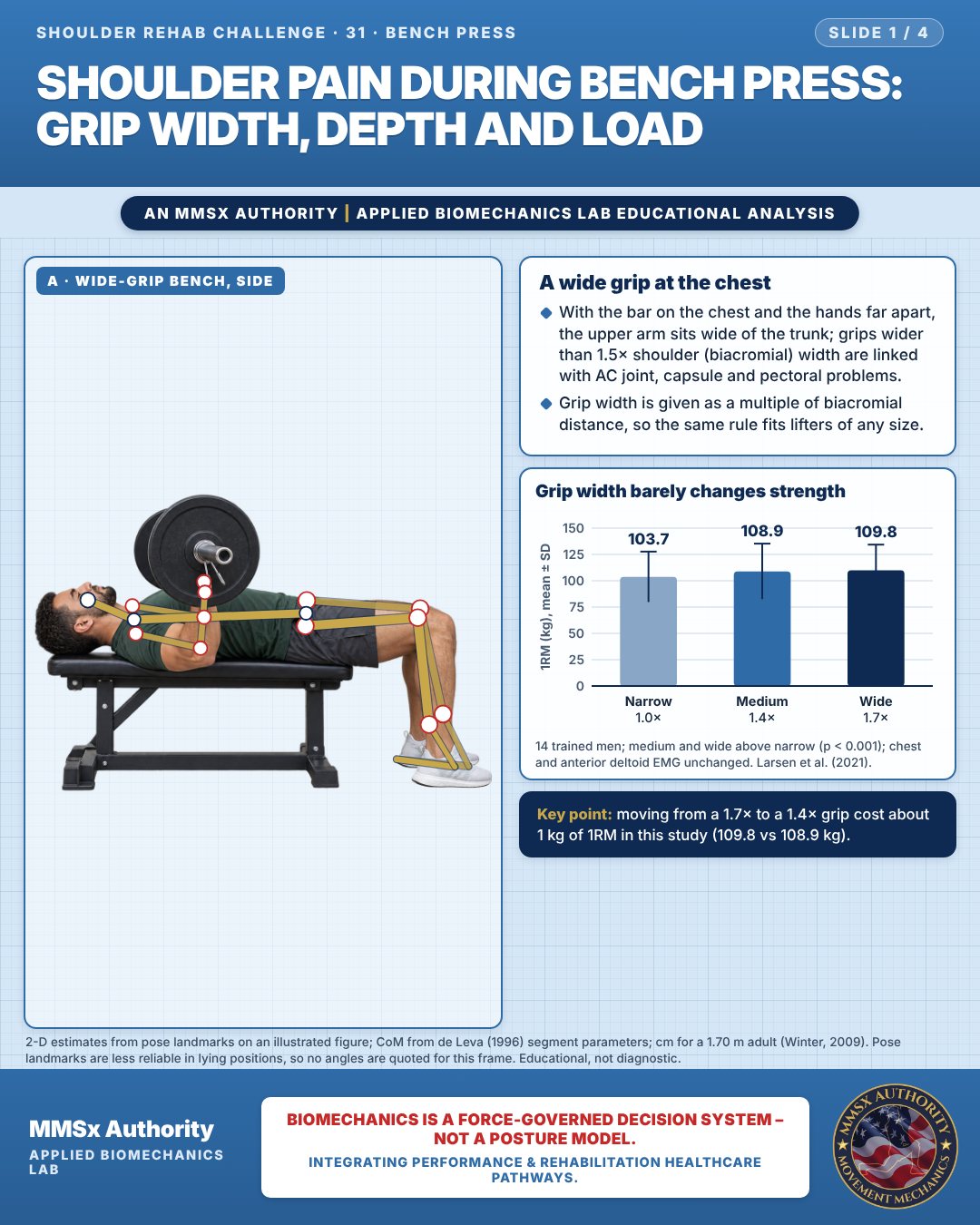
A wide grip at the chest
With the bar on the chest and the hands far apart, the upper arm sits wide of the trunk; grips wider than 1.5× shoulder (biacromial) width are linked with AC joint, capsule and pectoral problems.
Grip width is given as a multiple of biacromial distance, so the same rule fits lifters of any size.
Grip width barely changes strength
Movement B: Medium-grip bench (side view)
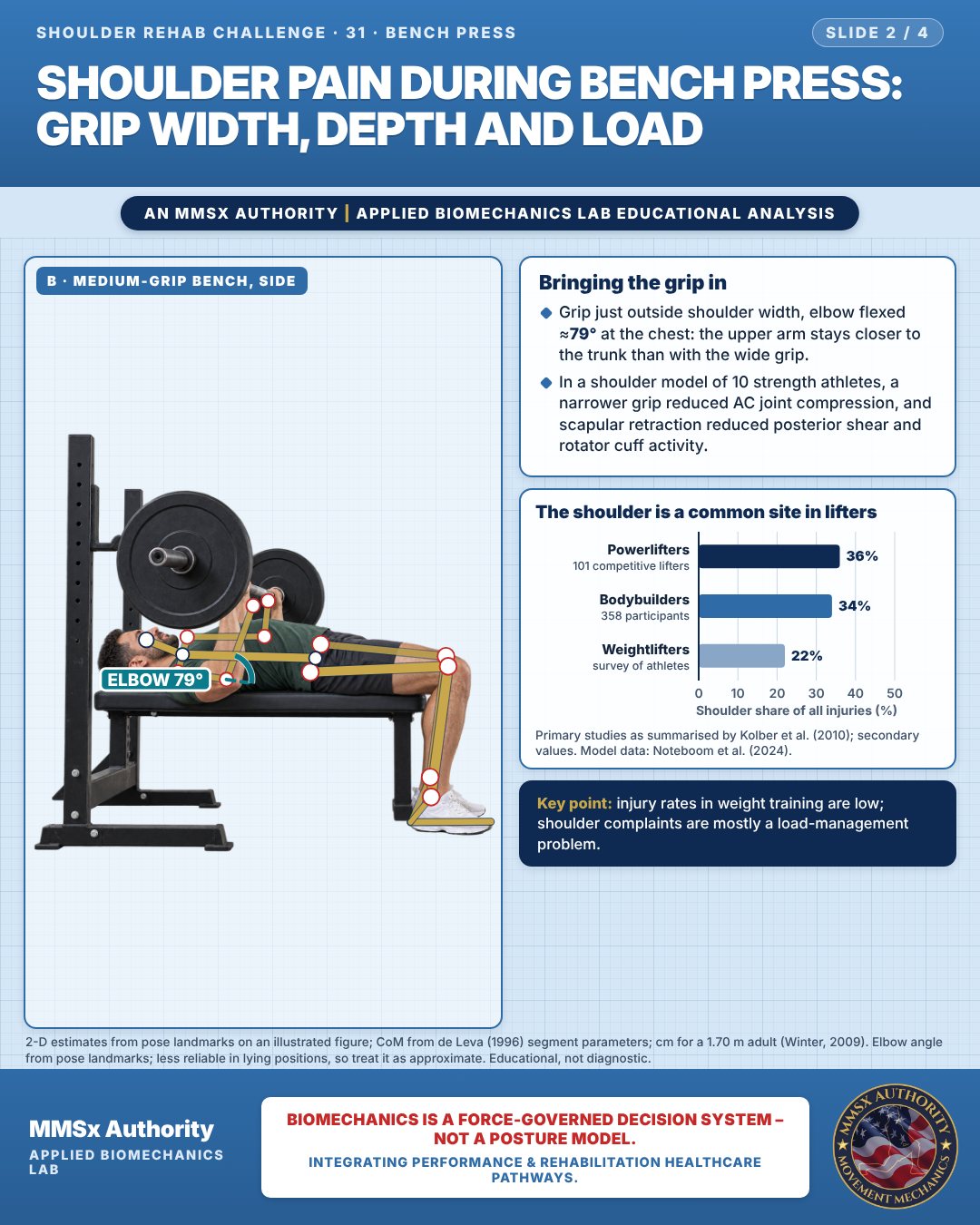
Bringing the grip in
Grip just outside shoulder width, elbow flexed ≈79° at the chest: the upper arm stays closer to the trunk than with the wide grip.
In a shoulder model of 10 strength athletes, a narrower grip reduced AC joint compression, and scapular retraction reduced posterior shear and rotator cuff activity.
The shoulder is a common site in lifters
Movement C: Lockout grip (front view)
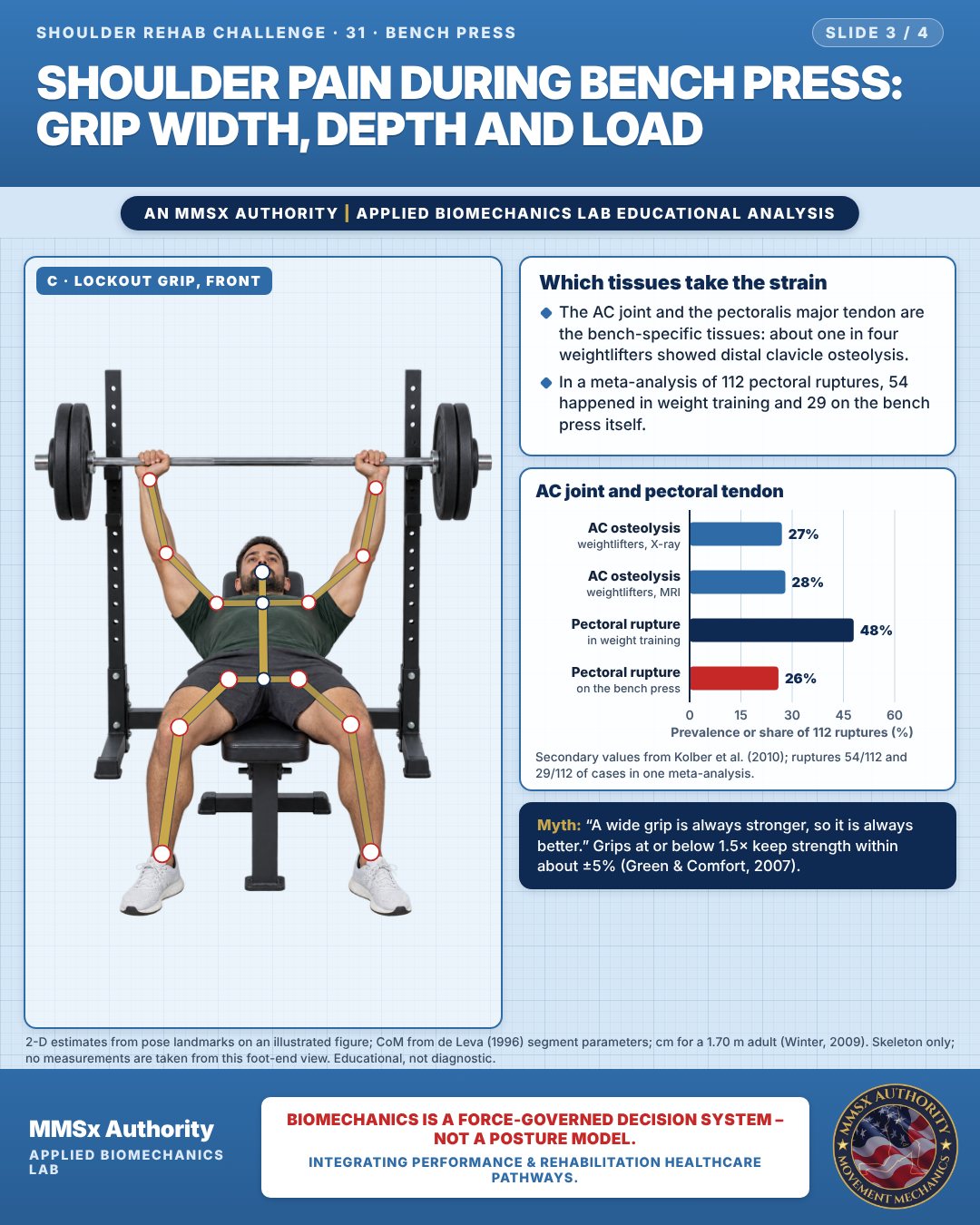
Which tissues take the strain
The AC joint and the pectoralis major tendon are the bench-specific tissues: about one in four weightlifters showed distal clavicle osteolysis.
In a meta-analysis of 112 pectoral ruptures, 54 happened in weight training and 29 on the bench press itself.
AC joint and pectoral tendon
Decision pathway
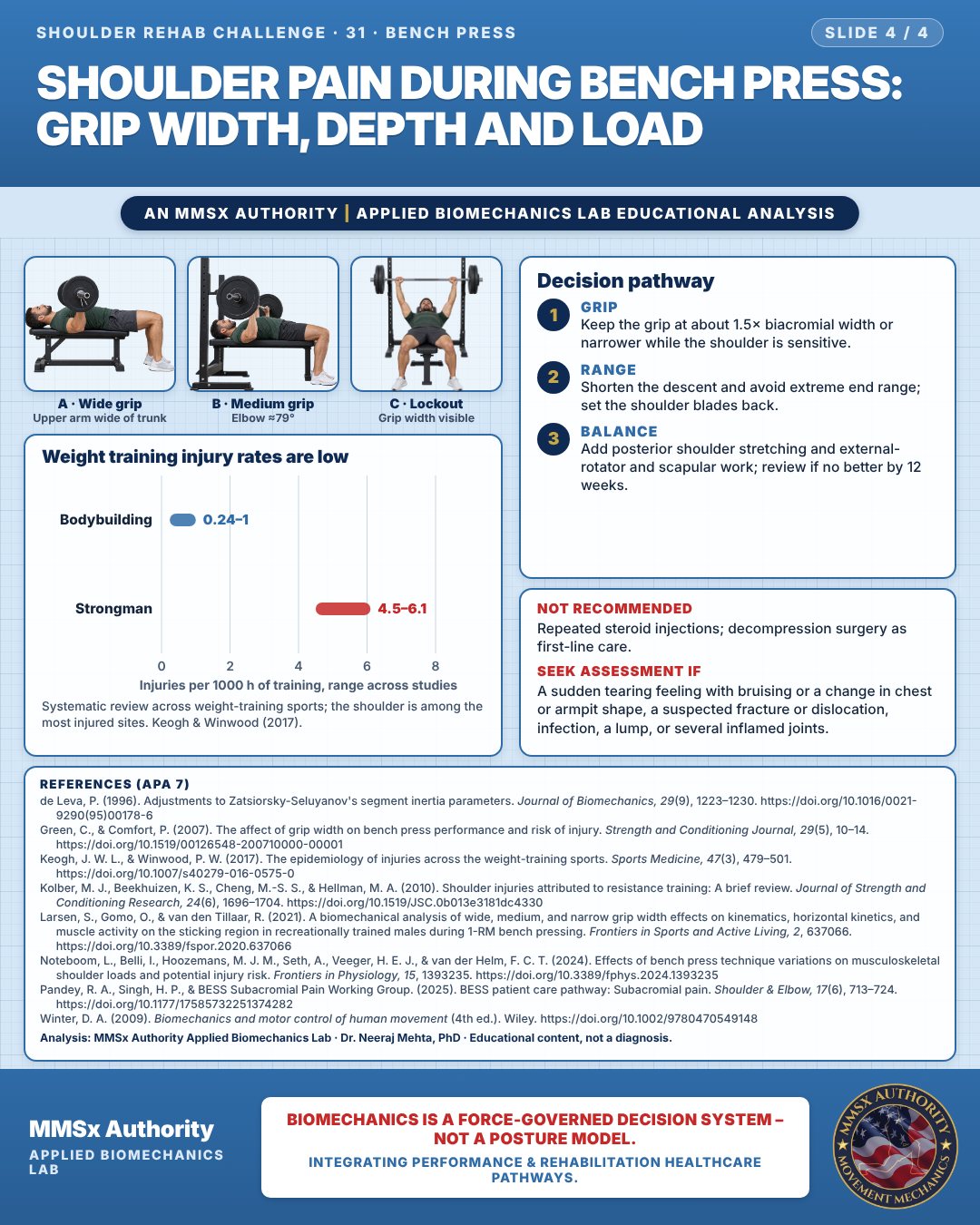
Weight training injury rates are low
Grip
Keep the grip at about 1.5× biacromial width or narrower while the shoulder is sensitive.
Range
Shorten the descent and avoid extreme end range; set the shoulder blades back.
Balance
Add posterior shoulder stretching and external-rotator and scapular work; review if no better by 12 weeks.
What the evidence supports
- No bench-press-specific clinical guideline was found. The expert-review recommendations are: keep the grip at about 1.5 × biacromial width or narrower (Green & Comfort, 2007); reduce the depth of the descent and avoid extreme end-range positions when symptomatic; add posterior shoulder stretching (sleeper/cross-body, 30 s × 3) and balance the programme with external-rotator and scapular work (Kolber et al., 2010).
- For subacromial-type pain in general, the BESS pathway recommends exercise first. It is effective for pain in the short term (8 weeks to 6 months) and for function at 6 months. Consider one subacromial steroid injection only if there is no improvement by 6–8 weeks; it gives transient benefit (<12 weeks), and multiple injections add nothing. Refer to secondary care if there is no improvement after 12 weeks of non-operative care. Surgery is not first-line, and decompression was no better than sham (Pandey & Singh, 2025).
- Not recommended: repeated steroid injections, or surgical decompression as first-line care (Pandey & Singh, 2025).
Myth and evidence
EvidenceEvidence: going from 1.4× to 1.7× biacromial width changed 1RM by only about 1 kg (108.9 vs 109.8 kg) and did not change pectoralis or anterior deltoid activity (Larsen et al., 2021). Grips wider than 1.5× are associated with AC, capsule and pectoralis injury risk, while narrowing costs only about ±5% of 1RM (Green & Comfort, 2007).
Cautions
Not recommended
Repeated steroid injections; decompression surgery as first-line care.
Seek assessment if
A sudden tearing feeling with bruising or a change in chest or armpit shape, a suspected fracture or dislocation, infection, a lump, or several inflamed joints.
Methods note
2-D estimates from pose landmarks on an illustrated figure; CoM from de Leva (1996) segment parameters; cm for a 1.70 m adult (Winter, 2009). Pose landmarks are less reliable in lying positions, so no angles are quoted for this frame. Elbow angle from pose landmarks; less reliable in lying positions, so treat it as approximate. Skeleton only; no measurements are taken from this foot-end view. These are educational estimates, not a diagnosis.
References
- de Leva, P. (1996). Adjustments to Zatsiorsky-Seluyanov's segment inertia parameters. Journal of Biomechanics, 29(9), 1223–1230. https://doi.org/10.1016/0021-9290(95)00178-6
- Green, C., & Comfort, P. (2007). The affect of grip width on bench press performance and risk of injury. Strength and Conditioning Journal, 29(5), 10–14. https://doi.org/10.1519/00126548-200710000-00001
- Keogh, J. W. L., & Winwood, P. W. (2017). The epidemiology of injuries across the weight-training sports. Sports Medicine, 47(3), 479–501. https://doi.org/10.1007/s40279-016-0575-0
- Kolber, M. J., Beekhuizen, K. S., Cheng, M.-S. S., & Hellman, M. A. (2010). Shoulder injuries attributed to resistance training: A brief review. Journal of Strength and Conditioning Research, 24(6), 1696–1704. https://doi.org/10.1519/JSC.0b013e3181dc4330
- Larsen, S., Gomo, O., & van den Tillaar, R. (2021). A biomechanical analysis of wide, medium, and narrow grip width effects on kinematics, horizontal kinetics, and muscle activity on the sticking region in recreationally trained males during 1-RM bench pressing. Frontiers in Sports and Active Living, 2, 637066. https://doi.org/10.3389/fspor.2020.637066
- Noteboom, L., Belli, I., Hoozemans, M. J. M., Seth, A., Veeger, H. E. J., & van der Helm, F. C. T. (2024). Effects of bench press technique variations on musculoskeletal shoulder loads and potential injury risk. Frontiers in Physiology, 15, 1393235. https://doi.org/10.3389/fphys.2024.1393235
- Pandey, R. A., Singh, H. P., & BESS Subacromial Pain Working Group. (2025). BESS patient care pathway: Subacromial pain. Shoulder & Elbow, 17(6), 713–724. https://doi.org/10.1177/17585732251374282
- Winter, D. A. (2009). Biomechanics and motor control of human movement (4th ed.). Wiley. https://doi.org/10.1002/9780470549148
Cite this article
Mehta, N. (2026, October 24). Shoulder pain during bench press: grip width, depth and load. MMSx Authority Applied Biomechanics Lab. https://mmsxauthority.org/edu/analysis/shoulder/31-shoulder-pain-during-bench-press-grip-width-depth-and-load/
Part of the collection
Mehta, N. (2026). Shoulder Rehabilitation: 50 Evidence-Based Biomechanics Analyses [Collection]. MMSx Authority Applied Biomechanics Lab. Zenodo. https://doi.org/10.5281/zenodo.23735725
All Shoulder Rehab Challenge articles · Rehabilitation Library