Shoulder Rehab Challenge · 30
After a shoulder dislocation: returning to sport and contact
Return to sport after a traumatic anterior shoulder dislocation is a staged, criterion-based decision covering restored range, strength, power and…
Key points
- Decide. Weigh age, sex, contact or overhead sport, laxity and bone loss when choosing rehabilitation or stabilisation.
- Build. Progress from cuff strength to plyometric and overhead power before any contact.
- Clear. Return on strength, control and an informed decision, not on being pain-free.
What it is
Return to sport after a traumatic anterior shoulder dislocation is a staged, criterion-based decision covering restored range, strength, power and sport-specific control (plyometric push-up, overhead medicine-ball throw and 90/90 external rotation), weighed against the individual's risk of recurrence and the choice between rehabilitation alone and surgical stabilisation.
How we analysed the movement
Three movements relevant to this topic were analysed from illustrated reference figures. Joint centres were located with two-dimensional pose estimation; arm elevation and elbow angles, shoulder level, the whole-body centre of mass and, where relevant, the arm lever (the horizontal distance from the shoulder joint to the centre of mass of the arm, with any hand load) and the resulting shoulder moment were then calculated from standard segment parameters. The figures are educational estimates that show how position changes mechanical demand; they are not measurements of a patient. Every research value quoted below comes from the published source cited beside it.
Movement A: Plyometric push-up (side view)
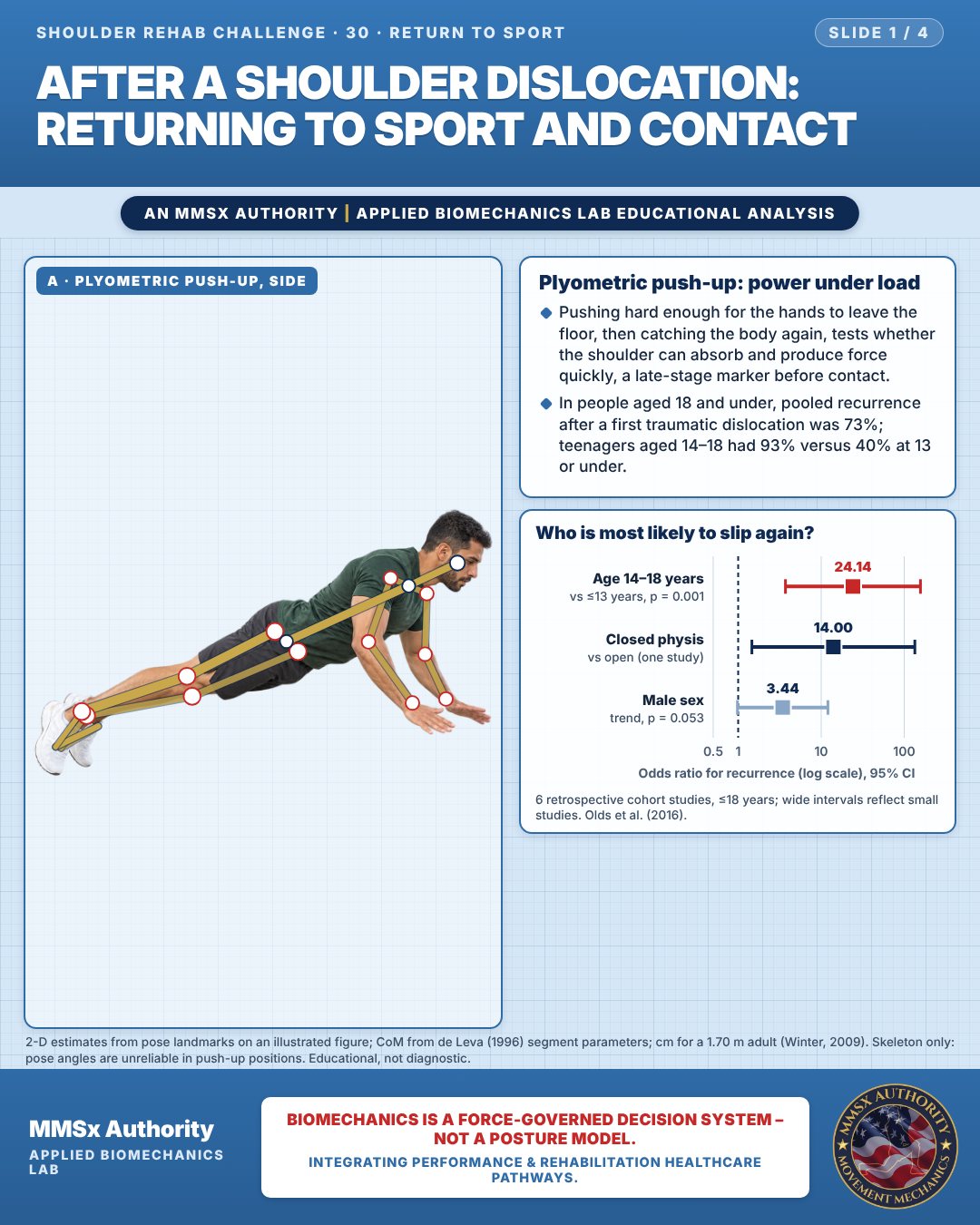
Plyometric push-up: power under load
Pushing hard enough for the hands to leave the floor, then catching the body again, tests whether the shoulder can absorb and produce force quickly, a late-stage marker before contact.
In people aged 18 and under, pooled recurrence after a first traumatic dislocation was 73%; teenagers aged 14–18 had 93% versus 40% at 13 or under.
Who is most likely to slip again?
Movement B: Overhead ball throw (side view)
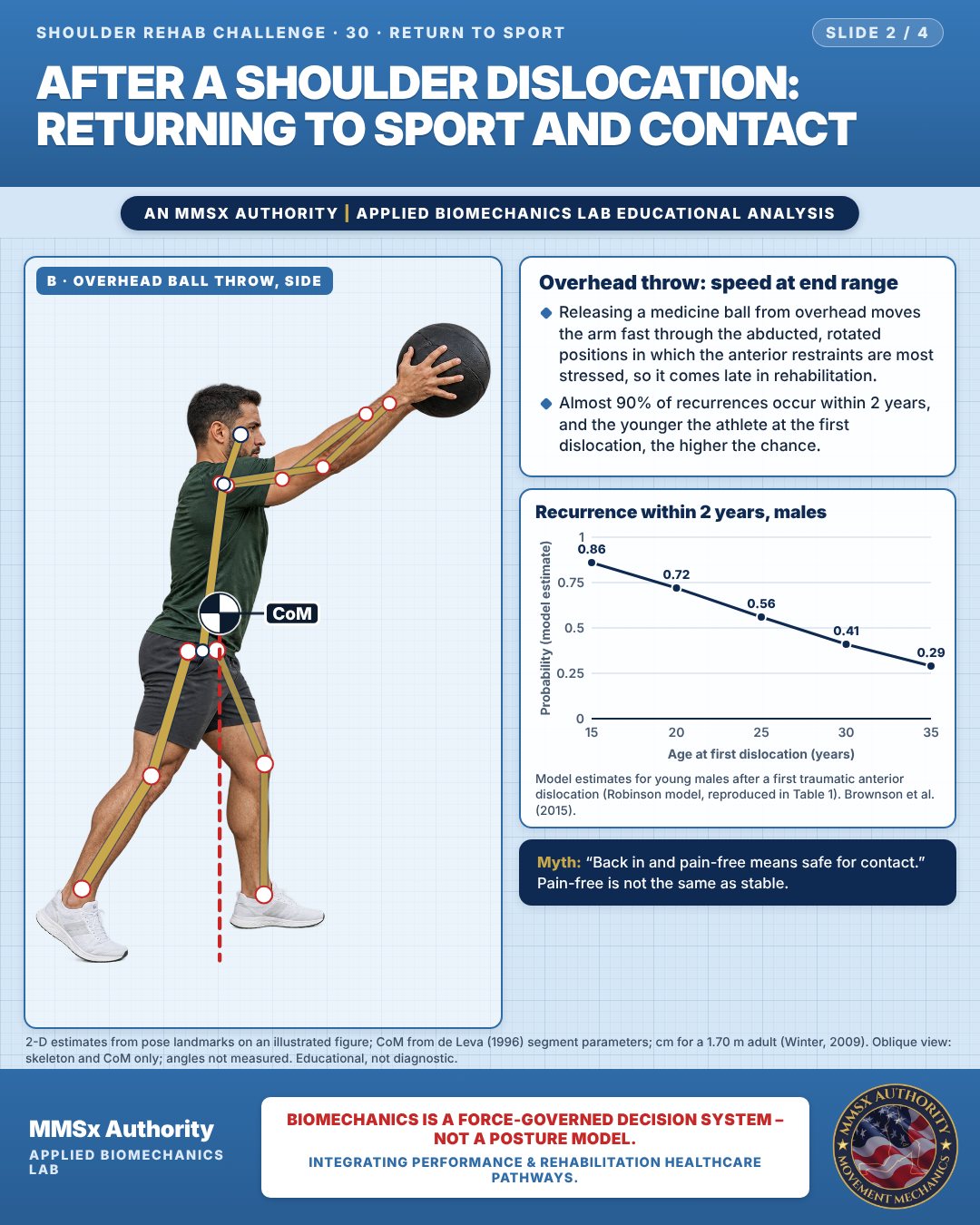
Overhead throw: speed at end range
Releasing a medicine ball from overhead moves the arm fast through the abducted, rotated positions in which the anterior restraints are most stressed, so it comes late in rehabilitation.
Almost 90% of recurrences occur within 2 years, and the younger the athlete at the first dislocation, the higher the chance.
Recurrence within 2 years, males
Movement C: 90/90 band rotation (front view)
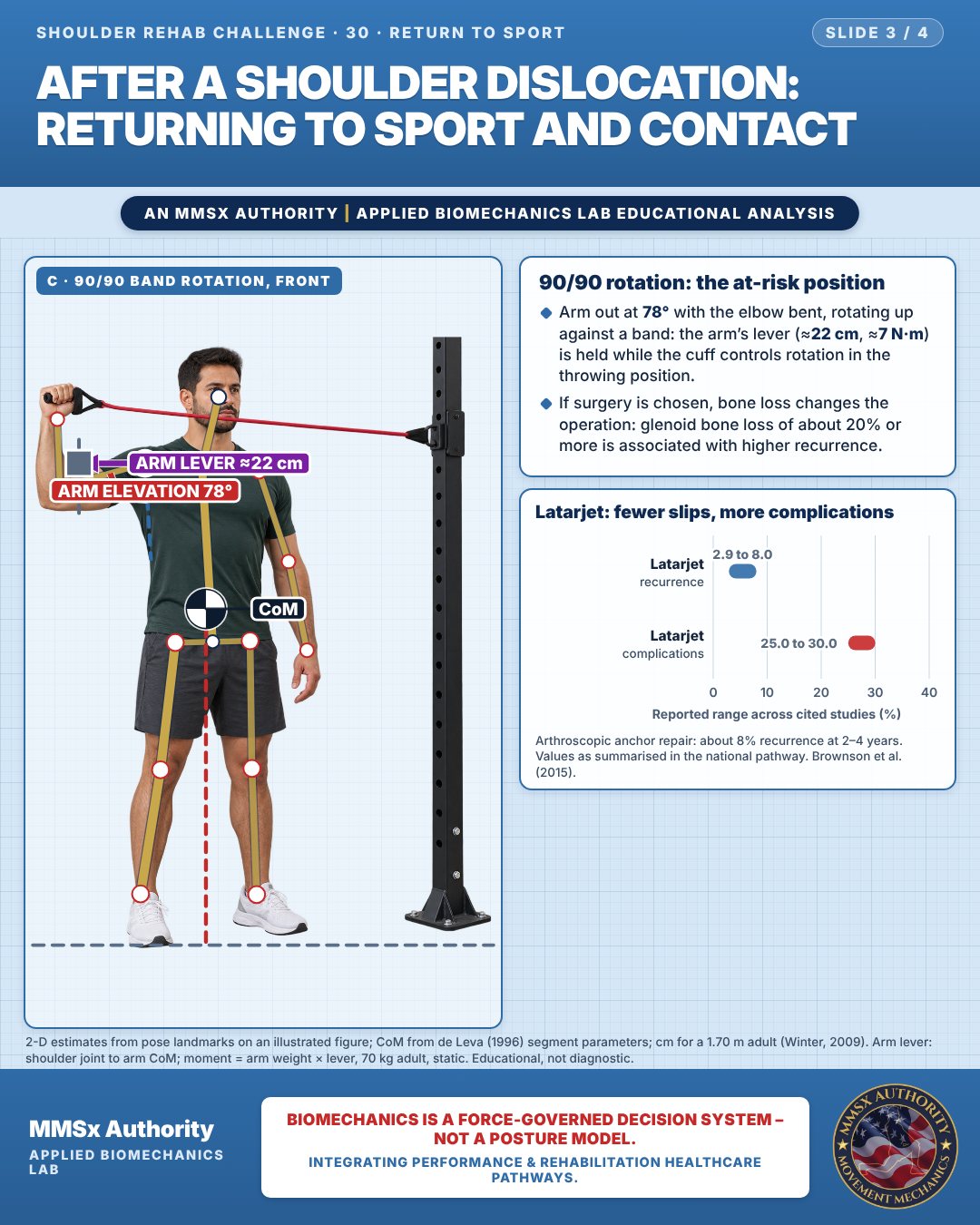
90/90 rotation: the at-risk position
Arm out at 78° with the elbow bent, rotating up against a band: the arm’s lever (≈22 cm, ≈7 N·m) is held while the cuff controls rotation in the throwing position.
If surgery is chosen, bone loss changes the operation: glenoid bone loss of about 20% or more is associated with higher recurrence.
Latarjet: fewer slips, more complications
Decision pathway
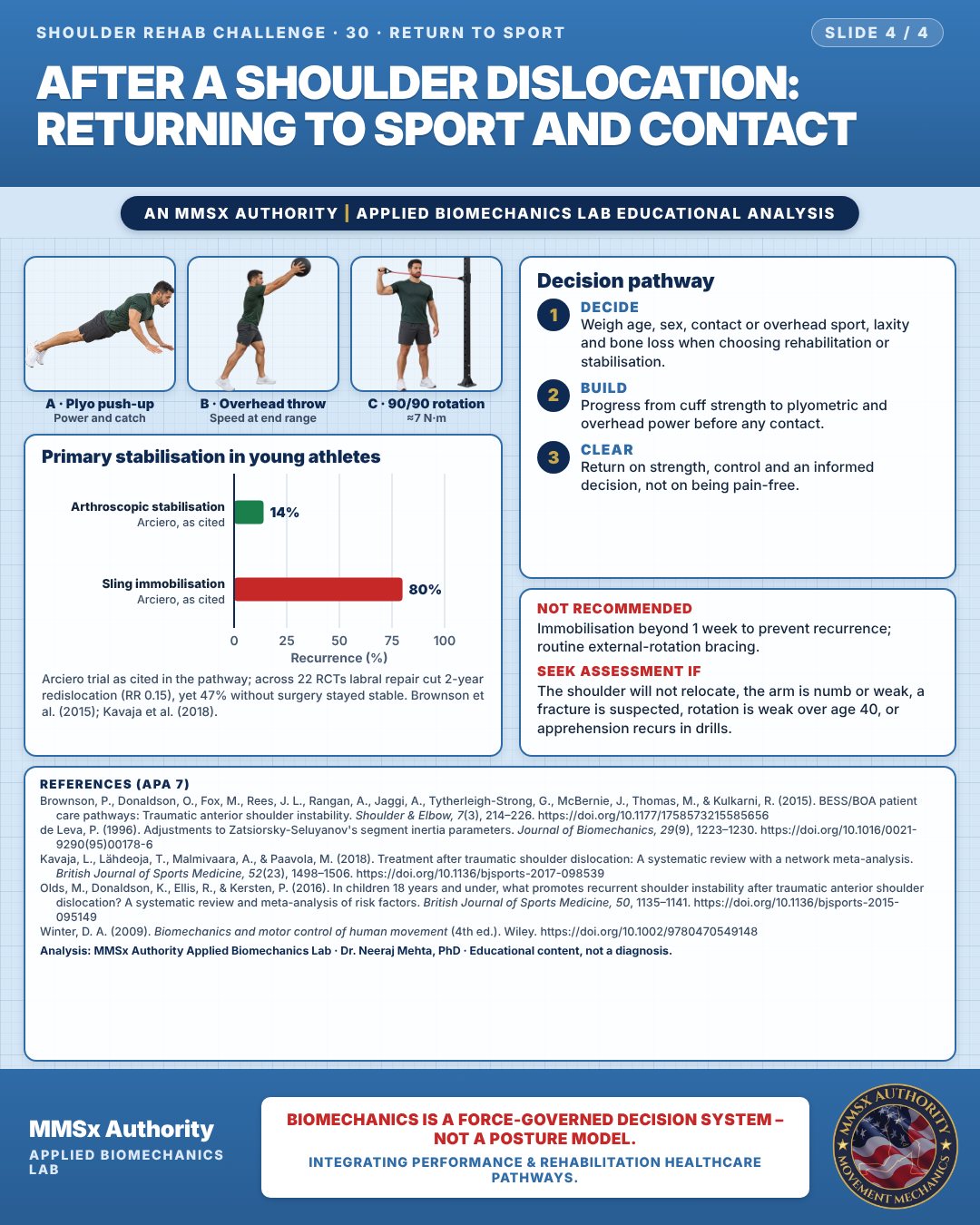
Primary stabilisation in young athletes
Decide
Weigh age, sex, contact or overhead sport, laxity and bone loss when choosing rehabilitation or stabilisation.
Build
Progress from cuff strength to plyometric and overhead power before any contact.
Clear
Return on strength, control and an informed decision, not on being pain-free.
What the evidence supports
- Not recommended: immobilisation beyond 1 week to "prevent" recurrence; routine external-rotation bracing (Brownson et al., 2015).
Cautions
Not recommended
Immobilisation beyond 1 week to prevent recurrence; routine external-rotation bracing.
Seek assessment if
The shoulder will not relocate, the arm is numb or weak, a fracture is suspected, rotation is weak over age 40, or apprehension recurs in drills.
Methods note
2-D estimates from pose landmarks on an illustrated figure; CoM from de Leva (1996) segment parameters; cm for a 1.70 m adult (Winter, 2009). Skeleton only: pose angles are unreliable in push-up positions. Oblique view: skeleton and CoM only; angles not measured. Arm lever: shoulder joint to arm CoM; moment = arm weight × lever, 70 kg adult, static. These are educational estimates, not a diagnosis.
References
- Brownson, P., Donaldson, O., Fox, M., Rees, J. L., Rangan, A., Jaggi, A., Tytherleigh-Strong, G., McBernie, J., Thomas, M., & Kulkarni, R. (2015). BESS/BOA patient care pathways: Traumatic anterior shoulder instability. Shoulder & Elbow, 7(3), 214–226. https://doi.org/10.1177/1758573215585656
- de Leva, P. (1996). Adjustments to Zatsiorsky-Seluyanov's segment inertia parameters. Journal of Biomechanics, 29(9), 1223–1230. https://doi.org/10.1016/0021-9290(95)00178-6
- Kavaja, L., Lähdeoja, T., Malmivaara, A., & Paavola, M. (2018). Treatment after traumatic shoulder dislocation: A systematic review with a network meta-analysis. British Journal of Sports Medicine, 52(23), 1498–1506. https://doi.org/10.1136/bjsports-2017-098539
- Olds, M., Donaldson, K., Ellis, R., & Kersten, P. (2016). In children 18 years and under, what promotes recurrent shoulder instability after traumatic anterior shoulder dislocation? A systematic review and meta-analysis of risk factors. British Journal of Sports Medicine, 50, 1135–1141. https://doi.org/10.1136/bjsports-2015-095149
- Winter, D. A. (2009). Biomechanics and motor control of human movement (4th ed.). Wiley. https://doi.org/10.1002/9780470549148
Cite this article
Mehta, N. (2026, October 24). After a shoulder dislocation: returning to sport and contact. MMSx Authority Applied Biomechanics Lab. https://mmsxauthority.org/edu/analysis/shoulder/30-after-a-shoulder-dislocation-returning-to-sport-and-contact/
Part of the collection
Mehta, N. (2026). Shoulder Rehabilitation: 50 Evidence-Based Biomechanics Analyses [Collection]. MMSx Authority Applied Biomechanics Lab. Zenodo. https://doi.org/10.5281/zenodo.23735725
All Shoulder Rehab Challenge articles · Rehabilitation Library