Shoulder Rehab Challenge · 29
After shoulder replacement: regaining reach, strength and daily function
Shoulder replacement (arthroplasty) replaces the damaged joint surfaces: anatomic total shoulder arthroplasty (aTSA) recreates the native…
Key points
- Expect. Set goals by implant type: reach is similar, rotation tends to be better after anatomic replacement.
- Load. Progress from supported pulling and reaching towards daily tasks such as cupboards and hair care.
- Counsel. Discuss age-specific revision and early medical risks as part of a shared decision.
What it is
Shoulder replacement (arthroplasty) replaces the damaged joint surfaces: anatomic total shoulder arthroplasty (aTSA) recreates the native ball-and-socket and relies on an intact rotator cuff; reverse total shoulder arthroplasty (rTSA) swaps ball and socket so the deltoid can elevate the arm when the cuff is deficient; hemiarthroplasty replaces the humeral head only.
How we analysed the movement
Three movements relevant to this topic were analysed from illustrated reference figures. Joint centres were located with two-dimensional pose estimation; arm elevation and elbow angles, shoulder level, the whole-body centre of mass and, where relevant, the arm lever (the horizontal distance from the shoulder joint to the centre of mass of the arm, with any hand load) and the resulting shoulder moment were then calculated from standard segment parameters. The figures are educational estimates that show how position changes mechanical demand; they are not measurements of a patient. Every research value quoted below comes from the published source cited beside it.
Movement A: Cupboard reach (side view)
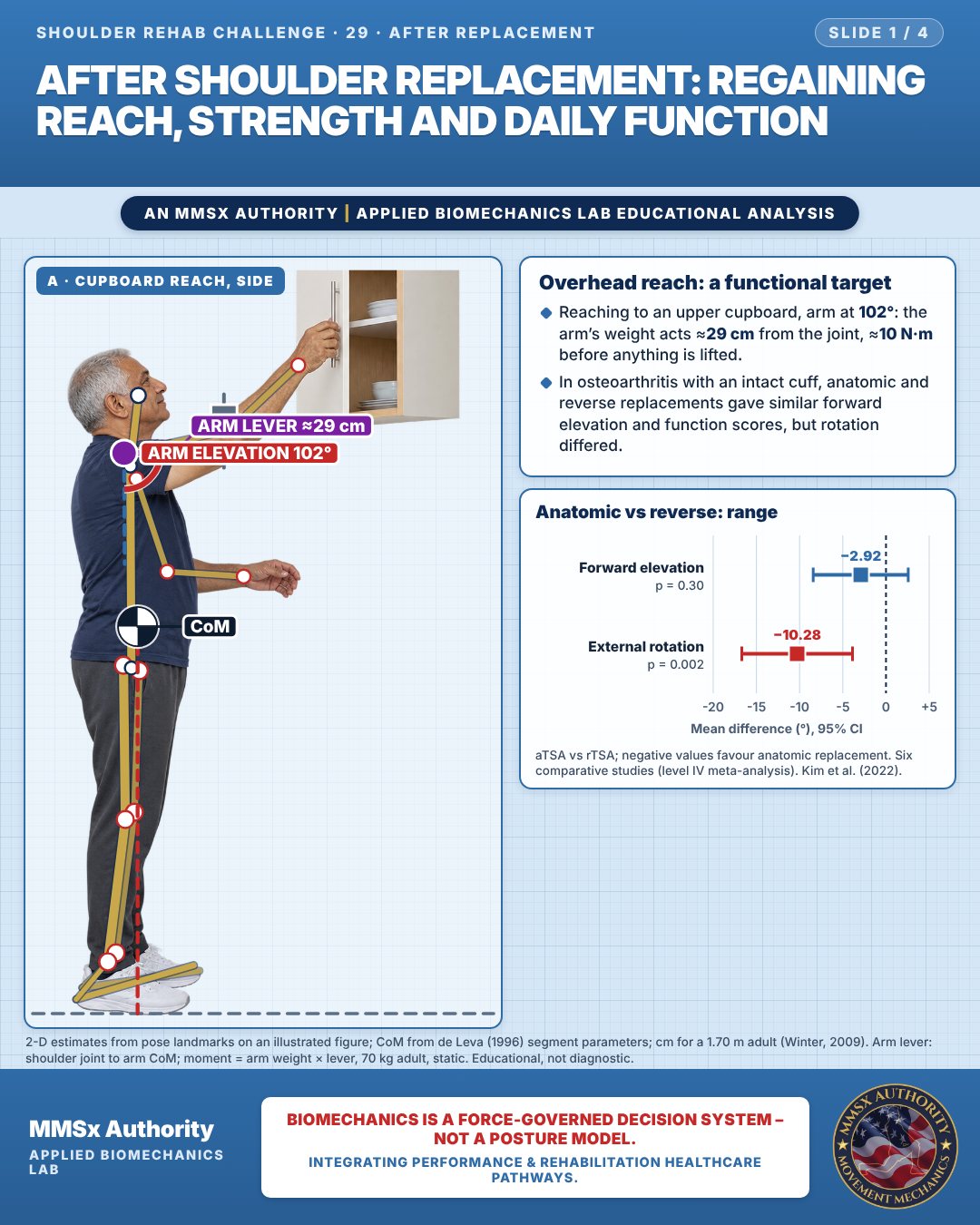
Overhead reach: a functional target
Reaching to an upper cupboard, arm at 102°: the arm’s weight acts ≈29 cm from the joint, ≈10 N·m before anything is lifted.
In osteoarthritis with an intact cuff, anatomic and reverse replacements gave similar forward elevation and function scores, but rotation differed.
Anatomic vs reverse: range
Movement B: Combing the hair (front view)
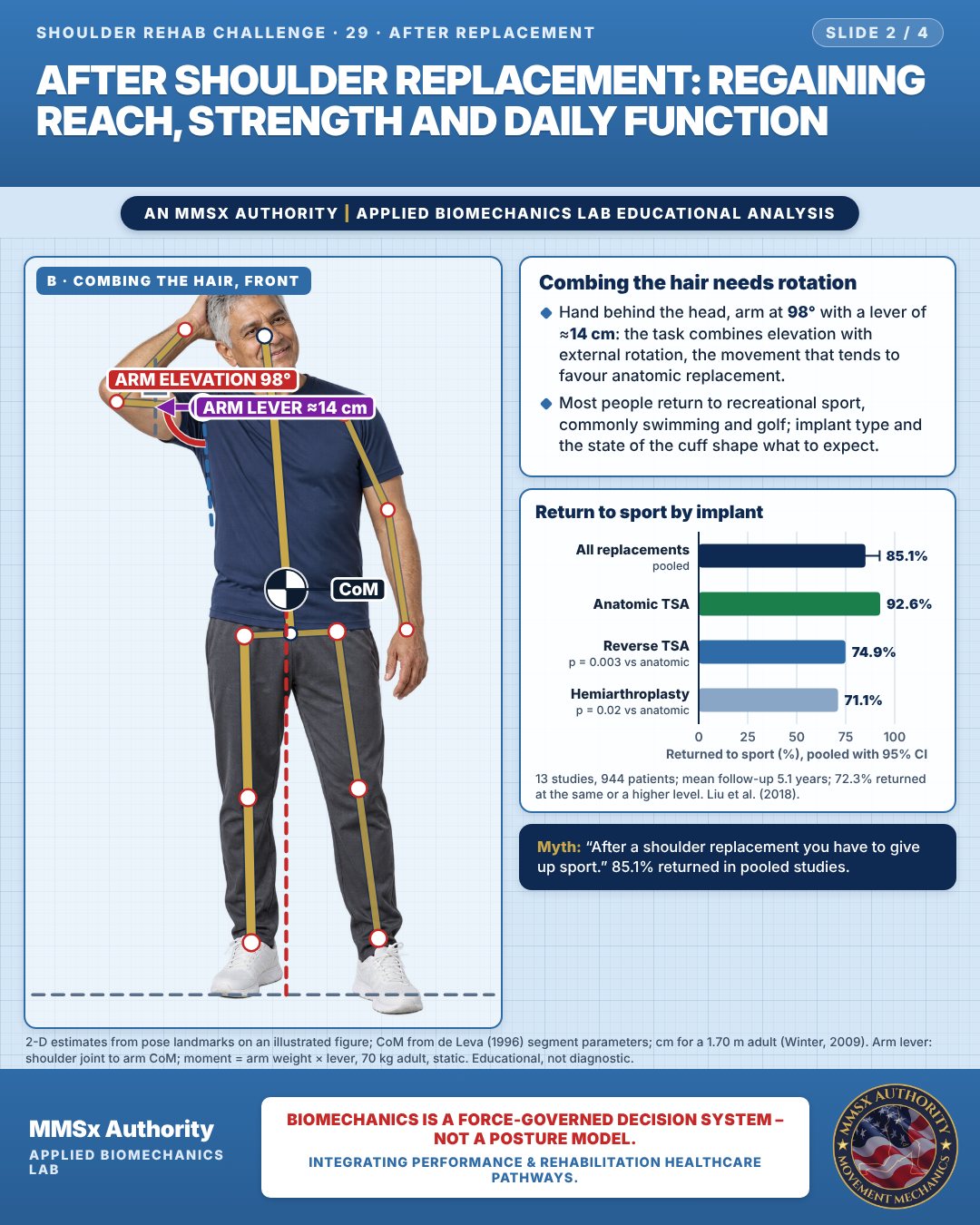
Combing the hair needs rotation
Hand behind the head, arm at 98° with a lever of ≈14 cm: the task combines elevation with external rotation, the movement that tends to favour anatomic replacement.
Most people return to recreational sport, commonly swimming and golf; implant type and the state of the cuff shape what to expect.
Return to sport by implant
Movement C: Seated band row (side view)
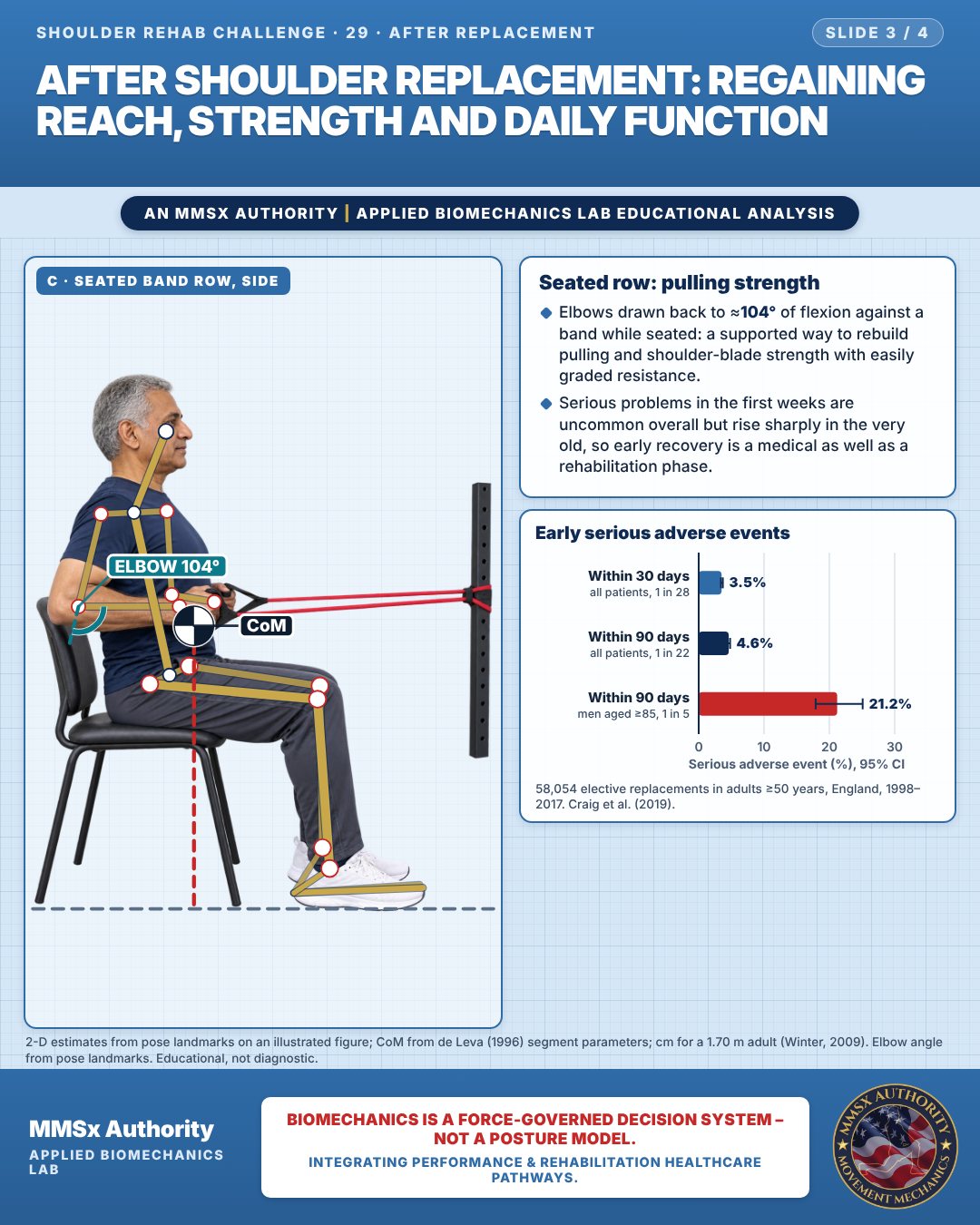
Seated row: pulling strength
Elbows drawn back to ≈104° of flexion against a band while seated: a supported way to rebuild pulling and shoulder-blade strength with easily graded resistance.
Serious problems in the first weeks are uncommon overall but rise sharply in the very old, so early recovery is a medical as well as a rehabilitation phase.
Early serious adverse events
Decision pathway
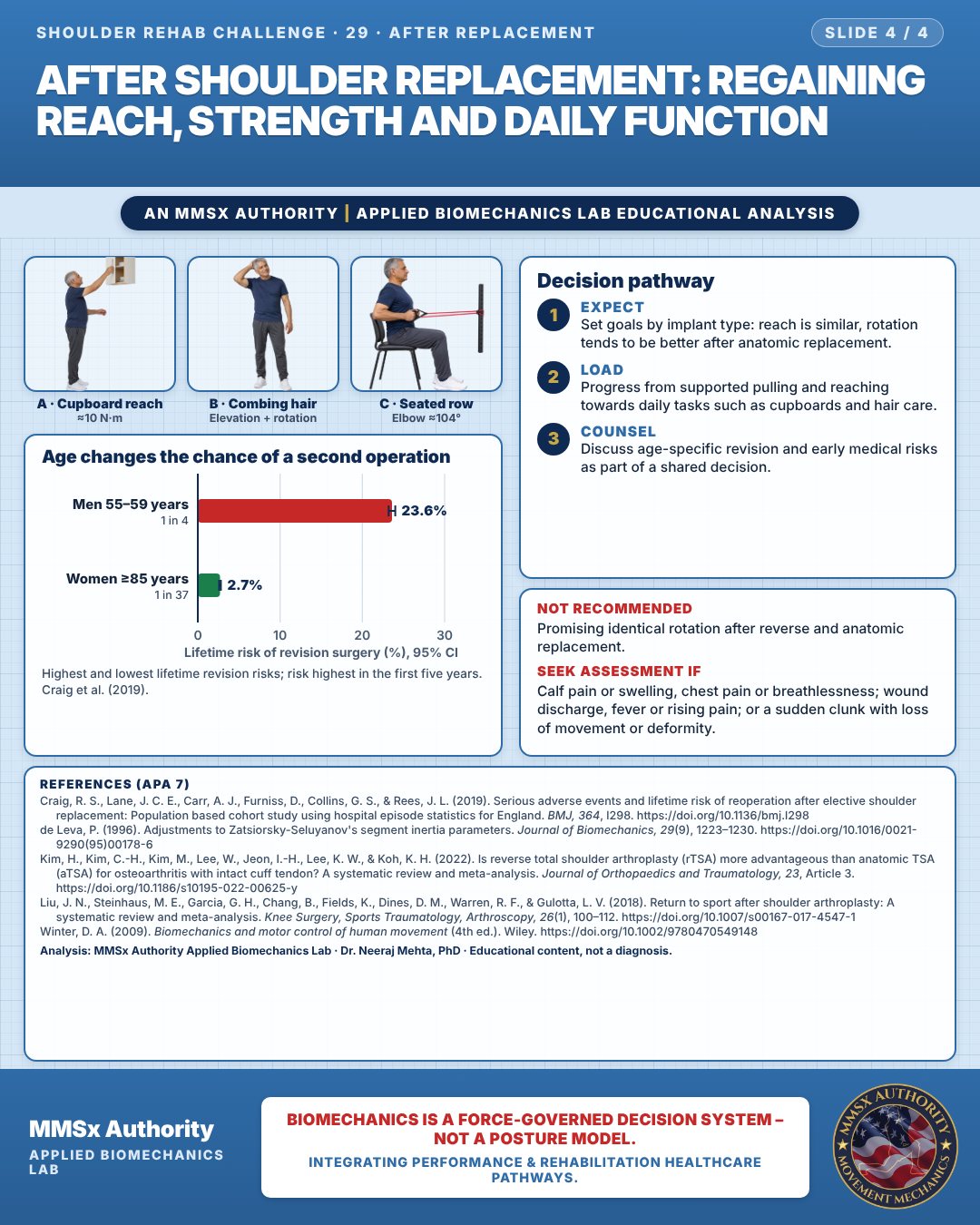
Age changes the chance of a second operation
Expect
Set goals by implant type: reach is similar, rotation tends to be better after anatomic replacement.
Load
Progress from supported pulling and reaching towards daily tasks such as cupboards and hair care.
Counsel
Discuss age-specific revision and early medical risks as part of a shared decision.
What the evidence supports
- Supported: individualised, progressive rehabilitation after arthroplasty aimed at functional reach (cupboard, hair-combing) and rowing/pulling strength; setting expectations by implant type (Kim et al., 2022; Liu et al., 2018); counselling on age-specific revision and early adverse-event risk in shared decision-making (Craig et al., 2019).
- Not supported by these sources: promising identical rotation range for reverse and anatomic replacements (Kim et al., 2022).
Myth and evidence
Myth“After a shoulder replacement you have to give up sport.”
Evidence85.1% of patients in 13 studies returned to sport, 92.6% after anatomic replacement (Liu et al., 2018).
Cautions
Not recommended
Promising identical rotation after reverse and anatomic replacement.
Seek assessment if
Calf pain or swelling, chest pain or breathlessness; wound discharge, fever or rising pain; or a sudden clunk with loss of movement or deformity.
Methods note
2-D estimates from pose landmarks on an illustrated figure; CoM from de Leva (1996) segment parameters; cm for a 1.70 m adult (Winter, 2009). Arm lever: shoulder joint to arm CoM; moment = arm weight × lever, 70 kg adult, static. Elbow angle from pose landmarks. These are educational estimates, not a diagnosis.
References
- Craig, R. S., Lane, J. C. E., Carr, A. J., Furniss, D., Collins, G. S., & Rees, J. L. (2019). Serious adverse events and lifetime risk of reoperation after elective shoulder replacement: Population based cohort study using hospital episode statistics for England. BMJ, 364, l298. https://doi.org/10.1136/bmj.l298
- de Leva, P. (1996). Adjustments to Zatsiorsky-Seluyanov's segment inertia parameters. Journal of Biomechanics, 29(9), 1223–1230. https://doi.org/10.1016/0021-9290(95)00178-6
- Kim, H., Kim, C.-H., Kim, M., Lee, W., Jeon, I.-H., Lee, K. W., & Koh, K. H. (2022). Is reverse total shoulder arthroplasty (rTSA) more advantageous than anatomic TSA (aTSA) for osteoarthritis with intact cuff tendon? A systematic review and meta-analysis. Journal of Orthopaedics and Traumatology, 23, Article 3. https://doi.org/10.1186/s10195-022-00625-y
- Liu, J. N., Steinhaus, M. E., Garcia, G. H., Chang, B., Fields, K., Dines, D. M., Warren, R. F., & Gulotta, L. V. (2018). Return to sport after shoulder arthroplasty: A systematic review and meta-analysis. Knee Surgery, Sports Traumatology, Arthroscopy, 26(1), 100–112. https://doi.org/10.1007/s00167-017-4547-1
- Winter, D. A. (2009). Biomechanics and motor control of human movement (4th ed.). Wiley. https://doi.org/10.1002/9780470549148
Cite this article
Mehta, N. (2026, October 24). After shoulder replacement: regaining reach, strength and daily function. MMSx Authority Applied Biomechanics Lab. https://mmsxauthority.org/edu/analysis/shoulder/29-after-shoulder-replacement-regaining-reach-strength-and-daily-function/
Part of the collection
Mehta, N. (2026). Shoulder Rehabilitation: 50 Evidence-Based Biomechanics Analyses [Collection]. MMSx Authority Applied Biomechanics Lab. Zenodo. https://doi.org/10.5281/zenodo.23735725
All Shoulder Rehab Challenge articles · Rehabilitation Library