Shoulder Rehab Challenge · 28
After rotator cuff repair: why early loading must be graded
Rehabilitation after rotator cuff repair balances protecting the healing tendon–bone repair against stiffness.
Key points
- Protect. Follow the surgeon’s protocol, graded to tear size and repair quality.
- Move. For typical repairs, pain-free active motion in the first 6 weeks can be considered; be cautious after large repairs.
- Load. Progress from assisted motion to isometrics, then to graded resisted work.
What it is
Rehabilitation after rotator cuff repair balances protecting the healing tendon–bone repair against stiffness; "early" programmes start passive or pain-free active motion within the first week(s), "delayed" or standard programmes keep the arm in a sling with restricted motion for about 3–6 weeks before progressing.
How we analysed the movement
Three movements relevant to this topic were analysed from illustrated reference figures. Joint centres were located with two-dimensional pose estimation; arm elevation and elbow angles, shoulder level, the whole-body centre of mass and, where relevant, the arm lever (the horizontal distance from the shoulder joint to the centre of mass of the arm, with any hand load) and the resulting shoulder moment were then calculated from standard segment parameters. The figures are educational estimates that show how position changes mechanical demand; they are not measurements of a patient. Every research value quoted below comes from the published source cited beside it.
Movement A: Arm in a sling (side view)
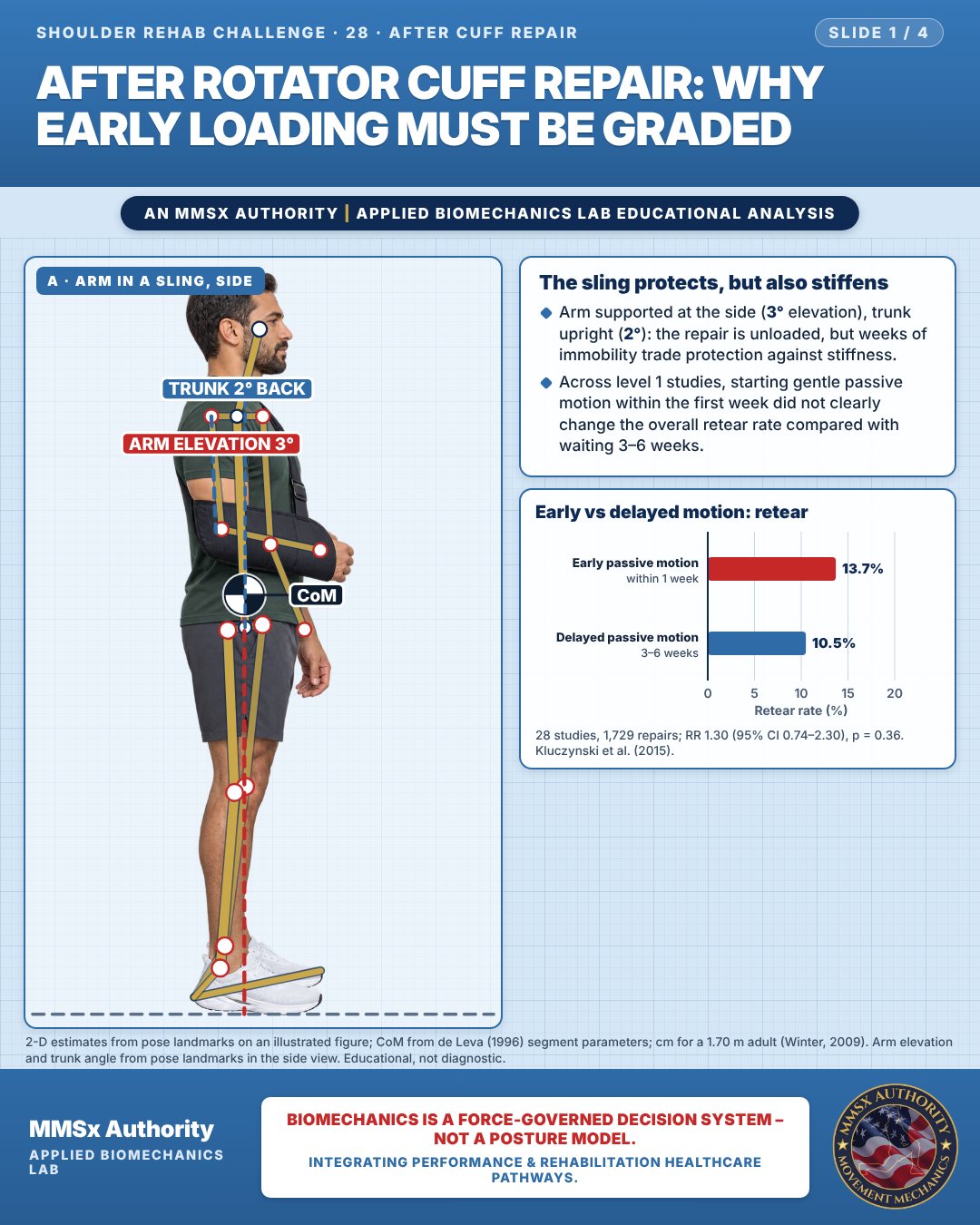
The sling protects, but also stiffens
Arm supported at the side (3° elevation), trunk upright (2°): the repair is unloaded, but weeks of immobility trade protection against stiffness.
Across level 1 studies, starting gentle passive motion within the first week did not clearly change the overall retear rate compared with waiting 3–6 weeks.
Early vs delayed motion: retear
Movement B: Assisted arm raise (side view)
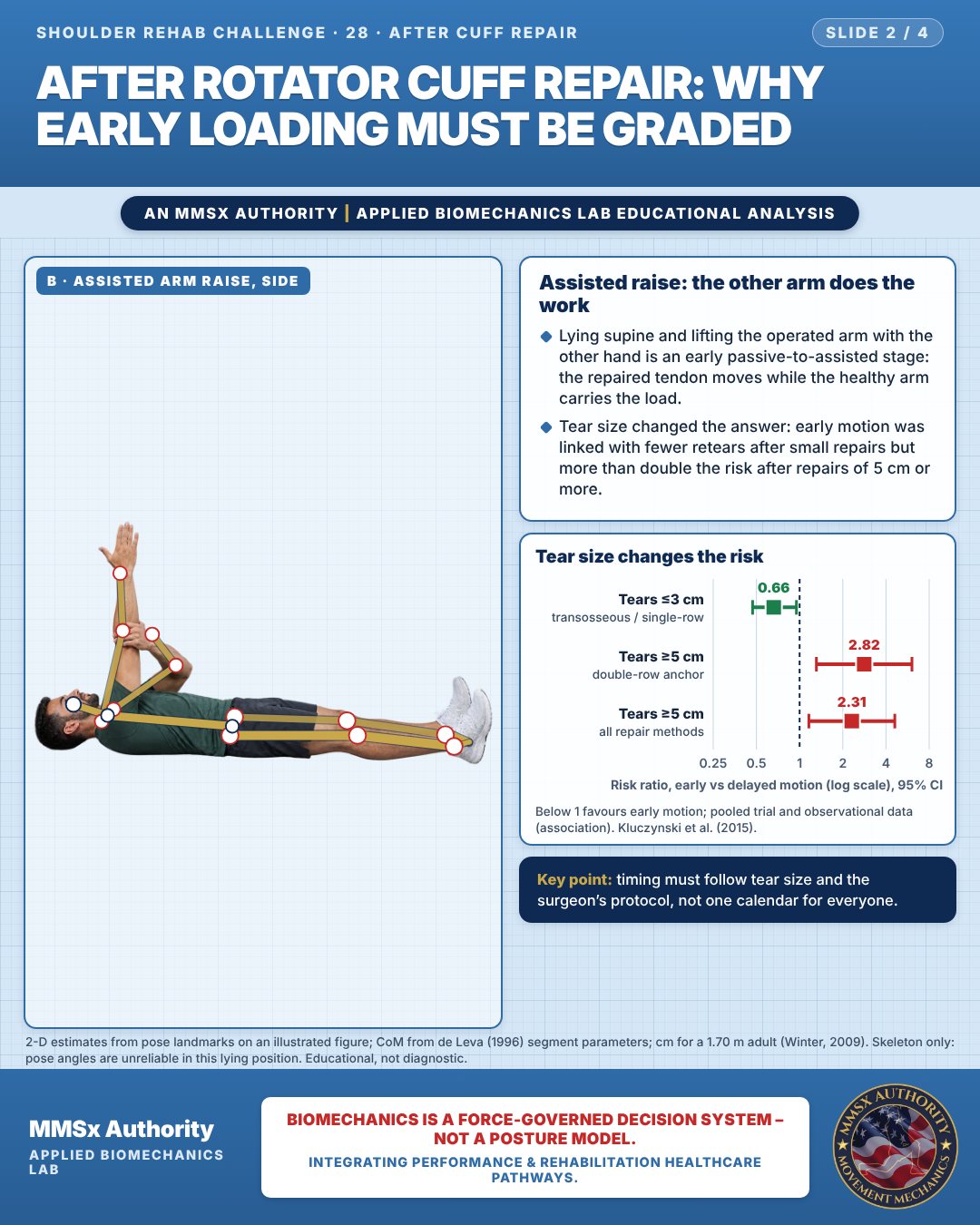
Assisted raise: the other arm does the work
Lying supine and lifting the operated arm with the other hand is an early passive-to-assisted stage: the repaired tendon moves while the healthy arm carries the load.
Tear size changed the answer: early motion was linked with fewer retears after small repairs but more than double the risk after repairs of 5 cm or more.
Tear size changes the risk
Movement C: Door-frame isometric (front view)
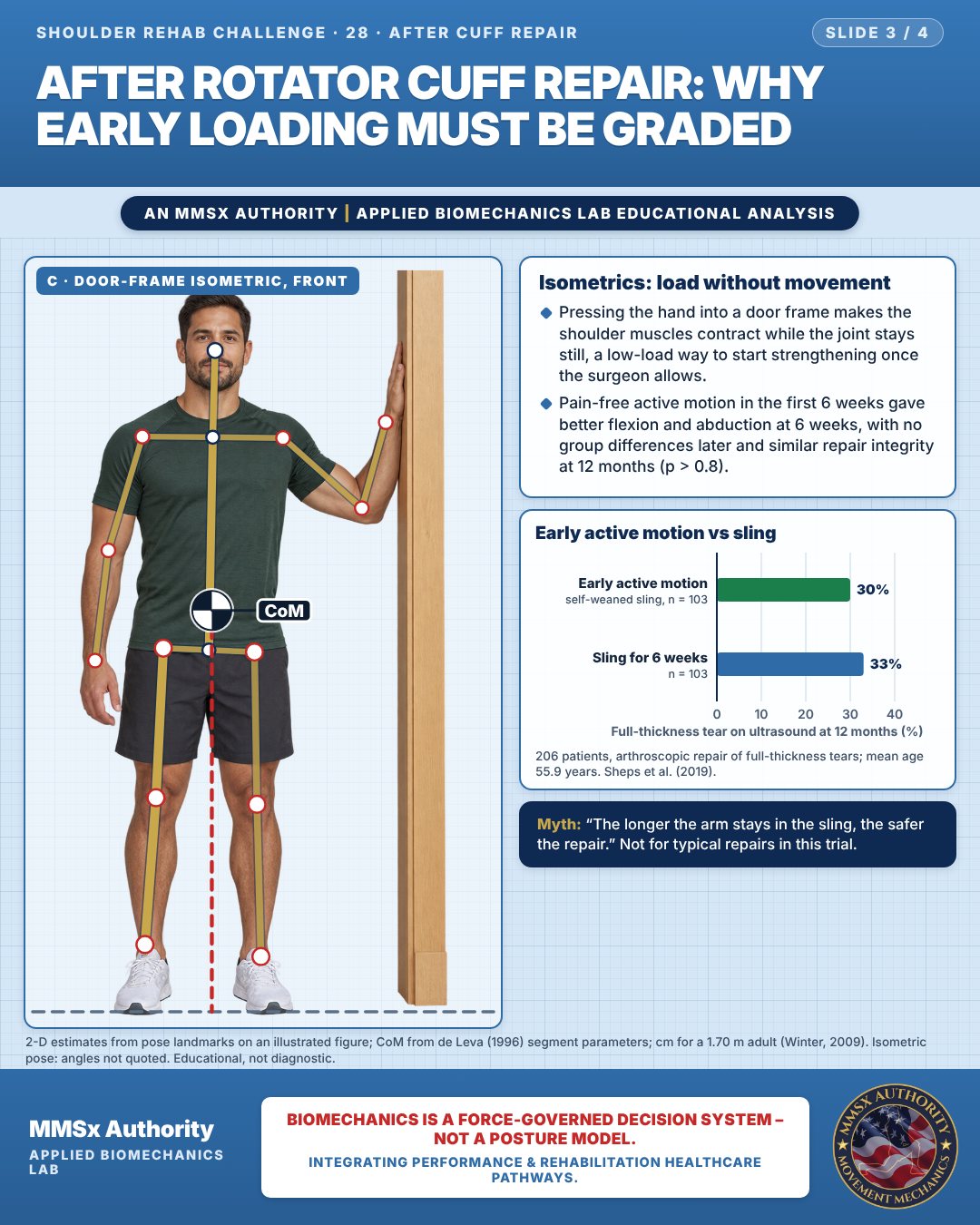
Isometrics: load without movement
Pressing the hand into a door frame makes the shoulder muscles contract while the joint stays still, a low-load way to start strengthening once the surgeon allows.
Pain-free active motion in the first 6 weeks gave better flexion and abduction at 6 weeks, with no group differences later and similar repair integrity at 12 months (p > 0.8).
Early active motion vs sling
Decision pathway
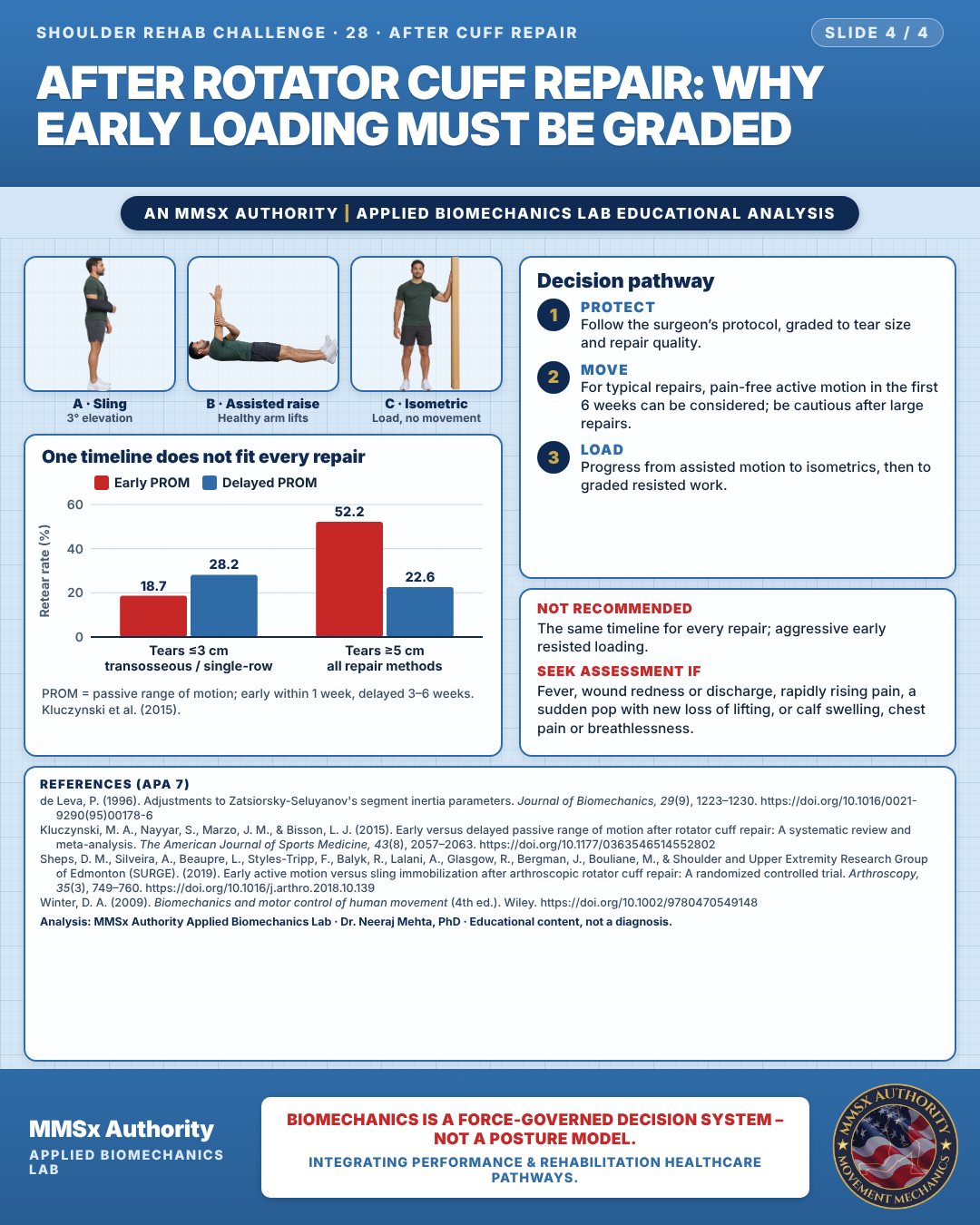
One timeline does not fit every repair
Protect
Follow the surgeon’s protocol, graded to tear size and repair quality.
Move
For typical repairs, pain-free active motion in the first 6 weeks can be considered; be cautious after large repairs.
Load
Progress from assisted motion to isometrics, then to graded resisted work.
What the evidence supports
- Not supported: one standard timeline for every repair regardless of tear size (Kluczynski et al., 2015); aggressive early resisted loading — not tested in these sources; isometrics are low-load starting points.
Myth and evidence
Myth“The longer the arm stays in the sling, the safer the repair.”
EvidenceIn a 206-patient RCT, early pain-free active motion gave better flexion/abduction at 6 weeks and similar 12-month repair integrity (30% vs 33% full-thickness tear) to 6 weeks in a sling (Sheps et al., 2019); however, for large repairs early motion was associated with higher retear (Kluczynski et al., 2015) — timing must be graded, not one-size-fits-all.
Cautions
Not recommended
The same timeline for every repair; aggressive early resisted loading.
Seek assessment if
Fever, wound redness or discharge, rapidly rising pain, a sudden pop with new loss of lifting, or calf swelling, chest pain or breathlessness.
Methods note
2-D estimates from pose landmarks on an illustrated figure; CoM from de Leva (1996) segment parameters; cm for a 1.70 m adult (Winter, 2009). Arm elevation and trunk angle from pose landmarks in the side view. Skeleton only: pose angles are unreliable in this lying position. Isometric pose: angles not quoted. These are educational estimates, not a diagnosis.
References
- de Leva, P. (1996). Adjustments to Zatsiorsky-Seluyanov's segment inertia parameters. Journal of Biomechanics, 29(9), 1223–1230. https://doi.org/10.1016/0021-9290(95)00178-6
- Kluczynski, M. A., Nayyar, S., Marzo, J. M., & Bisson, L. J. (2015). Early versus delayed passive range of motion after rotator cuff repair: A systematic review and meta-analysis. The American Journal of Sports Medicine, 43(8), 2057–2063. https://doi.org/10.1177/0363546514552802
- Sheps, D. M., Silveira, A., Beaupre, L., Styles-Tripp, F., Balyk, R., Lalani, A., Glasgow, R., Bergman, J., Bouliane, M., & Shoulder and Upper Extremity Research Group of Edmonton (SURGE). (2019). Early active motion versus sling immobilization after arthroscopic rotator cuff repair: A randomized controlled trial. Arthroscopy, 35(3), 749–760. https://doi.org/10.1016/j.arthro.2018.10.139
- Winter, D. A. (2009). Biomechanics and motor control of human movement (4th ed.). Wiley. https://doi.org/10.1002/9780470549148
Cite this article
Mehta, N. (2026, October 24). After rotator cuff repair: why early loading must be graded. MMSx Authority Applied Biomechanics Lab. https://mmsxauthority.org/edu/analysis/shoulder/28-after-rotator-cuff-repair-why-early-loading-must-be-graded/
Part of the collection
Mehta, N. (2026). Shoulder Rehabilitation: 50 Evidence-Based Biomechanics Analyses [Collection]. MMSx Authority Applied Biomechanics Lab. Zenodo. https://doi.org/10.5281/zenodo.23735725
All Shoulder Rehab Challenge articles · Rehabilitation Library