Shoulder Rehab Challenge · 27
Subacromial decompression surgery: what the CSAW and FIMPACT trials found
Arthroscopic subacromial decompression (ASD) removes bone and soft tissue from the under-surface of the acromion to "make space" for the rotator cuff.
Key points
- Explain. Share that placebo-controlled trials found no added benefit from removing bone.
- Load. Use progressive cuff and shoulder loading as first-line care, from scapular-plane raises to overhead work.
- Decide. A guideline panel strongly recommends against decompression for atraumatic pain over 3 months (Vandvik et al., 2019).
What it is
Arthroscopic subacromial decompression (ASD) removes bone and soft tissue from the under-surface of the acromion to "make space" for the rotator cuff; it was developed on the impingement model. Placebo-controlled trials compared it with arthroscopy alone (investigation only, no decompression).
How we analysed the movement
Three movements relevant to this topic were analysed from illustrated reference figures. Joint centres were located with two-dimensional pose estimation; arm elevation and elbow angles, shoulder level, the whole-body centre of mass and, where relevant, the arm lever (the horizontal distance from the shoulder joint to the centre of mass of the arm, with any hand load) and the resulting shoulder moment were then calculated from standard segment parameters. The figures are educational estimates that show how position changes mechanical demand; they are not measurements of a patient. Every research value quoted below comes from the published source cited beside it.
Movement A: Scaption raise (front view)
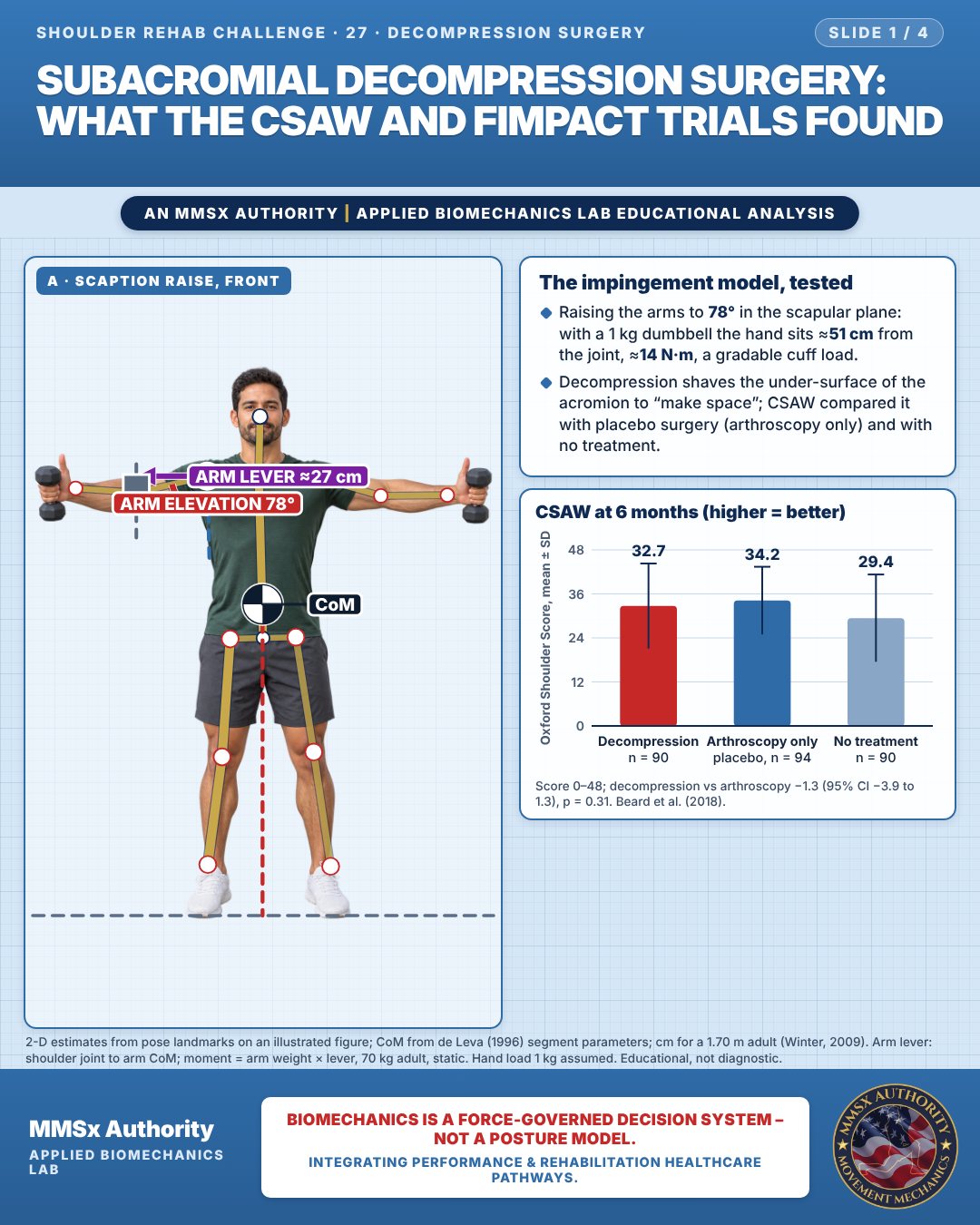
The impingement model, tested
Raising the arms to 78° in the scapular plane: with a 1 kg dumbbell the hand sits ≈51 cm from the joint, ≈14 N·m, a gradable cuff load.
Decompression shaves the under-surface of the acromion to “make space”; CSAW compared it with placebo surgery (arthroscopy only) and with no treatment.
CSAW at 6 months (higher = better)
Movement B: Band external rot. (front view)
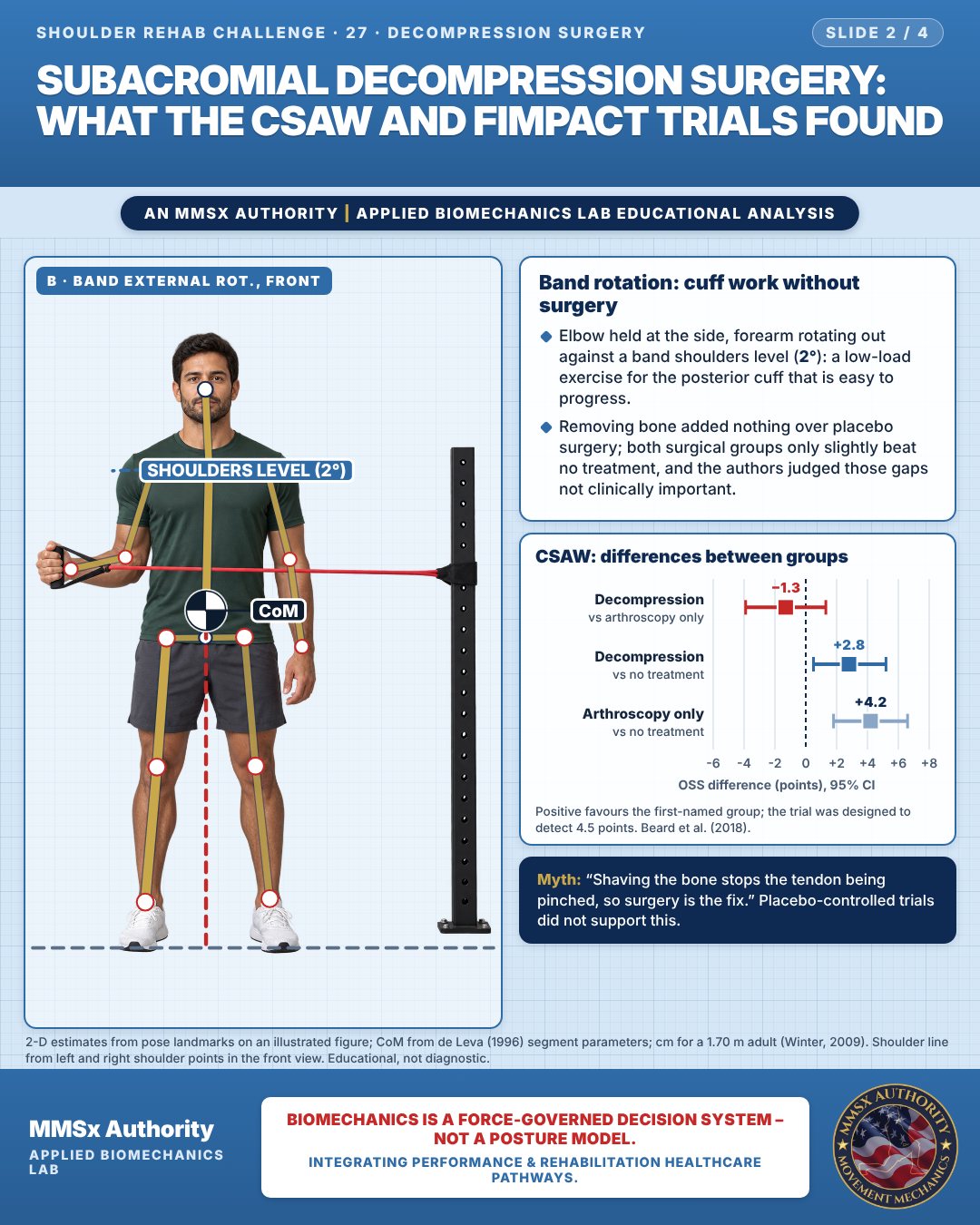
Band rotation: cuff work without surgery
Elbow held at the side, forearm rotating out against a band shoulders level (2°): a low-load exercise for the posterior cuff that is easy to progress.
Removing bone added nothing over placebo surgery; both surgical groups only slightly beat no treatment, and the authors judged those gaps not clinically important.
CSAW: differences between groups
Movement C: Overhead press (side view)
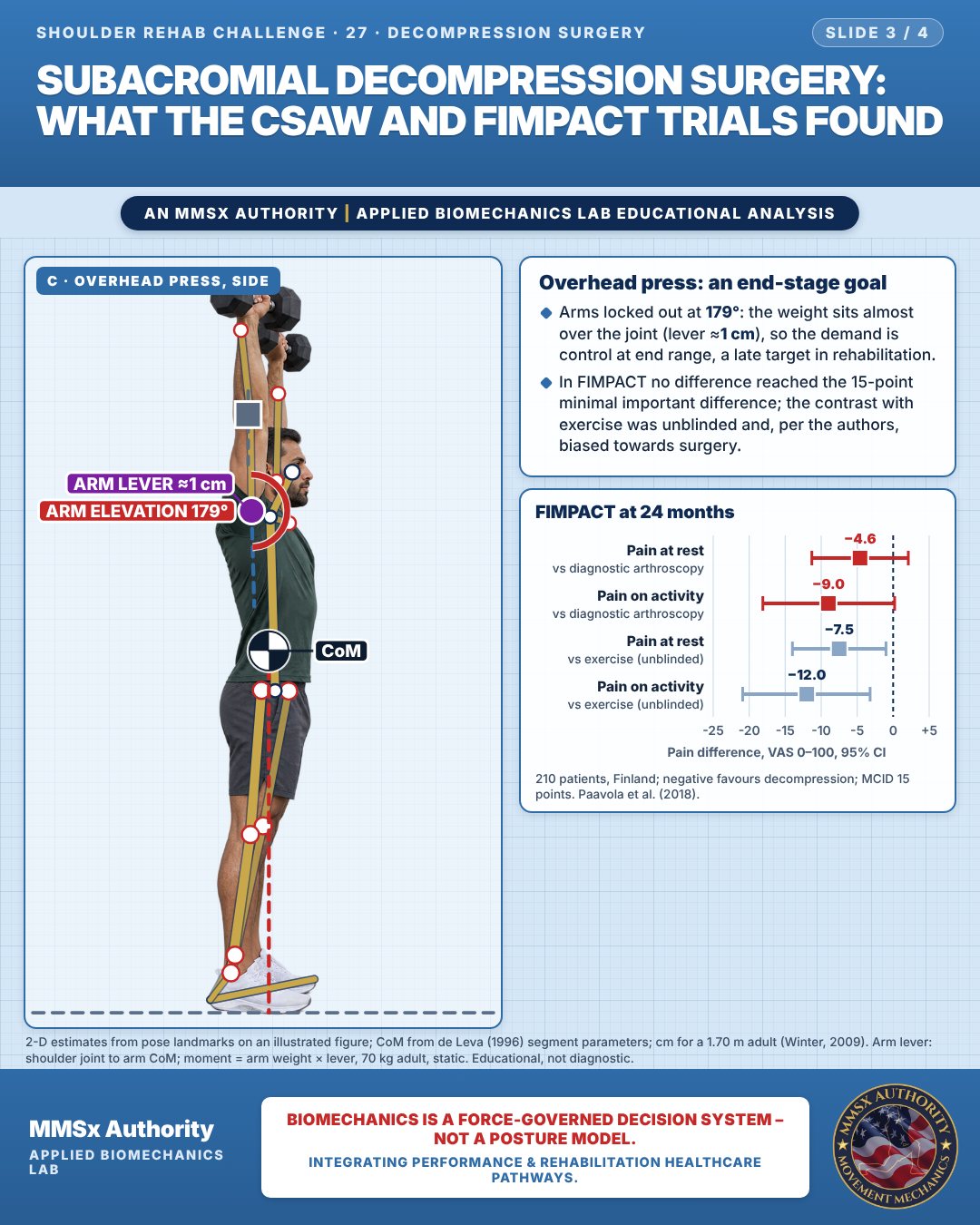
Overhead press: an end-stage goal
Arms locked out at 179°: the weight sits almost over the joint (lever ≈1 cm), so the demand is control at end range, a late target in rehabilitation.
In FIMPACT no difference reached the 15-point minimal important difference; the contrast with exercise was unblinded and, per the authors, biased towards surgery.
FIMPACT at 24 months
Decision pathway
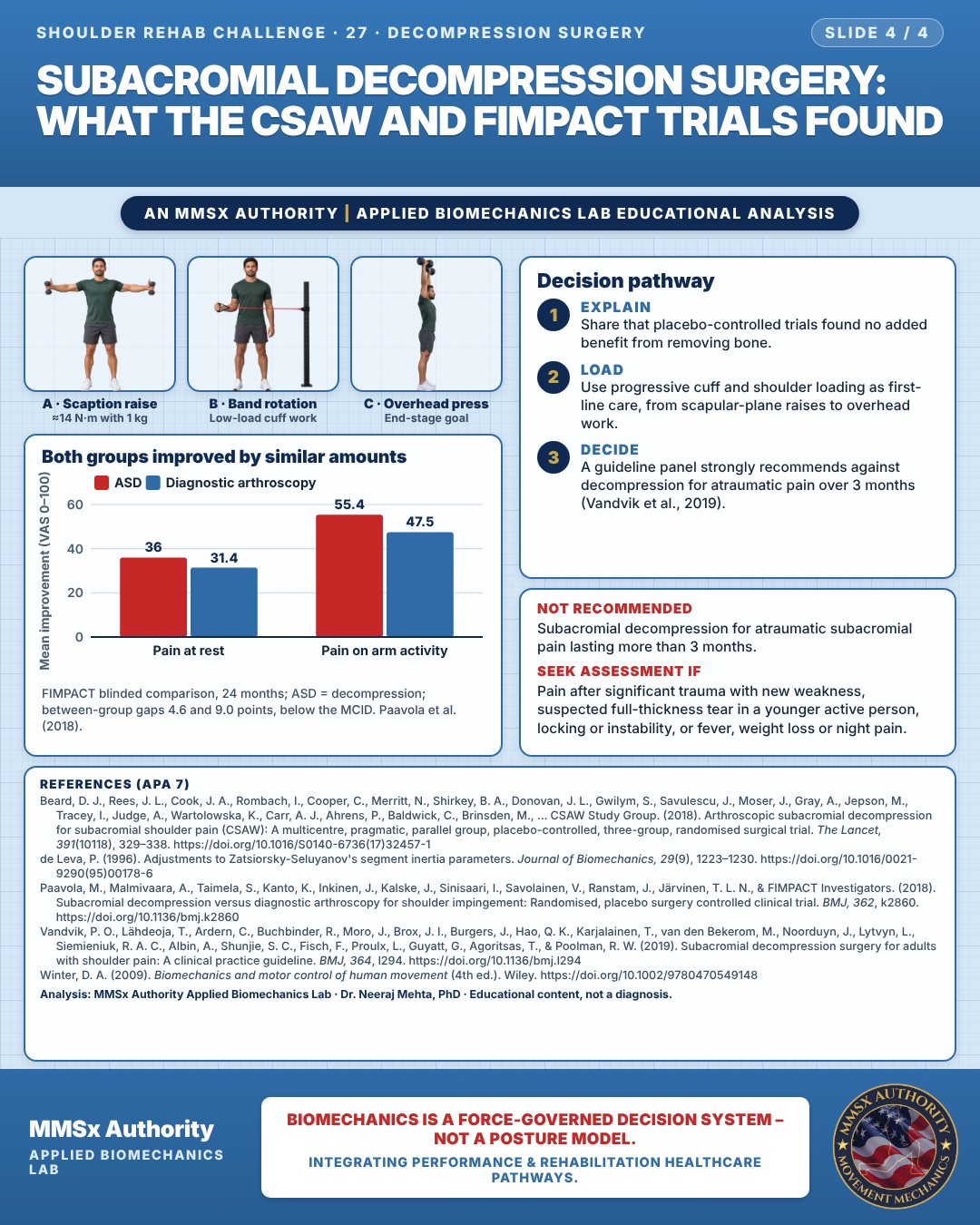
Both groups improved by similar amounts
Explain
Share that placebo-controlled trials found no added benefit from removing bone.
Load
Use progressive cuff and shoulder loading as first-line care, from scapular-plane raises to overhead work.
Decide
A guideline panel strongly recommends against decompression for atraumatic pain over 3 months (Vandvik et al., 2019).
What the evidence supports
- Not recommended: subacromial decompression for atraumatic subacromial pain syndrome >3 months (strong recommendation against; Vandvik et al., 2019; trial evidence from Beard et al., 2018 and Paavola et al., 2018).
Myth and evidence
Myth“Shaving the bone stops the tendon being pinched, so surgery is the fix.”
EvidenceDecompression was no better than arthroscopy without decompression in two placebo-controlled trials (CSAW 6-month OSS difference −1.3 points; FIMPACT 24-month pain differences below the 15-point MCID) (Beard et al., 2018; Paavola et al., 2018).
Cautions
Not recommended
Subacromial decompression for atraumatic subacromial pain lasting more than 3 months.
Seek assessment if
Pain after significant trauma with new weakness, suspected full-thickness tear in a younger active person, locking or instability, or fever, weight loss or night pain.
Methods note
2-D estimates from pose landmarks on an illustrated figure; CoM from de Leva (1996) segment parameters; cm for a 1.70 m adult (Winter, 2009). Arm lever: shoulder joint to arm CoM; moment = arm weight × lever, 70 kg adult, static. Hand load 1 kg assumed. Shoulder line from left and right shoulder points in the front view. These are educational estimates, not a diagnosis.
References
- Beard, D. J., Rees, J. L., Cook, J. A., Rombach, I., Cooper, C., Merritt, N., Shirkey, B. A., Donovan, J. L., Gwilym, S., Savulescu, J., Moser, J., Gray, A., Jepson, M., Tracey, I., Judge, A., Wartolowska, K., Carr, A. J., Ahrens, P., Baldwick, C., Brinsden, M., … CSAW Study Group. (2018). Arthroscopic subacromial decompression for subacromial shoulder pain (CSAW): A multicentre, pragmatic, parallel group, placebo-controlled, three-group, randomised surgical trial. The Lancet, 391(10118), 329–338. https://doi.org/10.1016/S0140-6736(17)32457-1
- de Leva, P. (1996). Adjustments to Zatsiorsky-Seluyanov's segment inertia parameters. Journal of Biomechanics, 29(9), 1223–1230. https://doi.org/10.1016/0021-9290(95)00178-6
- Paavola, M., Malmivaara, A., Taimela, S., Kanto, K., Inkinen, J., Kalske, J., Sinisaari, I., Savolainen, V., Ranstam, J., Järvinen, T. L. N., & FIMPACT Investigators. (2018). Subacromial decompression versus diagnostic arthroscopy for shoulder impingement: Randomised, placebo surgery controlled clinical trial. BMJ, 362, k2860. https://doi.org/10.1136/bmj.k2860
- Vandvik, P. O., Lähdeoja, T., Ardern, C., Buchbinder, R., Moro, J., Brox, J. I., Burgers, J., Hao, Q. K., Karjalainen, T., van den Bekerom, M., Noorduyn, J., Lytvyn, L., Siemieniuk, R. A. C., Albin, A., Shunjie, S. C., Fisch, F., Proulx, L., Guyatt, G., Agoritsas, T., & Poolman, R. W. (2019). Subacromial decompression surgery for adults with shoulder pain: A clinical practice guideline. BMJ, 364, l294. https://doi.org/10.1136/bmj.l294
- Winter, D. A. (2009). Biomechanics and motor control of human movement (4th ed.). Wiley. https://doi.org/10.1002/9780470549148
Cite this article
Mehta, N. (2026, October 24). Subacromial decompression surgery: what the CSAW and FIMPACT trials found. MMSx Authority Applied Biomechanics Lab. https://mmsxauthority.org/edu/analysis/shoulder/27-subacromial-decompression-surgery-what-the-csaw-and-fimpact-trials/
Part of the collection
Mehta, N. (2026). Shoulder Rehabilitation: 50 Evidence-Based Biomechanics Analyses [Collection]. MMSx Authority Applied Biomechanics Lab. Zenodo. https://doi.org/10.5281/zenodo.23735725
All Shoulder Rehab Challenge articles · Rehabilitation Library